
Wireless Technology
Beyond the wire culture
Overview
Wireless communication involves the transmission
of information over a distance without help of wires,
cables or any other forms of electrical conductors.
The transmitted distance can be anywhere between
a few meters (for example, a television’s remote control)
and thousands of kilometres (for example, radio
communication).
Different Modes

Wireless Communication can be via:

microwave communication

radio frequency communication

Infrared communication

Also some aplications may involve various
point-to-point communication, point-to-multipoint
communication, broadcasting, cellular networks
and many more other wireless connections.
Microwave Communication

Microwave communication is commonly occur to
transmit data over long distances.

It relies on high frequency microwave radiation
that travels at the speed of light.
Advantages

Can cover large distances over rough terrain
where you could'nt bury cables.

High Speed

Multi-channel transmissions

Wide bandwidth
Radio Frequency Communication

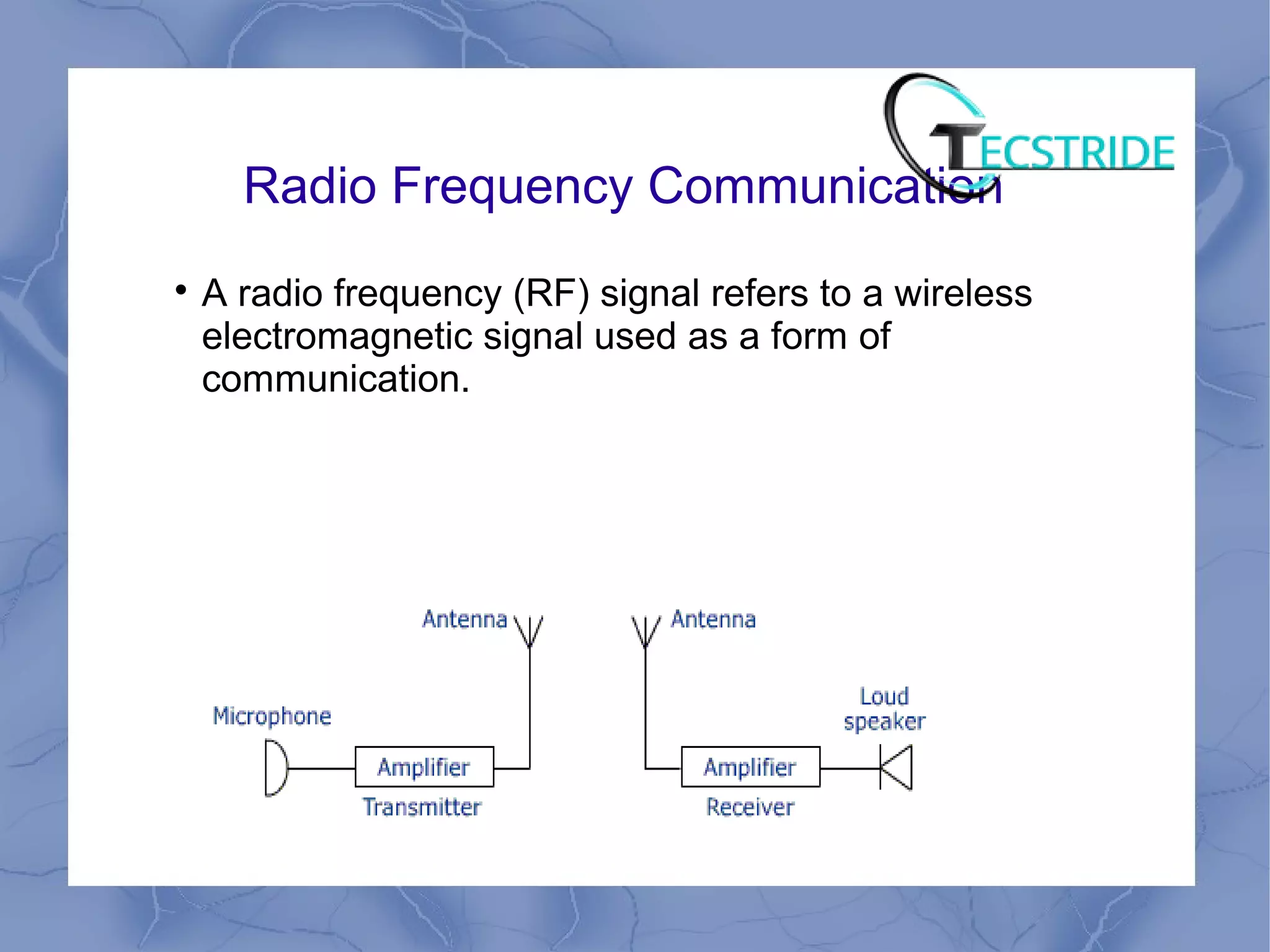
A radio frequency (RF) signal refers to a wireless
electromagnetic signal used as a form of
communication.
Advantages

It offers mobility

Cheaper

Offers freedom from land acquisition rights

Ease of communication over difficult terrain
Infrared Communication

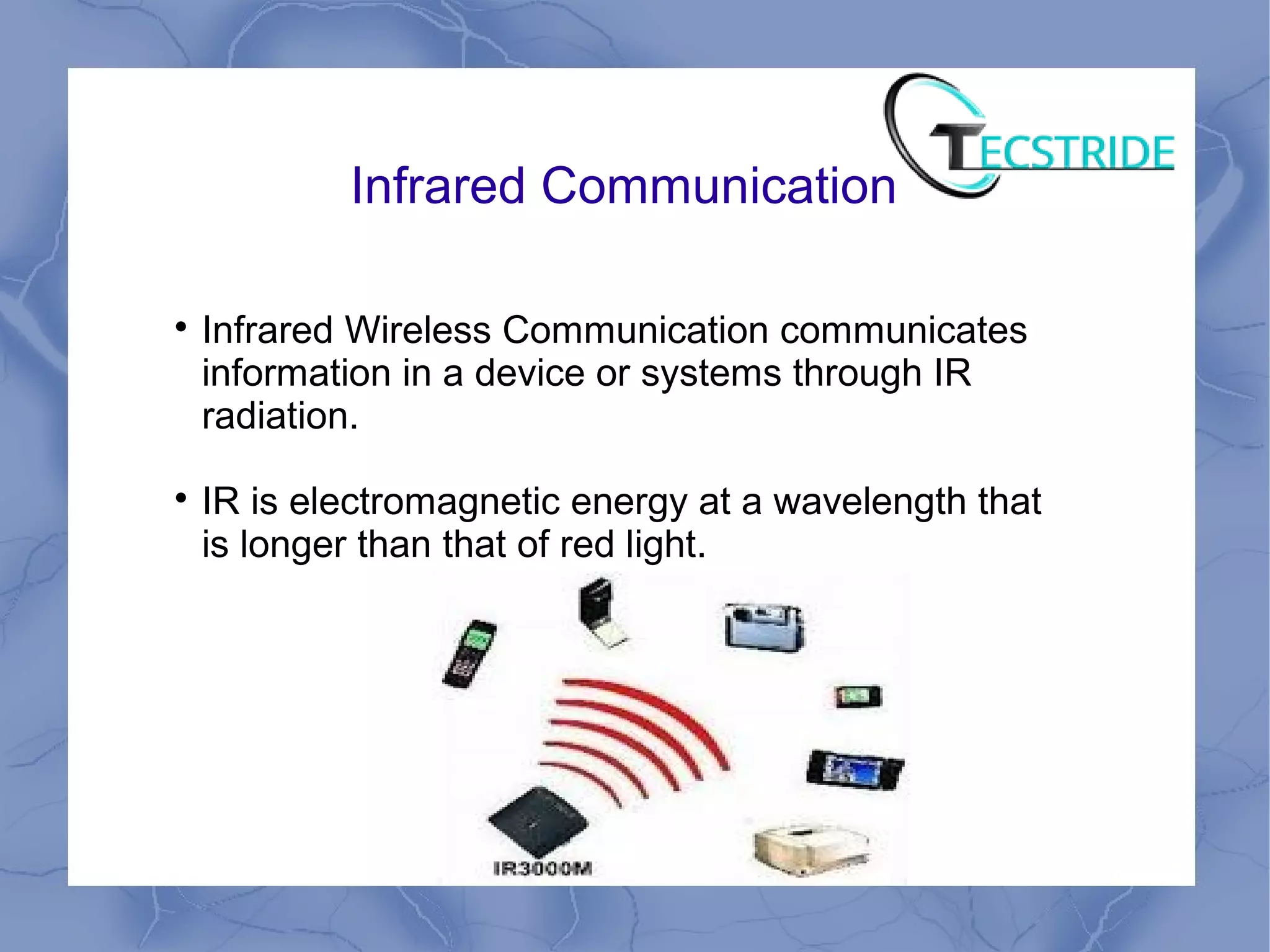
Infrared Wireless Communication communicates
information in a device or systems through IR
radiation.

IR is electromagnetic energy at a wavelength that
is longer than that of red light.
Advantages

Doesn't interfere with other signals

Cannot pass through walls

Low power required- ideal for laptops, telephones,
personal digital assistants

Portable
Contact Us
Website: http://www.tecstride.com/
Email us: info@tecstride.com
Wireless Technology_Tecstride

Wireless Technology_Tecstride