Anish Raj Goyal
Computer Project
(MS PowerPoint
presentation)
Wireless Trends…...
Anishrajgoyal09rockstar@gmail.com
Wireless communication
Wireless communication is the transfer of information or power between two or more
points that are not connected by an electrical conductor. The most common wireless
technologies use radio. With radio waves distances can be short, such as a few meters
for television or as far as thousands or even millions of kilometers for deep-space radio
communications. It encompasses various types of fixed, mobile, and portable
applications, including two-way radios, cellular telephones,personal digital
assistants (PDAs), and wireless networking. Other examples of applications of
radio wireless technology include GPS units, garage door openers, wireless computer
mice, keyboards and headsets, headphones, radio receivers,satellite
television, broadcast television and cordless telephones.
Wireless operations permit services, such as long-range communications, that are
impossible or impractical to implement with the use of wires. The term is commonly
used in the telecommunications industry to refer to telecommunications systems (e.g.
radio transmitters and receivers, remote controls, etc.) which use some form of energy
(e.g. radio waves, acoustic energy,) to transfer information without the use of wires.
Wireless Trends
Understanding wireless technology trends will allow you to position yourself and ride the
coming wave of change... the tide is already rising.
One trend is very clear...
It’s the overall rapid growth of wireless technology itself, driven by demand and
innovation, as it changes our lives in all sorts of useful ways. And it’s gaining momentum...
Frustrated of entangled in wires. Wireless Period has come……..
Today everything has gone wireless
•Computers
•Telephones
•Even the internet connectivity
Here are some of the major wireless technology trends
you need to know about...
Computer Reforms
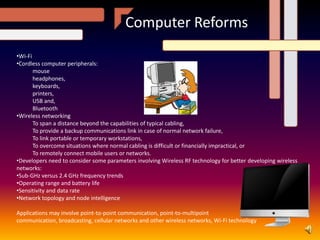
•Wi-Fi
•Cordless computer peripherals:
mouse
headphones,
keyboards,
printers,
USB and,
Bluetooth
•Wireless networking
To span a distance beyond the capabilities of typical cabling,
To provide a backup communications link in case of normal network failure,
To link portable or temporary workstations,
To overcome situations where normal cabling is difficult or financially impractical, or
To remotely connect mobile users or networks.
•Developers need to consider some parameters involving Wireless RF technology for better developing wireless
networks:
•Sub-GHz versus 2.4 GHz frequency trends
•Operating range and battery life
•Sensitivity and data rate
•Network topology and node intelligence
Applications may involve point-to-point communication, point-to-multipoint
communication, broadcasting, cellular networks and other wireless networks, Wi-Fi technology
Phones..
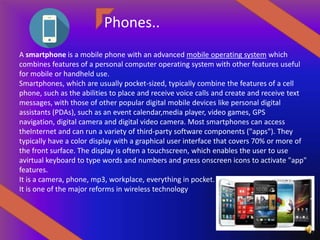
A smartphone is a mobile phone with an advanced mobile operating system which
combines features of a personal computer operating system with other features useful
for mobile or handheld use.
Smartphones, which are usually pocket-sized, typically combine the features of a cell
phone, such as the abilities to place and receive voice calls and create and receive text
messages, with those of other popular digital mobile devices like personal digital
assistants (PDAs), such as an event calendar,media player, video games, GPS
navigation, digital camera and digital video camera. Most smartphones can access
theInternet and can run a variety of third-party software components ("apps"). They
typically have a color display with a graphical user interface that covers 70% or more of
the front surface. The display is often a touchscreen, which enables the user to use
avirtual keyboard to type words and numbers and press onscreen icons to activate "app"
features.
It is a camera, phone, mp3, workplace, everything in pocket.
It is one of the major reforms in wireless technology
Bluetooth Connectivity
One of the most common connectivity options
Bluetooth technology is the global wireless standard enabling the Internet of Things
(IoT).
Created in 1994, Bluetooth® technology was conceived as a wireless alternative to
data cables by exchanging data using radio transmissions. The name Bluetooth came
from a tenth century Danish King, Harald Blåtand or, in English, Harold Bluetooth. As
the story goes, King Blåtand helped unite warring factions in parts of what are now
Norway, Sweden and Denmark. Similarly, Bluetooth technology was created as an
open standard to allow connectivity and collaboration between disparate products
and industries.
Bluetooth allows high quality streaming
One of the most popular applications for Bluetooth historically has been wireless
audio—headsets and hands-free connectivity in cars to wireless speakers and
headphones that stream music from your phone or tablet. This uses a version of
Bluetooth called BR/EDR (bit rate/enhanced data rate) that is optimized for sending a
steady stream of high quality data (i.e. music) in a power efficient way.
Wireless Services
Common examples of wireless equipment include:
•Infrared and ultrasonic remote control devices
•Professional LMR (Land Mobile Radio) and SMR (Specialized Mobile Radio) typically used by
business, industrial and Public Safety entities.
•Consumer Two-way radio including FRS Family Radio Service, GMRS (General Mobile Radio
Service) and Citizens band ("CB") radios.
•The Amateur Radio Service (Ham radio).
•Consumer and professional Marine VHF radios.
•Airband and radio navigation equipment used by aviators and air traffic control
Cellular telephones and pagers: provide connectivity for portable and mobile applications, both
personal and business.
Global Positioning System (GPS): allows drivers of cars and trucks, captains of boats and ships, and pilots
of aircraft to ascertain their location anywhere on earth
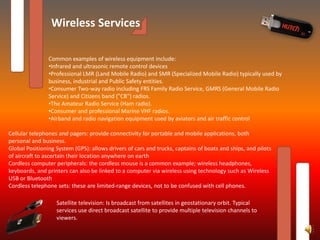
Cordless computer peripherals: the cordless mouse is a common example; wireless headphones,
keyboards, and printers can also be linked to a computer via wireless using technology such as Wireless
USB or Bluetooth
Cordless telephone sets: these are limited-range devices, not to be confused with cell phones.
Satellite television: Is broadcast from satellites in geostationary orbit. Typical
services use direct broadcast satellite to provide multiple television channels to
viewers.
Ways to get wireless access to the
Internet
There are three main ways you can get wireless access to the
Internet...
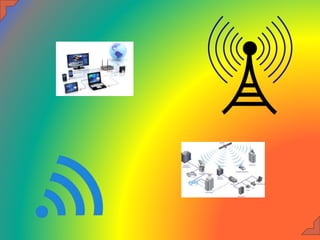
•Local WiFi Network
•Wide Area Cellular network
•Global Area Satellite network
Let's look at each of these in more detail...
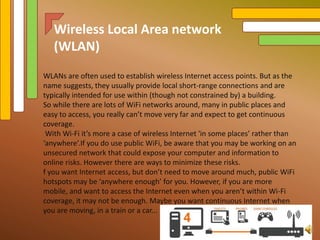
WLANs are often used to establish wireless Internet access points. But as the
name suggests, they usually provide local short-range connections and are
typically intended for use within (though not constrained by) a building.
So while there are lots of WiFi networks around, many in public places and
easy to access, you really can’t move very far and expect to get continuous
coverage.
With Wi-Fi it’s more a case of wireless Internet 'in some places’ rather than
‘anywhere’.If you do use public WiFi, be aware that you may be working on an
unsecured network that could expose your computer and information to
online risks. However there are ways to minimize these risks.
f you want Internet access, but don’t need to move around much, public WiFi
hotspots may be ‘anywhere enough’ for you. However, if you are more
mobile, and want to access the Internet even when you aren’t within Wi-Fi
coverage, it may not be enough. Maybe you want continuous Internet when
you are moving, in a train or a car...
Wireless Local Area network
(WLAN)
Wi Fi Connectivity
Today found everywhere
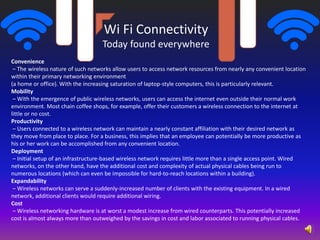
Convenience
– The wireless nature of such networks allow users to access network resources from nearly any convenient location
within their primary networking environment
(a home or office). With the increasing saturation of laptop-style computers, this is particularly relevant.
Mobility
– With the emergence of public wireless networks, users can access the internet even outside their normal work
environment. Most chain coffee shops, for example, offer their customers a wireless connection to the internet at
little or no cost.
Productivity
– Users connected to a wireless network can maintain a nearly constant affiliation with their desired network as
they move from place to place. For a business, this implies that an employee can potentially be more productive as
his or her work can be accomplished from any convenient location.
Deployment
– Initial setup of an infrastructure-based wireless network requires little more than a single access point. Wired
networks, on the other hand, have the additional cost and complexity of actual physical cables being run to
numerous locations (which can even be impossible for hard-to-reach locations within a building).
Expandability
– Wireless networks can serve a suddenly-increased number of clients with the existing equipment. In a wired
network, additional clients would require additional wiring.
Cost
– Wireless networking hardware is at worst a modest increase from wired counterparts. This potentially increased
cost is almost always more than outweighed by the savings in cost and labor associated to running physical cables.
Mobile Hotspot….
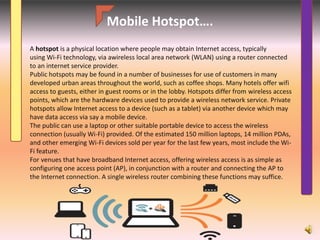
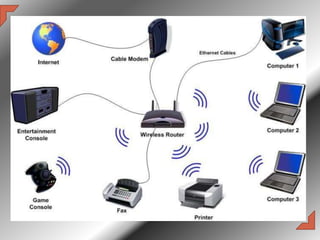
A hotspot is a physical location where people may obtain Internet access, typically
using Wi-Fi technology, via awireless local area network (WLAN) using a router connected
to an internet service provider.
Public hotspots may be found in a number of businesses for use of customers in many
developed urban areas throughout the world, such as coffee shops. Many hotels offer wifi
access to guests, either in guest rooms or in the lobby. Hotspots differ from wireless access
points, which are the hardware devices used to provide a wireless network service. Private
hotspots allow Internet access to a device (such as a tablet) via another device which may
have data access via say a mobile device.
The public can use a laptop or other suitable portable device to access the wireless
connection (usually Wi-Fi) provided. Of the estimated 150 million laptops, 14 million PDAs,
and other emerging Wi-Fi devices sold per year for the last few years, most include the Wi-
Fi feature.
For venues that have broadband Internet access, offering wireless access is as simple as
configuring one access point (AP), in conjunction with a router and connecting the AP to
the Internet connection. A single wireless router combining these functions may suffice.
Wireless Gaming…..
Today gaming has gone wireless. Wireless gaming consoles, keyboard, mouse are easily
available at an affordable price. One can also work by just sitting relaxed back on his/her
computer. It has brought reforms in day to day life. It has helped people to get rid of the
wires’ limitation but can sit and relax…..
A motion controller controls the motion of some object. Frequently motion controllers
are implemented using digital computers, but motion controllers can also be implemented with
only analog components as well.
Motion controllers are used to achieve some desired benefit(s) which can include:
•increased position and speed accuracy
•higher speeds
•faster reaction time
•increased production
•smoother movements
•reduction in costs
•integration with other automation
•integration with other processes
•ability to convert desired specifications into motion required to produce a product
•increased information and ability diagnose and troubleshoot
•increased consistency
•improved efficiency
•elimination of hazards to humans or animals
Wireless power transfer!!!!
Wireless power transfer (WPT) or wireless energy transmission is the
transmission of electrical energy from a power source Wireless power
is a generic term that refers to a number of different power
transmission technologies that use time-varying electric, magnetic,
or electromagnetic fields. In wireless power transfer, a wireless transmitter
connected to a power source conveys the field energy across an intervening space to
one or more receivers, where it is converted back to an electrical current
and then used. Wireless transmission is useful to power electrical devices
in cases where interconnecting wires are inconvenient, hazardous, or are
not possible. In non-radiative techniques, power is typically transferred by
magnetic fields using inductive coupling between coils of wire. Applications
of this type include electric toothbrush chargers, RFID tags, smartcards, and
chargers for implantable medical devices like artificial cardiac pacemakers, and
inductive powering or charging of electric vehicles like trains or buses. A current
focus is to develop wireless
systems to charge mobile and handheld computing devices such
as cellphones, digital music players and portable computers without
being tethered to a wall plug.
Wireless Printing….
HP ePrint via Email is a feature of most HP printers and MFPs that enables printing
documents attached to email messages sent to the device. The HP ePrint-capable
printer or MFP must be registered to an HP ePrint cloud service called HP ePrint
Center, which assigns a unique email address to the printer or MFP. The assigned email
address is customizable but by default is arbitrarily set to promote security since only
those who know the email address can use it to print. HP ePrint via Email does not
require a print driverinstalled on the client. The HP ePrint public cloud renders the
printing data from each separate attachment into a suitable print data stream, such as
PCL3, PCL 5, or PostScript, and, subsequently, sends it to the HP ePrint enabled printer.
For this to work, the attachments for printing must be in a native plain format, such as
any of the following:
•MS Word document
•MS PowerPoint presentation
•MS Outlook document
•Image file (JPEG, BMP, GIF, PNG, TIFF)
•Adobe Acrobat file (PDFs)
•Text file and Rich Text Format (RTF)
•HTML file
There are many more such reforms
That can’t be described in this small presentation……
Thanks for watching……
For more details about the presentation contact:-
Anish Raj Goyal
9th B
3355
Wir e less trends..

Wir e less trends..

  • 2.
    Anish Raj Goyal ComputerProject (MS PowerPoint presentation) Wireless Trends…... Anishrajgoyal09rockstar@gmail.com
  • 4.
    Wireless communication Wireless communicationis the transfer of information or power between two or more points that are not connected by an electrical conductor. The most common wireless technologies use radio. With radio waves distances can be short, such as a few meters for television or as far as thousands or even millions of kilometers for deep-space radio communications. It encompasses various types of fixed, mobile, and portable applications, including two-way radios, cellular telephones,personal digital assistants (PDAs), and wireless networking. Other examples of applications of radio wireless technology include GPS units, garage door openers, wireless computer mice, keyboards and headsets, headphones, radio receivers,satellite television, broadcast television and cordless telephones. Wireless operations permit services, such as long-range communications, that are impossible or impractical to implement with the use of wires. The term is commonly used in the telecommunications industry to refer to telecommunications systems (e.g. radio transmitters and receivers, remote controls, etc.) which use some form of energy (e.g. radio waves, acoustic energy,) to transfer information without the use of wires.
  • 5.
    Wireless Trends Understanding wirelesstechnology trends will allow you to position yourself and ride the coming wave of change... the tide is already rising. One trend is very clear... It’s the overall rapid growth of wireless technology itself, driven by demand and innovation, as it changes our lives in all sorts of useful ways. And it’s gaining momentum... Frustrated of entangled in wires. Wireless Period has come…….. Today everything has gone wireless •Computers •Telephones •Even the internet connectivity Here are some of the major wireless technology trends you need to know about...
  • 6.
    Computer Reforms •Wi-Fi •Cordless computerperipherals: mouse headphones, keyboards, printers, USB and, Bluetooth •Wireless networking To span a distance beyond the capabilities of typical cabling, To provide a backup communications link in case of normal network failure, To link portable or temporary workstations, To overcome situations where normal cabling is difficult or financially impractical, or To remotely connect mobile users or networks. •Developers need to consider some parameters involving Wireless RF technology for better developing wireless networks: •Sub-GHz versus 2.4 GHz frequency trends •Operating range and battery life •Sensitivity and data rate •Network topology and node intelligence Applications may involve point-to-point communication, point-to-multipoint communication, broadcasting, cellular networks and other wireless networks, Wi-Fi technology
  • 7.
    Phones.. A smartphone isa mobile phone with an advanced mobile operating system which combines features of a personal computer operating system with other features useful for mobile or handheld use. Smartphones, which are usually pocket-sized, typically combine the features of a cell phone, such as the abilities to place and receive voice calls and create and receive text messages, with those of other popular digital mobile devices like personal digital assistants (PDAs), such as an event calendar,media player, video games, GPS navigation, digital camera and digital video camera. Most smartphones can access theInternet and can run a variety of third-party software components ("apps"). They typically have a color display with a graphical user interface that covers 70% or more of the front surface. The display is often a touchscreen, which enables the user to use avirtual keyboard to type words and numbers and press onscreen icons to activate "app" features. It is a camera, phone, mp3, workplace, everything in pocket. It is one of the major reforms in wireless technology
  • 8.
    Bluetooth Connectivity One ofthe most common connectivity options Bluetooth technology is the global wireless standard enabling the Internet of Things (IoT). Created in 1994, Bluetooth® technology was conceived as a wireless alternative to data cables by exchanging data using radio transmissions. The name Bluetooth came from a tenth century Danish King, Harald Blåtand or, in English, Harold Bluetooth. As the story goes, King Blåtand helped unite warring factions in parts of what are now Norway, Sweden and Denmark. Similarly, Bluetooth technology was created as an open standard to allow connectivity and collaboration between disparate products and industries. Bluetooth allows high quality streaming One of the most popular applications for Bluetooth historically has been wireless audio—headsets and hands-free connectivity in cars to wireless speakers and headphones that stream music from your phone or tablet. This uses a version of Bluetooth called BR/EDR (bit rate/enhanced data rate) that is optimized for sending a steady stream of high quality data (i.e. music) in a power efficient way.
  • 9.
    Wireless Services Common examplesof wireless equipment include: •Infrared and ultrasonic remote control devices •Professional LMR (Land Mobile Radio) and SMR (Specialized Mobile Radio) typically used by business, industrial and Public Safety entities. •Consumer Two-way radio including FRS Family Radio Service, GMRS (General Mobile Radio Service) and Citizens band ("CB") radios. •The Amateur Radio Service (Ham radio). •Consumer and professional Marine VHF radios. •Airband and radio navigation equipment used by aviators and air traffic control Cellular telephones and pagers: provide connectivity for portable and mobile applications, both personal and business. Global Positioning System (GPS): allows drivers of cars and trucks, captains of boats and ships, and pilots of aircraft to ascertain their location anywhere on earth Cordless computer peripherals: the cordless mouse is a common example; wireless headphones, keyboards, and printers can also be linked to a computer via wireless using technology such as Wireless USB or Bluetooth Cordless telephone sets: these are limited-range devices, not to be confused with cell phones. Satellite television: Is broadcast from satellites in geostationary orbit. Typical services use direct broadcast satellite to provide multiple television channels to viewers.
  • 10.
    Ways to getwireless access to the Internet There are three main ways you can get wireless access to the Internet... •Local WiFi Network •Wide Area Cellular network •Global Area Satellite network Let's look at each of these in more detail...
  • 11.
    WLANs are oftenused to establish wireless Internet access points. But as the name suggests, they usually provide local short-range connections and are typically intended for use within (though not constrained by) a building. So while there are lots of WiFi networks around, many in public places and easy to access, you really can’t move very far and expect to get continuous coverage. With Wi-Fi it’s more a case of wireless Internet 'in some places’ rather than ‘anywhere’.If you do use public WiFi, be aware that you may be working on an unsecured network that could expose your computer and information to online risks. However there are ways to minimize these risks. f you want Internet access, but don’t need to move around much, public WiFi hotspots may be ‘anywhere enough’ for you. However, if you are more mobile, and want to access the Internet even when you aren’t within Wi-Fi coverage, it may not be enough. Maybe you want continuous Internet when you are moving, in a train or a car... Wireless Local Area network (WLAN)
  • 13.
    Wi Fi Connectivity Todayfound everywhere Convenience – The wireless nature of such networks allow users to access network resources from nearly any convenient location within their primary networking environment (a home or office). With the increasing saturation of laptop-style computers, this is particularly relevant. Mobility – With the emergence of public wireless networks, users can access the internet even outside their normal work environment. Most chain coffee shops, for example, offer their customers a wireless connection to the internet at little or no cost. Productivity – Users connected to a wireless network can maintain a nearly constant affiliation with their desired network as they move from place to place. For a business, this implies that an employee can potentially be more productive as his or her work can be accomplished from any convenient location. Deployment – Initial setup of an infrastructure-based wireless network requires little more than a single access point. Wired networks, on the other hand, have the additional cost and complexity of actual physical cables being run to numerous locations (which can even be impossible for hard-to-reach locations within a building). Expandability – Wireless networks can serve a suddenly-increased number of clients with the existing equipment. In a wired network, additional clients would require additional wiring. Cost – Wireless networking hardware is at worst a modest increase from wired counterparts. This potentially increased cost is almost always more than outweighed by the savings in cost and labor associated to running physical cables.
  • 14.
    Mobile Hotspot…. A hotspotis a physical location where people may obtain Internet access, typically using Wi-Fi technology, via awireless local area network (WLAN) using a router connected to an internet service provider. Public hotspots may be found in a number of businesses for use of customers in many developed urban areas throughout the world, such as coffee shops. Many hotels offer wifi access to guests, either in guest rooms or in the lobby. Hotspots differ from wireless access points, which are the hardware devices used to provide a wireless network service. Private hotspots allow Internet access to a device (such as a tablet) via another device which may have data access via say a mobile device. The public can use a laptop or other suitable portable device to access the wireless connection (usually Wi-Fi) provided. Of the estimated 150 million laptops, 14 million PDAs, and other emerging Wi-Fi devices sold per year for the last few years, most include the Wi- Fi feature. For venues that have broadband Internet access, offering wireless access is as simple as configuring one access point (AP), in conjunction with a router and connecting the AP to the Internet connection. A single wireless router combining these functions may suffice.
  • 15.
    Wireless Gaming….. Today gaminghas gone wireless. Wireless gaming consoles, keyboard, mouse are easily available at an affordable price. One can also work by just sitting relaxed back on his/her computer. It has brought reforms in day to day life. It has helped people to get rid of the wires’ limitation but can sit and relax….. A motion controller controls the motion of some object. Frequently motion controllers are implemented using digital computers, but motion controllers can also be implemented with only analog components as well. Motion controllers are used to achieve some desired benefit(s) which can include: •increased position and speed accuracy •higher speeds •faster reaction time •increased production •smoother movements •reduction in costs •integration with other automation •integration with other processes •ability to convert desired specifications into motion required to produce a product •increased information and ability diagnose and troubleshoot •increased consistency •improved efficiency •elimination of hazards to humans or animals
  • 16.
    Wireless power transfer!!!! Wirelesspower transfer (WPT) or wireless energy transmission is the transmission of electrical energy from a power source Wireless power is a generic term that refers to a number of different power transmission technologies that use time-varying electric, magnetic, or electromagnetic fields. In wireless power transfer, a wireless transmitter connected to a power source conveys the field energy across an intervening space to one or more receivers, where it is converted back to an electrical current and then used. Wireless transmission is useful to power electrical devices in cases where interconnecting wires are inconvenient, hazardous, or are not possible. In non-radiative techniques, power is typically transferred by magnetic fields using inductive coupling between coils of wire. Applications of this type include electric toothbrush chargers, RFID tags, smartcards, and chargers for implantable medical devices like artificial cardiac pacemakers, and inductive powering or charging of electric vehicles like trains or buses. A current focus is to develop wireless systems to charge mobile and handheld computing devices such as cellphones, digital music players and portable computers without being tethered to a wall plug.
  • 18.
    Wireless Printing…. HP ePrintvia Email is a feature of most HP printers and MFPs that enables printing documents attached to email messages sent to the device. The HP ePrint-capable printer or MFP must be registered to an HP ePrint cloud service called HP ePrint Center, which assigns a unique email address to the printer or MFP. The assigned email address is customizable but by default is arbitrarily set to promote security since only those who know the email address can use it to print. HP ePrint via Email does not require a print driverinstalled on the client. The HP ePrint public cloud renders the printing data from each separate attachment into a suitable print data stream, such as PCL3, PCL 5, or PostScript, and, subsequently, sends it to the HP ePrint enabled printer. For this to work, the attachments for printing must be in a native plain format, such as any of the following: •MS Word document •MS PowerPoint presentation •MS Outlook document •Image file (JPEG, BMP, GIF, PNG, TIFF) •Adobe Acrobat file (PDFs) •Text file and Rich Text Format (RTF) •HTML file
  • 19.
    There are manymore such reforms That can’t be described in this small presentation…… Thanks for watching…… For more details about the presentation contact:- Anish Raj Goyal 9th B 3355