
What is Wireless devices?
Defination:
A device which is use to transfer of information
between two or more points that are not connected by
an electrical conductor.
IT Legends
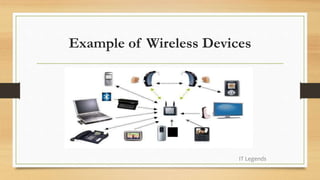
Example of Wireless Devices
IT Legends
Wireless comes of Age
• Guglielmo Marconi invented the wireless telegraph in 1896
Communication by encoding alphanumeric character in analog signal.
Sent telegraphic signals across the Atlantic Ocean.
• Communication satellites launched in 1957.
• Advances in wireless technology:
Radio,television,mobile telephones,communication satellites
• More recently:
Satellite communication ,wireless networking,cellular technology
IT Legends
Why Wireless?
• Characteristics
 mostly radio transmission, new protocols for data transmission are needed
• Advantages
 Ad hoc networks without former planning
 No problems with wiring
• Disadvantages
 Generally very low transmission rates for higher numbers of users
 Restricted frequency range ,interferences of frequencies
IT Legends
Photophone
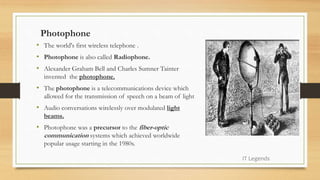
• The world's first wireless telephone .
• Photophone is also called Radiophone.
• Alexander Graham Bell and Charles Sumner Tainter
invented the photophone.
• The photophone is a telecommunications device which
allowed for the transmission of speech on a beam of light
• Audio conversations wirelessly over modulated light
beams.
• Photophone was a precursor to the fiber-optic
communication systems which achieved worldwide
popular usage starting in the 1980s.
IT Legends
Radio
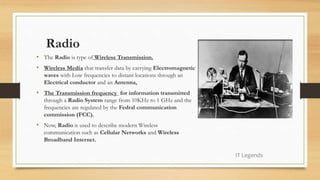
• The Radio is type of Wireless Transmission.
• Wireless Media that transfer data by carrying Electromagnetic
waves with Low frequencies to distant locations through an
Electrical conductor and an Antenna.
• The Transmission frequency for information transmitted
through a Radio System range from 10KHz to 1 GHz and the
frequencies are regulated by the Fedral communication
commission (FCC).
• Now, Radio is used to describe modern Wireless
communication such as Cellular Networks and Wireless
Broadband Internet.
IT Legends
Satellite
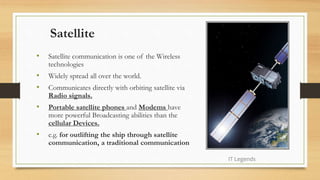
• Satellite communication is one of the Wireless
technologies
• Widely spread all over the world.
• Communicates directly with orbiting satellite via
Radio signals.
• Portable satellite phones and Modems have
more powerful Broadcasting abilities than the
cellular Devices.
• e.g. for outlifting the ship through satellite
communication, a traditional communication
IT Legends
Boardband Wireless Technology
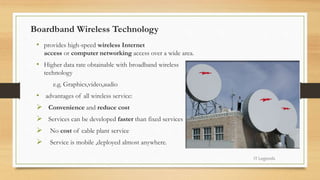
• provides high-speed wireless Internet
access or computer networking access over a wide area.
• Higher data rate obtainable with broadband wireless
technology
e.g. Graphics,video,audio
• advantages of all wireless service:
 Convenience and reduce cost
 Services can be developed faster than fixed services
 No cost of cable plant service
 Service is mobile ,deployed almost anywhere.
IT Legends
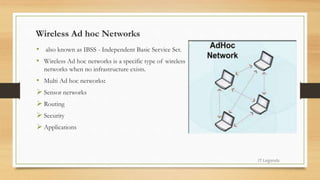
Wireless Ad hoc Networks
• also known as IBSS - Independent Basic Service Set.
• Wireless Ad hoc networks is a specific type of wireless
networks when no infrastructure exists.
• Multi Ad hoc networks:
 Sensor networks
 Routing
 Security
 Applications
IT Legends
LTE
• LTE stand for Long Term Evolution
• Standard for wireless communication of
High speed data for mobiles phones.
• Based on GSM/EDGE and UMTSHSPA
network technologies.
• Natural upgrade path for carriers with both
network technologies
IT Legends
Wi-Fi
• Local area wireless computer networking
• Allows electronic devices to connect to tha network
• Wi-Fi Alliance defines WiFi as “Wireless local area networks”
• Term Wi-Fi is used as synonym for “WLAN”
• Trademark of Wi-Fi Alliance
• Devices that used WiFi are PC’s, video game console, Smart
phones,Dijital cameras , Tablets and Dijital audio players
• Hotspot Wi-Fi
ITLegends
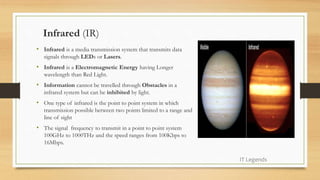
Infrared (IR)
• Infrared is a media transmission system that transmits data
signals through LEDs or Lasers.
• Infrared is a Electromagnetic Energy having Longer
wavelength than Red Light.
• Information cannot be travelled through Obstacles in a
infrared system but can be inhibited by light.
• One type of infrared is the point to point system in which
transmission possible between two points limited to a range and
line of sight
• The signal frequency to transmit in a point to point system
100GHz to 1000THz and the speed ranges from 100Kbps to
16Mbps.
IT Legends
Infrared Based Devices
IT Legends
 Thermographic camera
 Infrared countermeasure
 Consumer IR
 Infrared blaster
 Passive infrared sensor
 Bose SoundDock
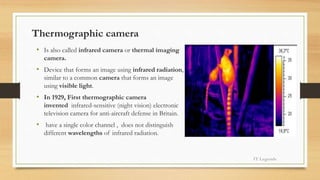
Thermographic camera
• Is also called infrared camera or thermal imaging
camera.
• Device that forms an image using infrared radiation,
similar to a common camera that forms an image
using visible light.
• In 1929, First thermographic camera
invented infrared-sensitive (night vision) electronic
television camera for anti-aircraft defense in Britain.
• have a single color channel , does not distinguish
different wavelengths of infrared radiation.
IT Legends
Infrared countermeasure
• designed to protect aircraft from infrared homing missiles by confusing the
missiles' infrared guidance system so that they will miss their target.
Consumer IR
• wide variety of devices employing the infrared electromagnetic spectrum for wireless
communications.
• Most commonly found in television remote controls
Infrared blasters
• emulates an infrared remote control to autonomously control a device that is normally controlled
only by remote control key presses.
• Most common use in recording devices such as DVR or VCR to change the channel on an external
tuner.
• Another common use is to extend infrared signals in order to place remote controlled products behind
closed doors.
IT Legends
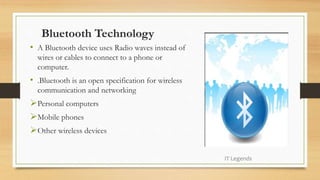
Bluetooth Technology
• A Bluetooth device uses Radio waves instead of
wires or cables to connect to a phone or
computer.
• .Bluetooth is an open specification for wireless
communication and networking
Personal computers
Mobile phones
Other wireless devices
IT Legends
Wireless USB
• Short range ,high bandwidth
• Based on ultra-wideband(UWB) common radio
platform.
• Capable of sending 480 Mbitss at distance
upto 3 metres(9.8 ft) and 110 Mbitss at upto 10
metres(33 ft).
• Wireless USB is based on the Ultra-
WideBand (UWB) platform, which operates in
the 3.1 to 10.6 GHz frequency range,
IT Legends
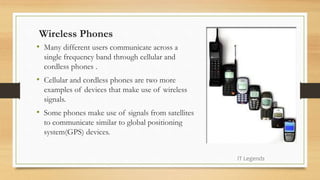
Wireless Phones
• Many different users communicate across a
single frequency band through cellular and
cordless phones .
• Cellular and cordless phones are two more
examples of devices that make use of wireless
signals.
• Some phones make use of signals from satellites
to communicate similar to global positioning
system(GPS) devices.
IT Legends
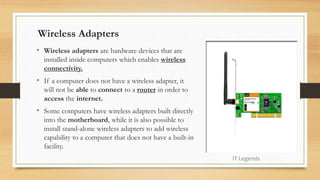
Wireless Adapters
• Wireless adapters are hardware devices that are
installed inside computers which enables wireless
connectivity.
• If a computer does not have a wireless adapter, it
will not be able to connect to a router in order to
access the internet.
• Some computers have wireless adapters built directly
into the motherboard, while it is also possible to
install stand-alone wireless adapters to add wireless
capability to a computer that does not have a built-in
facility.
IT Legends
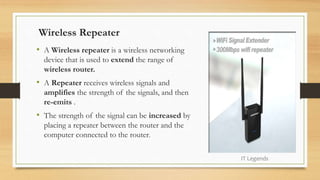
Wireless Repeater
• A Wireless repeater is a wireless networking
device that is used to extend the range of
wireless router.
• A Repeater receives wireless signals and
amplifies the strength of the signals, and then
re-emits .
• The strength of the signal can be increased by
placing a repeater between the router and the
computer connected to the router.
IT Legends
Cordless Computer Peripherals
• Two types of cordless peripherals
i. Infrared (IR) based on optical principle
ii. radio frequency (RF) based on wave principle.
• IR is cheaper, has less interference. But requires direct optical contact between
peripherals and receiver.
• Some devices as shown below:
i. Wireless keyboards
ii. Remote controls
iii. Wireless printers
IT Legends
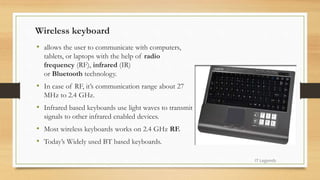
Wireless keyboard
• allows the user to communicate with computers,
tablets, or laptops with the help of radio
frequency (RF), infrared (IR)
or Bluetooth technology.
• In case of RF, it’s communication range about 27
MHz to 2.4 GHz.
• Infrared based keyboards use light waves to transmit
signals to other infrared enabled devices.
• Most wireless keyboards works on 2.4 GHz RF.
• Today’s Widely used BT based keyboards.
IT Legends
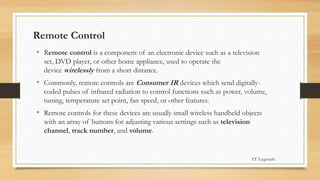
Remote Control
• Remote control is a component of an electronic device such as a television
set, DVD player, or other home appliance, used to operate the
device wirelessly from a short distance.
• Commonly, remote controls are Consumer IR devices which send digitally-
coded pulses of infrared radiation to control functions such as power, volume,
tuning, temperature set point, fan speed, or other features.
• Remote controls for these devices are usually small wireless handheld objects
with an array of buttons for adjusting various settings such as television
channel, track number, and volume.
IT Legends
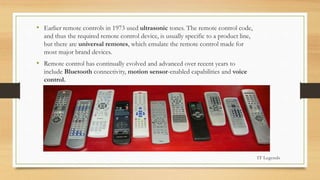
• Earlier remote controls in 1973 used ultrasonic tones. The remote control code,
and thus the required remote control device, is usually specific to a product line,
but there are universal remotes, which emulate the remote control made for
most major brand devices.
• Remote control has continually evolved and advanced over recent years to
include Bluetooth connectivity, motion sensor-enabled capabilities and voice
control.
IT Legends
Wireless Printers
• There are several printers on market that have WiFi transceivers built
into them.
• Network administrators must first comes install the printer to the
network so that other devices connected to the system can locate the
printer.
• Once connected, compatible devices can send print jobs to the printer.
• This comes handle for offices or households with lots of computers.
IT Legends
•THANKs FOR LISTENING….. 
ANY QUERY ….
IS NOT ALLOWED
IT Legends

Wireless devices by hm

  • 2.
    What is Wirelessdevices? Defination: A device which is use to transfer of information between two or more points that are not connected by an electrical conductor. IT Legends
  • 3.
    Example of WirelessDevices IT Legends
  • 4.
    Wireless comes ofAge • Guglielmo Marconi invented the wireless telegraph in 1896 Communication by encoding alphanumeric character in analog signal. Sent telegraphic signals across the Atlantic Ocean. • Communication satellites launched in 1957. • Advances in wireless technology: Radio,television,mobile telephones,communication satellites • More recently: Satellite communication ,wireless networking,cellular technology IT Legends
  • 5.
    Why Wireless? • Characteristics mostly radio transmission, new protocols for data transmission are needed • Advantages  Ad hoc networks without former planning  No problems with wiring • Disadvantages  Generally very low transmission rates for higher numbers of users  Restricted frequency range ,interferences of frequencies IT Legends
  • 6.
    Photophone • The world'sfirst wireless telephone . • Photophone is also called Radiophone. • Alexander Graham Bell and Charles Sumner Tainter invented the photophone. • The photophone is a telecommunications device which allowed for the transmission of speech on a beam of light • Audio conversations wirelessly over modulated light beams. • Photophone was a precursor to the fiber-optic communication systems which achieved worldwide popular usage starting in the 1980s. IT Legends
  • 7.
    Radio • The Radiois type of Wireless Transmission. • Wireless Media that transfer data by carrying Electromagnetic waves with Low frequencies to distant locations through an Electrical conductor and an Antenna. • The Transmission frequency for information transmitted through a Radio System range from 10KHz to 1 GHz and the frequencies are regulated by the Fedral communication commission (FCC). • Now, Radio is used to describe modern Wireless communication such as Cellular Networks and Wireless Broadband Internet. IT Legends
  • 8.
    Satellite • Satellite communicationis one of the Wireless technologies • Widely spread all over the world. • Communicates directly with orbiting satellite via Radio signals. • Portable satellite phones and Modems have more powerful Broadcasting abilities than the cellular Devices. • e.g. for outlifting the ship through satellite communication, a traditional communication IT Legends
  • 9.
    Boardband Wireless Technology •provides high-speed wireless Internet access or computer networking access over a wide area. • Higher data rate obtainable with broadband wireless technology e.g. Graphics,video,audio • advantages of all wireless service:  Convenience and reduce cost  Services can be developed faster than fixed services  No cost of cable plant service  Service is mobile ,deployed almost anywhere. IT Legends
  • 10.
    Wireless Ad hocNetworks • also known as IBSS - Independent Basic Service Set. • Wireless Ad hoc networks is a specific type of wireless networks when no infrastructure exists. • Multi Ad hoc networks:  Sensor networks  Routing  Security  Applications IT Legends
  • 11.
    LTE • LTE standfor Long Term Evolution • Standard for wireless communication of High speed data for mobiles phones. • Based on GSM/EDGE and UMTSHSPA network technologies. • Natural upgrade path for carriers with both network technologies IT Legends
  • 12.
    Wi-Fi • Local areawireless computer networking • Allows electronic devices to connect to tha network • Wi-Fi Alliance defines WiFi as “Wireless local area networks” • Term Wi-Fi is used as synonym for “WLAN” • Trademark of Wi-Fi Alliance • Devices that used WiFi are PC’s, video game console, Smart phones,Dijital cameras , Tablets and Dijital audio players • Hotspot Wi-Fi ITLegends
  • 13.
    Infrared (IR) • Infraredis a media transmission system that transmits data signals through LEDs or Lasers. • Infrared is a Electromagnetic Energy having Longer wavelength than Red Light. • Information cannot be travelled through Obstacles in a infrared system but can be inhibited by light. • One type of infrared is the point to point system in which transmission possible between two points limited to a range and line of sight • The signal frequency to transmit in a point to point system 100GHz to 1000THz and the speed ranges from 100Kbps to 16Mbps. IT Legends
  • 14.
    Infrared Based Devices ITLegends  Thermographic camera  Infrared countermeasure  Consumer IR  Infrared blaster  Passive infrared sensor  Bose SoundDock
  • 15.
    Thermographic camera • Isalso called infrared camera or thermal imaging camera. • Device that forms an image using infrared radiation, similar to a common camera that forms an image using visible light. • In 1929, First thermographic camera invented infrared-sensitive (night vision) electronic television camera for anti-aircraft defense in Britain. • have a single color channel , does not distinguish different wavelengths of infrared radiation. IT Legends
  • 16.
    Infrared countermeasure • designedto protect aircraft from infrared homing missiles by confusing the missiles' infrared guidance system so that they will miss their target. Consumer IR • wide variety of devices employing the infrared electromagnetic spectrum for wireless communications. • Most commonly found in television remote controls Infrared blasters • emulates an infrared remote control to autonomously control a device that is normally controlled only by remote control key presses. • Most common use in recording devices such as DVR or VCR to change the channel on an external tuner. • Another common use is to extend infrared signals in order to place remote controlled products behind closed doors. IT Legends
  • 17.
    Bluetooth Technology • ABluetooth device uses Radio waves instead of wires or cables to connect to a phone or computer. • .Bluetooth is an open specification for wireless communication and networking Personal computers Mobile phones Other wireless devices IT Legends
  • 18.
    Wireless USB • Shortrange ,high bandwidth • Based on ultra-wideband(UWB) common radio platform. • Capable of sending 480 Mbitss at distance upto 3 metres(9.8 ft) and 110 Mbitss at upto 10 metres(33 ft). • Wireless USB is based on the Ultra- WideBand (UWB) platform, which operates in the 3.1 to 10.6 GHz frequency range, IT Legends
  • 19.
    Wireless Phones • Manydifferent users communicate across a single frequency band through cellular and cordless phones . • Cellular and cordless phones are two more examples of devices that make use of wireless signals. • Some phones make use of signals from satellites to communicate similar to global positioning system(GPS) devices. IT Legends
  • 20.
    Wireless Adapters • Wirelessadapters are hardware devices that are installed inside computers which enables wireless connectivity. • If a computer does not have a wireless adapter, it will not be able to connect to a router in order to access the internet. • Some computers have wireless adapters built directly into the motherboard, while it is also possible to install stand-alone wireless adapters to add wireless capability to a computer that does not have a built-in facility. IT Legends
  • 21.
    Wireless Repeater • AWireless repeater is a wireless networking device that is used to extend the range of wireless router. • A Repeater receives wireless signals and amplifies the strength of the signals, and then re-emits . • The strength of the signal can be increased by placing a repeater between the router and the computer connected to the router. IT Legends
  • 22.
    Cordless Computer Peripherals •Two types of cordless peripherals i. Infrared (IR) based on optical principle ii. radio frequency (RF) based on wave principle. • IR is cheaper, has less interference. But requires direct optical contact between peripherals and receiver. • Some devices as shown below: i. Wireless keyboards ii. Remote controls iii. Wireless printers IT Legends
  • 23.
    Wireless keyboard • allowsthe user to communicate with computers, tablets, or laptops with the help of radio frequency (RF), infrared (IR) or Bluetooth technology. • In case of RF, it’s communication range about 27 MHz to 2.4 GHz. • Infrared based keyboards use light waves to transmit signals to other infrared enabled devices. • Most wireless keyboards works on 2.4 GHz RF. • Today’s Widely used BT based keyboards. IT Legends
  • 24.
    Remote Control • Remotecontrol is a component of an electronic device such as a television set, DVD player, or other home appliance, used to operate the device wirelessly from a short distance. • Commonly, remote controls are Consumer IR devices which send digitally- coded pulses of infrared radiation to control functions such as power, volume, tuning, temperature set point, fan speed, or other features. • Remote controls for these devices are usually small wireless handheld objects with an array of buttons for adjusting various settings such as television channel, track number, and volume. IT Legends
  • 25.
    • Earlier remotecontrols in 1973 used ultrasonic tones. The remote control code, and thus the required remote control device, is usually specific to a product line, but there are universal remotes, which emulate the remote control made for most major brand devices. • Remote control has continually evolved and advanced over recent years to include Bluetooth connectivity, motion sensor-enabled capabilities and voice control. IT Legends
  • 26.
    Wireless Printers • Thereare several printers on market that have WiFi transceivers built into them. • Network administrators must first comes install the printer to the network so that other devices connected to the system can locate the printer. • Once connected, compatible devices can send print jobs to the printer. • This comes handle for offices or households with lots of computers. IT Legends
  • 27.
    •THANKs FOR LISTENING….. ANY QUERY …. IS NOT ALLOWED IT Legends