+


    Sensor OpenFlow

    Enabling Software-Defined Wireless Sensor
    Networks
+
     Data Plane: Creating Flows
    Redefine flow tables to cater for the special addressing schemes in WSN


    classify WSN addressing schemes into Class-1 , compact network-unique addresses such as the ZigBee 16-bit network
    addresses (e.g., 0x796F as assigned by the CSkip algorithm [9]), and Class-2 , concatenated attribute-value pairs (CAV)
    such as “30< temperature< 60” and “Zone-ID=7 AND x -coordinate> 150”
+
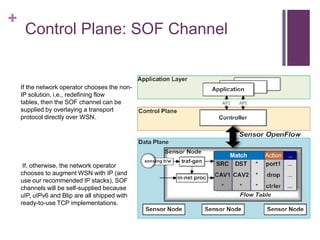
     Control Plane: SOF Channel


    If the network operator chooses the non-
    IP solution, i.e., redefining flow
    tables, then the SOF channel can be
    supplied by overlaying a transport
    protocol directly over WSN.


     If, otherwise, the network operator
    chooses to augment WSN with IP (and
    use our recommended IP stacks), SOF
    channels will be self-supplied because
    uIP, uIPv6 and Blip are all shipped with
    ready-to-use TCP implementations.
+
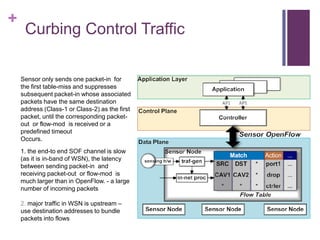
     Curbing Control Traffic

    Sensor only sends one packet-in for
    the first table-miss and suppresses
    subsequent packet-in whose associated
    packets have the same destination
    address (Class-1 or Class-2) as the first
    packet, until the corresponding packet-
    out or flow-mod is received or a
    predefined timeout
    Occurs.
    1. the end-to end SOF channel is slow
    (as it is in-band of WSN), the latency
    between sending packet-in and
    receiving packet-out or flow-mod is
    much larger than in OpenFlow. - a large
    number of incoming packets

    2. major traffic in WSN is upstream –
    use destination addresses to bundle
    packets into flows
+
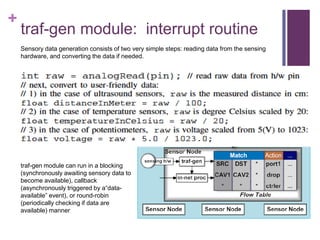
    traf-gen module: interrupt routine
    Sensory data generation consists of two very simple steps: reading data from the sensing
    hardware, and converting the data if needed.


    traf-gen module can run in a blocking
    (synchronously awaiting sensory data to
    become available), callback
    (asynchronously triggered by a“data-
    available” event), or round-robin
    (periodically checking if data are
    available) manner
+
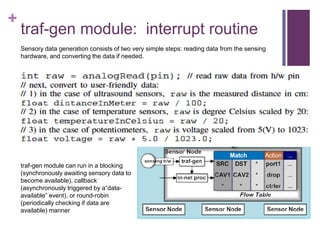
    traf-gen module: interrupt routine
    Sensory data generation consists of two very simple steps: reading data from the sensing
    hardware, and converting the data if needed.


    traf-gen module can run in a blocking
    (synchronously awaiting sensory data to
    become available), callback
    (asynchronously triggered by a“data-
    available” event), or round-robin
    (periodically checking if data are
    available) manner
+
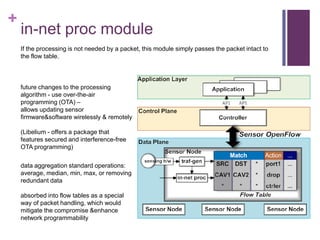
    in-net proc module
    If the processing is not needed by a packet, this module simply passes the packet intact to
    the flow table.


    future changes to the processing
    algorithm - use over-the-air
    programming (OTA) –
    allows updating sensor
    firmware&software wirelessly & remotely

    (Libelium - offers a package that
    features secured and interference-free
    OTA programming)

    data aggregation standard operations:
    average, median, min, max, or removing
    redundant data

    absorbed into flow tables as a special
    way of packet handling, which would
    mitigate the compromise &enhance
    network programmability
+
    Backward and Peer Compatibility
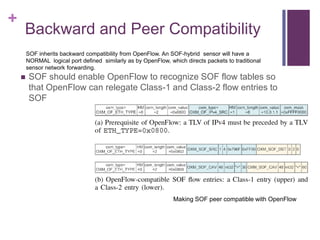
        SOF inherits backward compatibility from OpenFlow. An SOF-hybrid sensor will have a
        NORMAL logical port defined similarly as by OpenFlow, which directs packets to traditional
        sensor network forwarding.
        SOF should enable OpenFlow to recognize SOF flow tables so
         that OpenFlow can relegate Class-1 and Class-2 flow entries to
         SOF


                                                                Making SOF peer compatible with OpenFlow
+


    3g/Wireless Offload

    WiMax
+
+


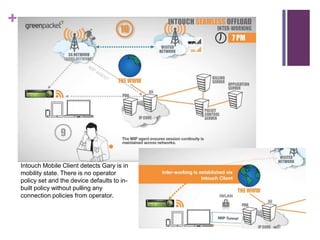
    Intouch Mobile Client detects Gary is in
    mobility state. There is no operator
    policy set and the device defaults to in-
    built policy without pulling any
    connection policies from operator.
+


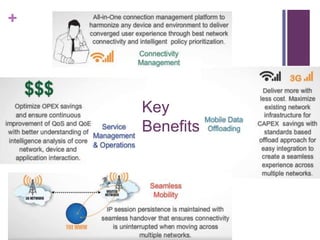
    Key
    Benefits
+


    New Idea

    Seamless connectivity from mobile/table to PC

Wireless sensor open flow

  • 1.
    + Sensor OpenFlow Enabling Software-Defined Wireless Sensor Networks
  • 2.
    + Data Plane: Creating Flows Redefine flow tables to cater for the special addressing schemes in WSN classify WSN addressing schemes into Class-1 , compact network-unique addresses such as the ZigBee 16-bit network addresses (e.g., 0x796F as assigned by the CSkip algorithm [9]), and Class-2 , concatenated attribute-value pairs (CAV) such as “30< temperature< 60” and “Zone-ID=7 AND x -coordinate> 150”
  • 3.
    + Control Plane: SOF Channel If the network operator chooses the non- IP solution, i.e., redefining flow tables, then the SOF channel can be supplied by overlaying a transport protocol directly over WSN. If, otherwise, the network operator chooses to augment WSN with IP (and use our recommended IP stacks), SOF channels will be self-supplied because uIP, uIPv6 and Blip are all shipped with ready-to-use TCP implementations.
  • 4.
    + Curbing Control Traffic Sensor only sends one packet-in for the first table-miss and suppresses subsequent packet-in whose associated packets have the same destination address (Class-1 or Class-2) as the first packet, until the corresponding packet- out or flow-mod is received or a predefined timeout Occurs. 1. the end-to end SOF channel is slow (as it is in-band of WSN), the latency between sending packet-in and receiving packet-out or flow-mod is much larger than in OpenFlow. - a large number of incoming packets 2. major traffic in WSN is upstream – use destination addresses to bundle packets into flows
  • 5.
    + traf-gen module: interrupt routine Sensory data generation consists of two very simple steps: reading data from the sensing hardware, and converting the data if needed. traf-gen module can run in a blocking (synchronously awaiting sensory data to become available), callback (asynchronously triggered by a“data- available” event), or round-robin (periodically checking if data are available) manner
  • 6.
    + traf-gen module: interrupt routine Sensory data generation consists of two very simple steps: reading data from the sensing hardware, and converting the data if needed. traf-gen module can run in a blocking (synchronously awaiting sensory data to become available), callback (asynchronously triggered by a“data- available” event), or round-robin (periodically checking if data are available) manner
  • 7.
    + in-net proc module If the processing is not needed by a packet, this module simply passes the packet intact to the flow table. future changes to the processing algorithm - use over-the-air programming (OTA) – allows updating sensor firmware&software wirelessly & remotely (Libelium - offers a package that features secured and interference-free OTA programming) data aggregation standard operations: average, median, min, max, or removing redundant data absorbed into flow tables as a special way of packet handling, which would mitigate the compromise &enhance network programmability
  • 8.
    + Backward and Peer Compatibility SOF inherits backward compatibility from OpenFlow. An SOF-hybrid sensor will have a NORMAL logical port defined similarly as by OpenFlow, which directs packets to traditional sensor network forwarding.  SOF should enable OpenFlow to recognize SOF flow tables so that OpenFlow can relegate Class-1 and Class-2 flow entries to SOF Making SOF peer compatible with OpenFlow
  • 9.
    + 3g/Wireless Offload WiMax
  • 10.
  • 11.
    + Intouch Mobile Client detects Gary is in mobility state. There is no operator policy set and the device defaults to in- built policy without pulling any connection policies from operator.
  • 12.
    + Key Benefits
  • 13.
    + New Idea Seamless connectivity from mobile/table to PC