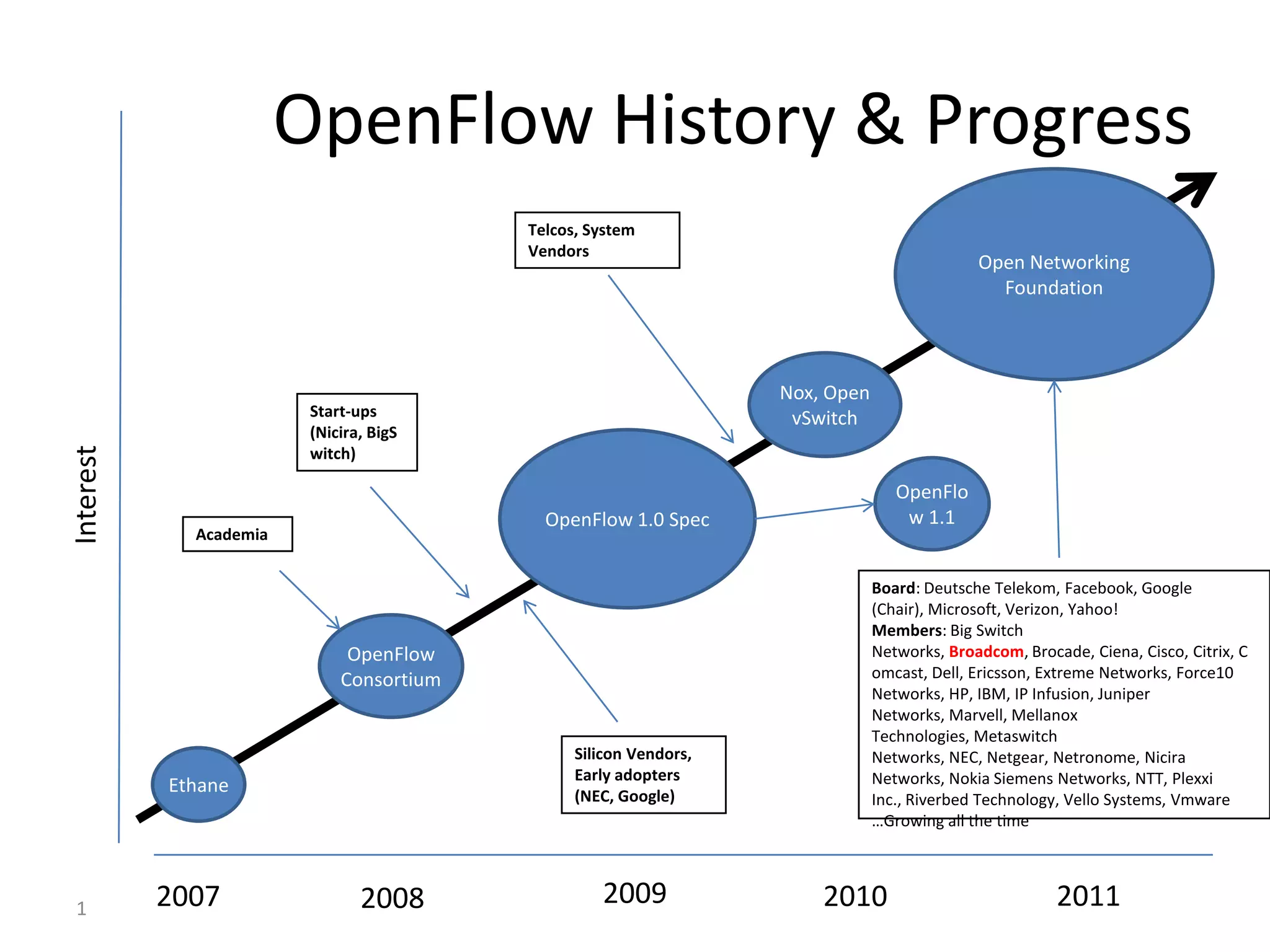
OpenFlow History & Progress
                                          Telcos, System
                                          Vendors
                                                                                             Open Networking
                                                                                               Foundation


                                                                   Nox, Open
                         Start-ups                                  vSwitch
                         (Nicira, BigS
Interest


                         witch)

                                                                                  OpenFlo
                                            OpenFlow 1.0 Spec                      w 1.1
             Academia


                                                                               Board: Deutsche Telekom, Facebook, Google
                                                                               (Chair), Microsoft, Verizon, Yahoo!
                                                                               Members: Big Switch
                              OpenFlow                                         Networks, Broadcom, Brocade, Ciena, Cisco, Citrix, C
                             Consortium                                        omcast, Dell, Ericsson, Extreme Networks, Force10
                                                                               Networks, HP, IBM, IP Infusion, Juniper
                                                                               Networks, Marvell, Mellanox
                                                                               Technologies, Metaswitch
                                                Silicon Vendors,               Networks, NEC, Netgear, Netronome, Nicira
                                                Early adopters                 Networks, Nokia Siemens Networks, NTT, Plexxi
           Ethane                               (NEC, Google)                  Inc., Riverbed Technology, Vello Systems, Vmware
                                                                               …Growing all the time


 1         2007                 2008               2009                2010                             2011
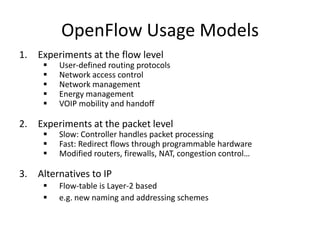
OpenFlow Usage Models
1. Experiments at the flow level
        User-defined routing protocols
        Network access control
        Network management
        Energy management
        VOIP mobility and handoff

2. Experiments at the packet level
        Slow: Controller handles packet processing
        Fast: Redirect flows through programmable hardware
        Modified routers, firewalls, NAT, congestion control…

3. Alternatives to IP
        Flow-table is Layer-2 based
        e.g. new naming and addressing schemes
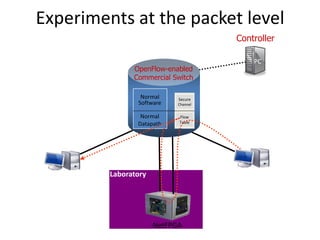
Experiments at the packet level
                                      Controller

                                          PC
               OpenFlow-enabled
               Commercial Switch

                 Normal     Secure
                Software    Channel


                 Normal     Flow
                Datapath    Table


         Laboratory


                      NetFPGA
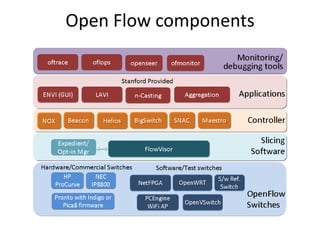
Open Flow components
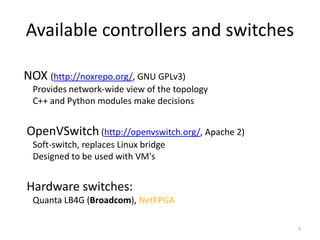
Available controllers and switches

NOX (http://noxrepo.org/, GNU GPLv3)


       Provides network-wide view of the topology
       C++ and Python modules make decisions


   OpenVSwitch (http://openvswitch.org/, Apache 2)
       Soft-switch, replaces Linux bridge
       Designed to be used with VM's


   Hardware switches:
       Quanta LB4G (Broadcom), NetFPGA

                                                      5
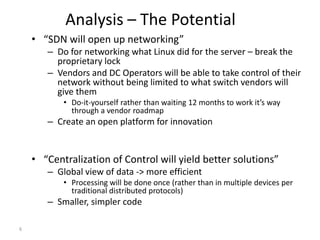
Analysis – The Potential
    • “SDN will open up networking”
       – Do for networking what Linux did for the server – break the
         proprietary lock
       – Vendors and DC Operators will be able to take control of their
         network without being limited to what switch vendors will
         give them
           • Do-it-yourself rather than waiting 12 months to work it’s way
             through a vendor roadmap
       – Create an open platform for innovation


    • “Centralization of Control will yield better solutions”
       – Global view of data -> more efficient
           • Processing will be done once (rather than in multiple devices per
             traditional distributed protocols)
       – Smaller, simpler code

6
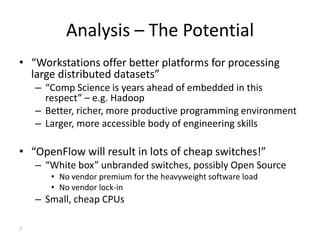
Analysis – The Potential
• “Workstations offer better platforms for processing
  large distributed datasets”
    – “Comp Science is years ahead of embedded in this
      respect” – e.g. Hadoop
    – Better, richer, more productive programming environment
    – Larger, more accessible body of engineering skills

• “OpenFlow will result in lots of cheap switches!”
    – “White box” unbranded switches, possibly Open Source
       • No vendor premium for the heavyweight software load
       • No vendor lock-in
    – Small, cheap CPUs

7
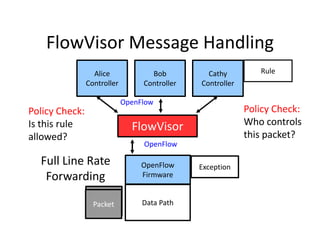
FlowVisor Message Handling
                  Alice             Bob          Cathy         Rule
                Controller        Controller   Controller

                             OpenFlow
Policy Check:                                               Policy Check:
Is this rule                   FlowVisor                    Who controls
allowed?                                                    this packet?
                                  OpenFlow

  Full Line Rate                  OpenFlow     Exception
   Forwarding                     Firmware


                  Packet
                  Packet          Data Path
Analysis – The Potential – Use Cases
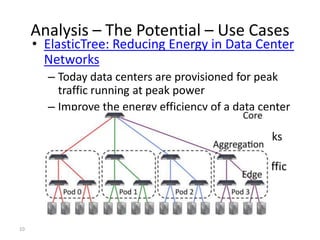
     • ElasticTree: Reducing Energy in Data Center
       Networks
       – Today data centers are provisioned for peak
         traffic running at peak power
       – Improve the energy efficiency of a data center
         network
       – Dynamically adjust network elements - links
         and switches.
       – ElasticTree uses OpenFlow to measure traffic
         statistics and control flow routes
       – Upto 60% savings demonstrated.

10
Analysis – The Potential – Some Use
                    Cases
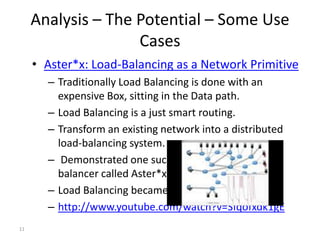
     • Aster*x: Load-Balancing as a Network Primitive
       – Traditionally Load Balancing is done with an
         expensive Box, sitting in the Data path.
       – Load Balancing is a just smart routing.
       – Transform an existing network into a distributed
         load-balancing system.
       – Demonstrated one such OpenFlow-based load-
         balancer called Aster*x
       – Load Balancing became a Control plane solution
       – http://www.youtube.com/watch?v=Sfqofxdk1gE
11
Analysis – The Potential – Some Use
                    Cases
     • Using All Wireless Networks Around Me
       – This demo shows how we can exploit all the wireless
         networks around us to achieve better connectivity
         and hence better video streaming from a moving
         vehicle.
       – simultaneous use of multiple wireless networks.
       – Uses OpenFlow Wireless-enabled WiFi and WiMAX
         networks.

       – http://www.youtube.com/watch?v=ov1DZYINg3Y
12
•
            Analysis – The Challenges
         “OpenFlow is too limited”
         – How can you solve all networking problems with such a narrow set of
           primitives?
         – All solutions will require lots of network services outside of OpenFlow in
           order to function, so does the “openness story” really hang together?

     • “You cannot replace all the traditional switch/routing functions”
         – Need to maintain Controller connectivity across a network
         – Local processing required for HA/Fast failover
         – So will the switches really be any cheaper/simpler, or does OpenFlow
           support become yet another switch feature?

     • “SDN doesn’t scale”
         – Today switches do a lot of local processing (and need complex software and
           big CPUs for a reason!) – they have a lot of dynamic, event-driven
           processing to-do
             • Yes you can simplify this, but can you replace or export it?
         – If you put all that up on a remote station, the both processing throughput
           and event latency will become big issues

13
Analysis – The Challenges
     • “Is it really that new? What can you do with
       OpenFlow that we can’t already do with
       existing configuration methods?”

     • “Solutions may move from being Switch
       vendor to Controller vendor dependent”
       – Where’s the interoperability?
       – Industry-hardened multi-vendor standards have
         been available in traditional networks for years.

14
Predictions
     • SDN will supplement rather than completely replace traditional switch
       features
         – Will still need much of traditional switching and routing for the foreseeable
           future
         – See OpenFlow as a value-add feature

     • SDN will create an innovation platform that will attract a lot of
       interesting solutions
         – OpenFlow Controllers will look more like OS’s – platforms not solutions
         – The Networking “App Store” will arrive!
         – However many solutions will require optional and proprietary features in
           the switch

     • SDN will create opportunities for silicon innovation
         – The richer the “instruction set”, the more powerful the solutions!

     • Overall, this is a key trend that will happen, and will energize our
       industry


15
Thank You – Q&A
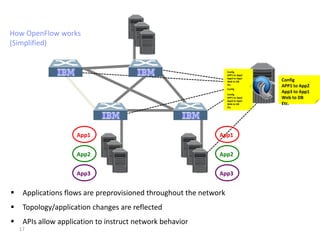
How OpenFlow works
(Simplified)


                                                                    Config
                                                                    APP1 to App2
                                                                    App3 to App1
                                                                    Config
                                                                    Web to DB
                                                                    APP1 to App2   Config
                                                                    Config App1
                                                                    Etc. to
                                                                    App3
                                                                    APP1to DB
                                                                    Web to App2
                                                                                   APP1 to App2
                                                                    Config App1
                                                                    App3
                                                                    Etc. to App2
                                                                    APP1to DB      App3 to App1
                                                                    Web to
                                                                    Config App1
                                                                    App3
                                                                    Etc. to App2
                                                                    APP1to DB
                                                                    Web to         Web to DB
                                                                    App3
                                                                    Etc. to App1
                                                                    Web to DB      Etc.
                                                                    Etc.


                     App1                                      App1


                     App2                                      App2


                     App3                                      App3


    Applications flows are preprovisioned throughout the network
    Topology/application changes are reflected
    APIs allow application to instruct network behavior
    17
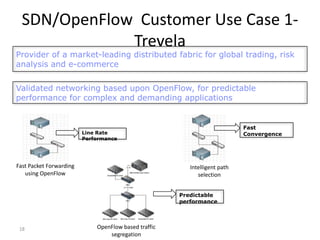
SDN/OpenFlow Customer Use Case 1-
              Trevela
Provider of a market-leading distributed fabric for global trading, risk
analysis and e-commerce


Validated networking based upon OpenFlow, for predictable
performance for complex and demanding applications


                                                                            Fast
                         Line Rate                                          Convergence
                         Performance


Fast Packet Forwarding                                   Intelligent path
   using OpenFlow                                           selection


                                                      Predictable
                                                      performance


 18                          OpenFlow based traffic
                                 segregation
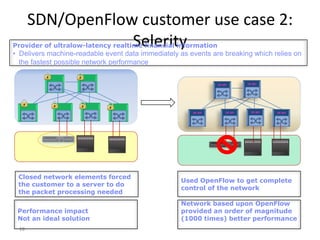
SDN/OpenFlow customer use case 2:
                  Selerity
Provider of ultralow-latency realtime financial information
• Delivers machine-readable event data immediately as events are breaking which relies on
  the fastest possible network performance


                                                                OF API        OF API


                                                       OF API        OF API     OF API   OF API


 Closed network elements forced
                                                   Used OpenFlow to get complete
 the customer to a server to do
                                                   control of the network
 the packet processing needed
                                                   Network based upon OpenFlow
 Performance impact                                provided an order of magnitude
 Not an ideal solution                             (1000 times) better performance
 19
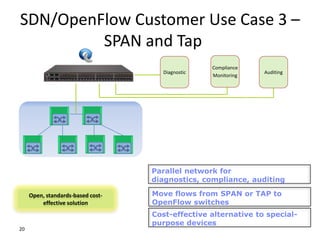
SDN/OpenFlow Customer Use Case 3 –
         SPAN and Tap
                                                  Compliance
                                     Diagnostic                 Auditing
                                                  Monitoring


                                   Parallel network for
                                   diagnostics, compliance, auditing

     Open, standards-based cost-   Move flows from SPAN or TAP to
         effective solution        OpenFlow switches
                                   Cost-effective alternative to special-
                                   purpose devices
20
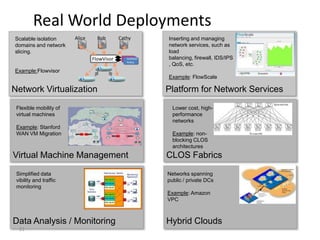
Real World Deployments
Scalable isolation      Alice     Bob       Cathy          Inserting and managing
domains and network                                        network services, such as
slicing.                                                   load
                                FlowVisor      Isolation   balancing, firewall, IDS/IPS
                                               Policy
                                                           , QoS, etc.
Example:Flowvisor
                                                           Example: FlowScale

Network Virtualization                                     Platform for Network Services
 Flexible mobility of                                        Lower cost, high-
 virtual machines                                            performance
                                                             networks
 Example: Stanford
 WAN VM Migration                                            Example: non-
                                                             blocking CLOS
                                                             architectures
Virtual Machine Management                                 CLOS Fabrics
 Simplified data                                           Networks spanning
 vibility and traffic                                      public / private DCs
 monitoring
                                                           Example: Amazon
                                                           VPC


Data Analysis / Monitoring                                 Hybrid Clouds
  21
OpenFlow as a strawman flow-
      based substrate
Our Approach
               1. Define the substrate
•   OpenFlow is an open external API to a flow-table

•   Version 1.0
    –   Defined to be easy to add to existing hardware
        switches, routers, APs, …
    –   Timeframe: Now
•   Version 2.0
    –   OpenFlow-optimized hardware
    –   General “flowspace”
    –   Timeframe: 2011
OpenFlow Deployments
• Stanford Deployments
  – Wired: CS Gates building, EE CIS building, EE Packard
    building
  – WiFi: 100 OpenFlow APs across SoE
  – WiMAX: OpenFlow service in SoE

• Other deployments
  – Internet2 (NetFPGA switches)
  – JGN2plus, Japan (NEC switches)
  – 10-15 research groups have switches
OpenFlow Deployments
               Plans in 2009-10

• Campus deployments
  – Lab + production use
  – “Enterprise GENI” (NSF/GPO)


• Backbone deployments
  – National research backbones
  – Research + Production use

Presentation11

  • 1.
    OpenFlow History &Progress Telcos, System Vendors Open Networking Foundation Nox, Open Start-ups vSwitch (Nicira, BigS Interest witch) OpenFlo OpenFlow 1.0 Spec w 1.1 Academia Board: Deutsche Telekom, Facebook, Google (Chair), Microsoft, Verizon, Yahoo! Members: Big Switch OpenFlow Networks, Broadcom, Brocade, Ciena, Cisco, Citrix, C Consortium omcast, Dell, Ericsson, Extreme Networks, Force10 Networks, HP, IBM, IP Infusion, Juniper Networks, Marvell, Mellanox Technologies, Metaswitch Silicon Vendors, Networks, NEC, Netgear, Netronome, Nicira Early adopters Networks, Nokia Siemens Networks, NTT, Plexxi Ethane (NEC, Google) Inc., Riverbed Technology, Vello Systems, Vmware …Growing all the time 1 2007 2008 2009 2010 2011
  • 2.
    OpenFlow Usage Models 1.Experiments at the flow level  User-defined routing protocols  Network access control  Network management  Energy management  VOIP mobility and handoff 2. Experiments at the packet level  Slow: Controller handles packet processing  Fast: Redirect flows through programmable hardware  Modified routers, firewalls, NAT, congestion control… 3. Alternatives to IP  Flow-table is Layer-2 based  e.g. new naming and addressing schemes
  • 3.
    Experiments at thepacket level Controller PC OpenFlow-enabled Commercial Switch Normal Secure Software Channel Normal Flow Datapath Table Laboratory NetFPGA
  • 4.
  • 5.
    Available controllers andswitches NOX (http://noxrepo.org/, GNU GPLv3)   Provides network-wide view of the topology  C++ and Python modules make decisions  OpenVSwitch (http://openvswitch.org/, Apache 2)  Soft-switch, replaces Linux bridge  Designed to be used with VM's  Hardware switches:  Quanta LB4G (Broadcom), NetFPGA 5
  • 6.
    Analysis – ThePotential • “SDN will open up networking” – Do for networking what Linux did for the server – break the proprietary lock – Vendors and DC Operators will be able to take control of their network without being limited to what switch vendors will give them • Do-it-yourself rather than waiting 12 months to work it’s way through a vendor roadmap – Create an open platform for innovation • “Centralization of Control will yield better solutions” – Global view of data -> more efficient • Processing will be done once (rather than in multiple devices per traditional distributed protocols) – Smaller, simpler code 6
  • 7.
    Analysis – ThePotential • “Workstations offer better platforms for processing large distributed datasets” – “Comp Science is years ahead of embedded in this respect” – e.g. Hadoop – Better, richer, more productive programming environment – Larger, more accessible body of engineering skills • “OpenFlow will result in lots of cheap switches!” – “White box” unbranded switches, possibly Open Source • No vendor premium for the heavyweight software load • No vendor lock-in – Small, cheap CPUs 7
  • 8.
    FlowVisor Message Handling Alice Bob Cathy Rule Controller Controller Controller OpenFlow Policy Check: Policy Check: Is this rule FlowVisor Who controls allowed? this packet? OpenFlow Full Line Rate OpenFlow Exception Forwarding Firmware Packet Packet Data Path
  • 9.
    Analysis – ThePotential – Use Cases • ElasticTree: Reducing Energy in Data Center Networks – Today data centers are provisioned for peak traffic running at peak power – Improve the energy efficiency of a data center network – Dynamically adjust network elements - links and switches. – ElasticTree uses OpenFlow to measure traffic statistics and control flow routes – Upto 60% savings demonstrated. 10
  • 10.
    Analysis – ThePotential – Some Use Cases • Aster*x: Load-Balancing as a Network Primitive – Traditionally Load Balancing is done with an expensive Box, sitting in the Data path. – Load Balancing is a just smart routing. – Transform an existing network into a distributed load-balancing system. – Demonstrated one such OpenFlow-based load- balancer called Aster*x – Load Balancing became a Control plane solution – http://www.youtube.com/watch?v=Sfqofxdk1gE 11
  • 11.
    Analysis – ThePotential – Some Use Cases • Using All Wireless Networks Around Me – This demo shows how we can exploit all the wireless networks around us to achieve better connectivity and hence better video streaming from a moving vehicle. – simultaneous use of multiple wireless networks. – Uses OpenFlow Wireless-enabled WiFi and WiMAX networks. – http://www.youtube.com/watch?v=ov1DZYINg3Y 12
  • 12.
    Analysis – The Challenges “OpenFlow is too limited” – How can you solve all networking problems with such a narrow set of primitives? – All solutions will require lots of network services outside of OpenFlow in order to function, so does the “openness story” really hang together? • “You cannot replace all the traditional switch/routing functions” – Need to maintain Controller connectivity across a network – Local processing required for HA/Fast failover – So will the switches really be any cheaper/simpler, or does OpenFlow support become yet another switch feature? • “SDN doesn’t scale” – Today switches do a lot of local processing (and need complex software and big CPUs for a reason!) – they have a lot of dynamic, event-driven processing to-do • Yes you can simplify this, but can you replace or export it? – If you put all that up on a remote station, the both processing throughput and event latency will become big issues 13
  • 13.
    Analysis – TheChallenges • “Is it really that new? What can you do with OpenFlow that we can’t already do with existing configuration methods?” • “Solutions may move from being Switch vendor to Controller vendor dependent” – Where’s the interoperability? – Industry-hardened multi-vendor standards have been available in traditional networks for years. 14
  • 14.
    Predictions • SDN will supplement rather than completely replace traditional switch features – Will still need much of traditional switching and routing for the foreseeable future – See OpenFlow as a value-add feature • SDN will create an innovation platform that will attract a lot of interesting solutions – OpenFlow Controllers will look more like OS’s – platforms not solutions – The Networking “App Store” will arrive! – However many solutions will require optional and proprietary features in the switch • SDN will create opportunities for silicon innovation – The richer the “instruction set”, the more powerful the solutions! • Overall, this is a key trend that will happen, and will energize our industry 15
  • 15.
  • 16.
    How OpenFlow works (Simplified) Config APP1 to App2 App3 to App1 Config Web to DB APP1 to App2 Config Config App1 Etc. to App3 APP1to DB Web to App2 APP1 to App2 Config App1 App3 Etc. to App2 APP1to DB App3 to App1 Web to Config App1 App3 Etc. to App2 APP1to DB Web to Web to DB App3 Etc. to App1 Web to DB Etc. Etc. App1 App1 App2 App2 App3 App3  Applications flows are preprovisioned throughout the network  Topology/application changes are reflected  APIs allow application to instruct network behavior 17
  • 17.
    SDN/OpenFlow Customer UseCase 1- Trevela Provider of a market-leading distributed fabric for global trading, risk analysis and e-commerce Validated networking based upon OpenFlow, for predictable performance for complex and demanding applications Fast Line Rate Convergence Performance Fast Packet Forwarding Intelligent path using OpenFlow selection Predictable performance 18 OpenFlow based traffic segregation
  • 18.
    SDN/OpenFlow customer usecase 2: Selerity Provider of ultralow-latency realtime financial information • Delivers machine-readable event data immediately as events are breaking which relies on the fastest possible network performance OF API OF API OF API OF API OF API OF API Closed network elements forced Used OpenFlow to get complete the customer to a server to do control of the network the packet processing needed Network based upon OpenFlow Performance impact provided an order of magnitude Not an ideal solution (1000 times) better performance 19
  • 19.
    SDN/OpenFlow Customer UseCase 3 – SPAN and Tap Compliance Diagnostic Auditing Monitoring Parallel network for diagnostics, compliance, auditing Open, standards-based cost- Move flows from SPAN or TAP to effective solution OpenFlow switches Cost-effective alternative to special- purpose devices 20
  • 20.
    Real World Deployments Scalableisolation Alice Bob Cathy Inserting and managing domains and network network services, such as slicing. load FlowVisor Isolation balancing, firewall, IDS/IPS Policy , QoS, etc. Example:Flowvisor Example: FlowScale Network Virtualization Platform for Network Services Flexible mobility of Lower cost, high- virtual machines performance networks Example: Stanford WAN VM Migration Example: non- blocking CLOS architectures Virtual Machine Management CLOS Fabrics Simplified data Networks spanning vibility and traffic public / private DCs monitoring Example: Amazon VPC Data Analysis / Monitoring Hybrid Clouds 21
  • 21.
    OpenFlow as astrawman flow- based substrate
  • 22.
    Our Approach 1. Define the substrate • OpenFlow is an open external API to a flow-table • Version 1.0 – Defined to be easy to add to existing hardware switches, routers, APs, … – Timeframe: Now • Version 2.0 – OpenFlow-optimized hardware – General “flowspace” – Timeframe: 2011
  • 23.
    OpenFlow Deployments • StanfordDeployments – Wired: CS Gates building, EE CIS building, EE Packard building – WiFi: 100 OpenFlow APs across SoE – WiMAX: OpenFlow service in SoE • Other deployments – Internet2 (NetFPGA switches) – JGN2plus, Japan (NEC switches) – 10-15 research groups have switches
  • 24.
    OpenFlow Deployments Plans in 2009-10 • Campus deployments – Lab + production use – “Enterprise GENI” (NSF/GPO) • Backbone deployments – National research backbones – Research + Production use

Editor's Notes

  • #19 30% faster convergence
  • #22 Network virtualization is one of the most interesting examples of SDN in the real world. It involves slicing a physical network into multiple logical networks and offering isolation between. In the server world, this has shown huge operational efficiency gains and it offers similar promise in networking.Network services - Example – instead of inserting and configuring a firewall, you could just tell your controller to automatically provision rulesVM mobility and management – Virtual machines have greatly increased the complexity in the network. They get spun up and down and even can be moved around while running. SDN offers the flexibility to have the network respond quickly to changes in vm state and offers a lot of operational efficiency. CLOS – SDN and Openflow offer very flexible forwarding paradigms. One of the thing is allows is the creation of relatively low cost non-blocking clos networks for high performance environments. Data analysis – OpenFlow also makes it possible, in fact easy, to get lots of real time information about a running network. The switches and controller maintain a rich set of stats but also make it possible to direct traffic to montioring devices much the way tap or span ports would.Network virtualiztion - huge operational benefits - puts all policy in one place. Great for audit. - also manages p and v togetherVirtual machine management - makes it eaier to tie polcies to a vm because you can track a mac trhoughout the network - IP address is stored in the vm. Can’t change it. SDN makes it easier to alter the network around this.Vlans – still require administration