




Presented by:
Md Arquam
Delay Constrained Routing Algorithm
for WSN with Mobile Sink
Outline
 Introduction
 Literature Survey
 Proposed Work
 Simulation and Result
 Conclusion
 References
7/30/2015 MD ARQUAM 2
INTRODUCTION
7/30/2015 MD ARQUAM 3
Sensor Node:Difinition
• A sensor node, is a node in a wireless sensor network that is capable
of performing some processing, gathering sensory information and
communicating with other connected nodes in the network.
7/30/2015 MD ARQUAM 4
Sensor Characteristics
 Low computing capabilities.
 Low Memory.
 Radio.
Low-power.
Low data rate.
Limited range.
 Limited Energy.
7/30/2015 MD ARQUAM 5
WSN: Definition
• Wireless sensor network (WSN) refers to a group of spatially dispersed
and dedicated sensors for monitoring and recording the physical
conditions of the environment and organizing the collected data at a
central location.
7/30/2015 6MD ARQUAM
WSN: Design Challenge
 Scalability
 Fault Tolerance
 Topology
 Hardware Constraint
 Transmission Media
 Power Consumption
 Environment
7/30/2015 MD ARQUAM 7
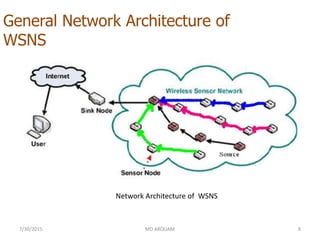
General Network Architecture of
WSNS
7/30/2015 MD ARQUAM 8
Network Architecture of WSNS
General Network Architecture of
WSNS
 The sensor nodes are usually scattered in a sensor field. Each of
these scattered sensor nodes has the capabilities to collect data and
route data back to the sink and the end users.
 Sink Node may be either stationary or mobile.
7/30/2015 MD ARQUAM 9
WSN: Design Challenges in Routing
Protocol
 Unable to maintain global addressing schemes
 Redundant data
 Limited energy, processing and storage
 Application Specific
 Flow of sense data from multiple source
 Location Awareness
7/30/2015 MD ARQUAM 10
With Stationary Sink
 The main aim is to design for energy efficient route setup and reliable
relaying of data from the sensor nodes to the sink so that the lifetime
of the network is maximized.
 Static Sink causes Energy Hole Problem.
7/30/2015 11MD ARQUAM
The Energy Hole Problem
 The sensor node transmits the data directly to the sink, or it relays the
data through neighbor nodes.
 The nodes near to the sink relay more data than other nodes. This
causes the nodes close to BS die out quicker than rest of the nodes.
 The phenomenon known as “energy hole problem” makes the network
unusable in spite of majority of nodes being still live.
7/30/2015 MD ARQUAM 12
With Mobile Sink
 By using mobile sink every time route of data from gateway node
to sink is changed.
 Sensor close to mobile sink depletes less energy and remains alive
longer.
7/30/2015 MD ARQUAM 13
Mobile Sink : Deployment Challenges
 Cost
 Data Collection Strategy
 Mobility Planning
 Random mobility
 fixed mobility,
 Controlled mobility
 Sojourn Locations and sojourn times
 Sojourn Tour
 Number of sinks
7/30/2015 MD ARQUAM 14
Study Objectives
 Imposing delay constraint with mobile sink to increase network life
time.
 Computation of variable sojourn time so that sink stop at the
sojourn location till the data transmission.
7/30/2015 MD ARQUAM 15
LITERATURE SURVEY
7/30/2015 MD ARQUAM 16
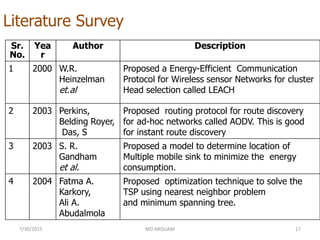
Literature Survey
Sr.
No.
Yea
r
Author Description
1 2000 W.R.
Heinzelman
et.al
Proposed a Energy-Efficient Communication
Protocol for Wireless sensor Networks for cluster
Head selection called LEACH
2 2003 Perkins,
Belding Royer,
Das, S
Proposed routing protocol for route discovery
for ad-hoc networks called AODV. This is good
for instant route discovery
3 2003 S. R.
Gandham
et al.
Proposed a model to determine location of
Multiple mobile sink to minimize the energy
consumption.
4 2004 Fatma A.
Karkory,
Ali A.
Abudalmola
Proposed optimization technique to solve the
TSP using nearest neighbor problem
and minimum spanning tree.
7/30/2015 MD ARQUAM 17
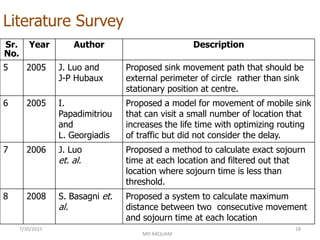
Literature Survey
Sr.
No.
Year Author Description
5 2005 J. Luo and
J-P Hubaux
Proposed sink movement path that should be
external perimeter of circle rather than sink
stationary position at centre.
6 2005 I.
Papadimitriou
and
L. Georgiadis
Proposed a model for movement of mobile sink
that can visit a small number of location that
increases the life time with optimizing routing
of traffic but did not consider the delay.
7 2006 J. Luo
et. al.
Proposed a method to calculate exact sojourn
time at each location and filtered out that
location where sojourn time is less than
threshold.
8 2008 S. Basagni et.
al.
Proposed a system to calculate maximum
distance between two consecutive movement
and sojourn time at each location
7/30/2015
MD ARQUAM
18
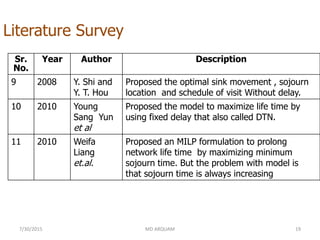
Literature Survey
Sr.
No.
Year Author Description
9 2008 Y. Shi and
Y. T. Hou
Proposed the optimal sink movement , sojourn
location and schedule of visit Without delay.
10 2010 Young
Sang Yun
et al
Proposed the model to maximize life time by
using fixed delay that also called DTN.
11 2010 Weifa
Liang
et.al.
Proposed an MILP formulation to prolong
network life time by maximizing minimum
sojourn time. But the problem with model is
that sojourn time is always increasing
7/30/2015 MD ARQUAM 19
Review Extract
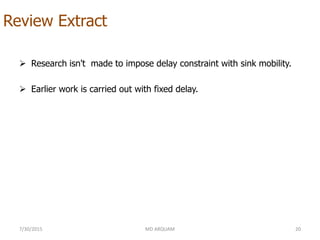
 Research isn't made to impose delay constraint with sink mobility.
 Earlier work is carried out with fixed delay.
7/30/2015 MD ARQUAM 20
Our Contribution
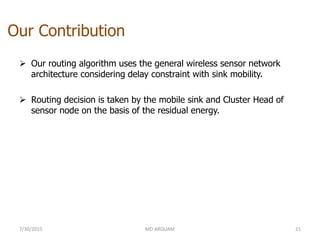
 Our routing algorithm uses the general wireless sensor network
architecture considering delay constraint with sink mobility.
 Routing decision is taken by the mobile sink and Cluster Head of
sensor node on the basis of the residual energy.
7/30/2015 MD ARQUAM 21
PROPOSED WORK
7/30/2015 MD ARQUAM 22
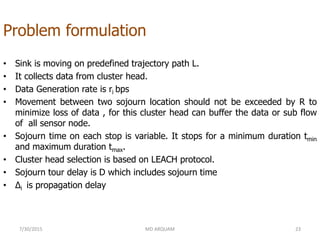
Problem formulation
• Sink is moving on predefined trajectory path L.
• It collects data from cluster head.
• Data Generation rate is ri bps
• Movement between two sojourn location should not be exceeded by R to
minimize loss of data , for this cluster head can buffer the data or sub flow
of all sensor node.
• Sojourn time on each stop is variable. It stops for a minimum duration tmin
and maximum duration tmax.
• Cluster head selection is based on LEACH protocol.
• Sojourn tour delay is D which includes sojourn time
• Δi is propagation delay
7/30/2015 23MD ARQUAM
7/30/2015 MD ARQUAM 24
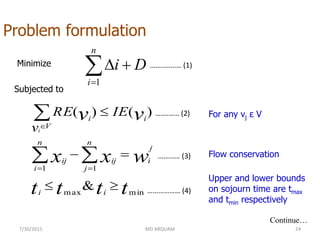
Problem formulation
Minimize
Subjected to


n
i
Di
1
tttt
wxx
vv
ii
j
i
n
j
ij
n
i
ij
ii
V
IE
v
RE
i
minmax
11
&
)()(







Continue…
For any vj ε V
Flow conservation
Upper and lower bounds
on sojourn time are tmax
and tmin respectively
……..……… (1)
…….…… (2)
………… (3)
……………… (4)
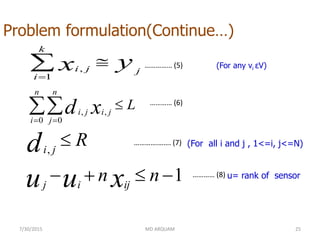
Problem formulation(Continue…)
7/30/2015 25MD ARQUAM
yx j
k
i
ji
1
,
Lxd ji
n
i
n
j
ji
 
,
0 0
,
(For any vi εV)
1
,


nn
R
xuu
d
ijij
ji
(For all i and j , 1<=i, j<=N)
u= rank of sensor
…………… (5)
………… (6)
………….……. (7)
………… (8)
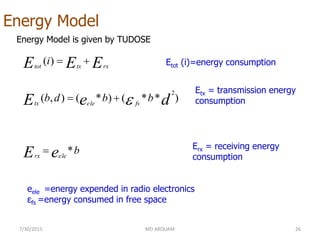
Energy Model
7/30/2015 MD ARQUAM 26
b
bbdb
i
eE
deE
EEE
elerx
fseletx
rxtxtot
*
)**()*(),(
)(
2




Etot (i)=energy consumption
Etx = transmission energy
consumption
Erx = receiving energy
consumption
eele =energy expended in radio electronics
εfs =energy consumed in free space
Energy Model is given by TUDOSE
Solution of Model
 Calculating Optimal Sojourn tour of mobile sink :-Find an optimal
sojourn tour based on Travelling Salesman problem.
Optimal sojourn tour is computed by solving TSP using Nearest
Neighbor problem.
 Computation of Sojourn Time: Mobiroute modified so that data is
collected from all the locations.
7/30/2015 MD ARQUAM 27
Nearest Neighbor problem
It is perhaps the simplest and straightforward TSP heuristic, which is
normally close to the optimal route, and it does not take too much
time to execute. The key to this algorithm is to always visit the
nearest node. Select a starting point, as long as there are nodes
that have not been visited yet, visit the nearest node that still has
not appeared in the tour, and finally return to the starting node.
7/30/2015 MD ARQUAM 28
Nearest Insertion Algorithm
The basics idea of this algorithm is to select the shortest route, and
make a sub tour of it, then select a node that is not in the sub tour,
having the shortest distance to any one of the node in the sub tour.
Find a shortest tour in the sub tour such that the cost of inserting the
selected node between the tour’s nodes will minimal. Repeat the
selection of the node until no more nodes exist
7/30/2015 MD ARQUAM 29
Tour Improvement Algorithms
• The tour construction is a greedy approach based heuristic. The part
of the tour, which is already constructed, remains unchanged during
the tour construction process. No any attempt is made to change
the tour that has been constructed. This is in contrast to the tour
improvement heuristic which changes the configuration of the tour
during the iterative improvement process until a short tour is found
7/30/2015 MD ARQUAM 30
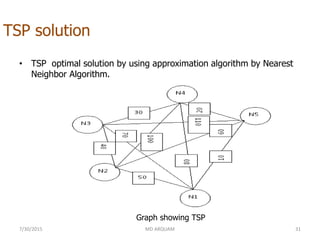
TSP solution
• TSP optimal solution by using approximation algorithm by Nearest
Neighbor Algorithm.
7/30/2015 31MD ARQUAM
Graph showing TSP
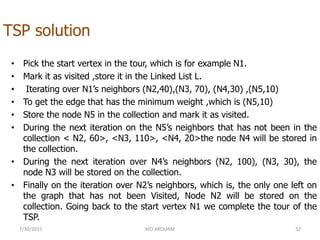
TSP solution
• Pick the start vertex in the tour, which is for example N1.
• Mark it as visited ,store it in the Linked List L.
• Iterating over N1’s neighbors (N2,40),(N3, 70), (N4,30) ,(N5,10)
• To get the edge that has the minimum weight ,which is (N5,10)
• Store the node N5 in the collection and mark it as visited.
• During the next iteration on the N5’s neighbors that has not been in the
collection < N2, 60>, <N3, 110>, <N4, 20>the node N4 will be stored in
the collection.
• During the next iteration over N4’s neighbors (N2, 100), (N3, 30), the
node N3 will be stored on the collection.
• Finally on the iteration over N2’s neighbors, which is, the only one left on
the graph that has not been Visited, Node N2 will be stored on the
collection. Going back to the start vertex N1 we complete the tour of the
TSP.
7/30/2015 MD ARQUAM 32
Calculation of Sojourn Time
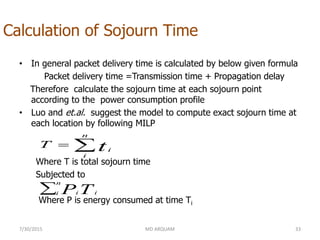
• In general packet delivery time is calculated by below given formula
Packet delivery time =Transmission time + Propagation delay
Therefore calculate the sojourn time at each sojourn point
according to the power consumption profile
• Luo and et.al. suggest the model to compute exact sojourn time at
each location by following MILP
Where T is total sojourn time
Subjected to
Where P is energy consumed at time Ti
7/30/2015 MD ARQUAM 33

n
i
itT

n
i iiTP
Algorithm
7/30/2015 MD ARQUAM 34
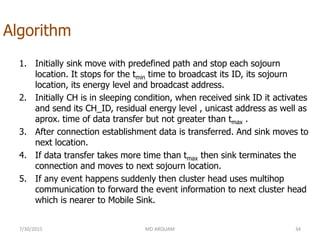
1. Initially sink move with predefined path and stop each sojourn
location. It stops for the tmin time to broadcast its ID, its sojourn
location, its energy level and broadcast address.
2. Initially CH is in sleeping condition, when received sink ID it activates
and send its CH_ID, residual energy level , unicast address as well as
aprox. time of data transfer but not greater than tmax .
3. After connection establishment data is transferred. And sink moves to
next location.
4. If data transfer takes more time than tmax then sink terminates the
connection and moves to next sojourn location.
5. If any event happens suddenly then cluster head uses multihop
communication to forward the event information to next cluster head
which is nearer to Mobile Sink.
SIMULATION and RESULT
7/30/2015 MD ARQUAM 36
Simulation Result
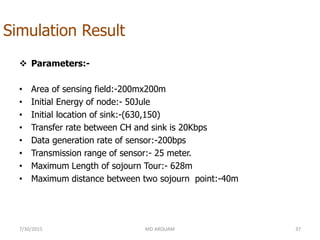
 Parameters:-
• Area of sensing field:-200mx200m
• Initial Energy of node:- 50Jule
• Initial location of sink:-(630,150)
• Transfer rate between CH and sink is 20Kbps
• Data generation rate of sensor:-200bps
• Transmission range of sensor:- 25 meter.
• Maximum Length of sojourn Tour:- 628m
• Maximum distance between two sojourn point:-40m
7/30/2015 MD ARQUAM 37
Comparison of DCRP v/s MILP
Name of Parameter DCRP MILP
Average Throughput[kbps] 197.55 162.03
Average Delay 89.598 287.293
Packet Delivery Ratio 0.9999 0.8084
Total Energy Consumption 204.125 187.049
Avg Energy Consumption 5.1475 6.44996
Overall Residual Energy 1298.47 1262.95
Avg Residual Energy 45.457 43.55
7/30/2015 MD ARQUAM 38
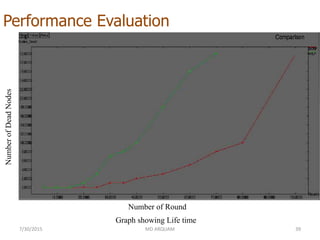
Performance Evaluation
7/30/2015 MD ARQUAM 39
Graph showing Life time
Number of Round
NumberofDeadNodes
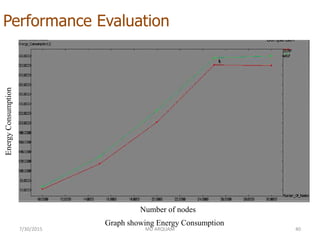
Performance Evaluation
7/30/2015 MD ARQUAM 40
Graph showing Energy Consumption
Number of nodes
EnergyConsumption
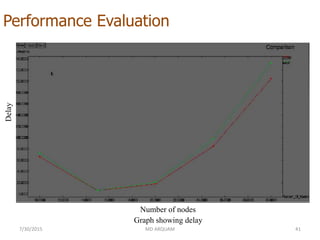
Performance Evaluation
7/30/2015 MD ARQUAM 41
Graph showing delay
Delay
Number of nodes
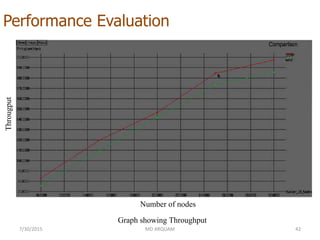
Performance Evaluation
7/30/2015 MD ARQUAM 42
Graph showing Throughput
Number of nodes
Througput
CONCLUSION
7/30/2015 MD ARQUAM 43
Conclusion
• We have stated how to design sojourn tour and use variable sojourn
time to bound delay.
• Experimental results show that the proposed model(DCRP) is better
than MILP.
• We have used the proposed model with clustering with mobile sink,
while earlier work was done by using gateway node.
7/30/2015 MD ARQUAM 44
References
[1] Gupta, C. P., and Arun Kumar. "Wireless Sensor Networks: A
Review."International Journal of Sensors Wireless Communications and
Control 3.1 (2013): 25-36.
[2] Akyildiz, Ian F., et al. "Wireless sensor networks: a survey." Computer
networks 38.4 (2002): 393-422.
[3] Ganesan et.al., Networking issues in wireless sensor networks, J. Parallel
Distrib. Comput. 64 (2004) 799–814.
[4] Ahmed, Nadeem, Salil S. Kanhere, and Sanjay Jha. "The holes problem in
wireless sensor networks: a survey." ACM SIGMOBILE Mobile Computing and
Communications Review 9.2 (2005): 4-18.
[5] Horst F. Wedde and Muddassar Farooq. “A Comprehensive review of nature
inspired routing algorithms for fixed telecommunication networks” Journal of
Systems Architecture, Vol. 52, 2006, pp. 461- 484.
7/30/2015 45MD ARQUAM
References
[6] Luo, Jun, et al. "Mobiroute: Routing towards a mobile sink for improving
lifetime in sensor networks." Distributed Computing in Sensor Systems
(2006): 480-497.
[7] Frederick Ducatelle, Gianni Di Caro and Luca M. Gambardella. “AntHocNet:
An Adaptive Nature-Inspired Algorithm for Routing in Mobile Ad Hoc
Networks”. European Trans. On Telecommunications, Vol. 16, 2005, pp. 443-
455.
[8] Urgaonkar, Rahul, and Bhaskar Krishnamachari. "FLOW: An efficient
forwarding scheme to mobile sink in wireless sensor networks." Proceedings
of ACM SECON (2004).
[9] Song, Liang, and Dimitrios Hatzinakos. "Architecture of wireless sensor
networks with mobile sinks: Sparsely deployed sensors." Vehicular
Technology, IEEE Transactions on 56.4 (2007): 1826- 1836.
7/30/2015 MD ARQUAM 46
References
[10] Li, Xu, Amiya Nayak, and Ivan Stojmenovic. "Sink mobility in wireless
sensor networks." Wireless Sensor and Actuator Networks (2010): 153.
[11] Yang, Tao, et al. "Impact of Mobile Sink for Wireless Sensor Networks
considering Different Radio Models and Performance Metrics." Broadband,
Wireless Computing, Communication and Applications (BWCCA), 2010
International Conference on. IEEE, 2010.
[12] Jordan, Edward, Jinsuk Baek, and Wood Kanampiu. "Impact of mobile
sink for wireless sensor network." Proceedings of the 49th Annual
Southeast Regional Conference. ACM, 2011.
[13] Liu, Wang, et al. "Performance Analysis of Wireless Sensor Networks
With Mobile Sinks." Vehicular Technology, IEEE Transactions on 61.6
(2012): 2777-2788.
7/30/2015 MD ARQUAM 47
References
[14] Rasheed, “Security Schemes for Wireless Sensor Network with Mobile
Sink” PhD Thesis, http://repository.tamu.edu/bitstream/ handle/1969.1/ETD-
TAMU-2010-05-7844/rasheed-dissertation.pdf? Sequence=3.
[15] Jerew, Oday, Kim Blackmore, and Weifa Liang. "Mobile Base Station and
Clustering to Maximize Network Lifetime in Wireless Sensor Networks."
Journal of Electrical and Computer Engineering2012 (2012).
[16] Di Francesco, Mario, Sajal K. Das, and Giuseppe Anastasi. "Data collection
in wireless sensor networks with mobile elements: A survey." ACM
Transactions on Sensor Networks (TOSN) 8.1 (2011): 7.
[17] Majid I. Khan, Wilfried N. Gansterer, Guenter Haring “Static vs. mobile
sink: The influence of basic parameters on energy efficiency in wireless
sensor networks” Computer Communications, Available online 7 November
2012 http://dx.doi.org/10.1016/ j.comcom.2012.10.010
7/30/2015 MD ARQUAM 48
Thank You
7/30/2015 MD ARQUAM 49

Arquam_reportfinal

  • 1.
    Presented by: Md Arquam DelayConstrained Routing Algorithm for WSN with Mobile Sink
  • 2.
    Outline  Introduction  LiteratureSurvey  Proposed Work  Simulation and Result  Conclusion  References 7/30/2015 MD ARQUAM 2
  • 3.
  • 4.
    Sensor Node:Difinition • Asensor node, is a node in a wireless sensor network that is capable of performing some processing, gathering sensory information and communicating with other connected nodes in the network. 7/30/2015 MD ARQUAM 4
  • 5.
    Sensor Characteristics  Lowcomputing capabilities.  Low Memory.  Radio. Low-power. Low data rate. Limited range.  Limited Energy. 7/30/2015 MD ARQUAM 5
  • 6.
    WSN: Definition • Wirelesssensor network (WSN) refers to a group of spatially dispersed and dedicated sensors for monitoring and recording the physical conditions of the environment and organizing the collected data at a central location. 7/30/2015 6MD ARQUAM
  • 7.
    WSN: Design Challenge Scalability  Fault Tolerance  Topology  Hardware Constraint  Transmission Media  Power Consumption  Environment 7/30/2015 MD ARQUAM 7
  • 8.
    General Network Architectureof WSNS 7/30/2015 MD ARQUAM 8 Network Architecture of WSNS
  • 9.
    General Network Architectureof WSNS  The sensor nodes are usually scattered in a sensor field. Each of these scattered sensor nodes has the capabilities to collect data and route data back to the sink and the end users.  Sink Node may be either stationary or mobile. 7/30/2015 MD ARQUAM 9
  • 10.
    WSN: Design Challengesin Routing Protocol  Unable to maintain global addressing schemes  Redundant data  Limited energy, processing and storage  Application Specific  Flow of sense data from multiple source  Location Awareness 7/30/2015 MD ARQUAM 10
  • 11.
    With Stationary Sink The main aim is to design for energy efficient route setup and reliable relaying of data from the sensor nodes to the sink so that the lifetime of the network is maximized.  Static Sink causes Energy Hole Problem. 7/30/2015 11MD ARQUAM
  • 12.
    The Energy HoleProblem  The sensor node transmits the data directly to the sink, or it relays the data through neighbor nodes.  The nodes near to the sink relay more data than other nodes. This causes the nodes close to BS die out quicker than rest of the nodes.  The phenomenon known as “energy hole problem” makes the network unusable in spite of majority of nodes being still live. 7/30/2015 MD ARQUAM 12
  • 13.
    With Mobile Sink By using mobile sink every time route of data from gateway node to sink is changed.  Sensor close to mobile sink depletes less energy and remains alive longer. 7/30/2015 MD ARQUAM 13
  • 14.
    Mobile Sink :Deployment Challenges  Cost  Data Collection Strategy  Mobility Planning  Random mobility  fixed mobility,  Controlled mobility  Sojourn Locations and sojourn times  Sojourn Tour  Number of sinks 7/30/2015 MD ARQUAM 14
  • 15.
    Study Objectives  Imposingdelay constraint with mobile sink to increase network life time.  Computation of variable sojourn time so that sink stop at the sojourn location till the data transmission. 7/30/2015 MD ARQUAM 15
  • 16.
  • 17.
    Literature Survey Sr. No. Yea r Author Description 12000 W.R. Heinzelman et.al Proposed a Energy-Efficient Communication Protocol for Wireless sensor Networks for cluster Head selection called LEACH 2 2003 Perkins, Belding Royer, Das, S Proposed routing protocol for route discovery for ad-hoc networks called AODV. This is good for instant route discovery 3 2003 S. R. Gandham et al. Proposed a model to determine location of Multiple mobile sink to minimize the energy consumption. 4 2004 Fatma A. Karkory, Ali A. Abudalmola Proposed optimization technique to solve the TSP using nearest neighbor problem and minimum spanning tree. 7/30/2015 MD ARQUAM 17
  • 18.
    Literature Survey Sr. No. Year AuthorDescription 5 2005 J. Luo and J-P Hubaux Proposed sink movement path that should be external perimeter of circle rather than sink stationary position at centre. 6 2005 I. Papadimitriou and L. Georgiadis Proposed a model for movement of mobile sink that can visit a small number of location that increases the life time with optimizing routing of traffic but did not consider the delay. 7 2006 J. Luo et. al. Proposed a method to calculate exact sojourn time at each location and filtered out that location where sojourn time is less than threshold. 8 2008 S. Basagni et. al. Proposed a system to calculate maximum distance between two consecutive movement and sojourn time at each location 7/30/2015 MD ARQUAM 18
  • 19.
    Literature Survey Sr. No. Year AuthorDescription 9 2008 Y. Shi and Y. T. Hou Proposed the optimal sink movement , sojourn location and schedule of visit Without delay. 10 2010 Young Sang Yun et al Proposed the model to maximize life time by using fixed delay that also called DTN. 11 2010 Weifa Liang et.al. Proposed an MILP formulation to prolong network life time by maximizing minimum sojourn time. But the problem with model is that sojourn time is always increasing 7/30/2015 MD ARQUAM 19
  • 20.
    Review Extract  Researchisn't made to impose delay constraint with sink mobility.  Earlier work is carried out with fixed delay. 7/30/2015 MD ARQUAM 20
  • 21.
    Our Contribution  Ourrouting algorithm uses the general wireless sensor network architecture considering delay constraint with sink mobility.  Routing decision is taken by the mobile sink and Cluster Head of sensor node on the basis of the residual energy. 7/30/2015 MD ARQUAM 21
  • 22.
  • 23.
    Problem formulation • Sinkis moving on predefined trajectory path L. • It collects data from cluster head. • Data Generation rate is ri bps • Movement between two sojourn location should not be exceeded by R to minimize loss of data , for this cluster head can buffer the data or sub flow of all sensor node. • Sojourn time on each stop is variable. It stops for a minimum duration tmin and maximum duration tmax. • Cluster head selection is based on LEACH protocol. • Sojourn tour delay is D which includes sojourn time • Δi is propagation delay 7/30/2015 23MD ARQUAM
  • 24.
    7/30/2015 MD ARQUAM24 Problem formulation Minimize Subjected to   n i Di 1 tttt wxx vv ii j i n j ij n i ij ii V IE v RE i minmax 11 & )()(        Continue… For any vj ε V Flow conservation Upper and lower bounds on sojourn time are tmax and tmin respectively ……..……… (1) …….…… (2) ………… (3) ……………… (4)
  • 25.
    Problem formulation(Continue…) 7/30/2015 25MDARQUAM yx j k i ji 1 , Lxd ji n i n j ji   , 0 0 , (For any vi εV) 1 ,   nn R xuu d ijij ji (For all i and j , 1<=i, j<=N) u= rank of sensor …………… (5) ………… (6) ………….……. (7) ………… (8)
  • 26.
    Energy Model 7/30/2015 MDARQUAM 26 b bbdb i eE deE EEE elerx fseletx rxtxtot * )**()*(),( )( 2     Etot (i)=energy consumption Etx = transmission energy consumption Erx = receiving energy consumption eele =energy expended in radio electronics εfs =energy consumed in free space Energy Model is given by TUDOSE
  • 27.
    Solution of Model Calculating Optimal Sojourn tour of mobile sink :-Find an optimal sojourn tour based on Travelling Salesman problem. Optimal sojourn tour is computed by solving TSP using Nearest Neighbor problem.  Computation of Sojourn Time: Mobiroute modified so that data is collected from all the locations. 7/30/2015 MD ARQUAM 27
  • 28.
    Nearest Neighbor problem Itis perhaps the simplest and straightforward TSP heuristic, which is normally close to the optimal route, and it does not take too much time to execute. The key to this algorithm is to always visit the nearest node. Select a starting point, as long as there are nodes that have not been visited yet, visit the nearest node that still has not appeared in the tour, and finally return to the starting node. 7/30/2015 MD ARQUAM 28
  • 29.
    Nearest Insertion Algorithm Thebasics idea of this algorithm is to select the shortest route, and make a sub tour of it, then select a node that is not in the sub tour, having the shortest distance to any one of the node in the sub tour. Find a shortest tour in the sub tour such that the cost of inserting the selected node between the tour’s nodes will minimal. Repeat the selection of the node until no more nodes exist 7/30/2015 MD ARQUAM 29
  • 30.
    Tour Improvement Algorithms •The tour construction is a greedy approach based heuristic. The part of the tour, which is already constructed, remains unchanged during the tour construction process. No any attempt is made to change the tour that has been constructed. This is in contrast to the tour improvement heuristic which changes the configuration of the tour during the iterative improvement process until a short tour is found 7/30/2015 MD ARQUAM 30
  • 31.
    TSP solution • TSPoptimal solution by using approximation algorithm by Nearest Neighbor Algorithm. 7/30/2015 31MD ARQUAM Graph showing TSP
  • 32.
    TSP solution • Pickthe start vertex in the tour, which is for example N1. • Mark it as visited ,store it in the Linked List L. • Iterating over N1’s neighbors (N2,40),(N3, 70), (N4,30) ,(N5,10) • To get the edge that has the minimum weight ,which is (N5,10) • Store the node N5 in the collection and mark it as visited. • During the next iteration on the N5’s neighbors that has not been in the collection < N2, 60>, <N3, 110>, <N4, 20>the node N4 will be stored in the collection. • During the next iteration over N4’s neighbors (N2, 100), (N3, 30), the node N3 will be stored on the collection. • Finally on the iteration over N2’s neighbors, which is, the only one left on the graph that has not been Visited, Node N2 will be stored on the collection. Going back to the start vertex N1 we complete the tour of the TSP. 7/30/2015 MD ARQUAM 32
  • 33.
    Calculation of SojournTime • In general packet delivery time is calculated by below given formula Packet delivery time =Transmission time + Propagation delay Therefore calculate the sojourn time at each sojourn point according to the power consumption profile • Luo and et.al. suggest the model to compute exact sojourn time at each location by following MILP Where T is total sojourn time Subjected to Where P is energy consumed at time Ti 7/30/2015 MD ARQUAM 33  n i itT  n i iiTP
  • 34.
    Algorithm 7/30/2015 MD ARQUAM34 1. Initially sink move with predefined path and stop each sojourn location. It stops for the tmin time to broadcast its ID, its sojourn location, its energy level and broadcast address. 2. Initially CH is in sleeping condition, when received sink ID it activates and send its CH_ID, residual energy level , unicast address as well as aprox. time of data transfer but not greater than tmax . 3. After connection establishment data is transferred. And sink moves to next location. 4. If data transfer takes more time than tmax then sink terminates the connection and moves to next sojourn location. 5. If any event happens suddenly then cluster head uses multihop communication to forward the event information to next cluster head which is nearer to Mobile Sink.
  • 35.
  • 36.
    Simulation Result  Parameters:- •Area of sensing field:-200mx200m • Initial Energy of node:- 50Jule • Initial location of sink:-(630,150) • Transfer rate between CH and sink is 20Kbps • Data generation rate of sensor:-200bps • Transmission range of sensor:- 25 meter. • Maximum Length of sojourn Tour:- 628m • Maximum distance between two sojourn point:-40m 7/30/2015 MD ARQUAM 37
  • 37.
    Comparison of DCRPv/s MILP Name of Parameter DCRP MILP Average Throughput[kbps] 197.55 162.03 Average Delay 89.598 287.293 Packet Delivery Ratio 0.9999 0.8084 Total Energy Consumption 204.125 187.049 Avg Energy Consumption 5.1475 6.44996 Overall Residual Energy 1298.47 1262.95 Avg Residual Energy 45.457 43.55 7/30/2015 MD ARQUAM 38
  • 38.
    Performance Evaluation 7/30/2015 MDARQUAM 39 Graph showing Life time Number of Round NumberofDeadNodes
  • 39.
    Performance Evaluation 7/30/2015 MDARQUAM 40 Graph showing Energy Consumption Number of nodes EnergyConsumption
  • 40.
    Performance Evaluation 7/30/2015 MDARQUAM 41 Graph showing delay Delay Number of nodes
  • 41.
    Performance Evaluation 7/30/2015 MDARQUAM 42 Graph showing Throughput Number of nodes Througput
  • 42.
  • 43.
    Conclusion • We havestated how to design sojourn tour and use variable sojourn time to bound delay. • Experimental results show that the proposed model(DCRP) is better than MILP. • We have used the proposed model with clustering with mobile sink, while earlier work was done by using gateway node. 7/30/2015 MD ARQUAM 44
  • 44.
    References [1] Gupta, C.P., and Arun Kumar. "Wireless Sensor Networks: A Review."International Journal of Sensors Wireless Communications and Control 3.1 (2013): 25-36. [2] Akyildiz, Ian F., et al. "Wireless sensor networks: a survey." Computer networks 38.4 (2002): 393-422. [3] Ganesan et.al., Networking issues in wireless sensor networks, J. Parallel Distrib. Comput. 64 (2004) 799–814. [4] Ahmed, Nadeem, Salil S. Kanhere, and Sanjay Jha. "The holes problem in wireless sensor networks: a survey." ACM SIGMOBILE Mobile Computing and Communications Review 9.2 (2005): 4-18. [5] Horst F. Wedde and Muddassar Farooq. “A Comprehensive review of nature inspired routing algorithms for fixed telecommunication networks” Journal of Systems Architecture, Vol. 52, 2006, pp. 461- 484. 7/30/2015 45MD ARQUAM
  • 45.
    References [6] Luo, Jun,et al. "Mobiroute: Routing towards a mobile sink for improving lifetime in sensor networks." Distributed Computing in Sensor Systems (2006): 480-497. [7] Frederick Ducatelle, Gianni Di Caro and Luca M. Gambardella. “AntHocNet: An Adaptive Nature-Inspired Algorithm for Routing in Mobile Ad Hoc Networks”. European Trans. On Telecommunications, Vol. 16, 2005, pp. 443- 455. [8] Urgaonkar, Rahul, and Bhaskar Krishnamachari. "FLOW: An efficient forwarding scheme to mobile sink in wireless sensor networks." Proceedings of ACM SECON (2004). [9] Song, Liang, and Dimitrios Hatzinakos. "Architecture of wireless sensor networks with mobile sinks: Sparsely deployed sensors." Vehicular Technology, IEEE Transactions on 56.4 (2007): 1826- 1836. 7/30/2015 MD ARQUAM 46
  • 46.
    References [10] Li, Xu,Amiya Nayak, and Ivan Stojmenovic. "Sink mobility in wireless sensor networks." Wireless Sensor and Actuator Networks (2010): 153. [11] Yang, Tao, et al. "Impact of Mobile Sink for Wireless Sensor Networks considering Different Radio Models and Performance Metrics." Broadband, Wireless Computing, Communication and Applications (BWCCA), 2010 International Conference on. IEEE, 2010. [12] Jordan, Edward, Jinsuk Baek, and Wood Kanampiu. "Impact of mobile sink for wireless sensor network." Proceedings of the 49th Annual Southeast Regional Conference. ACM, 2011. [13] Liu, Wang, et al. "Performance Analysis of Wireless Sensor Networks With Mobile Sinks." Vehicular Technology, IEEE Transactions on 61.6 (2012): 2777-2788. 7/30/2015 MD ARQUAM 47
  • 47.
    References [14] Rasheed, “SecuritySchemes for Wireless Sensor Network with Mobile Sink” PhD Thesis, http://repository.tamu.edu/bitstream/ handle/1969.1/ETD- TAMU-2010-05-7844/rasheed-dissertation.pdf? Sequence=3. [15] Jerew, Oday, Kim Blackmore, and Weifa Liang. "Mobile Base Station and Clustering to Maximize Network Lifetime in Wireless Sensor Networks." Journal of Electrical and Computer Engineering2012 (2012). [16] Di Francesco, Mario, Sajal K. Das, and Giuseppe Anastasi. "Data collection in wireless sensor networks with mobile elements: A survey." ACM Transactions on Sensor Networks (TOSN) 8.1 (2011): 7. [17] Majid I. Khan, Wilfried N. Gansterer, Guenter Haring “Static vs. mobile sink: The influence of basic parameters on energy efficiency in wireless sensor networks” Computer Communications, Available online 7 November 2012 http://dx.doi.org/10.1016/ j.comcom.2012.10.010 7/30/2015 MD ARQUAM 48
  • 48.