Supporting the Sink Mobility:  a case study for WSN D.Tacconi , I.Carreras, D.Miorandi, I.Chlamtac,   CREATE-NET research centre, Trento, Italy http://forum.toronews.net/viewtopic.php?t=240511&postdays=0&postorder=asc&start=0  F.Chiti, R.Fantacci  DET department, University of Florence
Overview Traditional application of WSNs Why WSN with a Mobile Sink? Examples and Applications Proposed Scenario and System Architecture Simulation Results Future Work and Conclusions
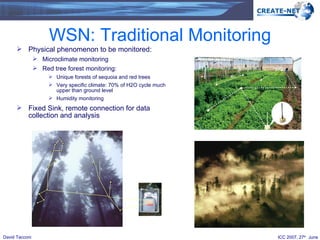
WSN: Traditional Monitoring Physical phenomenon to be monitored: Microclimate monitoring Red tree forest monitoring: Unique forests of sequoia and red trees Very specific climate: 70% of H2O cycle much upper than ground level Humidity monitoring Fixed Sink, remote connection for data collection and analysis
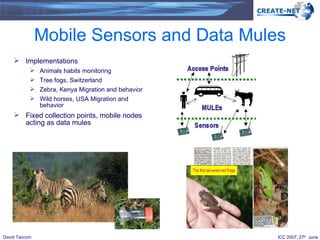
Mobile Sensors and Data Mules Implementations Animals habits monitoring Tree fogs, Switzerland Zebra, Kenya Migration and behavior  Wild horses, USA Migration and behavior Fixed collection points, mobile nodes acting as data mules
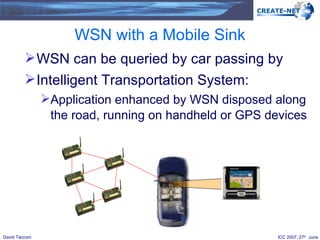
WSN with a Mobile Sink WSN can be queried by car passing by Intelligent Transportation System: Application enhanced by WSN disposed along the road, running on handheld or GPS devices
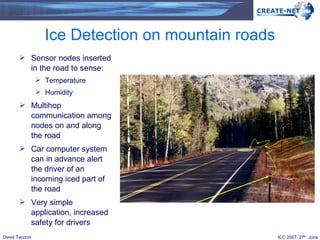
Ice Detection on mountain roads Sensor nodes inserted in the road to sense: Temperature  Humidity Multihop communication among nodes on and along the road Car computer system can in advance alert the driver of an incoming iced part of the road Very simple application, increased safety for drivers
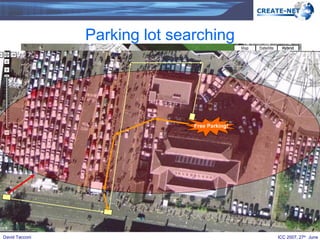
Parking lot searching Free Parking!
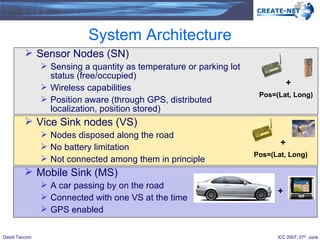
System Architecture Sensor Nodes (SN) Sensing a quantity as temperature or parking lot status (free/occupied) Wireless capabilities Position aware (through GPS, distributed localization, position stored) Vice Sink nodes (VS) Nodes disposed along the road  No battery limitation Not connected among them in principle Mobile Sink (MS) A car passing by on the road Connected with one VS at the time GPS enabled + + Pos=(Lat, Long) + Pos=(Lat, Long)
Geographic Query Forwarding MS injects a  query packet  to the closest VS: Containing  MS   mobility information,  i.e.   position, speed and direction (derived by GPS) Indicating the  target region   with centre coordinates and the maximum radius of interest Query forwarding: The VS starts a Greedy geographic routing toward  target region , by selecting the closest SN to the destination  The previous step is performed by each SN Once the target region is reached, localized flooding strategy performed by node closer to target region centre The node closest to the centre, prepares  Reply packet  toward expected MS position
Adaptive Geographic Forwarding Reply forwarding Same greedy geographic routing toward the  MS expected position The position is adapted step by step according to original  MS   mobility information Once a VS is reached the  replay packet  is: Delivered to MS, if it is in radio range Stored for a given amount of time, waiting for the MS to pass by Forwarded toward the next VS, following MS mobility if it has not passed by
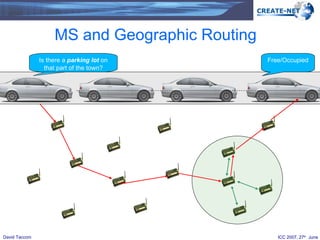
MS and Geographic Routing  Is there a  parking lot  on that part of the town? Free/Occupied
Simulation area: 1000x600 m ² 1  Mobile Sink (MS) moving with random speed among  Vmin and Vmax: Vmin = [10 ÷20] m/s Vmax = [20 ÷35] m/s Nvs  Vice Sinks (VSs) are equally spaced and always disconnected among them: Nvs = [2 ÷20] NxM  Sensor Nodes (SNs) are disposed along a grid and connected to 4 neighbors, with communication radius R=25m: N = 40 M = [1 ÷25] Simulation set up (Omnet++)
Results 1/2 Latency of packets vs. Number of Sensors (N=40, M= [1 ÷25]), Nvs=10, Packet Delivery Ratio (PDR)>90%
Results 2/2 Latency of packets vs. Number of Vice Sinks ( Nvs=[2÷20]),  N=40, M= 25 , Packet Delivery Ratio (PDR)>90%
Results evaluation Latency remains tolerable while increasing mobility and number of SNs: Proposed adaptive geographic routing is scalable Latency is mainly due to the number of hops for packet delivering Increasing mobility results in a smaller Packet Delivery Ratio (PDR), but always above 90% Are disconnections from the network a problem for packet delivering and latency? In simulations, the MS always experiences disconnections from Nvs=2 to Nvs=20 Delay decreases with increased Nvs (less time to look for the MS along the road) Starting from 10 VSs delay do not increase anymore and PDR is always above 90%
Conclusions and Future Work Design of a System Architecture to support Mobile Sink querying a WSN Adaptive geographic routing for packet forwarding Routing technique supports MS disconnection from the network due to mobility Next steps: Different topologies Number of MS>1 More complex mobility patterns Mobility management strategies Energy consumption evaluation Energy aware techniques
Thanks! David Tacconi Research staff member in Pervasive Computing area at CREATE-NET research centre Ph.D. candidate at the University of Florence [email_address] www.create-net.org/~dtacconi

Supporting the Sink mobility: a case study for WSN

  • 1.
    Supporting the SinkMobility: a case study for WSN D.Tacconi , I.Carreras, D.Miorandi, I.Chlamtac, CREATE-NET research centre, Trento, Italy http://forum.toronews.net/viewtopic.php?t=240511&postdays=0&postorder=asc&start=0 F.Chiti, R.Fantacci DET department, University of Florence
  • 2.
    Overview Traditional applicationof WSNs Why WSN with a Mobile Sink? Examples and Applications Proposed Scenario and System Architecture Simulation Results Future Work and Conclusions
  • 3.
    WSN: Traditional MonitoringPhysical phenomenon to be monitored: Microclimate monitoring Red tree forest monitoring: Unique forests of sequoia and red trees Very specific climate: 70% of H2O cycle much upper than ground level Humidity monitoring Fixed Sink, remote connection for data collection and analysis
  • 4.
    Mobile Sensors andData Mules Implementations Animals habits monitoring Tree fogs, Switzerland Zebra, Kenya Migration and behavior Wild horses, USA Migration and behavior Fixed collection points, mobile nodes acting as data mules
  • 5.
    WSN with aMobile Sink WSN can be queried by car passing by Intelligent Transportation System: Application enhanced by WSN disposed along the road, running on handheld or GPS devices
  • 6.
    Ice Detection onmountain roads Sensor nodes inserted in the road to sense: Temperature Humidity Multihop communication among nodes on and along the road Car computer system can in advance alert the driver of an incoming iced part of the road Very simple application, increased safety for drivers
  • 7.
    Parking lot searchingFree Parking!
  • 8.
    System Architecture SensorNodes (SN) Sensing a quantity as temperature or parking lot status (free/occupied) Wireless capabilities Position aware (through GPS, distributed localization, position stored) Vice Sink nodes (VS) Nodes disposed along the road No battery limitation Not connected among them in principle Mobile Sink (MS) A car passing by on the road Connected with one VS at the time GPS enabled + + Pos=(Lat, Long) + Pos=(Lat, Long)
  • 9.
    Geographic Query ForwardingMS injects a query packet to the closest VS: Containing MS mobility information, i.e. position, speed and direction (derived by GPS) Indicating the target region with centre coordinates and the maximum radius of interest Query forwarding: The VS starts a Greedy geographic routing toward target region , by selecting the closest SN to the destination The previous step is performed by each SN Once the target region is reached, localized flooding strategy performed by node closer to target region centre The node closest to the centre, prepares Reply packet toward expected MS position
  • 10.
    Adaptive Geographic ForwardingReply forwarding Same greedy geographic routing toward the MS expected position The position is adapted step by step according to original MS mobility information Once a VS is reached the replay packet is: Delivered to MS, if it is in radio range Stored for a given amount of time, waiting for the MS to pass by Forwarded toward the next VS, following MS mobility if it has not passed by
  • 11.
    MS and GeographicRouting Is there a parking lot on that part of the town? Free/Occupied
  • 12.
    Simulation area: 1000x600m ² 1 Mobile Sink (MS) moving with random speed among Vmin and Vmax: Vmin = [10 ÷20] m/s Vmax = [20 ÷35] m/s Nvs Vice Sinks (VSs) are equally spaced and always disconnected among them: Nvs = [2 ÷20] NxM Sensor Nodes (SNs) are disposed along a grid and connected to 4 neighbors, with communication radius R=25m: N = 40 M = [1 ÷25] Simulation set up (Omnet++)
  • 13.
    Results 1/2 Latencyof packets vs. Number of Sensors (N=40, M= [1 ÷25]), Nvs=10, Packet Delivery Ratio (PDR)>90%
  • 14.
    Results 2/2 Latencyof packets vs. Number of Vice Sinks ( Nvs=[2÷20]), N=40, M= 25 , Packet Delivery Ratio (PDR)>90%
  • 15.
    Results evaluation Latencyremains tolerable while increasing mobility and number of SNs: Proposed adaptive geographic routing is scalable Latency is mainly due to the number of hops for packet delivering Increasing mobility results in a smaller Packet Delivery Ratio (PDR), but always above 90% Are disconnections from the network a problem for packet delivering and latency? In simulations, the MS always experiences disconnections from Nvs=2 to Nvs=20 Delay decreases with increased Nvs (less time to look for the MS along the road) Starting from 10 VSs delay do not increase anymore and PDR is always above 90%
  • 16.
    Conclusions and FutureWork Design of a System Architecture to support Mobile Sink querying a WSN Adaptive geographic routing for packet forwarding Routing technique supports MS disconnection from the network due to mobility Next steps: Different topologies Number of MS>1 More complex mobility patterns Mobility management strategies Energy consumption evaluation Energy aware techniques
  • 17.
    Thanks! David TacconiResearch staff member in Pervasive Computing area at CREATE-NET research centre Ph.D. candidate at the University of Florence [email_address] www.create-net.org/~dtacconi