
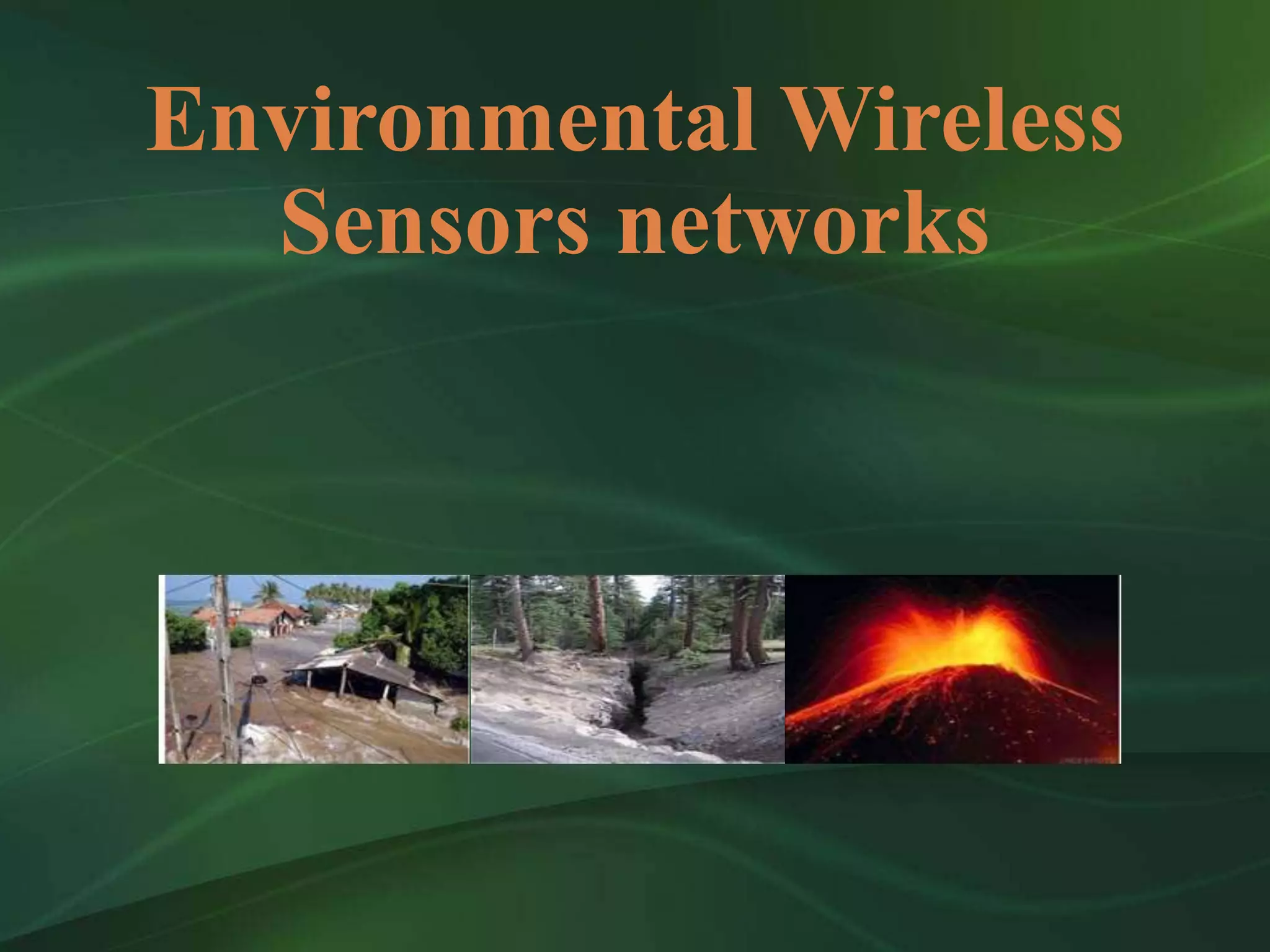



Environmental Wireless
Sensors networks
Le plan du trvail est comme ci-dessous:
Security in wireless sensors
networks
Enviremental control &
monotring
conclusion
WSN for Environmental
Monitoring
Wireless sensor network
 definition:
Environmental monitoring describes the processes and
activities that need to take place to characterize and
monitor the quality of the environment.
Environnemental control & monitoring
Wireless sensor network
 definition
A wireless sensor network (WSN) consists of spatially
distributed autonomous sensors to monitor physical or
environmental conditions, such
as temperature, sound, pressure, etc. and to cooperatively
pass their data through the network to a main location.
Wireless sensor network
 Advantage of WSN:
•Provide a bridge between the real physical and virtual
worlds.
•Allow the ability to observe the previously unobservable at a
fine resolution over large spatiotemporal scales.
•Have a wide range of potential applications to industry
science, transportation, civil infrastructure and security.
Wireless sensor network
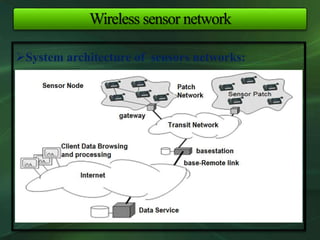
System architecture of sensors networks:
Wireless sensor network
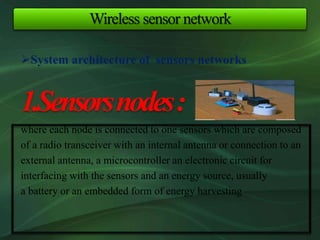
System architecture of sensors networks
1.Sensorsnodes:
where each node is connected to one sensors which are composed
of a radio transceiver with an internal antenna or connection to an
external antenna, a microcontroller an electronic circuit for
interfacing with the sensors and an energy source, usually
a battery or an embedded form of energy harvesting
This node processes and translates all the information sent by the
sensor nodes to make it compatible with the application running
on user’s computer.
Wireless sensor network
*Consume low power
*Autonomous
*Operate in high volumetric densities
*Adaptive to environment
*Cheap
Wireless sensor network
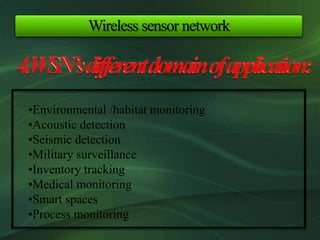
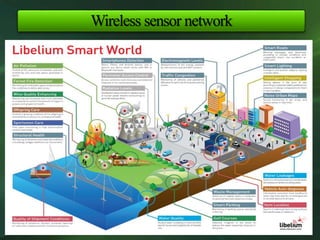
•Environmental /habitat monitoring
•Acoustic detection
•Seismic detection
•Military surveillance
•Inventory tracking
•Medical monitoring
•Smart spaces
•Process monitoring
Wireless sensor network
Introduction
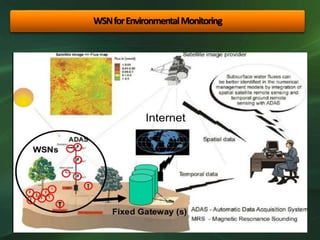
Wireless sensors networks and environmental care have
been always very close to each other, either because they
have been evolving alongside one another during the last
decade or because WSN features seem to suit very well
into the environmental evaluation requirements and When
talking about environmental applications for WSNs
WSNforEnvironmentalMonitoring
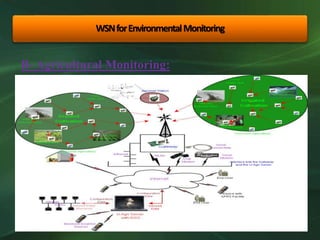
A-Agricultural Monitoring:
Agricultural monitoring always focuses mostly on
farming area.
it is important to have a monitoring system to monitor
animal behavior and produce a report regarding their
health or behavior in real-time system
WSNforEnvironmentalMonitoring
B- Agricultural Monitoring:
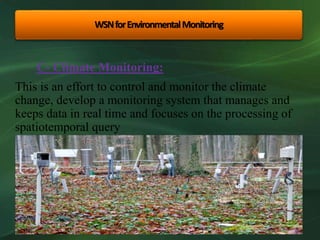
This is an effort to control and monitor the climate
change, develop a monitoring system that manages and
keeps data in real time and focuses on the processing of
spatiotemporal query
C- Climate Monitoring:
WSNforEnvironmentalMonitoring
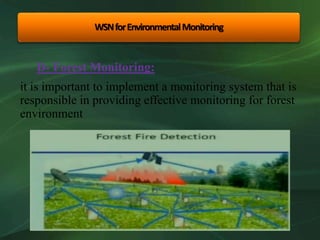
it is important to implement a monitoring system that is
responsible in providing effective monitoring for forest
environment
WSNforEnvironmentalMonitoring
D- Forest Monitoring:
1/Based On the Capability of the Attacker :
1.1/Outsider versus insider (node compromise)attacks
1.2/Passive versus active attacks
1.3/Mote-class versus laptop-class attacks
1.4/Mote-class versus laptop-class attacks
2/Attacks on Information in Transit :
2.1/Interruption
2.2/Interception
2.3/Modification
2.4/Fabrication
2.5/Replaying existing messages
3/Host Based Vs Network Based
Host-based attacks
Network-based attacks
Securityinwirelesssensorsnetworks
Type of attacks:
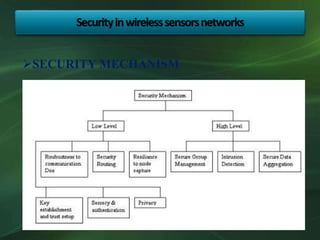
SECURITY MECHANISM
Securityinwirelesssensorsnetworks

Environmental wireless sensors networks

  • 1.
  • 2.
    Le plan dutrvail est comme ci-dessous: Security in wireless sensors networks Enviremental control & monotring conclusion WSN for Environmental Monitoring Wireless sensor network
  • 3.
     definition: Environmental monitoringdescribes the processes and activities that need to take place to characterize and monitor the quality of the environment. Environnemental control & monitoring
  • 4.
    Wireless sensor network definition A wireless sensor network (WSN) consists of spatially distributed autonomous sensors to monitor physical or environmental conditions, such as temperature, sound, pressure, etc. and to cooperatively pass their data through the network to a main location.
  • 5.
    Wireless sensor network Advantage of WSN: •Provide a bridge between the real physical and virtual worlds. •Allow the ability to observe the previously unobservable at a fine resolution over large spatiotemporal scales. •Have a wide range of potential applications to industry science, transportation, civil infrastructure and security.
  • 6.
    Wireless sensor network Systemarchitecture of sensors networks:
  • 7.
    Wireless sensor network Systemarchitecture of sensors networks 1.Sensorsnodes: where each node is connected to one sensors which are composed of a radio transceiver with an internal antenna or connection to an external antenna, a microcontroller an electronic circuit for interfacing with the sensors and an energy source, usually a battery or an embedded form of energy harvesting
  • 8.
    This node processesand translates all the information sent by the sensor nodes to make it compatible with the application running on user’s computer. Wireless sensor network
  • 9.
    Wireless sensor network *Consumelow power *Autonomous *Operate in high volumetric densities *Adaptive to environment *Cheap
  • 10.
    Wireless sensor network •Environmental/habitat monitoring •Acoustic detection •Seismic detection •Military surveillance •Inventory tracking •Medical monitoring •Smart spaces •Process monitoring
  • 11.
  • 12.
    Introduction Wireless sensors networksand environmental care have been always very close to each other, either because they have been evolving alongside one another during the last decade or because WSN features seem to suit very well into the environmental evaluation requirements and When talking about environmental applications for WSNs WSNforEnvironmentalMonitoring
  • 13.
  • 14.
    WSNforEnvironmentalMonitoring A-Agricultural Monitoring: Agricultural monitoringalways focuses mostly on farming area. it is important to have a monitoring system to monitor animal behavior and produce a report regarding their health or behavior in real-time system
  • 15.
  • 16.
    This is aneffort to control and monitor the climate change, develop a monitoring system that manages and keeps data in real time and focuses on the processing of spatiotemporal query C- Climate Monitoring: WSNforEnvironmentalMonitoring
  • 17.
    it is importantto implement a monitoring system that is responsible in providing effective monitoring for forest environment WSNforEnvironmentalMonitoring D- Forest Monitoring:
  • 18.
    1/Based On theCapability of the Attacker : 1.1/Outsider versus insider (node compromise)attacks 1.2/Passive versus active attacks 1.3/Mote-class versus laptop-class attacks 1.4/Mote-class versus laptop-class attacks 2/Attacks on Information in Transit : 2.1/Interruption 2.2/Interception 2.3/Modification 2.4/Fabrication 2.5/Replaying existing messages 3/Host Based Vs Network Based Host-based attacks Network-based attacks Securityinwirelesssensorsnetworks Type of attacks:
  • 19.