LET ME TAKE YOU TO THE WORD OF FUTURE POWER
WELCOME TO FUTURE
WIRELESS POWER TRANSMISSION
Presented by
ALAPATI BHARADWAJ KRISHNA
111517106003
ELECTRONICS AND COMMUNICATION
ENGINEERING
R.M.D.ENGINNEERING COLLEGE
SO
WIRELESS POWER
TRANSMISIION
WHAT IS
WIRELESS POWER
TRANSMISSION?
WHY IS WPT?
TYPES OF WPT?
ADVANTAGES
AND
DISADVANTAGES
APPLICATIONS
CONCLUSION
AND
REFERENCES
1. The transmission of energy from one place to another without using wires
2.. Conventional energy transfer is using wires.
3. But, the wireless transmission is made possible by using various technologies…
WHY NOT WIRES?
As per studies, most electrical energy transfer is through wires.
Most of the energy loss is during transmission
• On an average, more than 30%
• In India, it exceeds 40%
WHY WPT?
Reliable
Efficient
Fast
Low maintenance cost
Can be used for short-range or long-range.
Nikola Tesla in late 1890s
Pioneer of induction techniques
His vision for “World Wireless System”
The 187 feet tall tower to broadcast energy
All people can have access to free energy
Due to shortage of funds, tower did not operate
Tesla was able to transfer energy from one coil to another coil
He managed to light 200 lamps from a distance of 40km
The idea of Tesla is taken in to research after 100 years by a team led by Marin Soljačić from MIT.
The project is named as „WiTricity‟.
Near-field techniques
Inductive Coupling
Resonant Inductive Coupling
Air Ionization
Far-field techniques
Microwave Power Transmission (MPT)
LASER power transmission
Types and Technologies of WPT
INDUCTIVE COUPLING
Primary and secondary coils are not connected with wires.
Energy transfer is due to Mutual InductionTransformer is also an example Energy transfer devices are usually
aircored Wireless Charging Pad(WCP),electric brushes are some examples
On a WCP, the devices are to be kept, battery will be automatically charged. Less use of wires
Shock proof
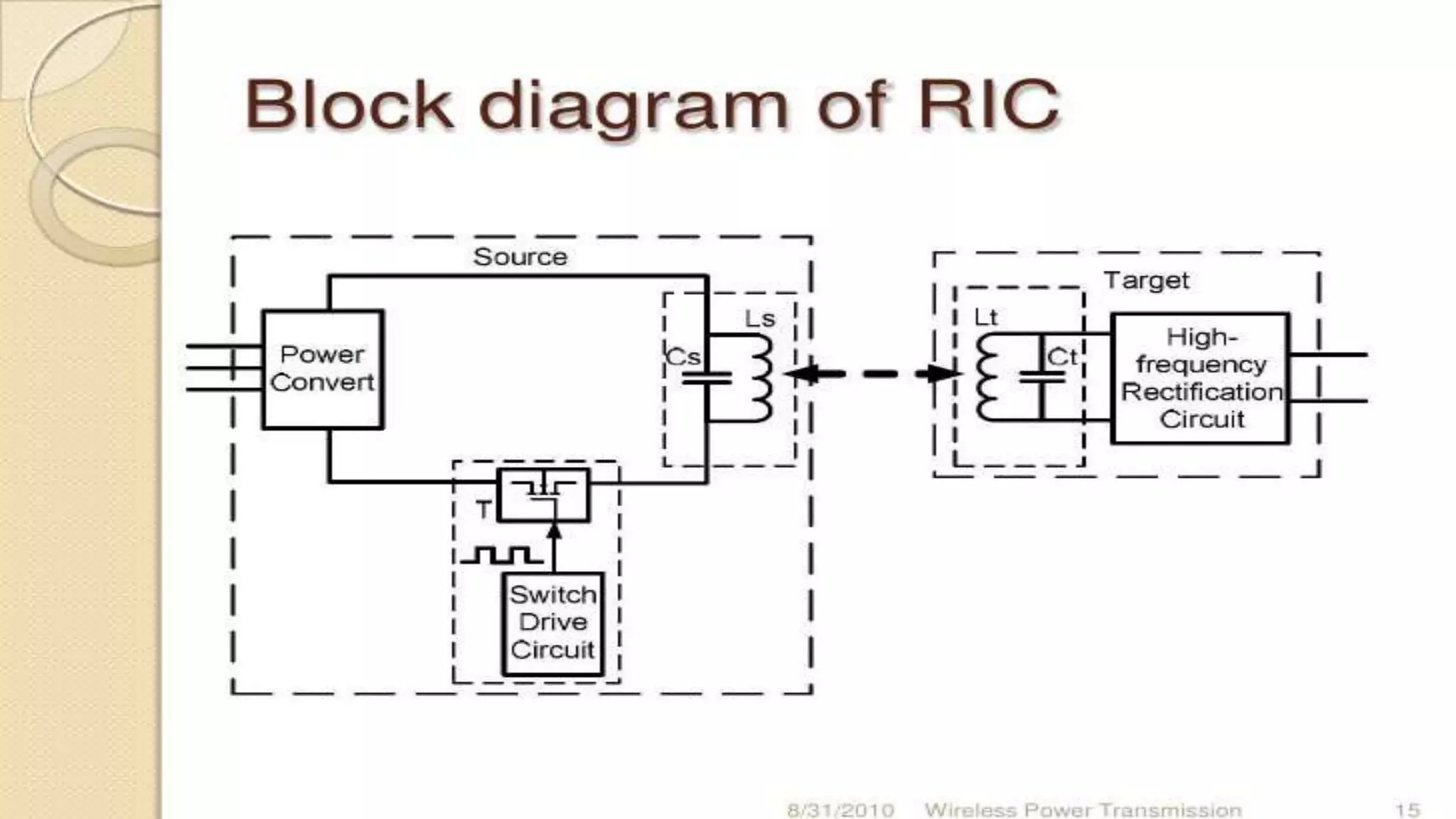
RESONANCE INDUCTIVE COUPLING (RIC)
Combination of inductive coupling and resonance
Resonance makes two objects interact very strongly
Inductance induces current
Toughest technique under near-field energy transfer techniques
Air ionizes only when there is a high field
Needed field is 2.11MV/m
Natural example: Lightening
Not feasible for practical implementation
Radiative
Needs line-of-sight
LASER or microwave
Aims at high power transfer
Tesla‟s tower was built for this
Transfers high power from one place to another. Two places being in line of sight usually
Steps:
◦ Electrical energy to microwave energy
◦ Capturing microwaves using rectenna
◦ Microwave energy to electrical energy AC can not be directly converted to microwave energy
AC is converted to DC first
DC is converted to microwaves using magnetron
Transmitted waves are received at rectenna which rectifies, gives DC as the output
DC is converted back to AC
LASER is highly directional, coherent
Not dispersed for very long
But, gets attenuated when it propagates through atmosphere
Simple receiver
◦ Photovoltaic cell
Cost-efficient
APPLICATIONSNear-field energy transfer
◦ Electric automobile charging
Static and moving
◦ Consumer electronics
◦ Industrial purposes
Harsh environmentFar-field energy transfer
◦ Solar Power Satellites
◦ Energy to remote areas
◦ Can broadcast energy globally (in future)
ADVANTAGES
DIS-ADVANTAGES
Reach
The initial investment to be high
Reduced power failure
Low efficiency over long distances
Reducing the losses
Security
Almost no maintenance
Interference
Easy installation
A clear line of sight
Economic
Causing damage to tissues of human and
other living organisms
CONCLUSION
Transmission without wires- a reality
Efficient
Low maintenance cost. But, high initial cost
Better than conventional wired transfer
Energy crisis can be decreased
Low loss
In near future, world will be completely wireless
ReferencesS. Sheik Mohammed, K. Ramasamy, T. Shanmuganantham,” Wireless power transmission – a next
generation power transmission system”, International Journal of Computer Applications (0975 – 8887)
(Volume 1 – No. 13) Peter Vaessen,” Wireless Power Transmission”, Leonardo Energy, September 2009
C.C. Leung, T.P. Chan, K.C. Lit, K.W. Tam and Lee Yi Chow, “Wireless Power Transmission and Charging
David Schneider, “Electrons unplugged”, IEEE Spectrum, May 2010 Shahrzad Jalali Mazlouman,
Mahanfar, Bozena Kaminska, “Mid-range Wireless Energy Transfer Using Inductive Resonance for
Sensors” Chunbo Zhu, Kai Liu, Chunlai Yu, Rui Ma, Hexiao Cheng, “Simulation and Experimental
on Wireless Energy Transfer Based on Magnetic Resonances”, IEEE Vehicle Power and Propulsion
Conference (VPPC), September 3-5, 2008
WIRELESS POWER TRANSMISSION TECHNOLOGY

WIRELESS POWER TRANSMISSION TECHNOLOGY

  • 1.
    LET ME TAKEYOU TO THE WORD OF FUTURE POWER WELCOME TO FUTURE
  • 2.
    WIRELESS POWER TRANSMISSION Presentedby ALAPATI BHARADWAJ KRISHNA 111517106003 ELECTRONICS AND COMMUNICATION ENGINEERING R.M.D.ENGINNEERING COLLEGE
  • 3.
    SO WIRELESS POWER TRANSMISIION WHAT IS WIRELESSPOWER TRANSMISSION? WHY IS WPT? TYPES OF WPT? ADVANTAGES AND DISADVANTAGES APPLICATIONS CONCLUSION AND REFERENCES
  • 4.
    1. The transmissionof energy from one place to another without using wires 2.. Conventional energy transfer is using wires. 3. But, the wireless transmission is made possible by using various technologies…
  • 5.
    WHY NOT WIRES? Asper studies, most electrical energy transfer is through wires. Most of the energy loss is during transmission • On an average, more than 30% • In India, it exceeds 40%
  • 6.
    WHY WPT? Reliable Efficient Fast Low maintenancecost Can be used for short-range or long-range.
  • 7.
    Nikola Tesla inlate 1890s Pioneer of induction techniques His vision for “World Wireless System” The 187 feet tall tower to broadcast energy All people can have access to free energy Due to shortage of funds, tower did not operate Tesla was able to transfer energy from one coil to another coil He managed to light 200 lamps from a distance of 40km The idea of Tesla is taken in to research after 100 years by a team led by Marin Soljačić from MIT. The project is named as „WiTricity‟.
  • 8.
    Near-field techniques Inductive Coupling ResonantInductive Coupling Air Ionization Far-field techniques Microwave Power Transmission (MPT) LASER power transmission Types and Technologies of WPT
  • 9.
    INDUCTIVE COUPLING Primary andsecondary coils are not connected with wires. Energy transfer is due to Mutual InductionTransformer is also an example Energy transfer devices are usually aircored Wireless Charging Pad(WCP),electric brushes are some examples On a WCP, the devices are to be kept, battery will be automatically charged. Less use of wires Shock proof
  • 10.
    RESONANCE INDUCTIVE COUPLING(RIC) Combination of inductive coupling and resonance Resonance makes two objects interact very strongly Inductance induces current
  • 12.
    Toughest technique undernear-field energy transfer techniques Air ionizes only when there is a high field Needed field is 2.11MV/m Natural example: Lightening Not feasible for practical implementation
  • 13.
    Radiative Needs line-of-sight LASER ormicrowave Aims at high power transfer Tesla‟s tower was built for this
  • 14.
    Transfers high powerfrom one place to another. Two places being in line of sight usually Steps: ◦ Electrical energy to microwave energy ◦ Capturing microwaves using rectenna ◦ Microwave energy to electrical energy AC can not be directly converted to microwave energy AC is converted to DC first DC is converted to microwaves using magnetron Transmitted waves are received at rectenna which rectifies, gives DC as the output DC is converted back to AC
  • 15.
    LASER is highlydirectional, coherent Not dispersed for very long But, gets attenuated when it propagates through atmosphere Simple receiver ◦ Photovoltaic cell Cost-efficient
  • 16.
    APPLICATIONSNear-field energy transfer ◦Electric automobile charging Static and moving ◦ Consumer electronics ◦ Industrial purposes Harsh environmentFar-field energy transfer ◦ Solar Power Satellites ◦ Energy to remote areas ◦ Can broadcast energy globally (in future)
  • 17.
    ADVANTAGES DIS-ADVANTAGES Reach The initial investmentto be high Reduced power failure Low efficiency over long distances Reducing the losses Security Almost no maintenance Interference Easy installation A clear line of sight Economic Causing damage to tissues of human and other living organisms
  • 18.
    CONCLUSION Transmission without wires-a reality Efficient Low maintenance cost. But, high initial cost Better than conventional wired transfer Energy crisis can be decreased Low loss In near future, world will be completely wireless
  • 19.
    ReferencesS. Sheik Mohammed,K. Ramasamy, T. Shanmuganantham,” Wireless power transmission – a next generation power transmission system”, International Journal of Computer Applications (0975 – 8887) (Volume 1 – No. 13) Peter Vaessen,” Wireless Power Transmission”, Leonardo Energy, September 2009 C.C. Leung, T.P. Chan, K.C. Lit, K.W. Tam and Lee Yi Chow, “Wireless Power Transmission and Charging David Schneider, “Electrons unplugged”, IEEE Spectrum, May 2010 Shahrzad Jalali Mazlouman, Mahanfar, Bozena Kaminska, “Mid-range Wireless Energy Transfer Using Inductive Resonance for Sensors” Chunbo Zhu, Kai Liu, Chunlai Yu, Rui Ma, Hexiao Cheng, “Simulation and Experimental on Wireless Energy Transfer Based on Magnetic Resonances”, IEEE Vehicle Power and Propulsion Conference (VPPC), September 3-5, 2008