Presented by-
Anushreya Gupta
1309020020
Branch:- Electrical Engineering
Wireless
Electricity
 Introduction
 What is WiTricity??
 Principle
 Working
 Advantages
 Some other methods of
wireless power transfer
 Future applications
 Conclusions
Computers, cell phones, laptops, iPods, etc.
are all used by many of us in our daily lives.
These devices have become an inherent part
of our day-to-day lives.
But charging all these appliances has become
so very cumbersome. Each appliance has its
own set of chargers, and with every family
member owning their cell phones, the
drawers are overflowing with all sorts of
wires.
How many times have you wished if there
could be some way to do away with all the
wiry litter?
The answer is WiTricity
•WiTricity is nothing but wireless electricity.
Transmission of electrical energy from one
object to another without the use of wires is
called as WiTricity.
•WiTricity will ensure that the cell phones,
laptops, and other power hungry devices get
charged on their own, eliminating the need of
plugging them in.
•Even better, because of WiTricity some of the
devices won't require batteries to operate.
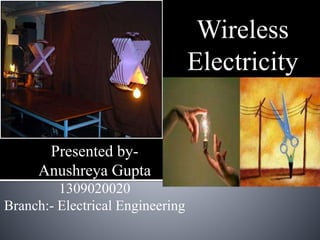
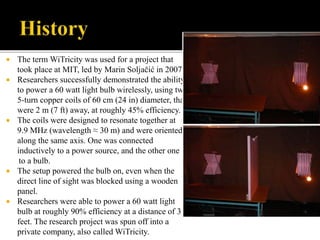
 The term WiTricity was used for a project that
took place at MIT, led by Marin Soljačić in 2007.
 Researchers successfully demonstrated the ability
to power a 60 watt light bulb wirelessly, using two
5-turn copper coils of 60 cm (24 in) diameter, that
were 2 m (7 ft) away, at roughly 45% efficiency.
 The coils were designed to resonate together at
9.9 MHz (wavelength ≈ 30 m) and were oriented
along the same axis. One was connected
inductively to a power source, and the other one
to a bulb.
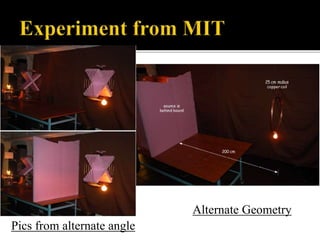
 The setup powered the bulb on, even when the
direct line of sight was blocked using a wooden
panel.
 Researchers were able to power a 60 watt light
bulb at roughly 90% efficiency at a distance of 3
feet. The research project was spun off into a
private company, also called WiTricity.
Pics from alternate angle
Alternate Geometry
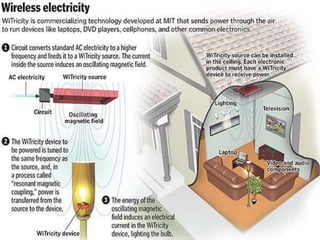
 Based on strong coupling between
electromagnetic resonant objects also called
“Resonant Magnetic Coupling”
 Transmitter and receiver coils oscillate or
“resonate” at the same “frequency”.
 Resonant frequency is the natural frequency of
an object.
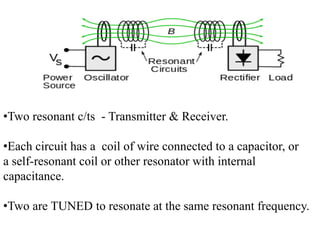
•Two resonant c/ts - Transmitter & Receiver.
•Each circuit has a coil of wire connected to a capacitor, or
a self-resonant coil or other resonator with internal
capacitance.
•Two are TUNED to resonate at the same resonant frequency.
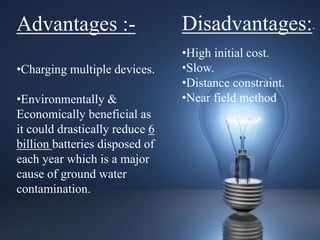
Advantages :-
•Charging multiple devices.
•Environmentally &
Economically beneficial as
it could drastically reduce 6
billion batteries disposed of
each year which is a major
cause of ground water
contamination.
Disadvantages:-
•High initial cost.
•Slow.
•Distance constraint.
•Near field method
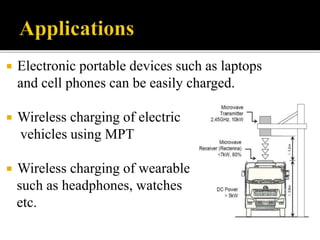
 Electronic portable devices such as laptops
and cell phones can be easily charged.
 Wireless charging of electric
vehicles using MPT
 Wireless charging of wearables
such as headphones, watches
etc.
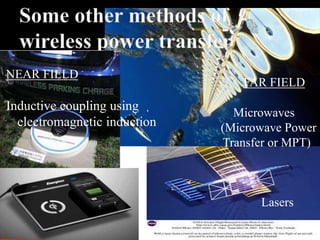
FAR FIELD
Microwaves
(Microwave Power
Transfer or MPT)
Lasers
NEAR FIELD
Inductive coupling using
electromagnetic induction
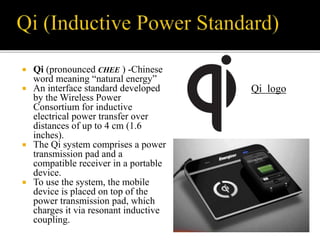
 Qi (pronounced CHEE ) -Chinese
word meaning “natural energy”
 An interface standard developed
by the Wireless Power
Consortium for inductive
electrical power transfer over
distances of up to 4 cm (1.6
inches).
 The Qi system comprises a power
transmission pad and a
compatible receiver in a portable
device.
 To use the system, the mobile
device is placed on top of the
power transmission pad, which
charges it via resonant inductive
coupling.
Qi logo
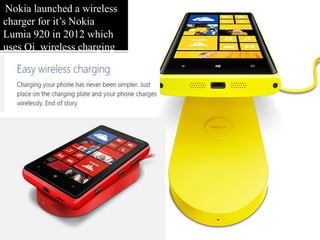
Nokia launched a wireless
charger for it’s Nokia
Lumia 920 in 2012 which
uses Qi wireless charging
standard
• Transmission without wires- a reality.
• Efficient.
• Low maintenance cost. But, high initial cost.
• Better than conventional wired transfer.
• Energy crisis can be decreased.
• Low loss .
• In near future, world will be completely
wireless.
Wireless electricity

Wireless electricity

  • 1.
    Presented by- Anushreya Gupta 1309020020 Branch:-Electrical Engineering Wireless Electricity
  • 2.
     Introduction  Whatis WiTricity??  Principle  Working  Advantages  Some other methods of wireless power transfer  Future applications  Conclusions
  • 3.
    Computers, cell phones,laptops, iPods, etc. are all used by many of us in our daily lives. These devices have become an inherent part of our day-to-day lives. But charging all these appliances has become so very cumbersome. Each appliance has its own set of chargers, and with every family member owning their cell phones, the drawers are overflowing with all sorts of wires. How many times have you wished if there could be some way to do away with all the wiry litter? The answer is WiTricity
  • 4.
    •WiTricity is nothingbut wireless electricity. Transmission of electrical energy from one object to another without the use of wires is called as WiTricity. •WiTricity will ensure that the cell phones, laptops, and other power hungry devices get charged on their own, eliminating the need of plugging them in. •Even better, because of WiTricity some of the devices won't require batteries to operate.
  • 5.
     The termWiTricity was used for a project that took place at MIT, led by Marin Soljačić in 2007.  Researchers successfully demonstrated the ability to power a 60 watt light bulb wirelessly, using two 5-turn copper coils of 60 cm (24 in) diameter, that were 2 m (7 ft) away, at roughly 45% efficiency.  The coils were designed to resonate together at 9.9 MHz (wavelength ≈ 30 m) and were oriented along the same axis. One was connected inductively to a power source, and the other one to a bulb.  The setup powered the bulb on, even when the direct line of sight was blocked using a wooden panel.  Researchers were able to power a 60 watt light bulb at roughly 90% efficiency at a distance of 3 feet. The research project was spun off into a private company, also called WiTricity.
  • 6.
    Pics from alternateangle Alternate Geometry
  • 7.
     Based onstrong coupling between electromagnetic resonant objects also called “Resonant Magnetic Coupling”  Transmitter and receiver coils oscillate or “resonate” at the same “frequency”.  Resonant frequency is the natural frequency of an object.
  • 8.
    •Two resonant c/ts- Transmitter & Receiver. •Each circuit has a coil of wire connected to a capacitor, or a self-resonant coil or other resonator with internal capacitance. •Two are TUNED to resonate at the same resonant frequency.
  • 11.
    Advantages :- •Charging multipledevices. •Environmentally & Economically beneficial as it could drastically reduce 6 billion batteries disposed of each year which is a major cause of ground water contamination. Disadvantages:- •High initial cost. •Slow. •Distance constraint. •Near field method
  • 12.
     Electronic portabledevices such as laptops and cell phones can be easily charged.  Wireless charging of electric vehicles using MPT  Wireless charging of wearables such as headphones, watches etc.
  • 13.
    FAR FIELD Microwaves (Microwave Power Transferor MPT) Lasers NEAR FIELD Inductive coupling using electromagnetic induction
  • 14.
     Qi (pronouncedCHEE ) -Chinese word meaning “natural energy”  An interface standard developed by the Wireless Power Consortium for inductive electrical power transfer over distances of up to 4 cm (1.6 inches).  The Qi system comprises a power transmission pad and a compatible receiver in a portable device.  To use the system, the mobile device is placed on top of the power transmission pad, which charges it via resonant inductive coupling. Qi logo
  • 15.
    Nokia launched awireless charger for it’s Nokia Lumia 920 in 2012 which uses Qi wireless charging standard
  • 16.
    • Transmission withoutwires- a reality. • Efficient. • Low maintenance cost. But, high initial cost. • Better than conventional wired transfer. • Energy crisis can be decreased. • Low loss . • In near future, world will be completely wireless.

Editor's Notes

  • #4 When you are on the way to work and your cellphone beeps in hunger for a battery charge, haven't you wished for your cellphone battery to get 'self charged'.
  • #6 The term WiTricity was used for a project that took place at MIT, led by Marin Soljačić in 2007. The MIT researchers successfully demonstrated the ability to power a 60 watt light bulb wirelessly, using two 5-turn copper coils of 60 cm (24 in) diameter, that were 2 m (7 ft) away, at roughly 45% efficiency. The coils were designed to resonate together at 9.9 MHz (wavelength ≈ 30 m) and were oriented along the same axis. One was connected inductively to a power source, and the other one to a bulb. The setup powered the bulb on, even when the direct line of sight was blocked using a wooden panel. Researchers were able to power a 60 watt light bulb at roughly 90% efficiency at a distance of 3 feet. The research project was spun off into a private company, also called WiTricity.
  • #13 MPT- microwave Power Transfer
  • #14 Microwave- An artist's depiction of a solar satellite that could send electric energy by microwaves to a space vessel or planetary surface. Laser- With a laser beam centered on its panel of photovoltaic cells, a lightweight model plane makes the first flight of an aircraft powered by a laser beam inside a building at NASA Marshall Space Flight Center