Wireless Power Transmission
Techniques
Presented by
A.Anantha Babu,
Master of Engineering,
Dept of Computer Science and Engineering,
Anna University Regoinal Campus,
Coimbatore.
Introduction
The transmission of energy from one
place to another without using wires
Conventional energy transfer is using
wires
But, the wireless transmission is made
possible by using various technologies
Wireless Power Transmission 2
Why not wires?
As per studies, most electrical energy
transfer is through wires.
Most of the energy loss is during
transmission
• On an average, more than 30%
• In India, it exceeds 40%
19/04/17 Wireless Power Transmission 3
Objective
Reliable
Efficient
Fast
Low maintenance cost
Can be used for short-range or
long-range.
19/04/17 Wireless Power Transmission 4
History
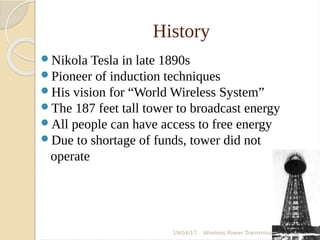
Nikola Tesla in late 1890s
Pioneer of induction techniques
His vision for “World Wireless System”
The 187 feet tall tower to broadcast energy
All people can have access to free energy
Due to shortage of funds, tower did not
operate
19/04/17 Wireless Power Transmission 5
History (contd…)
Tesla was able to transfer energy from
one coil to another coil
He managed to light 200 lamps from a
distance of 40km
The idea of Tesla is taken in to research
after 100 years by a team led by Marin
Soljacic from MIT. The project is named
as ‘WiTricity’.
19/04/17 Wireless Power Transmission 6
Energy Coupling
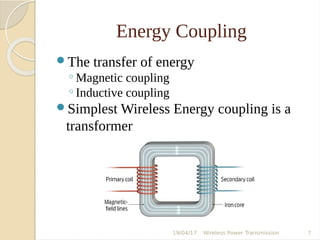
The transfer of energy
◦Magnetic coupling
◦Inductive coupling
Simplest Wireless Energy coupling is a
transformer
19/04/17 Wireless Power Transmission 7
Types and Technologies of WPT
Near-field techniques
Inductive Coupling
Resonant Inductive Coupling
Air Ionization
Far-field techniques
Microwave Power Transmission (MPT)
LASER power transmission
19/04/17 Wireless Power Transmission 8
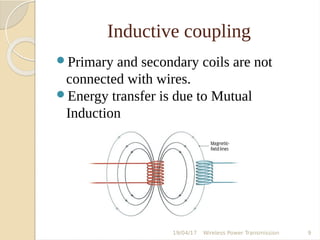
Inductive coupling
Primary and secondary coils are not
connected with wires.
Energy transfer is due to Mutual
Induction
19/04/17 Wireless Power Transmission 9
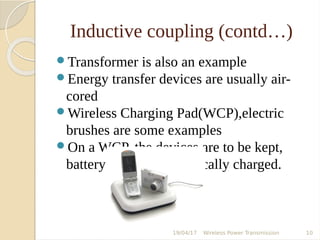
Inductive coupling (contd…)
Transformer is also an example
Energy transfer devices are usually air-
cored
Wireless Charging Pad(WCP),electric
brushes are some examples
On a WCP, the devices are to be kept,
battery will be automatically charged.
19/04/17 Wireless Power Transmission 10
Inductive coupling(contd…)
Electric brush also charges using
inductive coupling
The charging pad (primary coil) and the
device(secondary coil) have to be kept
very near to each other
It is preferred because it is comfortable.
Less use of wires
Shock proof
19/04/17 Wireless Power Transmission 11
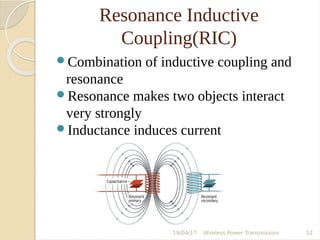
Resonance Inductive
Coupling(RIC)
Combination of inductive coupling and
resonance
Resonance makes two objects interact
very strongly
Inductance induces current
19/04/17 Wireless Power Transmission 12
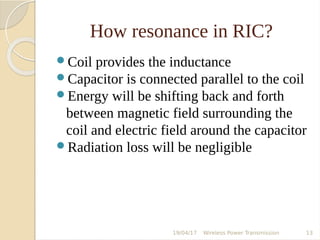
How resonance in RIC?
Coil provides the inductance
Capacitor is connected parallel to the coil
Energy will be shifting back and forth
between magnetic field surrounding the
coil and electric field around the capacitor
Radiation loss will be negligible
19/04/17 Wireless Power Transmission 13
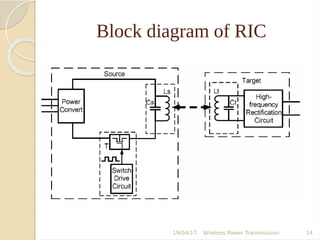
Block diagram of RIC
19/04/17 Wireless Power Transmission 14
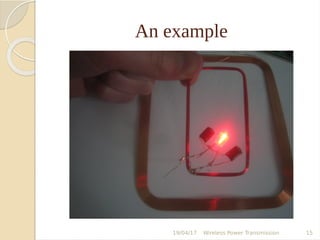
An example
19/04/17 Wireless Power Transmission 15
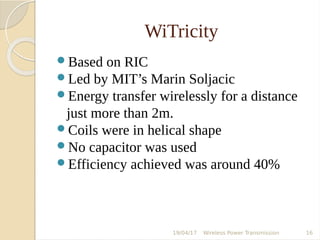
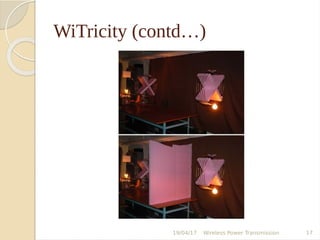
WiTricity
Based on RIC
Led by MIT’s Marin Soljacic
Energy transfer wirelessly for a distance
just more than 2m.
Coils were in helical shape
No capacitor was used
Efficiency achieved was around 40%
19/04/17 Wireless Power Transmission 16
WiTricity (contd…)
19/04/17 Wireless Power Transmission 17
WiTricity… Some statistics
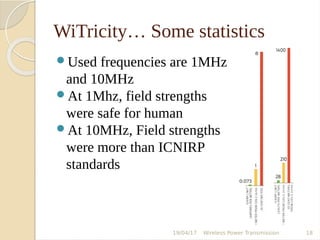
Used frequencies are 1MHz
and 10MHz
At 1Mhz, field strengths
were safe for human
At 10MHz, Field strengths
were more than ICNIRP
standards
19/04/17 Wireless Power Transmission 18
WiTricity now…
No more helical coils
Companies like Intel are also working on
devices that make use of RIC
Researches for decreasing the field
strength
Researches to increase the range
19/04/17 Wireless Power Transmission 19
RIC vs. inductive coupling
RIC is highly efficient
RIC has much greater range than
inductive coupling
RIC is directional when compared to
inductive coupling
RIC can be one-to-many. But usually
inductive coupling is one-to-one
Devices using RIC technique are highly
portable
19/04/17 Wireless Power Transmission 20
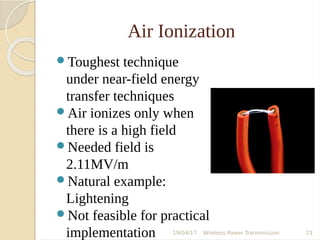
Air Ionization
Toughest technique
under near-field energy
transfer techniques
Air ionizes only when
there is a high field
Needed field is
2.11MV/m
Natural example:
Lightening
Not feasible for practical
implementation 19/04/17 Wireless Power Transmission 21
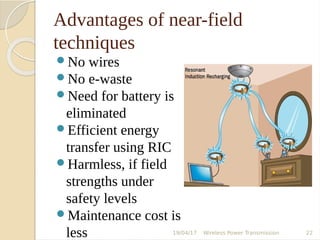
Advantages of near-field
techniques
No wires
No e-waste
Need for battery is
eliminated
Efficient energy
transfer using RIC
Harmless, if field
strengths under
safety levels
Maintenance cost is
less 19/04/17 Wireless Power Transmission 22
Disadvantages
Distance constraint
Field strengths have to be under safety
levels
Initial cost is high
In RIC, tuning is difficult
High frequency signals must be the
supply
Air ionization technique is not feasible
19/04/17 Wireless Power Transmission 23
Far-field energy transfer
Radiative
Needs line-of-sight
LASER or microwave
Aims at high power transfer
Tesla’s tower was built for this
19/04/17 Wireless Power Transmission 24
Microwave Power Transfer(MPT)
Transfers high power from one place to
another. Two places being in line of sight
usually
Steps:
◦Electrical energy to microwave energy
◦Capturing microwaves using rectenna
◦Microwave energy to electrical energy
19/04/17 Wireless Power Transmission 25
MPT (contd…)
AC can not be directly converted to
microwave energy
AC is converted to DC first
DC is converted to microwaves using
magnetron
Transmitted waves are received at
rectenna which rectifies, gives DC as the
output
DC is converted back to AC
19/04/17 Wireless Power Transmission 26
LASER transmission
LASER is highly directional, coherent
Not dispersed for very long
But, gets attenuated when it propagates
through atmosphere
Simple receiver
◦Photovoltaic cell
Cost-efficient
19/04/17 Wireless Power Transmission 27
Solar Power Satellites (SPS)
To provide energy to earth’s increasing
energy need
To efficiently make use of renewable
energy i.e., solar energy
SPS are placed in geostationary orbits
19/04/17 Wireless Power Transmission 28
SPS (contd…)
Solar energy is captured using photocells
Each SPS may have 400 million
photocells
Transmitted to earth in the form of
microwaves/LASER
Using rectenna/photovoltaic cell, the
energy is converted to electrical energy
Efficiency exceeds 95% if microwave is
used.
19/04/17 Wireless Power Transmission 29
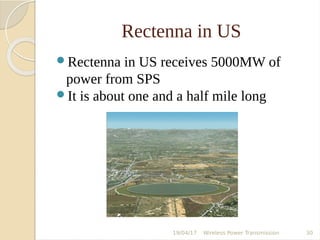
Rectenna in US
Rectenna in US receives 5000MW of
power from SPS
It is about one and a half mile long
19/04/17 Wireless Power Transmission 30
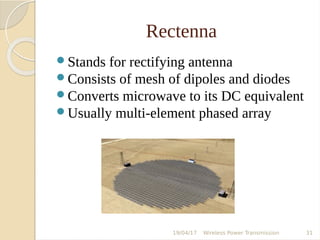
Rectenna
Stands for rectifying antenna
Consists of mesh of dipoles and diodes
Converts microwave to its DC equivalent
Usually multi-element phased array
19/04/17 Wireless Power Transmission 31
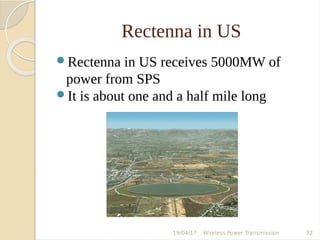
Rectenna in US
Rectenna in US receives 5000MW of
power from SPS
It is about one and a half mile long
19/04/17 Wireless Power Transmission 32
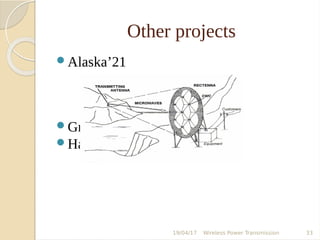
Other projects
Alaska’21
Grand Bassin
Hawaii
19/04/17 Wireless Power Transmission 33
LASER vs. MPT
When LASER is used, the antenna sizes
can be much smaller
Microwaves can face interference (two
frequencies can be used for WPT are
2.45GHz and 5.4GHz)
LASER has high attenuation loss and also
it gets diffracted by atmospheric particles
easily
19/04/17 Wireless Power Transmission 34
Advantages of far-field energy transfer
Efficient
Easy
Need for grids, substations etc are
eliminated
Low maintenance cost
More effective when the transmitting and
receiving points are along a line-of-sight
Can reach the places which are remote
19/04/17 Wireless Power Transmission 35
Disadvantages of far-field energy transfer
Radiative
Needs line-of-sight
Initial cost is high
When LASERs are used,
◦conversion is inefficient
◦Absorption loss is high
When microwaves are used,
◦interference may arise
◦FRIED BIRD effect
19/04/17 Wireless Power Transmission 36
Applications
Near-field energy transfer
◦ Electric automobile charging
 Static and moving
◦ Consumer electronics
◦ Industrial purposes
 Harsh environment
Far-field energy transfer
◦ Solar Power Satellites
◦ Energy to remote areas
◦ Can broadcast energy globally (in future)
19/04/17 Wireless Power Transmission 37
Conclusion
Transmission without wires- a reality
Efficient
Low maintenance cost. But, high initial cost
Better than conventional wired transfer
Energy crisis can be decreased
Low loss
In near future, world will be completely wireless
19/04/17 Wireless Power Transmission 38
References
 S. Sheik Mohammed, K. Ramasamy, T. Shanmuganantham,”
Wireless power transmission – a next generation power
transmission system”, International Journal of Computer
Applications (0975 – 8887) (Volume 1 – No. 13)
 Peter Vaessen,” Wireless Power Transmission”, Leonardo Energy,
September 2009
 C.C. Leung, T.P. Chan, K.C. Lit, K.W. Tam and Lee Yi Chow,
“Wireless Power Transmission and Charging Pad”
 David Schneider, “Electrons unplugged”, IEEE Spectrum, May
2010
 Shahrzad Jalali Mazlouman, Alireza Mahanfar, Bozena Kaminska,
“Mid-range Wireless Energy Transfer Using Inductive Resonance
for Wireless Sensors”
 Chunbo Zhu, Kai Liu, Chunlai Yu, Rui Ma, Hexiao Cheng,
“Simulation and Experimental Analysis on Wireless Energy
Transfer Based on Magnetic Resonances”, IEEE Vehicle Power and
Propulsion Conference (VPPC), September 3-5, 200819/04/17 Wireless Power Transmission 39
References(contd…)
 André Kurs, Aristeidis Karalis, Robert Moffatt, J. D.
Joannopoulos, Peter Fisher and Marin Soljačić, “Wireless
Power Transfer via Strongly Coupled Magnetic Resonances”,
Science, June 2007
 T. R. Robinson, T. K. Yeoman and R. S. Dhillon,
“Environmental impact of high power density microwave
beams on different atmospheric layers”,
 White Paper on Solar Power Satellite (SPS) Systems, URSI,
September 2006
 Richard M. Dickinson, and Jerry Grey, “Lasers for Wireless
Power Transmission”
 S.S. Ahmed, T.W. Yeong and H.B. Ahmad, “Wireless power
transmission and its annexure to the grid system”
19/04/17 Wireless Power Transmission 40
THANK YOU!
19/04/17 Wireless Power Transmission 41

Wirelesspowertransmission

  • 1.
    Wireless Power Transmission Techniques Presentedby A.Anantha Babu, Master of Engineering, Dept of Computer Science and Engineering, Anna University Regoinal Campus, Coimbatore.
  • 2.
    Introduction The transmission ofenergy from one place to another without using wires Conventional energy transfer is using wires But, the wireless transmission is made possible by using various technologies Wireless Power Transmission 2
  • 3.
    Why not wires? Asper studies, most electrical energy transfer is through wires. Most of the energy loss is during transmission • On an average, more than 30% • In India, it exceeds 40% 19/04/17 Wireless Power Transmission 3
  • 4.
    Objective Reliable Efficient Fast Low maintenance cost Canbe used for short-range or long-range. 19/04/17 Wireless Power Transmission 4
  • 5.
    History Nikola Tesla inlate 1890s Pioneer of induction techniques His vision for “World Wireless System” The 187 feet tall tower to broadcast energy All people can have access to free energy Due to shortage of funds, tower did not operate 19/04/17 Wireless Power Transmission 5
  • 6.
    History (contd…) Tesla wasable to transfer energy from one coil to another coil He managed to light 200 lamps from a distance of 40km The idea of Tesla is taken in to research after 100 years by a team led by Marin Soljacic from MIT. The project is named as ‘WiTricity’. 19/04/17 Wireless Power Transmission 6
  • 7.
    Energy Coupling The transferof energy ◦Magnetic coupling ◦Inductive coupling Simplest Wireless Energy coupling is a transformer 19/04/17 Wireless Power Transmission 7
  • 8.
    Types and Technologiesof WPT Near-field techniques Inductive Coupling Resonant Inductive Coupling Air Ionization Far-field techniques Microwave Power Transmission (MPT) LASER power transmission 19/04/17 Wireless Power Transmission 8
  • 9.
    Inductive coupling Primary andsecondary coils are not connected with wires. Energy transfer is due to Mutual Induction 19/04/17 Wireless Power Transmission 9
  • 10.
    Inductive coupling (contd…) Transformeris also an example Energy transfer devices are usually air- cored Wireless Charging Pad(WCP),electric brushes are some examples On a WCP, the devices are to be kept, battery will be automatically charged. 19/04/17 Wireless Power Transmission 10
  • 11.
    Inductive coupling(contd…) Electric brushalso charges using inductive coupling The charging pad (primary coil) and the device(secondary coil) have to be kept very near to each other It is preferred because it is comfortable. Less use of wires Shock proof 19/04/17 Wireless Power Transmission 11
  • 12.
    Resonance Inductive Coupling(RIC) Combination ofinductive coupling and resonance Resonance makes two objects interact very strongly Inductance induces current 19/04/17 Wireless Power Transmission 12
  • 13.
    How resonance inRIC? Coil provides the inductance Capacitor is connected parallel to the coil Energy will be shifting back and forth between magnetic field surrounding the coil and electric field around the capacitor Radiation loss will be negligible 19/04/17 Wireless Power Transmission 13
  • 14.
    Block diagram ofRIC 19/04/17 Wireless Power Transmission 14
  • 15.
    An example 19/04/17 WirelessPower Transmission 15
  • 16.
    WiTricity Based on RIC Ledby MIT’s Marin Soljacic Energy transfer wirelessly for a distance just more than 2m. Coils were in helical shape No capacitor was used Efficiency achieved was around 40% 19/04/17 Wireless Power Transmission 16
  • 17.
  • 18.
    WiTricity… Some statistics Usedfrequencies are 1MHz and 10MHz At 1Mhz, field strengths were safe for human At 10MHz, Field strengths were more than ICNIRP standards 19/04/17 Wireless Power Transmission 18
  • 19.
    WiTricity now… No morehelical coils Companies like Intel are also working on devices that make use of RIC Researches for decreasing the field strength Researches to increase the range 19/04/17 Wireless Power Transmission 19
  • 20.
    RIC vs. inductivecoupling RIC is highly efficient RIC has much greater range than inductive coupling RIC is directional when compared to inductive coupling RIC can be one-to-many. But usually inductive coupling is one-to-one Devices using RIC technique are highly portable 19/04/17 Wireless Power Transmission 20
  • 21.
    Air Ionization Toughest technique undernear-field energy transfer techniques Air ionizes only when there is a high field Needed field is 2.11MV/m Natural example: Lightening Not feasible for practical implementation 19/04/17 Wireless Power Transmission 21
  • 22.
    Advantages of near-field techniques Nowires No e-waste Need for battery is eliminated Efficient energy transfer using RIC Harmless, if field strengths under safety levels Maintenance cost is less 19/04/17 Wireless Power Transmission 22
  • 23.
    Disadvantages Distance constraint Field strengthshave to be under safety levels Initial cost is high In RIC, tuning is difficult High frequency signals must be the supply Air ionization technique is not feasible 19/04/17 Wireless Power Transmission 23
  • 24.
    Far-field energy transfer Radiative Needsline-of-sight LASER or microwave Aims at high power transfer Tesla’s tower was built for this 19/04/17 Wireless Power Transmission 24
  • 25.
    Microwave Power Transfer(MPT) Transfershigh power from one place to another. Two places being in line of sight usually Steps: ◦Electrical energy to microwave energy ◦Capturing microwaves using rectenna ◦Microwave energy to electrical energy 19/04/17 Wireless Power Transmission 25
  • 26.
    MPT (contd…) AC cannot be directly converted to microwave energy AC is converted to DC first DC is converted to microwaves using magnetron Transmitted waves are received at rectenna which rectifies, gives DC as the output DC is converted back to AC 19/04/17 Wireless Power Transmission 26
  • 27.
    LASER transmission LASER ishighly directional, coherent Not dispersed for very long But, gets attenuated when it propagates through atmosphere Simple receiver ◦Photovoltaic cell Cost-efficient 19/04/17 Wireless Power Transmission 27
  • 28.
    Solar Power Satellites(SPS) To provide energy to earth’s increasing energy need To efficiently make use of renewable energy i.e., solar energy SPS are placed in geostationary orbits 19/04/17 Wireless Power Transmission 28
  • 29.
    SPS (contd…) Solar energyis captured using photocells Each SPS may have 400 million photocells Transmitted to earth in the form of microwaves/LASER Using rectenna/photovoltaic cell, the energy is converted to electrical energy Efficiency exceeds 95% if microwave is used. 19/04/17 Wireless Power Transmission 29
  • 30.
    Rectenna in US Rectennain US receives 5000MW of power from SPS It is about one and a half mile long 19/04/17 Wireless Power Transmission 30
  • 31.
    Rectenna Stands for rectifyingantenna Consists of mesh of dipoles and diodes Converts microwave to its DC equivalent Usually multi-element phased array 19/04/17 Wireless Power Transmission 31
  • 32.
    Rectenna in US Rectennain US receives 5000MW of power from SPS It is about one and a half mile long 19/04/17 Wireless Power Transmission 32
  • 33.
  • 34.
    LASER vs. MPT WhenLASER is used, the antenna sizes can be much smaller Microwaves can face interference (two frequencies can be used for WPT are 2.45GHz and 5.4GHz) LASER has high attenuation loss and also it gets diffracted by atmospheric particles easily 19/04/17 Wireless Power Transmission 34
  • 35.
    Advantages of far-fieldenergy transfer Efficient Easy Need for grids, substations etc are eliminated Low maintenance cost More effective when the transmitting and receiving points are along a line-of-sight Can reach the places which are remote 19/04/17 Wireless Power Transmission 35
  • 36.
    Disadvantages of far-fieldenergy transfer Radiative Needs line-of-sight Initial cost is high When LASERs are used, ◦conversion is inefficient ◦Absorption loss is high When microwaves are used, ◦interference may arise ◦FRIED BIRD effect 19/04/17 Wireless Power Transmission 36
  • 37.
    Applications Near-field energy transfer ◦Electric automobile charging  Static and moving ◦ Consumer electronics ◦ Industrial purposes  Harsh environment Far-field energy transfer ◦ Solar Power Satellites ◦ Energy to remote areas ◦ Can broadcast energy globally (in future) 19/04/17 Wireless Power Transmission 37
  • 38.
    Conclusion Transmission without wires-a reality Efficient Low maintenance cost. But, high initial cost Better than conventional wired transfer Energy crisis can be decreased Low loss In near future, world will be completely wireless 19/04/17 Wireless Power Transmission 38
  • 39.
    References  S. SheikMohammed, K. Ramasamy, T. Shanmuganantham,” Wireless power transmission – a next generation power transmission system”, International Journal of Computer Applications (0975 – 8887) (Volume 1 – No. 13)  Peter Vaessen,” Wireless Power Transmission”, Leonardo Energy, September 2009  C.C. Leung, T.P. Chan, K.C. Lit, K.W. Tam and Lee Yi Chow, “Wireless Power Transmission and Charging Pad”  David Schneider, “Electrons unplugged”, IEEE Spectrum, May 2010  Shahrzad Jalali Mazlouman, Alireza Mahanfar, Bozena Kaminska, “Mid-range Wireless Energy Transfer Using Inductive Resonance for Wireless Sensors”  Chunbo Zhu, Kai Liu, Chunlai Yu, Rui Ma, Hexiao Cheng, “Simulation and Experimental Analysis on Wireless Energy Transfer Based on Magnetic Resonances”, IEEE Vehicle Power and Propulsion Conference (VPPC), September 3-5, 200819/04/17 Wireless Power Transmission 39
  • 40.
    References(contd…)  André Kurs,Aristeidis Karalis, Robert Moffatt, J. D. Joannopoulos, Peter Fisher and Marin Soljačić, “Wireless Power Transfer via Strongly Coupled Magnetic Resonances”, Science, June 2007  T. R. Robinson, T. K. Yeoman and R. S. Dhillon, “Environmental impact of high power density microwave beams on different atmospheric layers”,  White Paper on Solar Power Satellite (SPS) Systems, URSI, September 2006  Richard M. Dickinson, and Jerry Grey, “Lasers for Wireless Power Transmission”  S.S. Ahmed, T.W. Yeong and H.B. Ahmad, “Wireless power transmission and its annexure to the grid system” 19/04/17 Wireless Power Transmission 40
  • 41.
    THANK YOU! 19/04/17 WirelessPower Transmission 41