Under The Guidance Of:
Prof Srikant Dash
• Presented by:
• ASISH KUMAR NAYAK (1201298193)
• ASUTOSH MEHER (1201298145)
• BIKRAM KESHARI MOHANTY(1201298192
)
• ABHISEK MISHRA
(1201298105)
CONTENT
2
 Project outline
 Introduction
 Block diagram
 Working
 Hardware Components
 Software used
 Advantages
 Disadvantages
 Application
 Future Scope
 conclusion
 Reference
PROJECT OUTLINE
•A brief introduction to internal architecture of micro
controller.
•An over view of programming of micro controller.
•An over view of assembly/embedded c language.
•An over view the input/output devices.
3
INTRODUCTION -
 . Do you want to monitor various things at some remote
place where a human being cannot go? Do you think that is
it possible ?
 Yes, it is possible by making use of a mobile robot. How
wonder if it is a wireless!
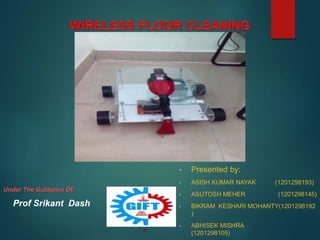
 The current design of the ‘wireless floor cleaning robot’ is an
application of that which does the above mentioned things
for you.
 The design is based on 8051 micro controller and various
interfaces like Rf, dc motors etc.
4
BLOCK DIAGRAM - 5
ROBOT RECEIVER
6
DISPLAY UNIT
POWER SUPPLY
UNIT
DRIVING UNIT
VACUUM
CLEANER
Micro Controller
Unit
Driving
unit
DECODER
DC
motors
RF RX
WORKING -
 The whole system consists is divided into two modules, the TX
module and the Rx module.
 The TX module is simply a PC where software will be designed
with appropriate hardware for the controlling the robot.
 The robot moves in various directions as per the switching action at
the transmitting side.
 The different key press generates different RF signals. The Rx
receives these signals and moves accordingly.
 But the important thing to be noted here is that there is no
connection between the TX and Rx section. RF makes this task
very simple.
7
 The RF sends a signal to the micro controller at the Rx
side as soon as any key is pressed at the TX side.
 Now the micro controller at the Rx side rotates dc
motors to make the robot move in various directions.
 Here a mechanical arrangement is provided for the
actual appearance of the robot.
 And also the robot is mounted with a vacuum cleaner
which can be controlled wirelessly.
8
ACTION PERFORMED CORRESPONDING TO
THE KEY
NUMBER PRESSED ACTION
PERFORMED
2 Backward motion
4 right turn
6 left turn
8 forward motion
5 stop
3 vacuum cleaner start
1 vacuum cleaner stop
9
 HARDWARE COMPONENTS:

1. MICROCONTROLLER (AT89S52)
2. MOTOR DRIVER
3. VOLTAGE REGULATOR
4. PUSH BUTTONS
5. LCD
6. DC MOTOR
7. RESISTOR
8. CAPACITOR
9. CRYSTAL OSCILLATOR
10. LED
11. POWER SUPPLY
12. TRANSFORMER
13. RF TRANSMITTER AND RECIVER
14. BLDC MOTOR
15. RELAY
10
MICROCONTROLLER (AT89S52)
CONSISTS OF:
1. Internal ROM And RAM
2. I/O Ports With Programmable Pins
3. Timers And Counters
4. Serial Data Communication
5. 16 Bit PC &Data Pointer (DPTR)
6. 8 Bit Program Status Word (PSW)
7. 8 Bit Stack Pointer (SP)
8. Internal ROM 4k
9. Internal RAM Of 128 Bytes.
11
 BLDC motors
 Brushless DC electric motor (BLDC motors, BL motors) also
known as electronically commutated motors (ECMs, EC motors)
 These are synchronous that are powered by a DC electric source
via an integrated inverter/switching power supply, which
produces an AC electric signal to drive the motor
 We are using this motor in vacuum cleaner for cleaning the floor.
12
Radio Frequency Technology
 Radio frequency (RF) is any of the electromagnetic wave
frequencies that lie in the range extending from
around 3 khz to 300 GHz , which include
those frequencies used for communications or radar
signals.[1]
 It has one transmitter part and receiver part
 Transmitter part have RF TX module and receiver has
RF RX module.
13
SOFTWARES USED
 A Cross compiler for compiling and linking the code
written for 8051.
 Serial communication software for downloading code
to 8051.
 Operating System: Windows.
 Application program development in Embedded C.
 Proteus for virtual circuit simulation.
14
ADVANTAGES -
1. Wireless control
2. It saves time
3. It can clean ,where we cant clean like under the bed .etc
4. It can clean floor from standing or sitting one place
5. Ideal for people with mobility issues
15
DISADVAANTAGES -
1. Quality of clean
2. Expensive
3. Limited range of working area from laptop or pc
4. It should be range of your eye
16
APPLICATIONS -
 For cleaning home.
 For cleaning hospitals
 For industries
 For shopping malls
17
FURTHER IMPROVEMENT & FUTURE
SCOPE
 IR Sensors
 Automatic control
 Automatic water clean using micro pump
18
CONCLUSION
 This project efficient floor cleaning with sweeping and mopping
operations. This robot works in manual for user convenience... RF
modules provide wireless communication between remote and
robot and their range is 50m. it sends the information to the
remote which gets displayed on tv or laptop. A wiper is connected
to it can wash the water in the for mopping purpose for the
convenience of user. User can also operate this robot manually
with the help of remote. It reduces the labor cost and saves time
also and provides efficient cleaning. In automatic mode, the robot
operates autonomously. The operations such as sweeping,
mopping and changing the path in case of hurdle are performed
automatically.
19
REFERENCE
REFERENCES
[1] Jens-Steffen Gutmann , Kristen Culp , Mario E. Munich and Paolo Pirjanian. The Social
Impact of a Systematic Floor Cleaner . In IEEE international workshop on advance robotics
an its social impacts , Technische University munchen, Germany May 21-23,2012.
[2]Evolution Robotics Inc. Introducing Mint-the evolution of floor care,
www.mintcleaner.com,2011.
[3]J-S. Gutmann, E.Eade, P.Fong and M.E. Munich. Vector field SLAM. IN Int. conf. on
Robotics and automation (ICRA), 2010.
[4]J-Y. SUNG, R.E.Grinter, and H.I.Chrstensen, and L.Go.Housewives domestic robot
technology int. Journal of social robotics, 2(4):417-429,2010.
[5]Youngkak Ma, seungwoo Kim, Dongik Oh and Youngwan Cho.A study on development
of home mess- cleanup robot McBot.In IEEE/ASME international conference
20
Thank You

22

WIRELESS FLOOR CLEANING ROBOT

  • 1.
    Under The GuidanceOf: Prof Srikant Dash • Presented by: • ASISH KUMAR NAYAK (1201298193) • ASUTOSH MEHER (1201298145) • BIKRAM KESHARI MOHANTY(1201298192 ) • ABHISEK MISHRA (1201298105)
  • 2.
    CONTENT 2  Project outline Introduction  Block diagram  Working  Hardware Components  Software used  Advantages  Disadvantages  Application  Future Scope  conclusion  Reference
  • 3.
    PROJECT OUTLINE •A briefintroduction to internal architecture of micro controller. •An over view of programming of micro controller. •An over view of assembly/embedded c language. •An over view the input/output devices. 3
  • 4.
    INTRODUCTION -  .Do you want to monitor various things at some remote place where a human being cannot go? Do you think that is it possible ?  Yes, it is possible by making use of a mobile robot. How wonder if it is a wireless!  The current design of the ‘wireless floor cleaning robot’ is an application of that which does the above mentioned things for you.  The design is based on 8051 micro controller and various interfaces like Rf, dc motors etc. 4
  • 5.
  • 6.
    ROBOT RECEIVER 6 DISPLAY UNIT POWERSUPPLY UNIT DRIVING UNIT VACUUM CLEANER Micro Controller Unit Driving unit DECODER DC motors RF RX
  • 7.
    WORKING -  Thewhole system consists is divided into two modules, the TX module and the Rx module.  The TX module is simply a PC where software will be designed with appropriate hardware for the controlling the robot.  The robot moves in various directions as per the switching action at the transmitting side.  The different key press generates different RF signals. The Rx receives these signals and moves accordingly.  But the important thing to be noted here is that there is no connection between the TX and Rx section. RF makes this task very simple. 7
  • 8.
     The RFsends a signal to the micro controller at the Rx side as soon as any key is pressed at the TX side.  Now the micro controller at the Rx side rotates dc motors to make the robot move in various directions.  Here a mechanical arrangement is provided for the actual appearance of the robot.  And also the robot is mounted with a vacuum cleaner which can be controlled wirelessly. 8
  • 9.
    ACTION PERFORMED CORRESPONDINGTO THE KEY NUMBER PRESSED ACTION PERFORMED 2 Backward motion 4 right turn 6 left turn 8 forward motion 5 stop 3 vacuum cleaner start 1 vacuum cleaner stop 9
  • 10.
     HARDWARE COMPONENTS:  1.MICROCONTROLLER (AT89S52) 2. MOTOR DRIVER 3. VOLTAGE REGULATOR 4. PUSH BUTTONS 5. LCD 6. DC MOTOR 7. RESISTOR 8. CAPACITOR 9. CRYSTAL OSCILLATOR 10. LED 11. POWER SUPPLY 12. TRANSFORMER 13. RF TRANSMITTER AND RECIVER 14. BLDC MOTOR 15. RELAY 10
  • 11.
    MICROCONTROLLER (AT89S52) CONSISTS OF: 1.Internal ROM And RAM 2. I/O Ports With Programmable Pins 3. Timers And Counters 4. Serial Data Communication 5. 16 Bit PC &Data Pointer (DPTR) 6. 8 Bit Program Status Word (PSW) 7. 8 Bit Stack Pointer (SP) 8. Internal ROM 4k 9. Internal RAM Of 128 Bytes. 11
  • 12.
     BLDC motors Brushless DC electric motor (BLDC motors, BL motors) also known as electronically commutated motors (ECMs, EC motors)  These are synchronous that are powered by a DC electric source via an integrated inverter/switching power supply, which produces an AC electric signal to drive the motor  We are using this motor in vacuum cleaner for cleaning the floor. 12
  • 13.
    Radio Frequency Technology Radio frequency (RF) is any of the electromagnetic wave frequencies that lie in the range extending from around 3 khz to 300 GHz , which include those frequencies used for communications or radar signals.[1]  It has one transmitter part and receiver part  Transmitter part have RF TX module and receiver has RF RX module. 13
  • 14.
    SOFTWARES USED  ACross compiler for compiling and linking the code written for 8051.  Serial communication software for downloading code to 8051.  Operating System: Windows.  Application program development in Embedded C.  Proteus for virtual circuit simulation. 14
  • 15.
    ADVANTAGES - 1. Wirelesscontrol 2. It saves time 3. It can clean ,where we cant clean like under the bed .etc 4. It can clean floor from standing or sitting one place 5. Ideal for people with mobility issues 15
  • 16.
    DISADVAANTAGES - 1. Qualityof clean 2. Expensive 3. Limited range of working area from laptop or pc 4. It should be range of your eye 16
  • 17.
    APPLICATIONS -  Forcleaning home.  For cleaning hospitals  For industries  For shopping malls 17
  • 18.
    FURTHER IMPROVEMENT &FUTURE SCOPE  IR Sensors  Automatic control  Automatic water clean using micro pump 18
  • 19.
    CONCLUSION  This projectefficient floor cleaning with sweeping and mopping operations. This robot works in manual for user convenience... RF modules provide wireless communication between remote and robot and their range is 50m. it sends the information to the remote which gets displayed on tv or laptop. A wiper is connected to it can wash the water in the for mopping purpose for the convenience of user. User can also operate this robot manually with the help of remote. It reduces the labor cost and saves time also and provides efficient cleaning. In automatic mode, the robot operates autonomously. The operations such as sweeping, mopping and changing the path in case of hurdle are performed automatically. 19
  • 20.
    REFERENCE REFERENCES [1] Jens-Steffen Gutmann, Kristen Culp , Mario E. Munich and Paolo Pirjanian. The Social Impact of a Systematic Floor Cleaner . In IEEE international workshop on advance robotics an its social impacts , Technische University munchen, Germany May 21-23,2012. [2]Evolution Robotics Inc. Introducing Mint-the evolution of floor care, www.mintcleaner.com,2011. [3]J-S. Gutmann, E.Eade, P.Fong and M.E. Munich. Vector field SLAM. IN Int. conf. on Robotics and automation (ICRA), 2010. [4]J-Y. SUNG, R.E.Grinter, and H.I.Chrstensen, and L.Go.Housewives domestic robot technology int. Journal of social robotics, 2(4):417-429,2010. [5]Youngkak Ma, seungwoo Kim, Dongik Oh and Youngwan Cho.A study on development of home mess- cleanup robot McBot.In IEEE/ASME international conference 20
  • 22.