

WIRELESS ELECTRICITY
PREVIEW
 Introduction (or Definition).
 History.
 How it works?
 Uses.
 Pros & Cons.
 Why do we need it?
 Cost.
 Conclusion.
INTRODUCTION (OR DEFINITION)
 wireless power transmission, wireless energy
transmission, or electromagnetic power transfer is the
transmission of electrical energy without wires.
 Wireless power techniques mainly fall into two
categories, non-radiative and radiative.
 In near field or non-radiative techniques, power is
transferred by magnetic fields using inductive
coupling between coils of wire, or by electric
fields using capacitive coupling between
metal electrodes.
 In far-field or radiative techniques, also called power
beaming, power is transferred by beams
of electromagnetic radiation,
like microwaves or laser beams.
HISTORY
Nikola Tesla (1856 - 1943)
“Nikola Tesla, the eccentric - and unbelievably under-rated - genius known as
the ‘wild man of electronics’, was without doubt one of the greatest minds in
the history of the human race.”The first one who gave the idea of wireless
electricity.
MIT Scientists (in 2007)
• The idea of wireless electricity has been around since the
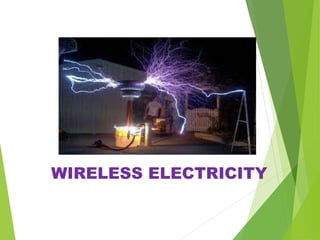
early days of the Tesla coil.
• But a group of MIT scientists, "WiTricity" (as these scientists
call it) is now one step closer to practical reality.
• Demonstrating the ability to power a 60-watt light bulb from a
power source seven feet away without wires might not seem like
the most impressive of feats.
HOW IT WORKS?
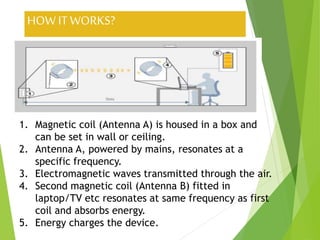
1. Magnetic coil (Antenna A) is housed in a box and
can be set in wall or ceiling.
2. Antenna A, powered by mains, resonates at a
specific frequency.
3. Electromagnetic waves transmitted through the air.
4. Second magnetic coil (Antenna B) fitted in
laptop/TV etc resonates at same frequency as first
coil and absorbs energy.
5. Energy charges the device.
USES
Wireless electricity can be used to power recharge and its
uses are as follows:
 Cell Phones.
 TVs.
 Computers.
 Electric Cars.
 Cordless Tools.
 Industrial Machinery.
 Medical Devices (pacemakers, etc.).
 Military Devices (unmanned robots, planes).
 Consumer Appliance.
 ANYTHING ELECTRIC!
PROS & CONS
PROS
• Significant decluttering of
office space
• No need for meter rooms
and electrical closets.
• Reduction of e-waste by
eliminating the need for
power cords
• Need more light in your
office, no need for
electrician. Simply place the
lamp where ever you need it.
CONS
• Need for standardization and
adaptation. So no
overheating occurs because
of different voltages.
• Retrofitting old equipment
or purchasing new
equipment could become a
very expensive endeavor
• possibility of “energy theft”.
Wi Fi, someone can be using
your internet or your power.
WHY DO WE NEED IT?
We need wireless electricity because of:
 Safety.
 Durability.
 Aesthetics.
 Clutter.
 Efficiency.
COST
 Cost is still undetermined.
 What they say is there are no exotic
materials being used that would make it
overly expensive.
 Prices should be comparable to products
already out.
CONCLUSION
 Wireless power transfer is quickly becoming a viable
reality.
 This technology offers an extremely efficient
alternative to previous attempts at providing
wireless power transfer.
 Future improvements in wireless technology offer
world changing implications.
REFRENCES
1.www.google.co.in
2.https://en.wikipedia.org/wiki/Engineer.
WIRELESS ELECTRICITY,ELECTRICITY WITHOUT WIRE,NEW TECHNOLOGY IN ELECTRICITY

WIRELESS ELECTRICITY,ELECTRICITY WITHOUT WIRE,NEW TECHNOLOGY IN ELECTRICITY

  • 1.
  • 2.
    PREVIEW  Introduction (orDefinition).  History.  How it works?  Uses.  Pros & Cons.  Why do we need it?  Cost.  Conclusion.
  • 3.
    INTRODUCTION (OR DEFINITION) wireless power transmission, wireless energy transmission, or electromagnetic power transfer is the transmission of electrical energy without wires.  Wireless power techniques mainly fall into two categories, non-radiative and radiative.  In near field or non-radiative techniques, power is transferred by magnetic fields using inductive coupling between coils of wire, or by electric fields using capacitive coupling between metal electrodes.  In far-field or radiative techniques, also called power beaming, power is transferred by beams of electromagnetic radiation, like microwaves or laser beams.
  • 4.
    HISTORY Nikola Tesla (1856- 1943) “Nikola Tesla, the eccentric - and unbelievably under-rated - genius known as the ‘wild man of electronics’, was without doubt one of the greatest minds in the history of the human race.”The first one who gave the idea of wireless electricity. MIT Scientists (in 2007) • The idea of wireless electricity has been around since the early days of the Tesla coil. • But a group of MIT scientists, "WiTricity" (as these scientists call it) is now one step closer to practical reality. • Demonstrating the ability to power a 60-watt light bulb from a power source seven feet away without wires might not seem like the most impressive of feats.
  • 5.
    HOW IT WORKS? 1.Magnetic coil (Antenna A) is housed in a box and can be set in wall or ceiling. 2. Antenna A, powered by mains, resonates at a specific frequency. 3. Electromagnetic waves transmitted through the air. 4. Second magnetic coil (Antenna B) fitted in laptop/TV etc resonates at same frequency as first coil and absorbs energy. 5. Energy charges the device.
  • 6.
    USES Wireless electricity canbe used to power recharge and its uses are as follows:  Cell Phones.  TVs.  Computers.  Electric Cars.  Cordless Tools.  Industrial Machinery.  Medical Devices (pacemakers, etc.).  Military Devices (unmanned robots, planes).  Consumer Appliance.  ANYTHING ELECTRIC!
  • 7.
    PROS & CONS PROS •Significant decluttering of office space • No need for meter rooms and electrical closets. • Reduction of e-waste by eliminating the need for power cords • Need more light in your office, no need for electrician. Simply place the lamp where ever you need it. CONS • Need for standardization and adaptation. So no overheating occurs because of different voltages. • Retrofitting old equipment or purchasing new equipment could become a very expensive endeavor • possibility of “energy theft”. Wi Fi, someone can be using your internet or your power.
  • 8.
    WHY DO WENEED IT? We need wireless electricity because of:  Safety.  Durability.  Aesthetics.  Clutter.  Efficiency.
  • 9.
    COST  Cost isstill undetermined.  What they say is there are no exotic materials being used that would make it overly expensive.  Prices should be comparable to products already out.
  • 10.
    CONCLUSION  Wireless powertransfer is quickly becoming a viable reality.  This technology offers an extremely efficient alternative to previous attempts at providing wireless power transfer.  Future improvements in wireless technology offer world changing implications.
  • 11.