
MADE BY :-
ALOK TIWARI
SAGAR SONI
An operating system (OS) is a set of
programs that manage computer
hardware resources and provide
common services for application
software. The operating system is the
most important type of system
software in a computer system. A
user cannot run an application
program on the computer without an
operating system
1. Real-time:-
   A real-time operating system is a
   multitasking operating system that aims at
   executing real-time applications.
2. Multi –User:-
A multi-user operating system allows multiple
users to access a computer system concurrently.
Time-sharing system can be classified as multi-user
systems as they enable a multiple user access to a
computer through the sharing of time.
3. Multi-tasking vs. Single-tasking:-

  When only a single program is allowed
  to run at a time, the system is grouped
  under     a    single-tasking    system.
  However, when the operating system
  allows the execution of multiple tasks
  at one time, it is classified as a multi-
  tasking operating system.
1. Resource Management:-
The resource management function of an OS allocates computer
resources such as CPU time, main memory, secondary storage,
and input and output devices for use.

2. Data Management:-
The data management functions of an OS govern the input and
output of the data and their location, storage, and retrieval.

3. Job (task) Management:-
The job management function of an OS prepares, schedules,
controls, and monitors jobs submitted for execution to ensure
the most efficient processing. A job is a collection of one or more
related programs and their data.
There are two types of interface:-

1. Command line Interface
2. Graphical user interface
Command-line Interface
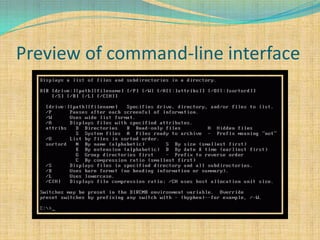
 A CLI (command line interface) is a user
  interface to a computer's operating system
  or an application in which the user
  responds to a visual prompt by typing in a
 command on a specified line, receives a
 response back from the system, and then
 enters another command, and so forth.
 The MS-DOS Prompt application in a
 Windows operating system is an example
 of the provision of a command line
 interface.
Preview of command-line interface
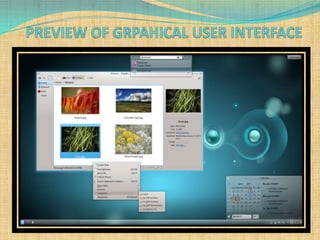
GRAPHICAL USER INTERFACE
 In  computing, a graphical user interface (GUI,
 sometimes pronounced gooey) is a type of user
 interface that allows users to interact with electronic
 devices with images rather than text commands. GUIs
 can be used in computers, hand-held devices such as
 MP3 players, portable media players or gaming
 devices, household appliances and office equipment . A
 GUI represents the information and actions available
 to a user through graphical icons and visual indicators
 such as secondary notation, as opposed to text-based
 interfaces, typed command labels or text navigation.
 The actions are usually performed through direct
 manipulation of the graphical elements
UNIX:-

Unix (officially trademarked as UNIX, sometimes also
written as UNIX) is a multitasking, multi-user
computer operating system originally developed in
1969 by a group of AT&T employees at Bell Labs,
including Ken Thompson, Dennis Ritchie The Unix
operating system was first developed in assembly
language, but by 1973 had been almost entirely recoded
in C, greatly facilitating its further development and
porting to other hardware.
MS-DOS:-

MS-DOS ( short for Microsoft Disk Operating
System) is an operating system for personal
computers. It was the most commonly used
member of the DOS family of operating
systems, and was the main operating system
for IBM PC compatible personal computers
during the 1980s to the mid 1990s, until it was
gradually superseded by operating systems
offering a graphical user interface (GUI), in
particular by various generations of the
Microsoft Windows operating system.
WINDOWS:-

Microsoft Windows is a series of operating
systems produced by Microsoft.
Microsoft introduced an operating environment
named Windows on November 20, 1985 as an add-
on to MS-DOS in response to the growing interest
in graphical user interfaces (GUIs). Microsoft
Windows came to dominate the world's personal
computer market, overtaking Mac OS, which had
been introduced in 1984.
FOLLOWING ARE THE VERSIONS OF WINDOWS
1.WINDOWS XP
2.WINDOWS VISTA
3.WINDOWS 7
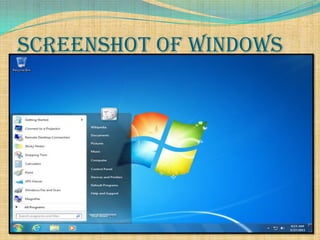
SCREENSHOT OF WINDOWS
LINUX:-
Linux (often pronounced LIH-nuhks with a short "i") is a
Unix-like operatingsystem that was designed to provide
personal computer users a free or very low-cost operating
system comparable to traditional and usually more
expensive Unix systems. Linux has a reputation as a very
efficient and fast-performing system. Linux‘ kernel (the
central part of the operating system) was developed by
Linus Torvalds at the University of Helsinki in Finland. To
complete the operating system, Torvald and other team
members made use of system components developed by
members of the Free Software Foundation for the GNU
Project.
Linux is a remarkably complete operating system, including
a graphical user interface
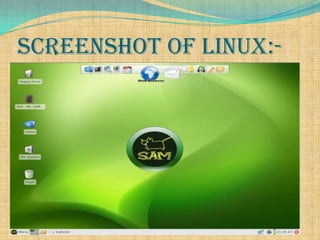
SCREENSHOT OF LINUX:-
Operating systems

Operating systems

  • 1.
    MADE BY :- ALOKTIWARI SAGAR SONI
  • 2.
    An operating system(OS) is a set of programs that manage computer hardware resources and provide common services for application software. The operating system is the most important type of system software in a computer system. A user cannot run an application program on the computer without an operating system
  • 3.
    1. Real-time:- A real-time operating system is a multitasking operating system that aims at executing real-time applications. 2. Multi –User:- A multi-user operating system allows multiple users to access a computer system concurrently. Time-sharing system can be classified as multi-user systems as they enable a multiple user access to a computer through the sharing of time.
  • 4.
    3. Multi-tasking vs.Single-tasking:- When only a single program is allowed to run at a time, the system is grouped under a single-tasking system. However, when the operating system allows the execution of multiple tasks at one time, it is classified as a multi- tasking operating system.
  • 5.
    1. Resource Management:- Theresource management function of an OS allocates computer resources such as CPU time, main memory, secondary storage, and input and output devices for use. 2. Data Management:- The data management functions of an OS govern the input and output of the data and their location, storage, and retrieval. 3. Job (task) Management:- The job management function of an OS prepares, schedules, controls, and monitors jobs submitted for execution to ensure the most efficient processing. A job is a collection of one or more related programs and their data.
  • 6.
    There are twotypes of interface:- 1. Command line Interface 2. Graphical user interface
  • 7.
    Command-line Interface  ACLI (command line interface) is a user interface to a computer's operating system or an application in which the user responds to a visual prompt by typing in a command on a specified line, receives a response back from the system, and then enters another command, and so forth. The MS-DOS Prompt application in a Windows operating system is an example of the provision of a command line interface.
  • 8.
  • 9.
    GRAPHICAL USER INTERFACE In computing, a graphical user interface (GUI, sometimes pronounced gooey) is a type of user interface that allows users to interact with electronic devices with images rather than text commands. GUIs can be used in computers, hand-held devices such as MP3 players, portable media players or gaming devices, household appliances and office equipment . A GUI represents the information and actions available to a user through graphical icons and visual indicators such as secondary notation, as opposed to text-based interfaces, typed command labels or text navigation. The actions are usually performed through direct manipulation of the graphical elements
  • 11.
    UNIX:- Unix (officially trademarkedas UNIX, sometimes also written as UNIX) is a multitasking, multi-user computer operating system originally developed in 1969 by a group of AT&T employees at Bell Labs, including Ken Thompson, Dennis Ritchie The Unix operating system was first developed in assembly language, but by 1973 had been almost entirely recoded in C, greatly facilitating its further development and porting to other hardware.
  • 12.
    MS-DOS:- MS-DOS ( shortfor Microsoft Disk Operating System) is an operating system for personal computers. It was the most commonly used member of the DOS family of operating systems, and was the main operating system for IBM PC compatible personal computers during the 1980s to the mid 1990s, until it was gradually superseded by operating systems offering a graphical user interface (GUI), in particular by various generations of the Microsoft Windows operating system.
  • 13.
    WINDOWS:- Microsoft Windows isa series of operating systems produced by Microsoft. Microsoft introduced an operating environment named Windows on November 20, 1985 as an add- on to MS-DOS in response to the growing interest in graphical user interfaces (GUIs). Microsoft Windows came to dominate the world's personal computer market, overtaking Mac OS, which had been introduced in 1984. FOLLOWING ARE THE VERSIONS OF WINDOWS 1.WINDOWS XP 2.WINDOWS VISTA 3.WINDOWS 7
  • 14.
  • 15.
    LINUX:- Linux (often pronouncedLIH-nuhks with a short "i") is a Unix-like operatingsystem that was designed to provide personal computer users a free or very low-cost operating system comparable to traditional and usually more expensive Unix systems. Linux has a reputation as a very efficient and fast-performing system. Linux‘ kernel (the central part of the operating system) was developed by Linus Torvalds at the University of Helsinki in Finland. To complete the operating system, Torvald and other team members made use of system components developed by members of the Free Software Foundation for the GNU Project. Linux is a remarkably complete operating system, including a graphical user interface
  • 16.