By Dr.Ummara khan
    (Pharm-D)
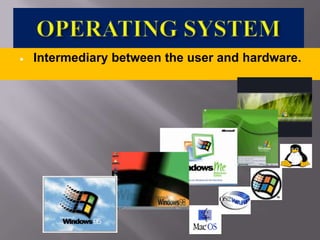
Intermediary between the user and hardware.
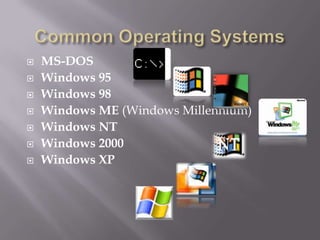
   MS-DOS
   Windows 95
   Windows 98
   Windows ME (Windows Millennium)
   Windows NT
   Windows 2000
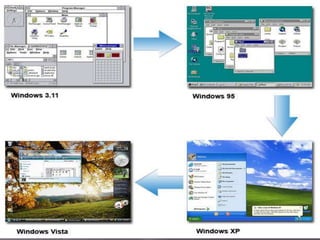
   Windows XP
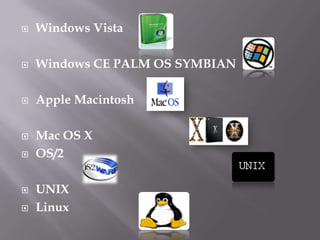
   Windows Vista

   Windows CE PALM OS SYMBIAN

   Apple Macintosh

   Mac OS X
   OS/2

   UNIX
   Linux
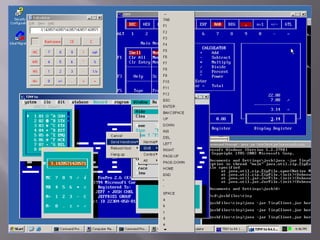
   Disk operating system
   Single-user Os from Microsoft for the Pc
   First OS for the PC
   Still the underlying control program for
    windows 3.1
   Windows 95/98 and Windows NT build in
    their own version of DOS to support existing
    DOS application.
   The most widely used OS for personal
    computers
   Windows provides graphical user
    interface (GUI, is a type of user interface that
    allows users to interact with electronic devices
    using images rather than text commands.
   Applications are displayed in re-sizeable,
    movable windows on screen
   The idea came from Xerox.
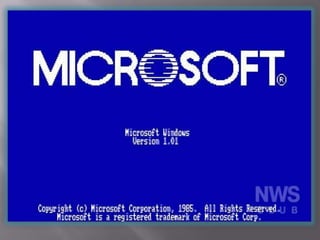
•16-bit graphical operating environment,
• Original version of Microsoft Windows
• intoduces in late 1985
• often regarded as a "front-end MS-DOS operating
system",user-friendly interface.
•Displayed tiled windows(side by side)
•supplied programs
are calculator, calendar, cardfile,clipboard viewer,
clock, notepad, paint, reversi, terminal, write.
•It never become popular
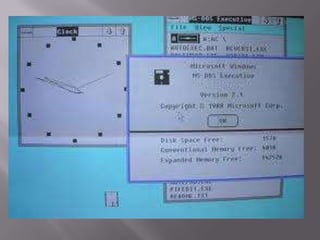
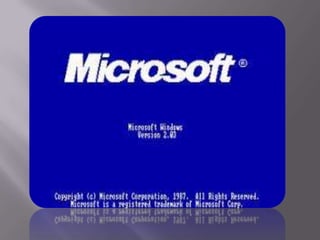
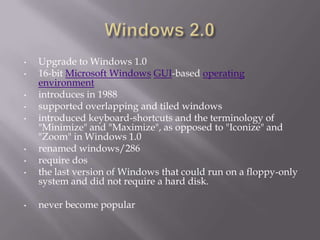
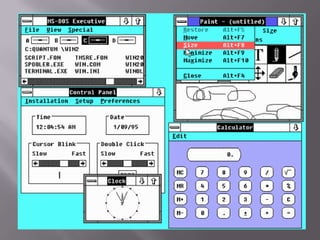
•   Upgrade to Windows 1.0
•   16-bit Microsoft Windows GUI-based operating
    environment
•   introduces in 1988
•   supported overlapping and tiled windows
•   introduced keyboard-shortcuts and the terminology of
    "Minimize" and "Maximize", as opposed to "Iconize" and
    "Zoom" in Windows 1.0
•   renamed windows/286
•   require dos
•   the last version of Windows that could run on a floppy-only
    system and did not require a hard disk.

•   never become popular
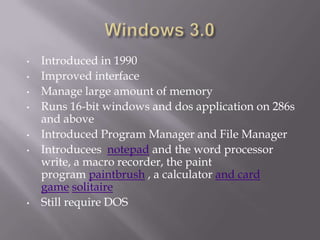
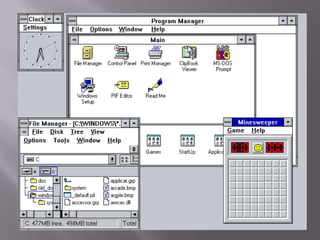
•   Introduced in 1990
•   Improved interface
•   Manage large amount of memory
•   Runs 16-bit windows and dos application on 286s
    and above
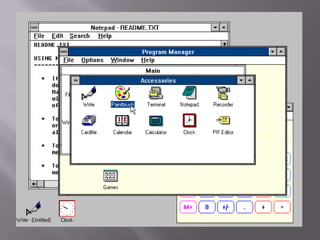
•   Introduced Program Manager and File Manager
•   Introducees notepad and the word processor
    write, a macro recorder, the paint
    program paintbrush , a calculator and card
    game solitaire
•   Still require DOS
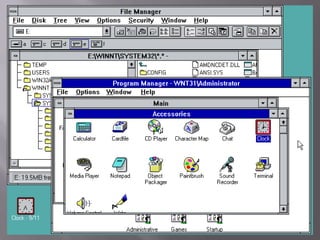
•   First major upgrade to 3.0
•   Into in 1992
•   Added support for
       Multimedia
       True type fonts
       Icons could be dragged and dropped
•   Supposedly more stable
   Upgrade to windows 3.121
   It was the final release of 3.1
   Released on August 11, 1993
   not a standalone version of Windows, but
    rather a software update like modern
    Windows service packs
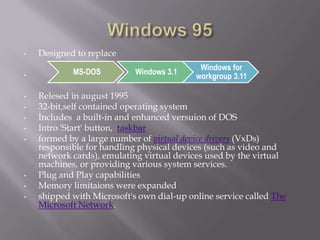
•   Designed to replace
                                            Windows for
            MS-DOS          Windows 3.1
•                                          workgroup 3.11

•   Relesed in august 1995
•   32-bit,self contained operating system
•   Includes a built-in and enhanced versuion of DOS
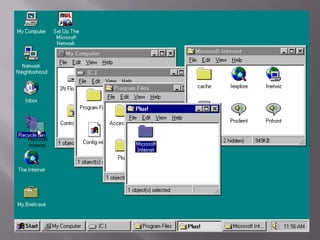
•   Intro 'Start' button, taskbar
•   formed by a large number of virtual device drivers (VxDs)
    responsible for handling physical devices (such as video and
    network cards), emulating virtual devices used by the virtual
    machines, or providing various system services.
•   Plug and Play capabilities
•   Memory limitaions were expanded
•   shipped with Microsoft's own dial-up online service called The
    Microsoft Network.
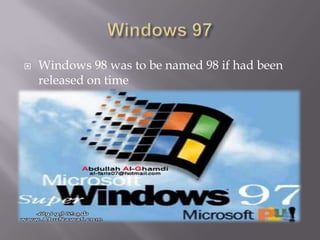
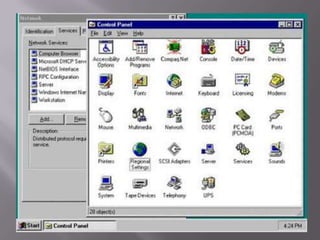
   Windows 98 was to be named 98 if had been
    released on time
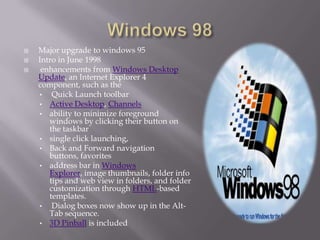
   Major upgrade to windows 95
   Intro in June 1998
    enhancements from Windows Desktop
    Update, an Internet Explorer 4
    component, such as the
    • Quick Launch toolbar
    • Active Desktop, Channels
    • ability to minimize foreground
       windows by clicking their button on
       the taskbar
    • single click launching,
    • Back and Forward navigation
       buttons, favorites
    • address bar in Windows
       Explorer, image thumbnails, folder info
       tips and web view in folders, and folder
       customization through HTML-based
       templates.
    • Dialog boxes now show up in the Alt-
       Tab sequence.
    • 3D Pinball is included
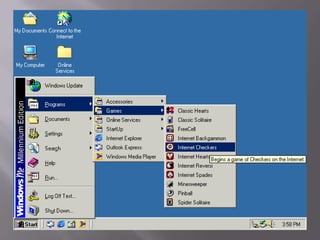
   Windows Me Millennium Edition
   graphical operating system released on September 14, 2000
    by Microsoft
   was the last operating system released in the Windows
    9x series.
    for home PC users.
   It included Internet Explorer 5.5, Windows Media
    Player 7, and the new Windows Movie Maker software
   Faster boot times
   Improved power management and suspend/resume
    operations.
   Includes drivers for USB mass storage devices and USB
    printers
   Windows Me had a short shelf-life of just over a year; it was
    often criticized for being buggy and unstable.
•   Windows NEW TECHNOLOGY
•   Intro in 1993
•   Advanced 32-bit "flat" virtual OS.
•   Works with Intel x86 and Alpha CPUs
•   Support for power PC has been dropped
•   Does not use DOS
•   Self contained OS that runs 16-bit and 32-bit
    windows application as well as DOS.
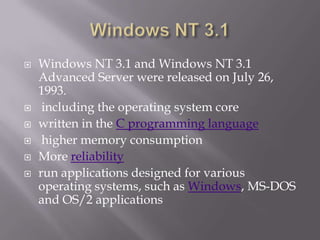
   Windows NT 3.1 and Windows NT 3.1
    Advanced Server were released on July 26,
    1993.
    including the operating system core
   written in the C programming language
    higher memory consumption
   More reliability
   run applications designed for various
    operating systems, such as Windows, MS-DOS
    and OS/2 applications
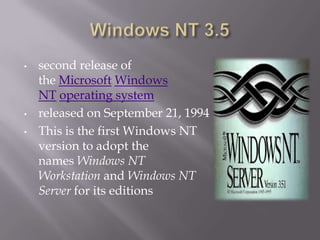
•   second release of
    the Microsoft Windows
    NT operating system
•   released on September 21, 1994
•   This is the first Windows NT
    version to adopt the
    names Windows NT
    Workstation and Windows NT
    Server for its editions
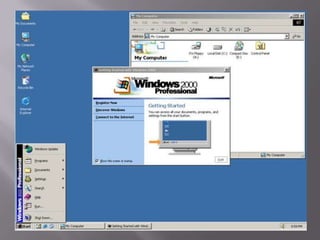
•   Windows 2000 professional desktop version
•   Windows 2000 server (server version)
•   Support multiprocessors
•   Was originally known as NT 5.0
•   introduces layered windows that allow for
    transparency, translucency and various transition effects like
    shadows, gradient fills and alpha blended GUI elements to top-
    level windows
•    Start Menu in Windows 2000 introduces personalized
    menus, expandable special folders and the ability to launch
    multiple programs without closing the menu by holding down
    the SHIFT key.
•   intro version 7.0 of the DirectX API, used by game developers
•   introduced the Multilingual User Interface (MUI)
•   introduced the Microsoft Management Console (MMC), which
    is used to create, save, and open administrative tools
•   Provide Support for distributed file systems, Active Directory.
   Built on the proven code base of Windows NT
    and Windows 2000
   32-bit computing architecture
   A fully protected memory model
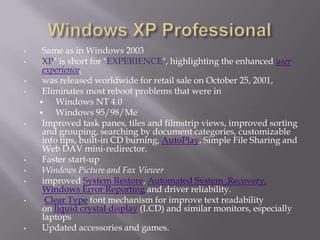
•    Same as in Windows 2003
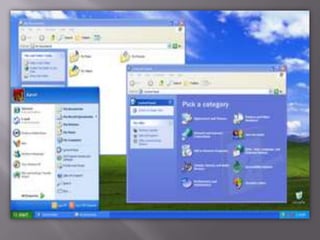
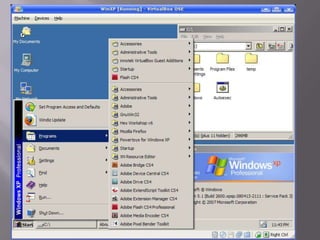
•    XP" is short for "EXPERIENCE", highlighting the enhanced user
     experience.
•    was released worldwide for retail sale on October 25, 2001,
•    Eliminates most reboot problems that were in
        Windows NT 4.0
        Windows 95/98/Me
•    Improved task panes, tiles and filmstrip views, improved sorting
     and grouping, searching by document categories, customizable
     info tips, built-in CD burning, AutoPlay, Simple File Sharing and
     Web DAV mini-redirector.
•    Faster start-up
•    Windows Picture and Fax Viewer
•    improved System Restore, Automated System ,Recovery,
     Windows Error Reporting and driver reliability.
•     Clear Type font mechanism for improve text readability
     on liquid crystal display (LCD) and similar monitors, especially
     laptops
•    Updated accessories and games.
•       Windows Vista is an operating system released in
        several variations developed by Microsoft for use on
        personal computers, including home and business
        desktops, laptops, tablet PCs, and media center PCs.
•       Prior to its announcement on July 22, 2005, Windows
        Vista was known by its codename "Longhorn.“
•       On January 30, 2007, it was released worldwide, and
        was made available for purchase and download from
        Microsoft's website
    •    Memory 512 MB-1 GB
    •    Graphics memory 32 MB-128 MB
    •    HDD capacity20 GB-40 GB
    •    The new graphical user interface is named Windows
         Aero
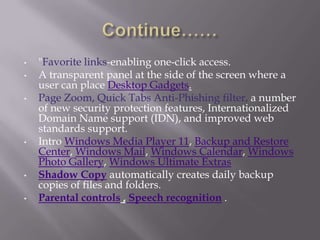
•   "Favorite links-enabling one-click access.
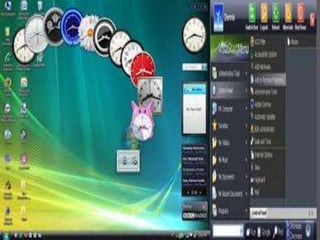
•   A transparent panel at the side of the screen where a
    user can place Desktop Gadgets.
•   Page Zoom, Quick Tabs Anti-Phishing filter, a number
    of new security protection features, Internationalized
    Domain Name support (IDN), and improved web
    standards support.
•   Intro Windows Media Player 11, Backup and Restore
    Center, Windows Mail, Windows Calendar, Windows
    Photo Gallery, Windows Ultimate Extras
•   Shadow Copy automatically creates daily backup
    copies of files and folders.
•   Parental controls , Speech recognition .
Windows series operating system

Windows series operating system

  • 1.
  • 2.
    Intermediary between theuser and hardware.
  • 3.
    MS-DOS  Windows 95  Windows 98  Windows ME (Windows Millennium)  Windows NT  Windows 2000  Windows XP
  • 4.
    Windows Vista  Windows CE PALM OS SYMBIAN  Apple Macintosh  Mac OS X  OS/2  UNIX  Linux
  • 5.
    Disk operating system  Single-user Os from Microsoft for the Pc  First OS for the PC  Still the underlying control program for windows 3.1  Windows 95/98 and Windows NT build in their own version of DOS to support existing DOS application.
  • 8.
    The most widely used OS for personal computers  Windows provides graphical user interface (GUI, is a type of user interface that allows users to interact with electronic devices using images rather than text commands.  Applications are displayed in re-sizeable, movable windows on screen  The idea came from Xerox.
  • 10.
    •16-bit graphical operatingenvironment, • Original version of Microsoft Windows • intoduces in late 1985 • often regarded as a "front-end MS-DOS operating system",user-friendly interface. •Displayed tiled windows(side by side) •supplied programs are calculator, calendar, cardfile,clipboard viewer, clock, notepad, paint, reversi, terminal, write. •It never become popular
  • 13.
    Upgrade to Windows 1.0 • 16-bit Microsoft Windows GUI-based operating environment • introduces in 1988 • supported overlapping and tiled windows • introduced keyboard-shortcuts and the terminology of "Minimize" and "Maximize", as opposed to "Iconize" and "Zoom" in Windows 1.0 • renamed windows/286 • require dos • the last version of Windows that could run on a floppy-only system and did not require a hard disk. • never become popular
  • 16.
    Introduced in 1990 • Improved interface • Manage large amount of memory • Runs 16-bit windows and dos application on 286s and above • Introduced Program Manager and File Manager • Introducees notepad and the word processor write, a macro recorder, the paint program paintbrush , a calculator and card game solitaire • Still require DOS
  • 18.
    First major upgrade to 3.0 • Into in 1992 • Added support for  Multimedia  True type fonts  Icons could be dragged and dropped • Supposedly more stable
  • 20.
    Upgrade to windows 3.121  It was the final release of 3.1  Released on August 11, 1993  not a standalone version of Windows, but rather a software update like modern Windows service packs
  • 23.
    Designed to replace Windows for MS-DOS Windows 3.1 • workgroup 3.11 • Relesed in august 1995 • 32-bit,self contained operating system • Includes a built-in and enhanced versuion of DOS • Intro 'Start' button, taskbar • formed by a large number of virtual device drivers (VxDs) responsible for handling physical devices (such as video and network cards), emulating virtual devices used by the virtual machines, or providing various system services. • Plug and Play capabilities • Memory limitaions were expanded • shipped with Microsoft's own dial-up online service called The Microsoft Network.
  • 25.
    Windows 98 was to be named 98 if had been released on time
  • 27.
    Major upgrade to windows 95  Intro in June 1998  enhancements from Windows Desktop Update, an Internet Explorer 4 component, such as the • Quick Launch toolbar • Active Desktop, Channels • ability to minimize foreground windows by clicking their button on the taskbar • single click launching, • Back and Forward navigation buttons, favorites • address bar in Windows Explorer, image thumbnails, folder info tips and web view in folders, and folder customization through HTML-based templates. • Dialog boxes now show up in the Alt- Tab sequence. • 3D Pinball is included
  • 30.
    Windows Me Millennium Edition  graphical operating system released on September 14, 2000 by Microsoft  was the last operating system released in the Windows 9x series.  for home PC users.  It included Internet Explorer 5.5, Windows Media Player 7, and the new Windows Movie Maker software  Faster boot times  Improved power management and suspend/resume operations.  Includes drivers for USB mass storage devices and USB printers  Windows Me had a short shelf-life of just over a year; it was often criticized for being buggy and unstable.
  • 32.
    Windows NEW TECHNOLOGY • Intro in 1993 • Advanced 32-bit "flat" virtual OS. • Works with Intel x86 and Alpha CPUs • Support for power PC has been dropped • Does not use DOS • Self contained OS that runs 16-bit and 32-bit windows application as well as DOS.
  • 33.
    Windows NT 3.1 and Windows NT 3.1 Advanced Server were released on July 26, 1993.  including the operating system core  written in the C programming language  higher memory consumption  More reliability  run applications designed for various operating systems, such as Windows, MS-DOS and OS/2 applications
  • 35.
    second release of the Microsoft Windows NT operating system • released on September 21, 1994 • This is the first Windows NT version to adopt the names Windows NT Workstation and Windows NT Server for its editions
  • 37.
    Windows 2000 professional desktop version • Windows 2000 server (server version) • Support multiprocessors • Was originally known as NT 5.0 • introduces layered windows that allow for transparency, translucency and various transition effects like shadows, gradient fills and alpha blended GUI elements to top- level windows • Start Menu in Windows 2000 introduces personalized menus, expandable special folders and the ability to launch multiple programs without closing the menu by holding down the SHIFT key. • intro version 7.0 of the DirectX API, used by game developers • introduced the Multilingual User Interface (MUI) • introduced the Microsoft Management Console (MMC), which is used to create, save, and open administrative tools • Provide Support for distributed file systems, Active Directory.
  • 39.
    Built on the proven code base of Windows NT and Windows 2000  32-bit computing architecture  A fully protected memory model
  • 41.
    Same as in Windows 2003 • XP" is short for "EXPERIENCE", highlighting the enhanced user experience. • was released worldwide for retail sale on October 25, 2001, • Eliminates most reboot problems that were in  Windows NT 4.0  Windows 95/98/Me • Improved task panes, tiles and filmstrip views, improved sorting and grouping, searching by document categories, customizable info tips, built-in CD burning, AutoPlay, Simple File Sharing and Web DAV mini-redirector. • Faster start-up • Windows Picture and Fax Viewer • improved System Restore, Automated System ,Recovery, Windows Error Reporting and driver reliability. • Clear Type font mechanism for improve text readability on liquid crystal display (LCD) and similar monitors, especially laptops • Updated accessories and games.
  • 45.
    Windows Vista is an operating system released in several variations developed by Microsoft for use on personal computers, including home and business desktops, laptops, tablet PCs, and media center PCs. • Prior to its announcement on July 22, 2005, Windows Vista was known by its codename "Longhorn.“ • On January 30, 2007, it was released worldwide, and was made available for purchase and download from Microsoft's website • Memory 512 MB-1 GB • Graphics memory 32 MB-128 MB • HDD capacity20 GB-40 GB • The new graphical user interface is named Windows Aero
  • 46.
    "Favorite links-enabling one-click access. • A transparent panel at the side of the screen where a user can place Desktop Gadgets. • Page Zoom, Quick Tabs Anti-Phishing filter, a number of new security protection features, Internationalized Domain Name support (IDN), and improved web standards support. • Intro Windows Media Player 11, Backup and Restore Center, Windows Mail, Windows Calendar, Windows Photo Gallery, Windows Ultimate Extras • Shadow Copy automatically creates daily backup copies of files and folders. • Parental controls , Speech recognition .