WINDOWS & VENTILATORS
PRESENTED BY
GAYATHRY SATHEESAN
•A WINDOW is also a vented barrier secured in a wall opening.
•The function of the window is to admit light and air to the building and to
give a view to the outside.
WINDOW consists of two parts:-
1.Window frame fixed to the opening in the wall with holdfast
2.Window shutter fixed to the window frame
WINDOW
SOME TECHNICALTERMS
FRAME:- It is an assembly of horizontal and vertical members, forming an
enclosure,to which the shutters are fixed
SHUTERS:-These are the openable parts of a door or window.
HEAD:-This is the top or uppermost horizontal part of frame
SILL:-This is the lowest or bottom horizontal part of a window frame, not
provided in door frames.
HORN:- These are the horizontal projections of a frame..
REBATE :- It is the depression or recess made inside the door frame to
receive the door shutter.
• The location of window should meet functional requirements of the
room.
• The window should be located in opposite wall, facing a door or
another window, to achieve cross ventilation.
• From the point of view of fresh air, a window should be located on the
northern side of of a room.
• The sill should be located about 70 t0 80 cm about floor level of the
room.
LOCATION OFWINDOWS
Types of Windows
• Fixed window
• Pivoted window
• Double hung window
• Sliding window
• Sash window
• louvered window
• Metal window
• Bay window
• Corner window
• Dormer window
• Gable window
• Lantern window
• Skylights
• ventilator
•A window that cannot be opened,whose function is limited to allowing light to enter.
•Used in situations where light or vision alone is needed as no ventilation is
possible through fixed windows
Fixed windows
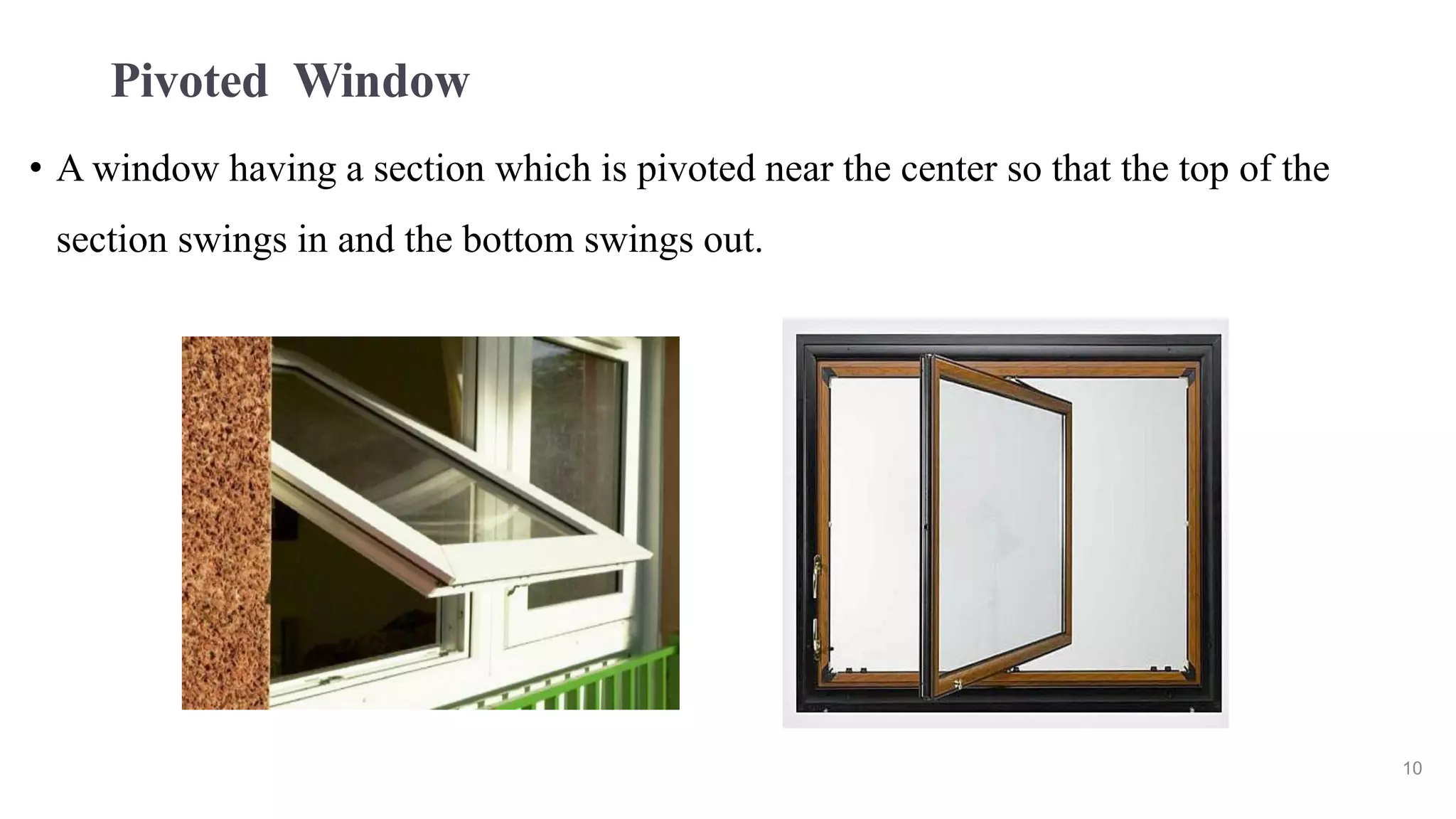
• A window having a section which is pivoted near the center so that the top of the
section swings in and the bottom swings out.
Pivoted Window
10
•A window with two parts that overlap slightly and slide up and down inside
the frame allowing for ventilation on the top, bottom or both.
•The two parts are not necessarily the same size.
Double hung windows
11
•Their shutters move either horizontally or vertically on roller bearing
•Suitable grooves are left in the frames to accommodate the shutters
•Provided in trains, buses, bank counter etc
Sliding Windows
12
• Panels are fully glazed
• Space between top and bottom rails divided into small panels by timber
members places horizontally and vertically
Sash Window
13
• A louver is a window, blind with horizontal slats that are angled to admit light
and air, but to keep out rain, direct sunshine, and noise
• Not permit outside vision
• The economical angle of the inclination of the louvers is45°
• Usually blinds are fixed.
Louvred Window
14
• Metal windows, made up of mild steel having lesser cost and more strength.
• Commonly used sections are angle, Z sections, T sections and channel sections, all
of which modified in shape to meet various requirement of window functioning
Metal Windows
15
16
Advantages
• Greater precision and better quality control
• No contraction or expansion due to weather effects
• Rot proof and termite proof
• Stronger and more durable
• Highly fire resistant
• Fabricated from thin section, they provide more effective area for light and
ventilation
• Easy to maintain
•Project outside the external wall of the room
•Projection may be triangular, circular or rectangular in plan.
•Provided to get an increased area of opening for admitting greater light and air.
•Provide extra space in room and improve appearance
Bay Window
17
• This type of window has two faces in perpendicular directions and these are
provided in the corner of room.
Corner Window
• Dormer window is a vertical window provided on the sloping roof
• Provides ventilation and lighting to enclosed space below the roof
• Very good appearance
Dormer window
19

Windows

  • 1.
    WINDOWS & VENTILATORS PRESENTEDBY GAYATHRY SATHEESAN
  • 2.
    •A WINDOW isalso a vented barrier secured in a wall opening. •The function of the window is to admit light and air to the building and to give a view to the outside. WINDOW consists of two parts:- 1.Window frame fixed to the opening in the wall with holdfast 2.Window shutter fixed to the window frame WINDOW
  • 3.
    SOME TECHNICALTERMS FRAME:- Itis an assembly of horizontal and vertical members, forming an enclosure,to which the shutters are fixed SHUTERS:-These are the openable parts of a door or window. HEAD:-This is the top or uppermost horizontal part of frame
  • 5.
    SILL:-This is thelowest or bottom horizontal part of a window frame, not provided in door frames. HORN:- These are the horizontal projections of a frame.. REBATE :- It is the depression or recess made inside the door frame to receive the door shutter.
  • 7.
    • The locationof window should meet functional requirements of the room. • The window should be located in opposite wall, facing a door or another window, to achieve cross ventilation. • From the point of view of fresh air, a window should be located on the northern side of of a room. • The sill should be located about 70 t0 80 cm about floor level of the room. LOCATION OFWINDOWS
  • 8.
    Types of Windows •Fixed window • Pivoted window • Double hung window • Sliding window • Sash window • louvered window • Metal window • Bay window • Corner window • Dormer window • Gable window • Lantern window • Skylights • ventilator
  • 9.
    •A window thatcannot be opened,whose function is limited to allowing light to enter. •Used in situations where light or vision alone is needed as no ventilation is possible through fixed windows Fixed windows
  • 10.
    • A windowhaving a section which is pivoted near the center so that the top of the section swings in and the bottom swings out. Pivoted Window 10
  • 11.
    •A window withtwo parts that overlap slightly and slide up and down inside the frame allowing for ventilation on the top, bottom or both. •The two parts are not necessarily the same size. Double hung windows 11
  • 12.
    •Their shutters moveeither horizontally or vertically on roller bearing •Suitable grooves are left in the frames to accommodate the shutters •Provided in trains, buses, bank counter etc Sliding Windows 12
  • 13.
    • Panels arefully glazed • Space between top and bottom rails divided into small panels by timber members places horizontally and vertically Sash Window 13
  • 14.
    • A louveris a window, blind with horizontal slats that are angled to admit light and air, but to keep out rain, direct sunshine, and noise • Not permit outside vision • The economical angle of the inclination of the louvers is45° • Usually blinds are fixed. Louvred Window 14
  • 15.
    • Metal windows,made up of mild steel having lesser cost and more strength. • Commonly used sections are angle, Z sections, T sections and channel sections, all of which modified in shape to meet various requirement of window functioning Metal Windows 15
  • 16.
    16 Advantages • Greater precisionand better quality control • No contraction or expansion due to weather effects • Rot proof and termite proof • Stronger and more durable • Highly fire resistant • Fabricated from thin section, they provide more effective area for light and ventilation • Easy to maintain
  • 17.
    •Project outside theexternal wall of the room •Projection may be triangular, circular or rectangular in plan. •Provided to get an increased area of opening for admitting greater light and air. •Provide extra space in room and improve appearance Bay Window 17
  • 18.
    • This typeof window has two faces in perpendicular directions and these are provided in the corner of room. Corner Window
  • 19.
    • Dormer windowis a vertical window provided on the sloping roof • Provides ventilation and lighting to enclosed space below the roof • Very good appearance Dormer window 19