BY:
FALAK ARORA
TANVI CHADHA
2ND YEAR
B.ARCH
MBS SPA
Part of the primary capital programme, the design
carefully integrates an open and inviting building into
a well-balanced landscape proposal. The building
envelope is extremely permeable to the exterior
environment and all classrooms have direct access to
external activity spaces.
 Name: Park Brow Community Primary
School, Knowsley
 Colour ref: Natural White, 32300, 32400,
31400
 Completed: 15th August 2011
 Architect: 2020 Liverpool
 Location: Broad Lane, Kirkby, Liverpool,
Merseyside , England
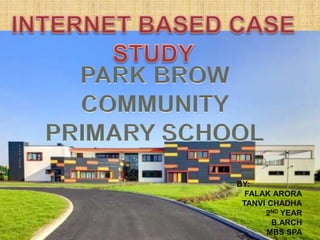
 The school consists of blocks of two differing heights which serve
to break the overall mass of the building.
 The facades have a backdrop of white render and individual
elements highlighted with cladding of varying colours.
 These highlighted elements are used to signify important aspects
of the scheme, such as the entrance block and main hall.
 The toilets pods between the classrooms are also brightly
coloured to highlight entrance points and to differentiate between
classes.
 The classrooms on the edge of the building have been located on
the east and south facades to exploit better aspects within the
site.
 All classrooms benefit from floor to ceiling glazed walls internally
and externally, which provide bright and open learning spaces.
 Internally the screens have adjustable louvers which allow the
teaching staff to vary the degree of visibility into each teaching
space. This open and transparent arrangement allows both
students and staff to feel fully integrated with all other members of
the school community.
 Integral to design development was the client's wish to have an
environmentally sustainable school, with the associated lifecycle
benefits. The building is almost completely naturally ventilated with
attenuation provided to the elevations which face onto a busy road.
 Central north lights are linked to a system which responds to
temperature and carbon dioxide levels within the building.
 All classrooms and the school hall are passively ventilated and provide
through ventilation from the facade openings and grilles.
 The overheating potential within the building is reduced by the careful
use of overhangs and building orientation.
 Environmental performance is further enhanced by the use of Biomass
as the primary energy supply.
DESIGN
 The monotony has been very well broken by introducing soothing
colors in the facades.
 Also the variation of height has contributed to the aesthetic appeal of the
building.
 The building has been brought into proportion by dividing it into different
blocks of varying heights.
 The background has been chosen as white to enhance the bright
colours.
 Even the interiors are designed well for the students and staff to enjoy
the environment.
 School, being boring at times ,has been made interesting in this
manner.
 Even the interiors are designed well for the staff and students to
enjoy the environment.
 The main entrance of the building has been highlighted by putting
varying colours to it.
 Classrooms are in south and east for a good view which incorporates a
playful environment.
 Transparency has been provided through glass and louvers.
 The main thing about the school is that it has been built keeping in mind
the environmental impact.
 The building is naturally ventilated which is seen very less nowadays.
 Use of passive techniques- provision of grilles- and overheating is
reduced by the use of overhangs and orientation of the building.
 Primary energy supply- biomass, enhances the environmental
performance.

Park Brow community primary school

  • 1.
  • 2.
    Part of theprimary capital programme, the design carefully integrates an open and inviting building into a well-balanced landscape proposal. The building envelope is extremely permeable to the exterior environment and all classrooms have direct access to external activity spaces.
  • 4.
     Name: ParkBrow Community Primary School, Knowsley  Colour ref: Natural White, 32300, 32400, 31400  Completed: 15th August 2011  Architect: 2020 Liverpool  Location: Broad Lane, Kirkby, Liverpool, Merseyside , England
  • 5.
     The schoolconsists of blocks of two differing heights which serve to break the overall mass of the building.  The facades have a backdrop of white render and individual elements highlighted with cladding of varying colours.  These highlighted elements are used to signify important aspects of the scheme, such as the entrance block and main hall.  The toilets pods between the classrooms are also brightly coloured to highlight entrance points and to differentiate between classes.
  • 12.
     The classroomson the edge of the building have been located on the east and south facades to exploit better aspects within the site.  All classrooms benefit from floor to ceiling glazed walls internally and externally, which provide bright and open learning spaces.  Internally the screens have adjustable louvers which allow the teaching staff to vary the degree of visibility into each teaching space. This open and transparent arrangement allows both students and staff to feel fully integrated with all other members of the school community.
  • 17.
     Integral todesign development was the client's wish to have an environmentally sustainable school, with the associated lifecycle benefits. The building is almost completely naturally ventilated with attenuation provided to the elevations which face onto a busy road.  Central north lights are linked to a system which responds to temperature and carbon dioxide levels within the building.  All classrooms and the school hall are passively ventilated and provide through ventilation from the facade openings and grilles.  The overheating potential within the building is reduced by the careful use of overhangs and building orientation.  Environmental performance is further enhanced by the use of Biomass as the primary energy supply.
  • 19.
    DESIGN  The monotonyhas been very well broken by introducing soothing colors in the facades.  Also the variation of height has contributed to the aesthetic appeal of the building.  The building has been brought into proportion by dividing it into different blocks of varying heights.  The background has been chosen as white to enhance the bright colours.  Even the interiors are designed well for the students and staff to enjoy the environment.
  • 20.
     School, beingboring at times ,has been made interesting in this manner.  Even the interiors are designed well for the staff and students to enjoy the environment.  The main entrance of the building has been highlighted by putting varying colours to it.
  • 21.
     Classrooms arein south and east for a good view which incorporates a playful environment.  Transparency has been provided through glass and louvers.  The main thing about the school is that it has been built keeping in mind the environmental impact.  The building is naturally ventilated which is seen very less nowadays.  Use of passive techniques- provision of grilles- and overheating is reduced by the use of overhangs and orientation of the building.  Primary energy supply- biomass, enhances the environmental performance.