1) With thehelp of neat diagrams explain the constructional details of Darrieus
type and multi-bladed type wind turbines. What are their applications?
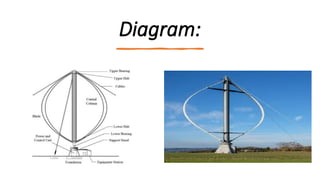
1. DARRIEUS TYPE WIND TURBINE
Constructional Details:
The Darrieus turbine is a vertical axis wind turbine (VAWT), named after the
French engineer Georges Darrieus. It operates on the lift principle rather than drag.
3.
Key Components:
Rotor Blades: Usually 2 or 3 curved blades shaped like an eggbeater.
Vertical Shaft : Axis of rotation is vertical.
Generator : Placed at the base (ground level), making maintenance easier.
Support Structure : Includes guy wires or a frame to support the vertical shaft.
Yaw Mechanism : Not needed because it captures wind from all directions.
Working Principle:
Uses aerofoil-shaped blades that rotate due to lift generated by wind.
Self-starting is often poor; requires external force or another turbine to start.
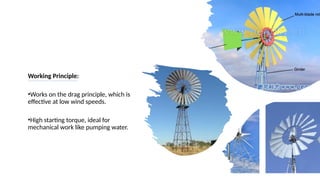
2. MULTI-BLADED TYPEWIND TURBINE
Constructional Details:
Multi-bladed wind turbines are typically horizontal axis wind turbines (HAWT) with many blades, usually 12 or more. They
are commonly used in low-speed applications like water pumping.
Key Components:
Rotor with Multiple Blades : Often wooden or metal, shaped for drag operation.
Horizontal Shaft : Axis of rotation is horizontal and aligned with wind.
Tail Vane : Keeps turbine facing the wind.
Gearbox/Pump : Connected to the rotor shaft; commonly used for mechanical work like water lifting.
Tower : Elevates the turbine to catch higher wind speeds.
6.
Working Principle:
•Works onthe drag principle, which is
effective at low wind speeds.
•High starting torque, ideal for
mechanical work like pumping water.
7.
APPLICATIONS:
Darrieus Type:
• Urbanwind energy systems.
• Wind farms (less common than HAWTs).
• Hybrid renewable systems.
• Areas with variable wind directions.
Multi-bladed Type:
• Water pumping in rural/agricultural areas.
• Mechanical grinding or milling (historically).
• Small-scale off-grid applications
8.
2). What arethe limitations of wind energy conversion systems?
1. Intermittent and Unpredictable Wind
• Wind speed is variable and uncontrollable.
• Power generation is not constant or reliable.
• Not suitable as a sole power source without storage or backup.
2. Low Energy Density
• Wind energy has a low power density compared to fossil fuels.
• Requires large areas of land or sea for utility-scale power generation.
3. Energy Storage Requirement
• Because of wind variability, energy storage (like batteries) is needed to maintain a stable power supply.
• Storage solutions add to cost and complexity.
9.
4. High InitialInvestment
• High cost for installation, infrastructure, and grid connection.
• Payback periods can be long, especially in low-wind regions.
5. Noise and Visual Pollution
• Turbines produce mechanical and aerodynamic noise.
• Can be aesthetic nuisances, especially in scenic or residential areas.
6. Impact on Wildlife
• Rotating blades can be hazardous to birds and bats.
• Offshore turbines may disturb marine ecosystems.
7. Location Constraints
• Effective only in areas with consistent and strong wind speeds (≥12–15 km/h).
• Unsuitable for heavily forested, mountainous, or urban areas without adequate wind.
10.
3) Explain indetail the different types of classifications of Wind energy Conversion
systems ?
1. Based on Axis of Rotation
a) Horizontal Axis Wind Turbine (HAWT)
• Rotor shaft is parallel to the ground and wind direction.
• Most common type in large-scale wind farms.
• Requires a yaw mechanism to face the wind.
Examples: Three-bladed turbines used in wind farms.
Advantages:
• High efficiency.
• Mature technology.
11.
Disadvantages:
• Needs winddirection tracking.
• Tower-mounted generator is hard to maintain
b) Vertical Axis Wind Turbine (VAWT)
• Rotor shaft is perpendicular to the ground.
• Accepts wind from any direction; no yaw mechanism needed.
Types:
• Darrieus type (lift-based)
• Savonius type (drag-based)
Advantages:
• Can be placed closer to the ground.
• Easier maintenance.
Disadvantages:
• Lower efficiency.
• Often needs external help to start
12.
2. Based onPower Output Capacity
a) Small WECS
• Capacity: Up to 10 kW
• Used for residential or small-scale applications.
b) Medium WECS
• Capacity: 10 kW – 100 kW
• Suitable for farms, schools, and small industries.
c) Large WECS
• Capacity: Above 100 kW (usually in MW)
• Used in grid-connected commercial wind farms.
13.
3. Based onRotor Speed
a) Constant Speed WECS
• Operates at fixed RPM.
• Simple design but less efficient in variable wind
b) Variable Speed WECS
• RPM varies with wind speed.
• Requires power electronics but improves energy capture.
4. Based on Location
a) Onshore WECS
• Installed on land.
• Easier to install and maintain.
14.
b) Offshore WECS
•Installed in sea or lakes.
• Higher wind speeds but expensive installation and maintenance
5.Based on Generator Type
a) Synchronous Generator WECS
b) Induction Generator WECS
c) Permanent Magnet Generator WECS
d) Each has different efficiency, control, and cost implications.
15.
4) Explain theworking principle of a wind energy conversion system. What is the
importance of drag and lift forces acting on wind energy systems ?
A Wind Energy Conversion System (WECS) converts the kinetic energy of the wind into mechanical
energy, which is then often converted into electrical energy using a generator.
Basic Working Principle:
1. Wind Flow:
• Wind is moving air that contains kinetic energy.
• The amount of energy available is proportional to the cube of wind speed.
2. Rotor Blades (Wind Turbine Blades):
• Wind strikes the aerodynamically shaped blades.
• The blades rotate due to the wind's force (primarily using lift and drag forces).
• The rotor is connected to a shaft
16.
3. Shaft andGearbox:
• The rotating blades turn a low-speed shaft.
• In large turbines, a gearbox increases the rotational speed to match the generator's requirements.
4. Generator:
• The mechanical energy from the shaft is converted to electrical energy by a generator.
5. Power Electronics and Control Systems:
• These systems manage voltage, frequency, and grid connection.
6. Output:
• The final output is usable electrical power, which can be used locally or fed into the electrical grid.
17.
Importance of Dragand Lift Forces in Wind Energy Systems
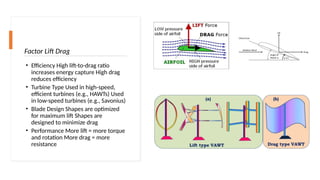
Wind turbine blades are airfoils, similar to airplane wings. Two aerodynamic forces act on them:
1. Lift Force:
• Acts perpendicular to the direction of the wind.
• Caused by pressure differences between the upper and lower surfaces of the blade due to wind flow.
• Primary force responsible for rotating the blades in modern horizontal-axis wind turbines (HAWTs).
• Enables efficient energy extraction from the wind.
2. Drag Force:
• Acts parallel and in the direction of wind flow.
• Caused by friction and pressure on the blade surface.
• Usually undesirable in lift-based turbines as it resists blade motion, reducing efficiency
18.
Factor Lift Drag
•Efficiency High lift-to-drag ratio
increases energy capture High drag
reduces efficiency
• Turbine Type Used in high-speed,
efficient turbines (e.g., HAWTs) Used
in low-speed turbines (e.g., Savonius)
• Blade Design Shapes are optimized
for maximum lift Shapes are
designed to minimize drag
• Performance More lift = more torque
and rotation More drag = more
resistance
19.
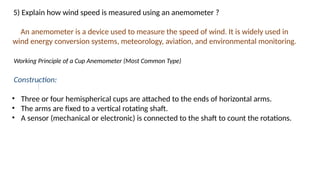
5) Explain howwind speed is measured using an anemometer ?
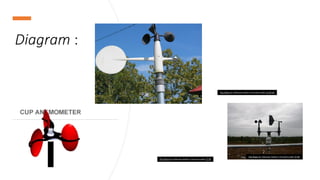
An anemometer is a device used to measure the speed of wind. It is widely used in
wind energy conversion systems, meteorology, aviation, and environmental monitoring.
Working Principle of a Cup Anemometer (Most Common Type)
Construction:
• Three or four hemispherical cups are attached to the ends of horizontal arms.
• The arms are fixed to a vertical rotating shaft.
• A sensor (mechanical or electronic) is connected to the shaft to count the rotations.
20.
How It Works:
1.Wind blows into the cups.
2. The cups rotate around the vertical axis.
3. The rotation speed increases with wind speed.
4. The number of revolutions per unit time (e.g., per second) is recorded.
5. This rotational speed is converted into wind speed using a calibration constant.
21.
Diagram :
This Photoby Unknown Author is licensed under CC BY-NC
This Photo by Unknown Author is licensed under CC BY
This Photo by Unknown Author is licensed under CC BY