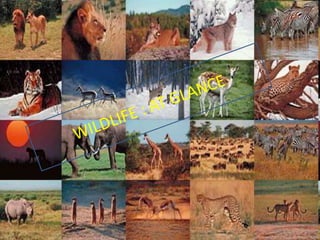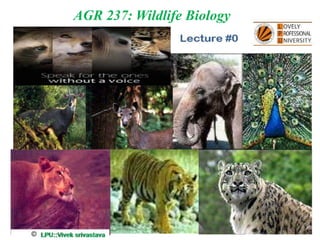
AGR 237: Wildlife Biology
Course Details:
• LTP: 1 0 0 [One lecture/ Week]
Textbook:
• Manual for Wildlife Management in India by S.S.
Negi, International Book Distributors 1st Edition
(2013).
• Plant, Wildlife, and Man A Conservation Scenario of
Bay Islands and the Himalayas" by A.B. Chaudhuri,
A.P.H. Publishing Corporation 1st Edition (2013).
WILDLIFE?
Wildlife or Wild animal
species refers to all living
things, plants, invertebrates
and vertebrates outside the
direct control of man (that
is, all non-cultivated plants
and non-domesticated
animals). It embraces all
animals in their natural
habitat.
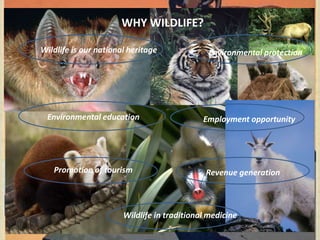
WHY WILDLIFE?
Wildlife is our national heritage Environmental protection
Promotion of tourism
Wildlife in traditional medicine
Employment opportunity
Revenue generation
Environmental education
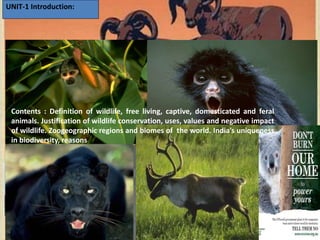
UNIT-1 Introduction:
Contents : Definition of wildlife, free living, captive, domesticated and feral
animals. Justification of wildlife conservation, uses, values and negative impact
of wildlife. Zoogeographic regions and biomes of the world. India’s uniqueness
in biodiversity, reasons
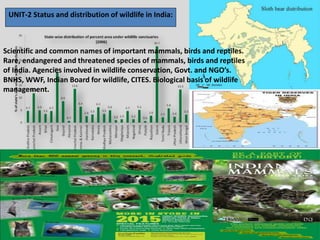
UNIT-2 Status and distribution of wildlife in India:
Scientific and common names of important mammals, birds and reptiles.
Rare, endangered and threatened species of mammals, birds and reptiles
of India. Agencies involved in wildlife conservation, Govt. and NGO’s.
BNHS, WWF, Indian Board for wildlife, CITES. Biological basis of wildlife
management.
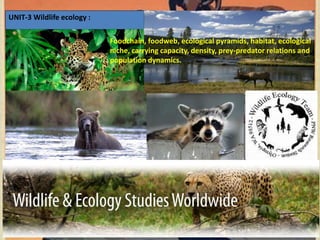
UNIT-3 Wildlife ecology :
Foodchain, foodweb, ecological pyramids, habitat, ecological
niche, carrying capacity, density, prey-predator relations and
population dynamics.
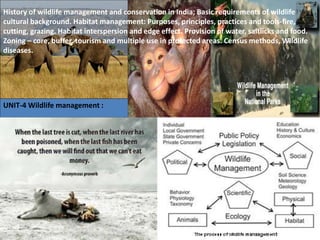
UNIT-4 Wildlife management :
History of wildlife management and conservation in India; Basic requirements of wildlife
cultural background. Habitat management: Purposes, principles, practices and tools-fire,
cutting, grazing. Habitat interspersion and edge effect. Provision of water, saltlicks and food.
Zoning – core, buffer, tourism and multiple use in protected areas. Census methods, Wildlife
diseases.
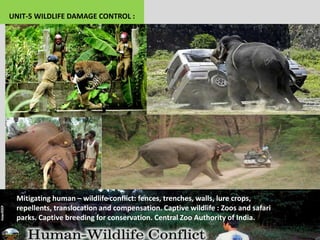
UNIT-5 WILDLIFE DAMAGE CONTROL :
Mitigating human – wildlife conflict: fences, trenches, walls, lure crops,
repellents, translocation and compensation. Captive wildlife : Zoos and safari
parks. Captive breeding for conservation. Central Zoo Authority of India.
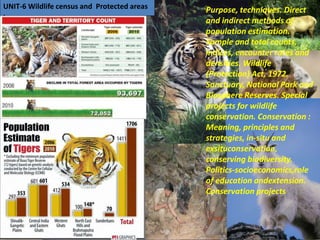
UNIT-6 Wildlife census and Protected areas
:
Purpose, techniques. Direct
and indirect methods of
population estimation.
Sample and total counts,
indices, encounter rates and
densities. Wildlife
(Protection) Act, 1972.
Sanctuary, National Park and
Biosphere Reserves. Special
projects for wildlife
conservation. Conservation :
Meaning, principles and
strategies, in-situ and
exsituconservation,
conserving biodiversity.
Politics-socioeconomics,role
of education andextension.
Conservation projects
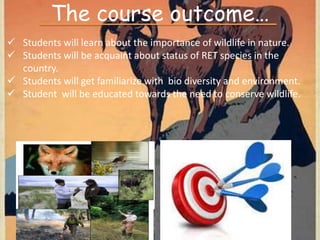
The course outcome…
 Students will learn about the importance of wildlife in nature.
 Students will be acquaint about status of RET species in the
country.
 Students will get familiarize with bio diversity and environment.
 Student will be educated towards the need to conserve wildlife.
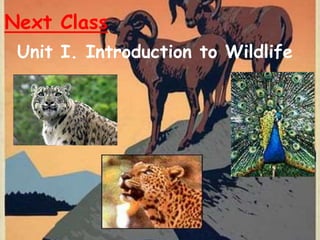
Next Class
Unit I. Introduction to Wildlife
THANK YOU ALL

wildlife biology

  • 1.
  • 2.
    Course Details: • LTP:1 0 0 [One lecture/ Week] Textbook: • Manual for Wildlife Management in India by S.S. Negi, International Book Distributors 1st Edition (2013). • Plant, Wildlife, and Man A Conservation Scenario of Bay Islands and the Himalayas" by A.B. Chaudhuri, A.P.H. Publishing Corporation 1st Edition (2013).
  • 5.
    WILDLIFE? Wildlife or Wildanimal species refers to all living things, plants, invertebrates and vertebrates outside the direct control of man (that is, all non-cultivated plants and non-domesticated animals). It embraces all animals in their natural habitat.
  • 6.
    WHY WILDLIFE? Wildlife isour national heritage Environmental protection Promotion of tourism Wildlife in traditional medicine Employment opportunity Revenue generation Environmental education
  • 7.
    UNIT-1 Introduction: Contents :Definition of wildlife, free living, captive, domesticated and feral animals. Justification of wildlife conservation, uses, values and negative impact of wildlife. Zoogeographic regions and biomes of the world. India’s uniqueness in biodiversity, reasons
  • 8.
    UNIT-2 Status anddistribution of wildlife in India: Scientific and common names of important mammals, birds and reptiles. Rare, endangered and threatened species of mammals, birds and reptiles of India. Agencies involved in wildlife conservation, Govt. and NGO’s. BNHS, WWF, Indian Board for wildlife, CITES. Biological basis of wildlife management.
  • 9.
    UNIT-3 Wildlife ecology: Foodchain, foodweb, ecological pyramids, habitat, ecological niche, carrying capacity, density, prey-predator relations and population dynamics.
  • 10.
    UNIT-4 Wildlife management: History of wildlife management and conservation in India; Basic requirements of wildlife cultural background. Habitat management: Purposes, principles, practices and tools-fire, cutting, grazing. Habitat interspersion and edge effect. Provision of water, saltlicks and food. Zoning – core, buffer, tourism and multiple use in protected areas. Census methods, Wildlife diseases.
  • 11.
    UNIT-5 WILDLIFE DAMAGECONTROL : Mitigating human – wildlife conflict: fences, trenches, walls, lure crops, repellents, translocation and compensation. Captive wildlife : Zoos and safari parks. Captive breeding for conservation. Central Zoo Authority of India.
  • 12.
    UNIT-6 Wildlife censusand Protected areas : Purpose, techniques. Direct and indirect methods of population estimation. Sample and total counts, indices, encounter rates and densities. Wildlife (Protection) Act, 1972. Sanctuary, National Park and Biosphere Reserves. Special projects for wildlife conservation. Conservation : Meaning, principles and strategies, in-situ and exsituconservation, conserving biodiversity. Politics-socioeconomics,role of education andextension. Conservation projects
  • 13.
    The course outcome… Students will learn about the importance of wildlife in nature.  Students will be acquaint about status of RET species in the country.  Students will get familiarize with bio diversity and environment.  Student will be educated towards the need to conserve wildlife.
  • 14.
    Next Class Unit I.Introduction to Wildlife
  • 15.