An introduction to 5G
Speaker: Andrei Novikov, PhD, Software Designer at Sioux Technologies
© 2020 Andrei Novikov 1
What does G mean?
Like 1G, 2G, etc.
© 2020 Andrei Novikov 2
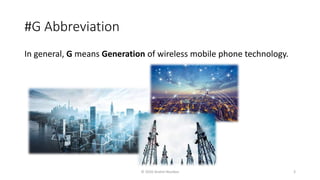
#G Abbreviation
In general, G means Generation of wireless mobile phone technology.
© 2020 Andrei Novikov 3
1G Technology
© 2020 Andrei Novikov 4
1G Technology
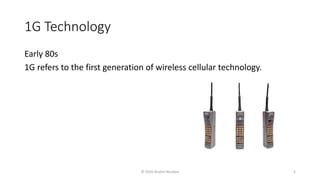
Early 80s
1G refers to the first generation of wireless cellular technology.
© 2020 Andrei Novikov 5
1G Technology
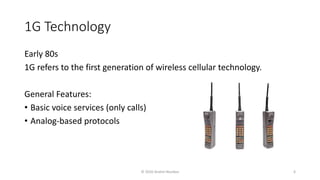
Early 80s
1G refers to the first generation of wireless cellular technology.
General Features:
• Basic voice services (only calls)
• Analog-based protocols
© 2020 Andrei Novikov 6
1G Features
© 2020 Andrei Novikov 7
1G Technology – Features
• Frequency: 150MHz, 900MHz.
© 2020 Andrei Novikov 8
1G Technology – Features
• Frequency: 150MHz, 900MHz
• Bandwidth: 30KHz – Analog
© 2020 Andrei Novikov 9
1G Technology – Features
• Frequency: 150MHz, 900MHz
• Bandwidth: 30KHz – Analog
• Data Rate: 2.4Kbps
© 2020 Andrei Novikov 10
1G Technology – Features
• Frequency: 150MHz, 900MHz
• Bandwidth: 30KHz – Analog
• Data Rate: 2.4Kbps
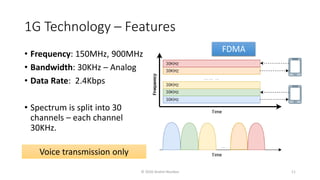
• Spectrum is split into 30
channels – each channel
30KHz.
Voice transmission only
FDMA
© 2020 Andrei Novikov 11
1G Limitations
© 2020 Andrei Novikov 12
1G Technology – Limitations
• Poor sound quality.
© 2020 Andrei Novikov 13
1G Technology – Limitations
• Poor sound quality.
• Analog systems – inefficient use of the spectrum.
© 2020 Andrei Novikov 14
1G Technology – Limitations
• Poor sound quality.
• Analog systems – inefficient use of the spectrum.
• Low capacity, FDMA technique does maximize system capacity.
© 2020 Andrei Novikov 15
1G Technology – Limitations
• Poor sound quality.
• Analog systems – inefficient use of the spectrum.
• Low capacity, FDMA technique does maximize system capacity.
• Different 1G systems are incompatible with one another.
© 2020 Andrei Novikov 16
1G Technology – Limitations
• Poor sound quality.
• Analog systems – inefficient use of the spectrum.
• Low capacity, FDMA technique does maximize system capacity.
• Different 1G systems are incompatible with one another.
• No roaming between different operators.
© 2020 Andrei Novikov 17
1G Technology – Limitations
• Poor sound quality.
• Analog systems – inefficient use of the spectrum.
• Low capacity, FDMA technique does maximize system capacity.
• Different 1G systems are incompatible with one another.
• No roaming between different operators.
• Weak security on air interface, no support for encryption.
© 2020 Andrei Novikov 18
1G Technology – Limitations
• Poor sound quality.
• Analog systems – inefficient use of the spectrum.
• Low capacity, FDMA technique does maximize system capacity.
• Different 1G systems are incompatible with one another.
• No roaming between different operators.
• Weak security on air interface, no support for encryption.
• Lack of mobile assisted handover.
© 2020 Andrei Novikov 19
2G Technology
© 2020 Andrei Novikov 20
2G Technology
2G refers to the second generation cellular network.
© 2020 Andrei Novikov 21
2G Technology
2G refers to the second generation cellular network.
2G cellular networks were commercially launched on the GSM standard
in Finland by Radiolinja in 1991.
© 2020 Andrei Novikov 22
2G Technology
2G refers to the second generation cellular network.
2G cellular networks were commercially launched on the GSM standard
in Finland by Radiolinja in 1991.
General Services:
• Text messages (SMS)
• Multi-media messages (MMS)
© 2020 Andrei Novikov 23
2G Technology
2G refers to the second generation cellular network.
2G cellular networks were commercially launched on the GSM standard
in Finland by Radiolinja in 1991.
General Services:
• Text messages (SMS)
• Multi-media messages (MMS)
Radio signals are digital unlike 1G
© 2020 Andrei Novikov 24
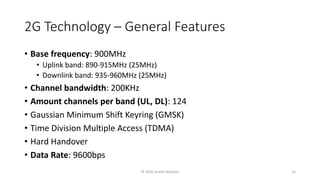
2G Technology – General Features
• Base frequency: 900MHz
• Uplink band: 890-915MHz (25MHz)
• Downlink band: 935-960MHz (25MHz)
• Channel bandwidth: 200KHz
• Amount channels per band (UL, DL): 124
• Gaussian Minimum Shift Keyring (GMSK)
• Time Division Multiple Access (TDMA)
• Hard Handover
• Data Rate: 9600bps
© 2020 Andrei Novikov 25
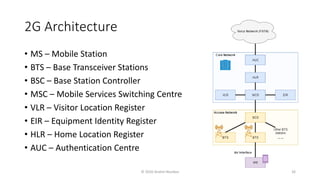
2G Architecture
• MS – Mobile Station
• BTS – Base Transceiver Stations
• BSC – Base Station Controller
• MSC – Mobile Services Switching Centre
• VLR – Visitor Location Register
• EIR – Equipment Identity Register
• HLR – Home Location Register
• AUC – Authentication Centre
© 2020 Andrei Novikov 26
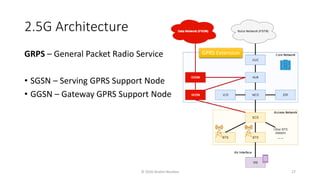
2.5G Architecture
GRPS – General Packet Radio Service
• SGSN – Serving GPRS Support Node
• GGSN – Gateway GPRS Support Node
GPRS Extension
© 2020 Andrei Novikov 27
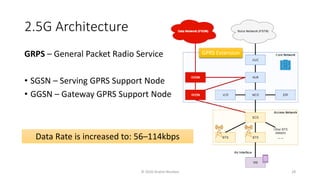
2.5G Architecture
GRPS – General Packet Radio Service
• SGSN – Serving GPRS Support Node
• GGSN – Gateway GPRS Support Node
GPRS Extension
Data Rate is increased to: 56–114kbps
© 2020 Andrei Novikov 28
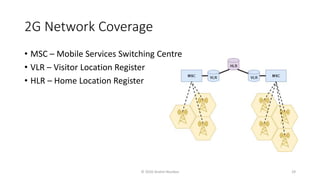
2G Network Coverage
• MSC – Mobile Services Switching Centre
• VLR – Visitor Location Register
• HLR – Home Location Register
© 2020 Andrei Novikov 29
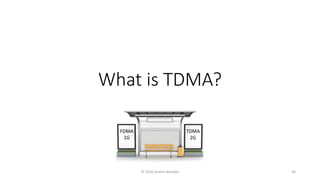
What is TDMA?
TDMA
2G
FDMA
1G
© 2020 Andrei Novikov 30
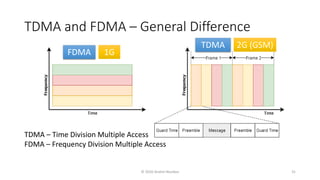
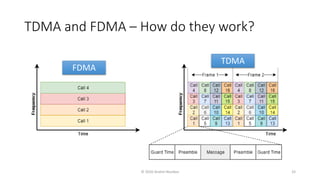
TDMA and FDMA – General Difference
TDMA – Time Division Multiple Access
FDMA – Frequency Division Multiple Access
FDMA
TDMA
1G
2G (GSM)
© 2020 Andrei Novikov 31
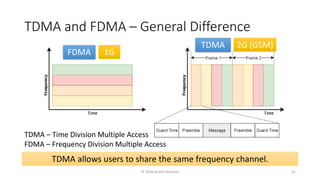
TDMA and FDMA – General Difference
TDMA allows users to share the same frequency channel.
TDMA – Time Division Multiple Access
FDMA – Frequency Division Multiple Access
FDMA
TDMA
1G
2G (GSM)
© 2020 Andrei Novikov 32
TDMA and FDMA – How do they work?
FDMA
TDMA
© 2020 Andrei Novikov 33
3G Technology
© 2020 Andrei Novikov 34
3G Technology – UMTS
UMTS – Universal Mobile Telecommunication System.
3G technology evolved from GSM-GPRS based network architecture.
Minimum data rate requirement:
• 2Mpbs for stationary users.
• 384 Kbps for walking users.
© 2020 Andrei Novikov 35
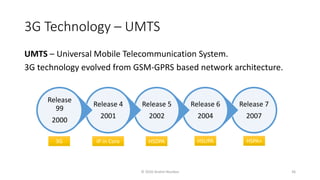
3G Technology – UMTS
UMTS – Universal Mobile Telecommunication System.
3G technology evolved from GSM-GPRS based network architecture.
Release 7
2007
Release 6
2004
Release 5
2002
Release 4
2001
Release
99
2000
HSPA+HSUPAHSDPA3G IP in Core
© 2020 Andrei Novikov 36
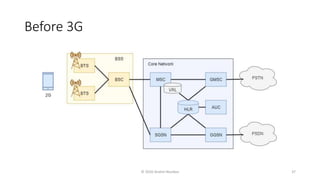
Before 3G
© 2020 Andrei Novikov 37
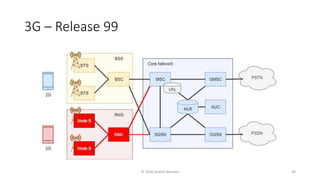
3G – Release 99
© 2020 Andrei Novikov 38
3G – Release 99
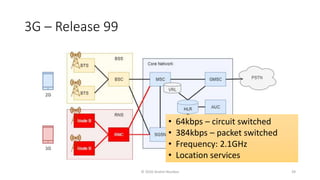
• 64kbps – circuit switched
• 384kbps – packet switched
• Frequency: 2.1GHz
• Location services
© 2020 Andrei Novikov 39
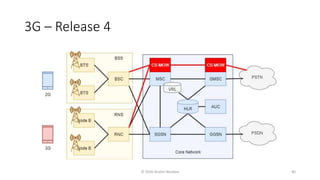
3G – Release 4
© 2020 Andrei Novikov 40
3G – Release 4
• EDGE radio – Enhanced Data rates for GSM Evolution.
• IMS – IP Multimedia Services
• MExE – Mobile Execution Environment
• Improved location services
• TD-SCDMA (UTRA-TDD 1.28 Mcps low chip rate)
© 2020 Andrei Novikov 41
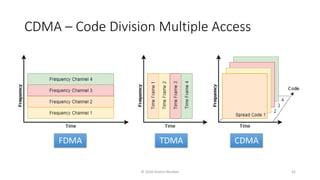
CDMA – Code Division Multiple Access
FDMA TDMA CDMA
© 2020 Andrei Novikov 42
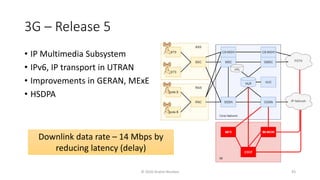
3G – Release 5
• IP Multimedia Subsystem
• IPv6, IP transport in UTRAN
• Improvements in GERAN, MExE
• HSDPA
Downlink data rate – 14 Mbps by
reducing latency (delay)
© 2020 Andrei Novikov 43
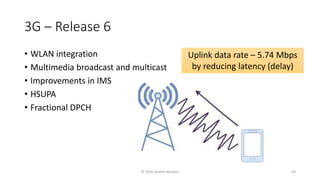
3G – Release 6
• WLAN integration
• Multimedia broadcast and multicast
• Improvements in IMS
• HSUPA
• Fractional DPCH
Uplink data rate – 5.74 Mbps
by reducing latency (delay)
© 2020 Andrei Novikov 44
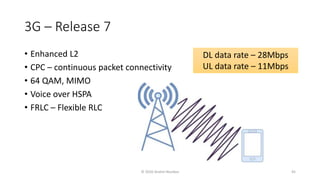
3G – Release 7
• Enhanced L2
• CPC – continuous packet connectivity
• 64 QAM, MIMO
• Voice over HSPA
• FRLC – Flexible RLC
DL data rate – 28Mbps
UL data rate – 11Mbps
© 2020 Andrei Novikov 45
4G Technology
LTE (Long Term Evolution)
© 2020 Andrei Novikov 46
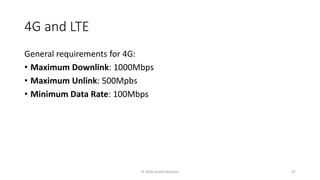
4G and LTE
General requirements for 4G:
• Maximum Downlink: 1000Mbps
• Maximum Unlink: 500Mpbs
• Minimum Data Rate: 100Mbps
© 2020 Andrei Novikov 47
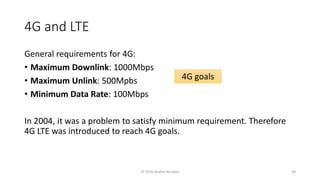
4G and LTE
General requirements for 4G:
• Maximum Downlink: 1000Mbps
• Maximum Unlink: 500Mpbs
• Minimum Data Rate: 100Mbps
In 2004, it was a problem to satisfy minimum requirement. Therefore
4G LTE was introduced to reach 4G goals.
4G goals
© 2020 Andrei Novikov 48
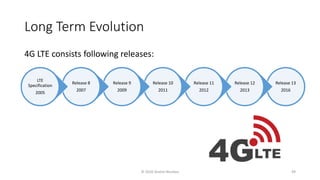
Release 13
2016
Release 12
2013
Release 11
2012
Release 10
2011
Release 9
2009
Release 8
2007
LTE
Specification
2005
Long Term Evolution
4G LTE consists following releases:
© 2020 Andrei Novikov 49
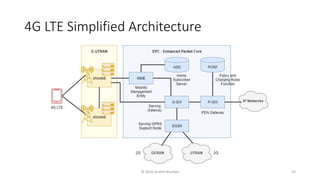
4G LTE Simplified Architecture
© 2020 Andrei Novikov 50
4G Features – Heterogeneous Networks
• Heterogeneous Networks
© 2020 Andrei Novikov 51
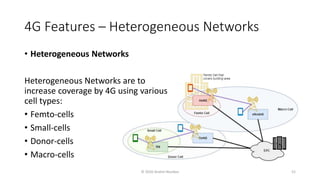
4G Features – Heterogeneous Networks
• Heterogeneous Networks
Heterogeneous Networks are to
increase coverage by 4G using various
cell types:
• Femto-cells
• Small-cells
• Donor-cells
• Macro-cells
© 2020 Andrei Novikov 52
4G Features – Coordinate Multipoint
• Heterogeneous Networks
• Coordinate Multipoint
© 2020 Andrei Novikov 53
4G Features – Coordinate Multipoint
• Heterogeneous Networks
• Coordinate Multipoint
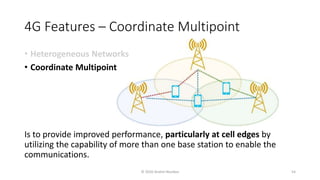
Is to provide improved performance, particularly at cell edges by
utilizing the capability of more than one base station to enable the
communications.
© 2020 Andrei Novikov 54
4G Features – Coordinate Multipoint
• Heterogeneous Networks
• Coordinate Multipoint Distributed
coordination
© 2020 Andrei Novikov 55
4G Features – Carrier Aggregation
• Heterogeneous Networks
• Coordinate Multipoint
• Carrier Aggregation
© 2020 Andrei Novikov 56
4G Features – Carrier Aggregation
• Heterogeneous Networks
• Coordinate Multipoint
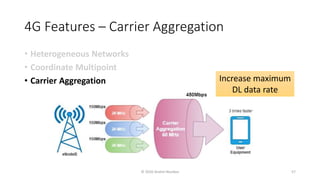
• Carrier Aggregation Increase maximum
DL data rate
© 2020 Andrei Novikov 57
4G Features – Carrier Aggregation
• Heterogeneous Networks
• Coordinate Multipoint
• Carrier Aggregation
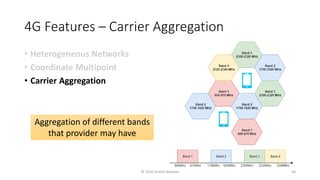
Aggregation of different bands
that provider may have
© 2020 Andrei Novikov 58
4G Features – Massive MIMO
• Heterogeneous Networks
• Coordinate Multipoint
• Carrier Aggregation
• Massive MIMO
© 2020 Andrei Novikov 59
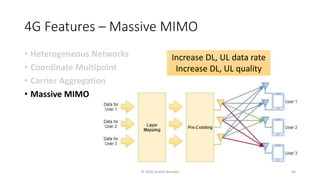
4G Features – Massive MIMO
• Heterogeneous Networks
• Coordinate Multipoint
• Carrier Aggregation
• Massive MIMO
Increase DL, UL data rate
Increase DL, UL quality
© 2020 Andrei Novikov 60
5G Technology
© 2020 Andrei Novikov 61
5 Key Technologies to Build
5G Network
© 2020 Andrei Novikov 62
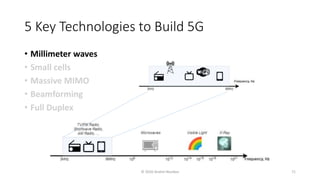
5 Key Technologies to Build 5G
• Millimeter waves
© 2020 Andrei Novikov 63
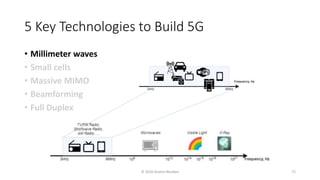
5 Key Technologies to Build 5G
• Millimeter waves
• Small cells
© 2020 Andrei Novikov 64
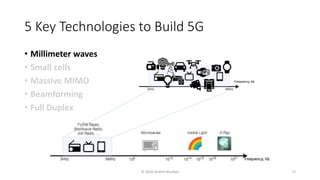
5 Key Technologies to Build 5G
• Millimeter waves
• Small cells
• Massive MIMO
© 2020 Andrei Novikov 65
5 Key Technologies to Build 5G
• Millimeter waves
• Small cells
• Massive MIMO
• Beamforming
© 2020 Andrei Novikov 66
5 Key Technologies to Build 5G
• Millimeter waves
• Small cells
• Massive MIMO
• Beamforming
• Full Duplex
© 2020 Andrei Novikov 67
5 Key Technologies to Build 5G
• Millimeter waves
• Small cells
• Massive MIMO
• Beamforming
• Full Duplex
© 2020 Andrei Novikov 68
5 Key Technologies to Build 5G
• Millimeter waves
• Small cells
• Massive MIMO
• Beamforming
• Full Duplex
© 2020 Andrei Novikov 69
5 Key Technologies to Build 5G
• Millimeter waves
• Small cells
• Massive MIMO
• Beamforming
• Full Duplex
© 2020 Andrei Novikov 70
5 Key Technologies to Build 5G
• Millimeter waves
• Small cells
• Massive MIMO
• Beamforming
• Full Duplex
© 2020 Andrei Novikov 71
5 Key Technologies to Build 5G
• Millimeter waves
• Small cells
• Massive MIMO
• Beamforming
• Full Duplex
© 2020 Andrei Novikov 72
5 Key Technologies to Build 5G
• Millimeter waves
• Small cells
• Massive MIMO
• Beamforming
• Full Duplex
© 2020 Andrei Novikov 73
5 Key Technologies to Build 5G
• Millimeter waves
• Small cells
• Massive MIMO
• Beamforming
• Full Duplex
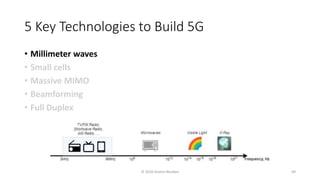
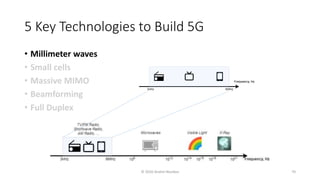
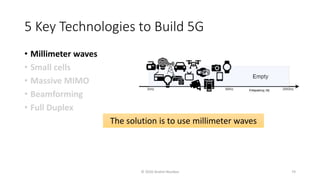
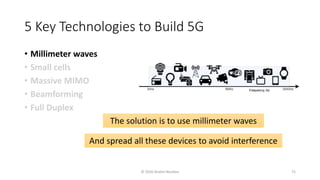
The solution is to use millimeter waves
© 2020 Andrei Novikov 74
5 Key Technologies to Build 5G
• Millimeter waves
• Small cells
• Massive MIMO
• Beamforming
• Full Duplex
The solution is to use millimeter waves
And spread all these devices to avoid interference
© 2020 Andrei Novikov 75
5 Key Technologies to Build 5G
• Millimeter waves
• Small cells
• Massive MIMO
• Beamforming
• Full Duplex
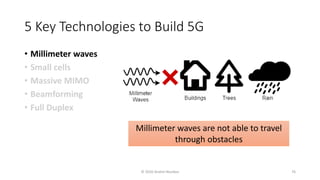
Millimeter waves are not able to travel
through obstacles
© 2020 Andrei Novikov 76
5 Key Technologies to Build 5G
• Millimeter waves
• Small cells
• Massive MIMO
• Beamforming
• Full Duplex
© 2020 Andrei Novikov 77
5 Key Technologies to Build 5G
• Millimeter waves
• Small cells
• Massive MIMO
• Beamforming
• Full Duplex
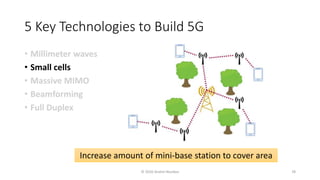
Increase amount of mini-base station to cover area
© 2020 Andrei Novikov 78
5 Key Technologies to Build 5G
• Millimeter waves
• Small cells
• Massive MIMO
• Beamforming
• Full Duplex
© 2020 Andrei Novikov 79
5 Key Technologies to Build 5G
• Millimeter waves
• Small cells
• Massive MIMO
• Beamforming
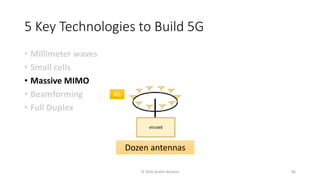
• Full Duplex
4G
Dozen antennas
© 2020 Andrei Novikov 80
5 Key Technologies to Build 5G
• Millimeter waves
• Small cells
• Massive MIMO
• Beamforming
• Full Duplex
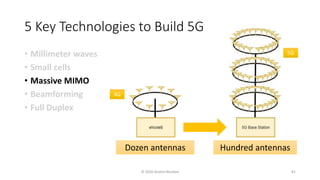
4G
Dozen antennas
5G
Hundred antennas
© 2020 Andrei Novikov 81
5 Key Technologies to Build 5G
• Millimeter waves
• Small cells
• Massive MIMO
• Beamforming
• Full Duplex
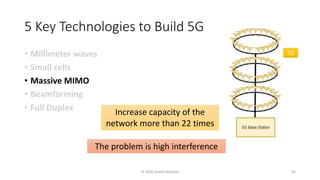
5G
Increase capacity of the
network more than 22 times
The problem is high interference
© 2020 Andrei Novikov 82
5 Key Technologies to Build 5G
• Millimeter waves
• Small cells
• Massive MIMO
• Beamforming
• Full Duplex
© 2020 Andrei Novikov 83
5 Key Technologies to Build 5G
• Millimeter waves
• Small cells
• Massive MIMO
• Beamforming
• Full Duplex
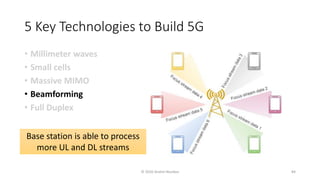
Base station is able to process
more UL and DL streams
© 2020 Andrei Novikov 84
5 Key Technologies to Build 5G
• Millimeter waves
• Small cells
• Massive MIMO
• Beamforming
• Full Duplex
© 2020 Andrei Novikov 85
5 Key Technologies to Build 5G
• Millimeter waves
• Small cells
• Massive MIMO
• Beamforming
• Full Duplex
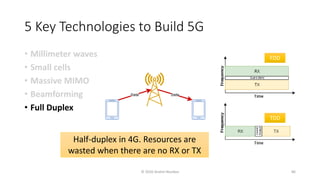
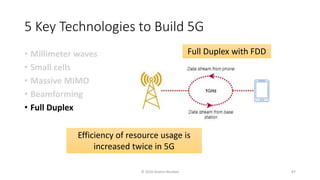
FDD
TDD
Half-duplex in 4G. Resources are
wasted when there are no RX or TX
© 2020 Andrei Novikov 86
5 Key Technologies to Build 5G
• Millimeter waves
• Small cells
• Massive MIMO
• Beamforming
• Full Duplex
Efficiency of resource usage is
increased twice in 5G
Full Duplex with FDD
© 2020 Andrei Novikov 87
5 Key Technologies to Build 5G
• Millimeter waves
• Small cells
• Massive MIMO
• Beamforming
• Full Duplex
© 2020 Andrei Novikov 88
Thank you
© 2020 Andrei Novikov 89

An introduction to 5G

  • 1.
    An introduction to5G Speaker: Andrei Novikov, PhD, Software Designer at Sioux Technologies © 2020 Andrei Novikov 1
  • 2.
    What does Gmean? Like 1G, 2G, etc. © 2020 Andrei Novikov 2
  • 3.
    #G Abbreviation In general,G means Generation of wireless mobile phone technology. © 2020 Andrei Novikov 3
  • 4.
    1G Technology © 2020Andrei Novikov 4
  • 5.
    1G Technology Early 80s 1Grefers to the first generation of wireless cellular technology. © 2020 Andrei Novikov 5
  • 6.
    1G Technology Early 80s 1Grefers to the first generation of wireless cellular technology. General Features: • Basic voice services (only calls) • Analog-based protocols © 2020 Andrei Novikov 6
  • 7.
    1G Features © 2020Andrei Novikov 7
  • 8.
    1G Technology –Features • Frequency: 150MHz, 900MHz. © 2020 Andrei Novikov 8
  • 9.
    1G Technology –Features • Frequency: 150MHz, 900MHz • Bandwidth: 30KHz – Analog © 2020 Andrei Novikov 9
  • 10.
    1G Technology –Features • Frequency: 150MHz, 900MHz • Bandwidth: 30KHz – Analog • Data Rate: 2.4Kbps © 2020 Andrei Novikov 10
  • 11.
    1G Technology –Features • Frequency: 150MHz, 900MHz • Bandwidth: 30KHz – Analog • Data Rate: 2.4Kbps • Spectrum is split into 30 channels – each channel 30KHz. Voice transmission only FDMA © 2020 Andrei Novikov 11
  • 12.
    1G Limitations © 2020Andrei Novikov 12
  • 13.
    1G Technology –Limitations • Poor sound quality. © 2020 Andrei Novikov 13
  • 14.
    1G Technology –Limitations • Poor sound quality. • Analog systems – inefficient use of the spectrum. © 2020 Andrei Novikov 14
  • 15.
    1G Technology –Limitations • Poor sound quality. • Analog systems – inefficient use of the spectrum. • Low capacity, FDMA technique does maximize system capacity. © 2020 Andrei Novikov 15
  • 16.
    1G Technology –Limitations • Poor sound quality. • Analog systems – inefficient use of the spectrum. • Low capacity, FDMA technique does maximize system capacity. • Different 1G systems are incompatible with one another. © 2020 Andrei Novikov 16
  • 17.
    1G Technology –Limitations • Poor sound quality. • Analog systems – inefficient use of the spectrum. • Low capacity, FDMA technique does maximize system capacity. • Different 1G systems are incompatible with one another. • No roaming between different operators. © 2020 Andrei Novikov 17
  • 18.
    1G Technology –Limitations • Poor sound quality. • Analog systems – inefficient use of the spectrum. • Low capacity, FDMA technique does maximize system capacity. • Different 1G systems are incompatible with one another. • No roaming between different operators. • Weak security on air interface, no support for encryption. © 2020 Andrei Novikov 18
  • 19.
    1G Technology –Limitations • Poor sound quality. • Analog systems – inefficient use of the spectrum. • Low capacity, FDMA technique does maximize system capacity. • Different 1G systems are incompatible with one another. • No roaming between different operators. • Weak security on air interface, no support for encryption. • Lack of mobile assisted handover. © 2020 Andrei Novikov 19
  • 20.
    2G Technology © 2020Andrei Novikov 20
  • 21.
    2G Technology 2G refersto the second generation cellular network. © 2020 Andrei Novikov 21
  • 22.
    2G Technology 2G refersto the second generation cellular network. 2G cellular networks were commercially launched on the GSM standard in Finland by Radiolinja in 1991. © 2020 Andrei Novikov 22
  • 23.
    2G Technology 2G refersto the second generation cellular network. 2G cellular networks were commercially launched on the GSM standard in Finland by Radiolinja in 1991. General Services: • Text messages (SMS) • Multi-media messages (MMS) © 2020 Andrei Novikov 23
  • 24.
    2G Technology 2G refersto the second generation cellular network. 2G cellular networks were commercially launched on the GSM standard in Finland by Radiolinja in 1991. General Services: • Text messages (SMS) • Multi-media messages (MMS) Radio signals are digital unlike 1G © 2020 Andrei Novikov 24
  • 25.
    2G Technology –General Features • Base frequency: 900MHz • Uplink band: 890-915MHz (25MHz) • Downlink band: 935-960MHz (25MHz) • Channel bandwidth: 200KHz • Amount channels per band (UL, DL): 124 • Gaussian Minimum Shift Keyring (GMSK) • Time Division Multiple Access (TDMA) • Hard Handover • Data Rate: 9600bps © 2020 Andrei Novikov 25
  • 26.
    2G Architecture • MS– Mobile Station • BTS – Base Transceiver Stations • BSC – Base Station Controller • MSC – Mobile Services Switching Centre • VLR – Visitor Location Register • EIR – Equipment Identity Register • HLR – Home Location Register • AUC – Authentication Centre © 2020 Andrei Novikov 26
  • 27.
    2.5G Architecture GRPS –General Packet Radio Service • SGSN – Serving GPRS Support Node • GGSN – Gateway GPRS Support Node GPRS Extension © 2020 Andrei Novikov 27
  • 28.
    2.5G Architecture GRPS –General Packet Radio Service • SGSN – Serving GPRS Support Node • GGSN – Gateway GPRS Support Node GPRS Extension Data Rate is increased to: 56–114kbps © 2020 Andrei Novikov 28
  • 29.
    2G Network Coverage •MSC – Mobile Services Switching Centre • VLR – Visitor Location Register • HLR – Home Location Register © 2020 Andrei Novikov 29
  • 30.
    What is TDMA? TDMA 2G FDMA 1G ©2020 Andrei Novikov 30
  • 31.
    TDMA and FDMA– General Difference TDMA – Time Division Multiple Access FDMA – Frequency Division Multiple Access FDMA TDMA 1G 2G (GSM) © 2020 Andrei Novikov 31
  • 32.
    TDMA and FDMA– General Difference TDMA allows users to share the same frequency channel. TDMA – Time Division Multiple Access FDMA – Frequency Division Multiple Access FDMA TDMA 1G 2G (GSM) © 2020 Andrei Novikov 32
  • 33.
    TDMA and FDMA– How do they work? FDMA TDMA © 2020 Andrei Novikov 33
  • 34.
    3G Technology © 2020Andrei Novikov 34
  • 35.
    3G Technology –UMTS UMTS – Universal Mobile Telecommunication System. 3G technology evolved from GSM-GPRS based network architecture. Minimum data rate requirement: • 2Mpbs for stationary users. • 384 Kbps for walking users. © 2020 Andrei Novikov 35
  • 36.
    3G Technology –UMTS UMTS – Universal Mobile Telecommunication System. 3G technology evolved from GSM-GPRS based network architecture. Release 7 2007 Release 6 2004 Release 5 2002 Release 4 2001 Release 99 2000 HSPA+HSUPAHSDPA3G IP in Core © 2020 Andrei Novikov 36
  • 37.
    Before 3G © 2020Andrei Novikov 37
  • 38.
    3G – Release99 © 2020 Andrei Novikov 38
  • 39.
    3G – Release99 • 64kbps – circuit switched • 384kbps – packet switched • Frequency: 2.1GHz • Location services © 2020 Andrei Novikov 39
  • 40.
    3G – Release4 © 2020 Andrei Novikov 40
  • 41.
    3G – Release4 • EDGE radio – Enhanced Data rates for GSM Evolution. • IMS – IP Multimedia Services • MExE – Mobile Execution Environment • Improved location services • TD-SCDMA (UTRA-TDD 1.28 Mcps low chip rate) © 2020 Andrei Novikov 41
  • 42.
    CDMA – CodeDivision Multiple Access FDMA TDMA CDMA © 2020 Andrei Novikov 42
  • 43.
    3G – Release5 • IP Multimedia Subsystem • IPv6, IP transport in UTRAN • Improvements in GERAN, MExE • HSDPA Downlink data rate – 14 Mbps by reducing latency (delay) © 2020 Andrei Novikov 43
  • 44.
    3G – Release6 • WLAN integration • Multimedia broadcast and multicast • Improvements in IMS • HSUPA • Fractional DPCH Uplink data rate – 5.74 Mbps by reducing latency (delay) © 2020 Andrei Novikov 44
  • 45.
    3G – Release7 • Enhanced L2 • CPC – continuous packet connectivity • 64 QAM, MIMO • Voice over HSPA • FRLC – Flexible RLC DL data rate – 28Mbps UL data rate – 11Mbps © 2020 Andrei Novikov 45
  • 46.
    4G Technology LTE (LongTerm Evolution) © 2020 Andrei Novikov 46
  • 47.
    4G and LTE Generalrequirements for 4G: • Maximum Downlink: 1000Mbps • Maximum Unlink: 500Mpbs • Minimum Data Rate: 100Mbps © 2020 Andrei Novikov 47
  • 48.
    4G and LTE Generalrequirements for 4G: • Maximum Downlink: 1000Mbps • Maximum Unlink: 500Mpbs • Minimum Data Rate: 100Mbps In 2004, it was a problem to satisfy minimum requirement. Therefore 4G LTE was introduced to reach 4G goals. 4G goals © 2020 Andrei Novikov 48
  • 49.
    Release 13 2016 Release 12 2013 Release11 2012 Release 10 2011 Release 9 2009 Release 8 2007 LTE Specification 2005 Long Term Evolution 4G LTE consists following releases: © 2020 Andrei Novikov 49
  • 50.
    4G LTE SimplifiedArchitecture © 2020 Andrei Novikov 50
  • 51.
    4G Features –Heterogeneous Networks • Heterogeneous Networks © 2020 Andrei Novikov 51
  • 52.
    4G Features –Heterogeneous Networks • Heterogeneous Networks Heterogeneous Networks are to increase coverage by 4G using various cell types: • Femto-cells • Small-cells • Donor-cells • Macro-cells © 2020 Andrei Novikov 52
  • 53.
    4G Features –Coordinate Multipoint • Heterogeneous Networks • Coordinate Multipoint © 2020 Andrei Novikov 53
  • 54.
    4G Features –Coordinate Multipoint • Heterogeneous Networks • Coordinate Multipoint Is to provide improved performance, particularly at cell edges by utilizing the capability of more than one base station to enable the communications. © 2020 Andrei Novikov 54
  • 55.
    4G Features –Coordinate Multipoint • Heterogeneous Networks • Coordinate Multipoint Distributed coordination © 2020 Andrei Novikov 55
  • 56.
    4G Features –Carrier Aggregation • Heterogeneous Networks • Coordinate Multipoint • Carrier Aggregation © 2020 Andrei Novikov 56
  • 57.
    4G Features –Carrier Aggregation • Heterogeneous Networks • Coordinate Multipoint • Carrier Aggregation Increase maximum DL data rate © 2020 Andrei Novikov 57
  • 58.
    4G Features –Carrier Aggregation • Heterogeneous Networks • Coordinate Multipoint • Carrier Aggregation Aggregation of different bands that provider may have © 2020 Andrei Novikov 58
  • 59.
    4G Features –Massive MIMO • Heterogeneous Networks • Coordinate Multipoint • Carrier Aggregation • Massive MIMO © 2020 Andrei Novikov 59
  • 60.
    4G Features –Massive MIMO • Heterogeneous Networks • Coordinate Multipoint • Carrier Aggregation • Massive MIMO Increase DL, UL data rate Increase DL, UL quality © 2020 Andrei Novikov 60
  • 61.
    5G Technology © 2020Andrei Novikov 61
  • 62.
    5 Key Technologiesto Build 5G Network © 2020 Andrei Novikov 62
  • 63.
    5 Key Technologiesto Build 5G • Millimeter waves © 2020 Andrei Novikov 63
  • 64.
    5 Key Technologiesto Build 5G • Millimeter waves • Small cells © 2020 Andrei Novikov 64
  • 65.
    5 Key Technologiesto Build 5G • Millimeter waves • Small cells • Massive MIMO © 2020 Andrei Novikov 65
  • 66.
    5 Key Technologiesto Build 5G • Millimeter waves • Small cells • Massive MIMO • Beamforming © 2020 Andrei Novikov 66
  • 67.
    5 Key Technologiesto Build 5G • Millimeter waves • Small cells • Massive MIMO • Beamforming • Full Duplex © 2020 Andrei Novikov 67
  • 68.
    5 Key Technologiesto Build 5G • Millimeter waves • Small cells • Massive MIMO • Beamforming • Full Duplex © 2020 Andrei Novikov 68
  • 69.
    5 Key Technologiesto Build 5G • Millimeter waves • Small cells • Massive MIMO • Beamforming • Full Duplex © 2020 Andrei Novikov 69
  • 70.
    5 Key Technologiesto Build 5G • Millimeter waves • Small cells • Massive MIMO • Beamforming • Full Duplex © 2020 Andrei Novikov 70
  • 71.
    5 Key Technologiesto Build 5G • Millimeter waves • Small cells • Massive MIMO • Beamforming • Full Duplex © 2020 Andrei Novikov 71
  • 72.
    5 Key Technologiesto Build 5G • Millimeter waves • Small cells • Massive MIMO • Beamforming • Full Duplex © 2020 Andrei Novikov 72
  • 73.
    5 Key Technologiesto Build 5G • Millimeter waves • Small cells • Massive MIMO • Beamforming • Full Duplex © 2020 Andrei Novikov 73
  • 74.
    5 Key Technologiesto Build 5G • Millimeter waves • Small cells • Massive MIMO • Beamforming • Full Duplex The solution is to use millimeter waves © 2020 Andrei Novikov 74
  • 75.
    5 Key Technologiesto Build 5G • Millimeter waves • Small cells • Massive MIMO • Beamforming • Full Duplex The solution is to use millimeter waves And spread all these devices to avoid interference © 2020 Andrei Novikov 75
  • 76.
    5 Key Technologiesto Build 5G • Millimeter waves • Small cells • Massive MIMO • Beamforming • Full Duplex Millimeter waves are not able to travel through obstacles © 2020 Andrei Novikov 76
  • 77.
    5 Key Technologiesto Build 5G • Millimeter waves • Small cells • Massive MIMO • Beamforming • Full Duplex © 2020 Andrei Novikov 77
  • 78.
    5 Key Technologiesto Build 5G • Millimeter waves • Small cells • Massive MIMO • Beamforming • Full Duplex Increase amount of mini-base station to cover area © 2020 Andrei Novikov 78
  • 79.
    5 Key Technologiesto Build 5G • Millimeter waves • Small cells • Massive MIMO • Beamforming • Full Duplex © 2020 Andrei Novikov 79
  • 80.
    5 Key Technologiesto Build 5G • Millimeter waves • Small cells • Massive MIMO • Beamforming • Full Duplex 4G Dozen antennas © 2020 Andrei Novikov 80
  • 81.
    5 Key Technologiesto Build 5G • Millimeter waves • Small cells • Massive MIMO • Beamforming • Full Duplex 4G Dozen antennas 5G Hundred antennas © 2020 Andrei Novikov 81
  • 82.
    5 Key Technologiesto Build 5G • Millimeter waves • Small cells • Massive MIMO • Beamforming • Full Duplex 5G Increase capacity of the network more than 22 times The problem is high interference © 2020 Andrei Novikov 82
  • 83.
    5 Key Technologiesto Build 5G • Millimeter waves • Small cells • Massive MIMO • Beamforming • Full Duplex © 2020 Andrei Novikov 83
  • 84.
    5 Key Technologiesto Build 5G • Millimeter waves • Small cells • Massive MIMO • Beamforming • Full Duplex Base station is able to process more UL and DL streams © 2020 Andrei Novikov 84
  • 85.
    5 Key Technologiesto Build 5G • Millimeter waves • Small cells • Massive MIMO • Beamforming • Full Duplex © 2020 Andrei Novikov 85
  • 86.
    5 Key Technologiesto Build 5G • Millimeter waves • Small cells • Massive MIMO • Beamforming • Full Duplex FDD TDD Half-duplex in 4G. Resources are wasted when there are no RX or TX © 2020 Andrei Novikov 86
  • 87.
    5 Key Technologiesto Build 5G • Millimeter waves • Small cells • Massive MIMO • Beamforming • Full Duplex Efficiency of resource usage is increased twice in 5G Full Duplex with FDD © 2020 Andrei Novikov 87
  • 88.
    5 Key Technologiesto Build 5G • Millimeter waves • Small cells • Massive MIMO • Beamforming • Full Duplex © 2020 Andrei Novikov 88
  • 89.
    Thank you © 2020Andrei Novikov 89