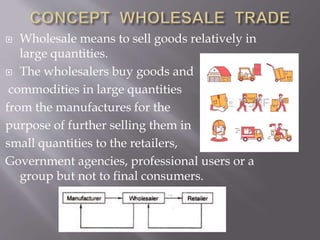
 Wholesale means to sell goods relatively in
large quantities.
 The wholesalers buy goods and
commodities in large quantities
from the manufactures for the
purpose of further selling them in
small quantities to the retailers,
Government agencies, professional users or a
group but not to final consumers.
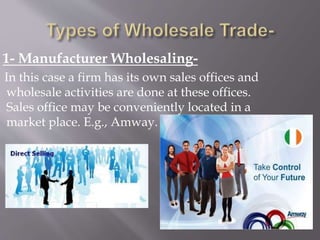
1- Manufacturer Wholesaling-
In this case a firm has its own sales offices and
wholesale activities are done at these offices.
Sales office may be conveniently located in a
market place. E.g., Amway.
2- Merchant Wholesaling-
Merchant wholesalers buy, take title and take
possession of products for further resale. Merchant
wholesalers may perform full range distribution
tasks. They provide credit, store and deliver
products, after merchandising and promotion
assistance.
3- Agents and Brokers-
They perform various wholesale tasks, but
do not take title of products, unlike
merchant wholesalers. Agents and
brokers enable a manufacturer to expand
sales volume because of their special
expertise and experience in the field.
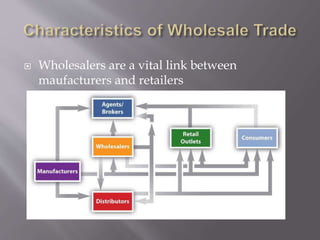
 Wholesalers are a vital link between
maufacturers and retailers
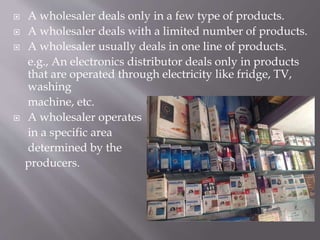
 A wholesaler deals only in a few type of products.
 A wholesaler deals with a limited number of products.
 A wholesaler usually deals in one line of products.
e.g., An electronics distributor deals only in products
that are operated through electricity like fridge, TV,
washing
machine, etc.
 A wholesaler operates
in a specific area
determined by the
producers.
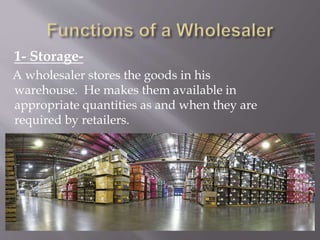
1- Storage-
A wholesaler stores the goods in his
warehouse. He makes them available in
appropriate quantities as and when they are
required by retailers.
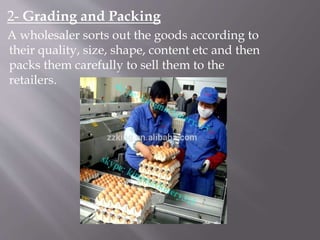
2- Grading and Packing
A wholesaler sorts out the goods according to
their quality, size, shape, content etc and then
packs them carefully to sell them to the
retailers.
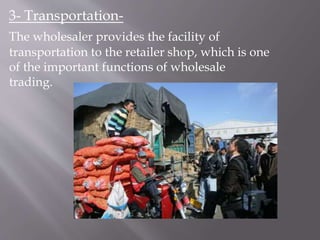
3- Transportation-
The wholesaler provides the facility of
transportation to the retailer shop, which is one
of the important functions of wholesale
trading.
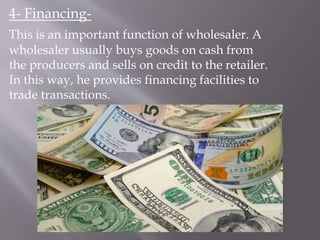
4- Financing-
This is an important function of wholesaler. A
wholesaler usually buys goods on cash from
the producers and sells on credit to the retailer.
In this way, he provides financing facilities to
trade transactions.
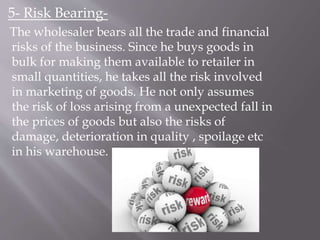
5- Risk Bearing-
The wholesaler bears all the trade and financial
risks of the business. Since he buys goods in
bulk for making them available to retailer in
small quantities, he takes all the risk involved
in marketing of goods. He not only assumes
the risk of loss arising from a unexpected fall in
the prices of goods but also the risks of
damage, deterioration in quality , spoilage etc
in his warehouse.
6- Providing Marketing Information:
The wholesaler imparts valuable information to both
the manufacturer and the retailer. He keeps informing
the manufacturer about the tastes, preferences, likes
and dislikes of the customers. He gathers this
information from the retailers.
At the same time he informs the retailer about the
goods produced by the manufacturer. In order to
gather the information the wholesaler conducts
various market surveys.
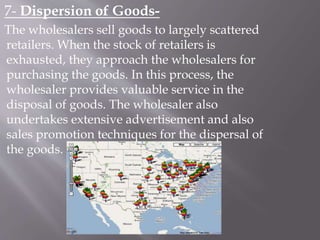
7- Dispersion of Goods-
The wholesalers sell goods to largely scattered
retailers. When the stock of retailers is
exhausted, they approach the wholesalers for
purchasing the goods. In this process, the
wholesaler provides valuable service in the
disposal of goods. The wholesaler also
undertakes extensive advertisement and also
sales promotion techniques for the dispersal of
the goods.
 Services to Manufacturers
 Services to Retailers
 Services to Society
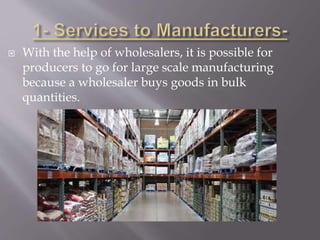
 With the help of wholesalers, it is possible for
producers to go for large scale manufacturing
because a wholesaler buys goods in bulk
quantities.
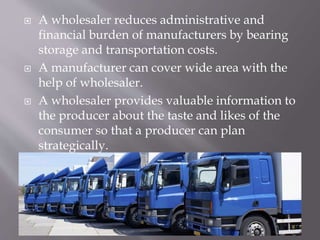
 A wholesaler reduces administrative and
financial burden of manufacturers by bearing
storage and transportation costs.
 A manufacturer can cover wide area with the
help of wholesaler.
 A wholesaler provides valuable information to
the producer about the taste and likes of the
consumer so that a producer can plan
strategically.
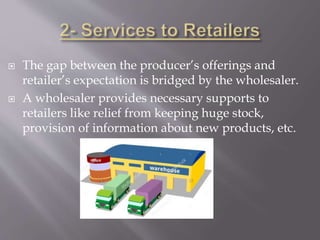
 The gap between the producer’s offerings and
retailer’s expectation is bridged by the wholesaler.
 A wholesaler provides necessary supports to
retailers like relief from keeping huge stock,
provision of information about new products, etc.
 Risk and investment at retailer level is
substantially reduced because a wholesaler
provides goods to retailers on credit.
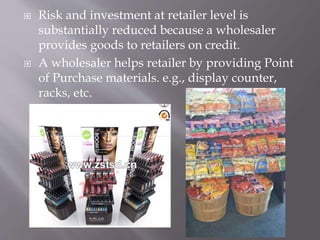
 A wholesaler helps retailer by providing Point
of Purchase materials. e.g., display counter,
racks, etc.
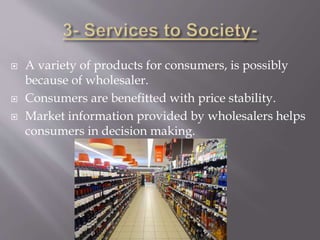
 A variety of products for consumers, is possibly
because of wholesaler.
 Consumers are benefitted with price stability.
 Market information provided by wholesalers helps
consumers in decision making.
Wholesale Trade for Students

Wholesale Trade for Students

  • 3.
     Wholesale meansto sell goods relatively in large quantities.  The wholesalers buy goods and commodities in large quantities from the manufactures for the purpose of further selling them in small quantities to the retailers, Government agencies, professional users or a group but not to final consumers.
  • 5.
    1- Manufacturer Wholesaling- Inthis case a firm has its own sales offices and wholesale activities are done at these offices. Sales office may be conveniently located in a market place. E.g., Amway.
  • 6.
    2- Merchant Wholesaling- Merchantwholesalers buy, take title and take possession of products for further resale. Merchant wholesalers may perform full range distribution tasks. They provide credit, store and deliver products, after merchandising and promotion assistance. 3- Agents and Brokers- They perform various wholesale tasks, but do not take title of products, unlike merchant wholesalers. Agents and brokers enable a manufacturer to expand sales volume because of their special expertise and experience in the field.
  • 7.
     Wholesalers area vital link between maufacturers and retailers
  • 8.
     A wholesalerdeals only in a few type of products.  A wholesaler deals with a limited number of products.  A wholesaler usually deals in one line of products. e.g., An electronics distributor deals only in products that are operated through electricity like fridge, TV, washing machine, etc.  A wholesaler operates in a specific area determined by the producers.
  • 9.
    1- Storage- A wholesalerstores the goods in his warehouse. He makes them available in appropriate quantities as and when they are required by retailers.
  • 10.
    2- Grading andPacking A wholesaler sorts out the goods according to their quality, size, shape, content etc and then packs them carefully to sell them to the retailers.
  • 11.
    3- Transportation- The wholesalerprovides the facility of transportation to the retailer shop, which is one of the important functions of wholesale trading.
  • 12.
    4- Financing- This isan important function of wholesaler. A wholesaler usually buys goods on cash from the producers and sells on credit to the retailer. In this way, he provides financing facilities to trade transactions.
  • 13.
    5- Risk Bearing- Thewholesaler bears all the trade and financial risks of the business. Since he buys goods in bulk for making them available to retailer in small quantities, he takes all the risk involved in marketing of goods. He not only assumes the risk of loss arising from a unexpected fall in the prices of goods but also the risks of damage, deterioration in quality , spoilage etc in his warehouse.
  • 14.
    6- Providing MarketingInformation: The wholesaler imparts valuable information to both the manufacturer and the retailer. He keeps informing the manufacturer about the tastes, preferences, likes and dislikes of the customers. He gathers this information from the retailers. At the same time he informs the retailer about the goods produced by the manufacturer. In order to gather the information the wholesaler conducts various market surveys.
  • 15.
    7- Dispersion ofGoods- The wholesalers sell goods to largely scattered retailers. When the stock of retailers is exhausted, they approach the wholesalers for purchasing the goods. In this process, the wholesaler provides valuable service in the disposal of goods. The wholesaler also undertakes extensive advertisement and also sales promotion techniques for the dispersal of the goods.
  • 16.
     Services toManufacturers  Services to Retailers  Services to Society
  • 17.
     With thehelp of wholesalers, it is possible for producers to go for large scale manufacturing because a wholesaler buys goods in bulk quantities.
  • 18.
     A wholesalerreduces administrative and financial burden of manufacturers by bearing storage and transportation costs.  A manufacturer can cover wide area with the help of wholesaler.  A wholesaler provides valuable information to the producer about the taste and likes of the consumer so that a producer can plan strategically.
  • 19.
     The gapbetween the producer’s offerings and retailer’s expectation is bridged by the wholesaler.  A wholesaler provides necessary supports to retailers like relief from keeping huge stock, provision of information about new products, etc.
  • 20.
     Risk andinvestment at retailer level is substantially reduced because a wholesaler provides goods to retailers on credit.  A wholesaler helps retailer by providing Point of Purchase materials. e.g., display counter, racks, etc.
  • 21.
     A varietyof products for consumers, is possibly because of wholesaler.  Consumers are benefitted with price stability.  Market information provided by wholesalers helps consumers in decision making.