Middlemen ,retailers, 
wholesalers and their 
functions 
By-NYK
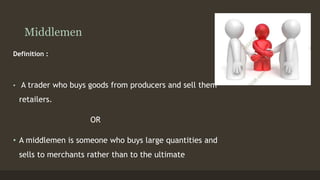
Middlemen 
Definition : 
• A trader who buys goods from producers and sell them 
retailers. 
OR 
• A middlemen is someone who buys large quantities and 
sells to merchants rather than to the ultimate
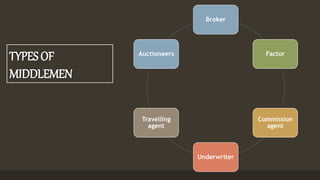
Broker 
Factor 
Commission 
agent 
Underwriter 
Auctioneers TYPES OF 
MIDDLEMEN 
Travelling 
agent
Types of middlemen : 
I. Broker : a broker is a agent involved to buying and selling on behalf of 
principals for a commission , he does not hold any stock 
II. Factor: he is an agent whose function is to receive goods from his 
principal for sale in commission . He can sell goods in his own name 
III. Commission agent: he acts on behalf of foreign importers his functions 
is to buy goods on behalf of client abroad.
Cont... 
IV. Underwriter : they enter into agreement with promoters of newly started 
company which have not been taken up by the public. 
V. Travelling agent: sometimes wholesalers appoints number of agents who 
goes from place to place shows price list to retailers book orders and 
forward them to principals. 
VI. Auctioneers: it is an agent who sells goods by auction.
FUNCTIONS: 
Information: 
Middlemen have a role in providing information about the market to 
manufacturer. Developments like changes in customer demography, 
psychology, media habits and the entry of a new competitor or a new 
Price Stability: 
Maintaining price stability in the market is another function a 
middleman performs. Many a time the middleman absorbs an increase 
in the price of the products and continues to charge the same old 
price to the customer
Cont... 
Promotion : 
Promoting the products in his territory is another function 
middlemen perform. Many of them design their own sales 
incentive programs aimed at building customer traffic at 
oFuintalentcsi.ng : 
Middlemen finance manufacturers operations by providing 
the necessary working capital in the form of advance 
payments for goods and services.
WHOLESALERS 
Person or firm that buys large quantity of goods from various producers or vendors, warehouses them, 
and resells to retailers. 
Wholesaling refers to all activities performed in selling goods and services to those who buy for resale. 
They also perform such functions as warehousing, transportation, financing and risk bearing. Wholesalers 
also provide market information and management services and advice to the producers. 
Wholesalers who carry only non-competing goods or lines are called distributors
Functions of wholesalers: 
Collection of goods: A wholesaler collects goods from 
manufacturers or producers in large quantities. 
Storage of goods: A wholesaler collects the goods and 
stores them safely in warehouses, till they are sold out. 
goods like fruits, vegetables, etc. are stored in cold storage. 
Distribution: A wholesaler sells goods to different 
retailers. In this way, he also performs the function of
Cont.. 
Financing: The wholesaler provides financial support to producers and 
manufacturers by sending money in advance to them. He sells goods to the 
on credit. Thus, at both ends the wholesaler acts as a financier. 
Risk taking: The wholesaler buys finished goods from the producer and 
keeps them in the 
warehouses till they are sold. Therefore, he assumes the risks arising out of 
in 
demand, rise in price, spoilage or destruction of goods.
Retailers 
Retailer is a person one who sells goods or commodities 
directly to consumers these items are purchased from the 
manufacturers or wholesalers and sold to the end user at 
a marked up price.
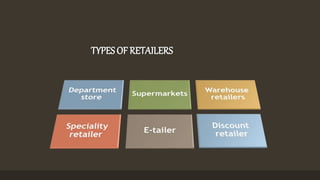
TYPES OF RETAILERS
Types of retailers: 
Department store: this type of retailers often the most complex 
offering a wide range of products and can appear as a collection of 
smaller retail stores managed by one company. 
Supermarkets: generally this types of retail concentrates in 
supplying a range of food and beverage product. 
Warehouse retailers: this type of retailers is usually situated in 
retail or business park and where premises rents are low.
Cont... 
Speciality retailer: specialising in specific industries or products 
this type of retailers is able to offer the customer expert knowledge 
high level of service 
E-tailer : this type of retailer enables customer to shop online via 
internet. 
Discount retailer: this type of retailer offers a variety of 
discounted products. They offer low prices on less fashionable 
products from a range of suppliers by reselling end of line and 
goods at discounted prices.
Functions of retailers: 
1. Buying and Assembling: 
It has been said that a retailer stocks wide variety of products to meet the requirements of a 
large number of customers. For this purpose, the retailer has to assemble products of different 
manufacturers from different wholesalers through the process of buying. 
2. Warehousing and storing: 
Products thus assembled have to be stored by the retailer so that they are held in reserve stocks 
out of which consumers requirements are met without any interruption by selling in small 
quantities.
Cont... 
3. Selling: 
The ultimate purpose of retailing business is to sell these products to the consumers. 
Though a retailer is sometimes referred to as buying agent of consumers, producers and 
manufacturers regard retailer as a means of dispersing goods to the market and drawing 
income into their hands so that they can continue their business of production. 
4. Assumption of Risk: 
The retailer has to bear the risk of physical deterioration of goods and fall in value. A retailer 
has to stock goods in anticipation of demand from his customers. This stock must always be 
sufficient to meet any demand from the customers.
Cont... 
5. Grading and Packing: 
Retailers have to sort out in different lots goods or products left ungraded by the producer 
or the wholesaler. Also, they must make arrangements for proper packing of goods which 
are sold loose. 
6. Financing: 
Often retailers have to grant credit to consumers. Credit sale in effect means facilitating 
the flow of products through the marketing channel to its ultimate goal. Thus retailers 
contribute in financing the marketing process.
Cont... 
7. Supply of Market Information: 
Retailers, being in touch with the consumers, are most favourably situated to study 
consumers' ehavior, changes in the tastes, fashions and demand etc. Thus they collect 
valuable information pertaining to the problems of marketing. 
8. Advertising: 
Retailers display goods in their 
stores.
THANK 
YOU

Middlemen ,retailers and their functions new

  • 1.
    Middlemen ,retailers, wholesalersand their functions By-NYK
  • 2.
    Middlemen Definition : • A trader who buys goods from producers and sell them retailers. OR • A middlemen is someone who buys large quantities and sells to merchants rather than to the ultimate
  • 3.
    Broker Factor Commission agent Underwriter Auctioneers TYPES OF MIDDLEMEN Travelling agent
  • 4.
    Types of middlemen: I. Broker : a broker is a agent involved to buying and selling on behalf of principals for a commission , he does not hold any stock II. Factor: he is an agent whose function is to receive goods from his principal for sale in commission . He can sell goods in his own name III. Commission agent: he acts on behalf of foreign importers his functions is to buy goods on behalf of client abroad.
  • 5.
    Cont... IV. Underwriter: they enter into agreement with promoters of newly started company which have not been taken up by the public. V. Travelling agent: sometimes wholesalers appoints number of agents who goes from place to place shows price list to retailers book orders and forward them to principals. VI. Auctioneers: it is an agent who sells goods by auction.
  • 6.
    FUNCTIONS: Information: Middlemenhave a role in providing information about the market to manufacturer. Developments like changes in customer demography, psychology, media habits and the entry of a new competitor or a new Price Stability: Maintaining price stability in the market is another function a middleman performs. Many a time the middleman absorbs an increase in the price of the products and continues to charge the same old price to the customer
  • 7.
    Cont... Promotion : Promoting the products in his territory is another function middlemen perform. Many of them design their own sales incentive programs aimed at building customer traffic at oFuintalentcsi.ng : Middlemen finance manufacturers operations by providing the necessary working capital in the form of advance payments for goods and services.
  • 8.
    WHOLESALERS Person orfirm that buys large quantity of goods from various producers or vendors, warehouses them, and resells to retailers. Wholesaling refers to all activities performed in selling goods and services to those who buy for resale. They also perform such functions as warehousing, transportation, financing and risk bearing. Wholesalers also provide market information and management services and advice to the producers. Wholesalers who carry only non-competing goods or lines are called distributors
  • 9.
    Functions of wholesalers: Collection of goods: A wholesaler collects goods from manufacturers or producers in large quantities. Storage of goods: A wholesaler collects the goods and stores them safely in warehouses, till they are sold out. goods like fruits, vegetables, etc. are stored in cold storage. Distribution: A wholesaler sells goods to different retailers. In this way, he also performs the function of
  • 10.
    Cont.. Financing: Thewholesaler provides financial support to producers and manufacturers by sending money in advance to them. He sells goods to the on credit. Thus, at both ends the wholesaler acts as a financier. Risk taking: The wholesaler buys finished goods from the producer and keeps them in the warehouses till they are sold. Therefore, he assumes the risks arising out of in demand, rise in price, spoilage or destruction of goods.
  • 11.
    Retailers Retailer isa person one who sells goods or commodities directly to consumers these items are purchased from the manufacturers or wholesalers and sold to the end user at a marked up price.
  • 12.
  • 13.
    Types of retailers: Department store: this type of retailers often the most complex offering a wide range of products and can appear as a collection of smaller retail stores managed by one company. Supermarkets: generally this types of retail concentrates in supplying a range of food and beverage product. Warehouse retailers: this type of retailers is usually situated in retail or business park and where premises rents are low.
  • 14.
    Cont... Speciality retailer:specialising in specific industries or products this type of retailers is able to offer the customer expert knowledge high level of service E-tailer : this type of retailer enables customer to shop online via internet. Discount retailer: this type of retailer offers a variety of discounted products. They offer low prices on less fashionable products from a range of suppliers by reselling end of line and goods at discounted prices.
  • 15.
    Functions of retailers: 1. Buying and Assembling: It has been said that a retailer stocks wide variety of products to meet the requirements of a large number of customers. For this purpose, the retailer has to assemble products of different manufacturers from different wholesalers through the process of buying. 2. Warehousing and storing: Products thus assembled have to be stored by the retailer so that they are held in reserve stocks out of which consumers requirements are met without any interruption by selling in small quantities.
  • 16.
    Cont... 3. Selling: The ultimate purpose of retailing business is to sell these products to the consumers. Though a retailer is sometimes referred to as buying agent of consumers, producers and manufacturers regard retailer as a means of dispersing goods to the market and drawing income into their hands so that they can continue their business of production. 4. Assumption of Risk: The retailer has to bear the risk of physical deterioration of goods and fall in value. A retailer has to stock goods in anticipation of demand from his customers. This stock must always be sufficient to meet any demand from the customers.
  • 17.
    Cont... 5. Gradingand Packing: Retailers have to sort out in different lots goods or products left ungraded by the producer or the wholesaler. Also, they must make arrangements for proper packing of goods which are sold loose. 6. Financing: Often retailers have to grant credit to consumers. Credit sale in effect means facilitating the flow of products through the marketing channel to its ultimate goal. Thus retailers contribute in financing the marketing process.
  • 18.
    Cont... 7. Supplyof Market Information: Retailers, being in touch with the consumers, are most favourably situated to study consumers' ehavior, changes in the tastes, fashions and demand etc. Thus they collect valuable information pertaining to the problems of marketing. 8. Advertising: Retailers display goods in their stores.
  • 19.