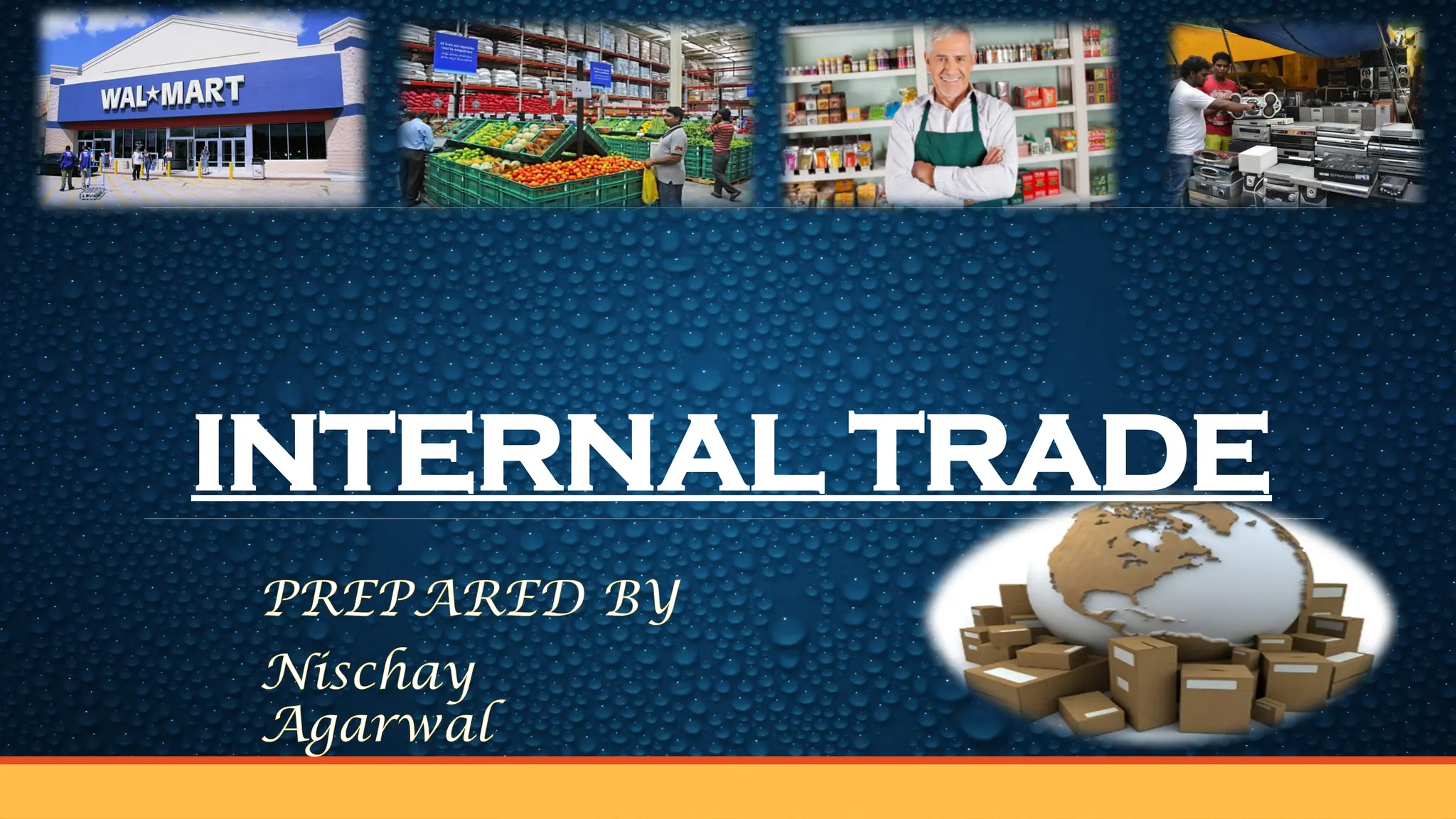
INTERNAL TRADE
PREPARED BY
Nischay
Agarwal
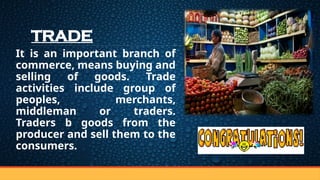
TRADE
It is an important branch of
commerce, means buying and
selling of goods. Trade
activities include group of
peoples, merchants,
middleman or traders.
Traders b goods from the
producer and sell them to the
consumers.
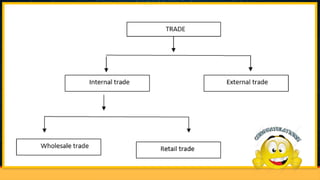
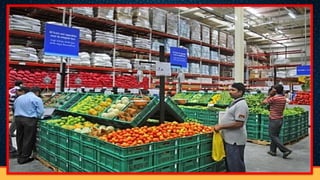
Wholesale trade
A wholesaler is a person who buys goods in large
quantities from the producers and sells them in small
quantities to the retailers.
Characteristic of wholesale
Intermediaries between the primary producer and
retailers
Wholesalers operate on a large scale and deal only in a
limited line of goods
Not directly deal with individual consumers
Functions of wholesalers
Assembling ; the wholesaler collects goods from different
manufactures and stores them in his warehouse
Grading; wholesalers sort out the goods on the basis of quality,
size, content, design, etc..
Warehousing: the goods are kept in warehouses for
distribution to retailers and when required
Transporting ; goods are moved from the place of production to
the warehouses and from there to the retailers
Risk bearing; wholesaler assume great risk when they buy and
store goods in fairly large quantities. All these risks are to be
shouldered by the wholesaler himself.
Functions of wholesalers….
Pricing; the wholesaler fixes the prices of the goods he
deals in , and based on this, the retailer determines the
consumer price
Financing; the wholesalers give financial help both to the
producers and to the retailers
Distribution; the wholesalers by selling the goods to the
retailers as and when needed in small quantities facilitates
smooth distribution of goods
Collecting information; they collect information about
market conditions and pass it on to producers.
Services of wholesalers
Large-scale production; bulk order form wholesalers enable
producer to benefits of large scale production
Bulk purchase;
Specialization ; as marketing is done by wholesalers the
producer can concentrate on production which results in
specialization
Ready market; the wholesalers provides a ready market for the
mass-produced goods
Better use of capital; wholesalers usually purchases goods for
cash or accepts bill of exchange. manufactures need not keep
large stock of raw materials or finished goods
Warehousing; the wholesalers holds large stocks of goods in his
Services of wholesalers…….
Supply of raw materials; sometimes the wholesalers stocks
large quantities of row materials and makes them available to
the producers in time
Market information ; constantly in touch with the retailers’ the
wholesalers collects information regarding tastes and fashions
of consumers and passes it on to producers
Financing; the wholesalers make ready payment for purchases
and even advance money to the manufacturers
Transportation; supply of raw materials and delivery of finished
goods are taken up by the wholesalers. Economy in scale ;
through advertising and sales promotion , wholesalers reduces
the selling expenses of manufactures
Risk taking; as the wholesalers purchases the entire goods
Services of retailers
Buying center for all varieties of goods
Storage facilities: by holding large stocks of goods
near the retailers , the wholesalers help them
Credit facilities
Information about new products
Specializations; the wholesaler’s deals in a limited line
of goods in which they are specialized. hence they offer
expert advice to the retailers on those goods
Services of retailers……..
Quick supply of goods
Price stability ; wholesalers is in control of the supply of
goods , he regulates the supply in accordance with
demand and stabilizes the price in the market
Advertisement
Supply of goods reasonable price
Reduced risk ; the wholesalers assume most of the risk
connected with marketing such as fluctuating in prices,
loss of goods during transit and storage.
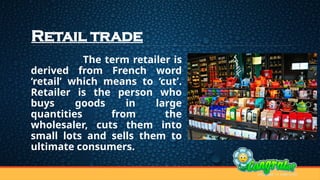
Retail trade
The term retailer is
derived from French word
‘retail’ which means to ‘cut’.
Retailer is the person who
buys goods in large
quantities from the
wholesaler, cuts them into
small lots and sells them to
ultimate consumers.
Characteristics
1) A retailer is the last link in the chain of
distribution
2) Sells them to ultimate consumers
3) He act as a connecting link between the
wholesalers and the consumers
4) He deals in a wide variety of goods
5) Thus occupies a key role in marketing
Functions of retailer
Choice of goods ; a retailer provides his consumer with a wide
choice of goods
Ready stock ; the retailer holds stocks to maintain uninterrupted
supply of goods
Market information ; the close contact with the consumer , the
retailer are in a position to collect market information demand,
and supply , consumer behaviors , tastes ,fashions etc.
Financing; they meet the cost of goods purchased, storage,
transportation etc..
Advertising: the retailer undertakes sales promotional activities
like displaying the goods in their shop
Transportation ; the retailers arrange for the transportation of
goods from the wholesalers premises to their shops and in turn to
Wholesaler Retailer
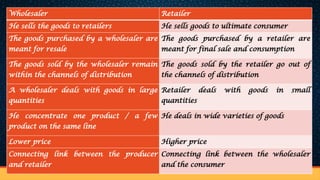
He sells the goods to retailers He sells goods to ultimate consumer
The goods purchased by a wholesaler are
meant for resale
The goods purchased by a retailer are
meant for final sale and consumption
The goods sold by the wholesaler remain
within the channels of distribution
The goods sold by the retailer go out of
the channels of distribution
A wholesaler deals with goods in large
quantities
Retailer deals with goods in small
quantities
He concentrate one product / a few
product on the same line
He deals in wide varieties of goods
Lower price Higher price
Connecting link between the producer
and retailer
Connecting link between the wholesaler
and the consumer
Services to producers and wholesalers
Ready market ; the retailer provide ready market for
the products of the manufactures
Small order; the manufacturers and wholesalers are
delivered of the task of collecting a large number of
small orders from the consumers
Market information ;
Advertisement; by displaying the goods in their shops
attractively , they supplement the efforts of the
manufacture and the wholesaler in sales promotion
Popularizing new products;
Service to consumers
Selection of goods
Ready availability
Consumer education
Credit facility
Assistance in buying
Door delivery and after sales service
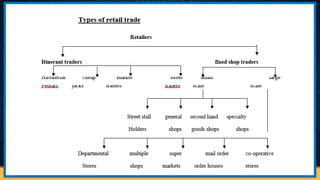
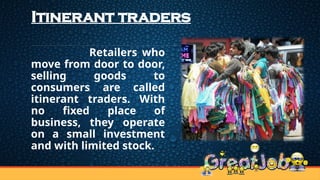
Itinerant traders
Retailers who
move from door to door,
selling goods to
consumers are called
itinerant traders. With
no fixed place of
business, they operate
on a small investment
and with limited stock.
a) Hawkers and pedlars: hawkers carry goods
on vehicles, while pedlares on their backs or
heads moving from door to door in residential
areas to sell their goods
b) Cheap jacks: they do business in rented shops
or sheds, shifting from one locality to another.
Cheap jacks sell their goods in temporary sheds
during festivals
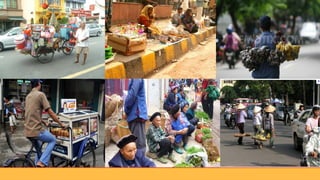
c) Market traders: these traders sell their
goods on periodical markets- weekly,
monthly, etc.. They also occupy fronts of
main shops on holidays and do thriving
business
d) Street vendors; these traders display their
goods in busy street corners or pavements
near railway stations, bus stands, cinema
houses.etc...
Fixed shop traders
Fixed shop traders carry on business
in a fixed building either owned or rented.
Selection of site is made after considering
factors like line of business, nature of
customers, easy accessibility etc..
Small-scale fixed retailers
General shops: set up in residential areas, general shops deal
in a variety of products needed by the locals. They also offer
credit facility and home delivery.
Street stall: these are fixed retail shops erected in the
minimum space available at street corners. Travelling public
usually depend on these shops.
Second –hand goods shops: second –hand books, furniture,
cloth and other household items are bought through their
agents. The poorer sections of society buy second-hand goods
from these shops.
Specialty shops: these shops specialize in a single line of
products. They are found moistly in buy shopping centers in
Large –scale fixed retailers
Large scale fixed shops have become common today, reaping
the benefits of large scale operations.
 Departmental store
 Multiple shop
 Super market
 Mail order business
 Consumer co-operative stores
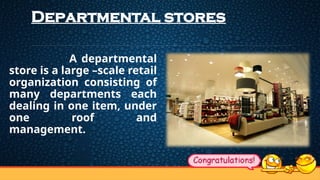
Departmental stores
A departmental
store is a large –scale retail
organization consisting of
many departments each
dealing in one item, under
one roof and
management.
Features:
Large size: it is a large –scale retail organization
Central location : to attract more customers , it is located in
central place
Spacious premises: it is generally housed in a spacious
building to accommodate different departments
Variety of goods: it offer widest variety of goods under one
roof
Amenities and attractions: it offers a great number of
amenities and attractions to the customers
No credit: it deal on cash and carry basis
Features……..
Centralized purchases and decentralized sales: the purchasing
department buys everything needed for various departments but
sells in each department
Advertising: to increase sales, they resort to expensive
advertisement.
High cost of operation: rent, advertising and provision for amenities
increases the cost of running a departmental store
Serving the upper class: it generally serves the salaried and rich class
Door delivery: some departmental stores undertake door delivery
Advantages
Ideal location: being centrally placed they serve people from all parts of a
town or city
Easy shopping: a whole range of goods displayed in the same store make
shopping easy
Economic purchases: large-scale purchase from manufactures being down
the price of consumer items, and the benefit is passed to consumers
Efficient staff: a departmental store is in a better position to employ
efficient staff to run departments
Large capital: as it is usually formed as a joint stock company, it commands
large capital
Amenities and attractions to customers: free home delivery, restaurants,
reading rooms, telephone booth etc... in the store are added attraction to
the customers
Disadvantages
Heavy operational cost; high rent in cities, provision for amenities and specialized staff
increase operational cast of departmental stores
High prices: heavy establishment charges lead to higher prices of goods sold.
Location: always situated in town and cities these stores serve only a section of society
leaving out the vast majority in the villages
Lack of personal contact; larger the organization, lesser the personal contact with
customers
Inflexible nature: because of its inflexible nature, losses pile up. A particular department
which incurs loss cannot be closed down
Managerial problems: effective co-ordination and control of staff become practically
impossible
Serves only the rich and not the masses: goods sold through departmental store usually
are needed by the rich and seldom by the low income strata
Dependent on advertisement; the success of a departmental store depends upon
advertisement and publicity. If there is poor response to the advertisement, it will affect
sales and profitability of a departmental store.
Multiple shops
A multiple shop is a large scale retail organization with a
number of branches at different places under one
ownership and management and dealing in one variety of
goods. The head office controls, owns and manages the
branches through a branch manager. Multiple shops are
organized by the manufactures to eliminate middlemen.
Multiple shops may be defined as “ a system of branch
shops operated under a centralized management and
dealing in similar line of goods”
Important features
It is generally organized as a joint stock company
It operates through a large number of branch shops spread over a wide area
Each shop deals in the same type of product
Each shop is decorated in the same style and fashion
The product dealt in are meant for everyday use , are durable and have a steady
demand
Their purchases are centralized and their sales are decentralized
It generally sells goods on cash and carry basis
It possesses flexibility in operation. An existing unprofitable branch can be closed
down easily
It is an attempt on the part of the manufacturer to eliminate the middleman fro the
chain of distribution
It is a large –scale retail organization
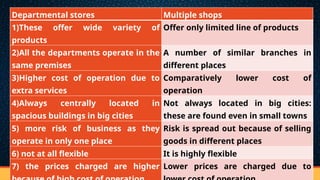
Departmental stores Multiple shops
1)These offer wide variety of
products
Offer only limited line of products
2)All the departments operate in the
same premises
A number of similar branches in
different places
3)Higher cost of operation due to
extra services
Comparatively lower cost of
operation
4)Always centrally located in
spacious buildings in big cities
Not always located in big cities:
these are found even in small towns
5) more risk of business as they
operate in only one place
Risk is spread out because of selling
goods in different places
6) not at all flexible It is highly flexible
7) the prices charged are higher Lower prices are charged due to
8) extra services like free from home
delivery , reading room, telephone,
recreational facilities etc., are
provided to customers
No such extra services to customers
9) there is no uniformity among
departments .they deal in different
types of goods
Uniformity among all branch shops
10) serve mainly the rich class Serve the masses
11) shortage of goods cannot be met
by transfer from one department to
another
Shortage of stock at one branch can
be overcome by transfer of stock
from nearby branches
12) sell goods both for cash and on
credit
Always on cash basis
13) managers have wider power Branch managers have no power to
Super market
A unique feature of the super market is
the absence of salesman to serve the
consumers. The consumers pick up the
required products and payment is made at
the counter. In super markets, goods are sold
on cash basis. The super market serves a large
number of consumers. in India super markets
are mostly organized on a co-operative basis
Mail order business
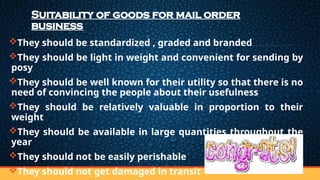
Mail order business is a kind of
retail business which receives orders
and delivers the articles through post.
Post office plays an important role
here. There is no direct contact
between the buyer and the sellers.
This system of retailing enables the
consumers to get the goods at their
door steps without the expense and
trouble o going to the shops.
Suitability of goods for mail order
business
They should be standardized , graded and branded
They should be light in weight and convenient for sending by
posy
They should be well known for their utility so that there is no
need of convincing the people about their usefulness
They should be relatively valuable in proportion to their
weight
They should be available in large quantities throughout the
year
They should not be easily perishable
They should not get damaged in transit
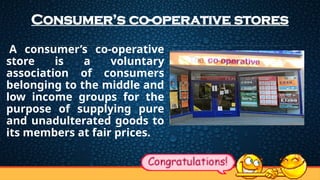
Consumer’s co-operative stores
A consumer’s co-operative
store is a voluntary
association of consumers
belonging to the middle and
low income groups for the
purpose of supplying pure
and unadulterated goods to
its members at fair prices.
Vending machines
Vending machines are especially useful
for selling pre-packed items of low priced
products, with uniform size and weight. Initial
cost of the machine and its maintenance
charges on regular basis and repair are quite
high. Another drawback is that consumers
cannot see the product before buying. No return
of goods is also possible. In spite of these
limitations, vending machines have become
popular in retail sales of high turnover, uniform
size and low priced products.
Internal Trade.pptxnischayeeefefefefefef

Internal Trade.pptxnischayeeefefefefefef

  • 1.
  • 2.
    TRADE It is animportant branch of commerce, means buying and selling of goods. Trade activities include group of peoples, merchants, middleman or traders. Traders b goods from the producer and sell them to the consumers.
  • 4.
    Wholesale trade A wholesaleris a person who buys goods in large quantities from the producers and sells them in small quantities to the retailers. Characteristic of wholesale Intermediaries between the primary producer and retailers Wholesalers operate on a large scale and deal only in a limited line of goods Not directly deal with individual consumers
  • 6.
    Functions of wholesalers Assembling; the wholesaler collects goods from different manufactures and stores them in his warehouse Grading; wholesalers sort out the goods on the basis of quality, size, content, design, etc.. Warehousing: the goods are kept in warehouses for distribution to retailers and when required Transporting ; goods are moved from the place of production to the warehouses and from there to the retailers Risk bearing; wholesaler assume great risk when they buy and store goods in fairly large quantities. All these risks are to be shouldered by the wholesaler himself.
  • 7.
    Functions of wholesalers…. Pricing;the wholesaler fixes the prices of the goods he deals in , and based on this, the retailer determines the consumer price Financing; the wholesalers give financial help both to the producers and to the retailers Distribution; the wholesalers by selling the goods to the retailers as and when needed in small quantities facilitates smooth distribution of goods Collecting information; they collect information about market conditions and pass it on to producers.
  • 8.
    Services of wholesalers Large-scaleproduction; bulk order form wholesalers enable producer to benefits of large scale production Bulk purchase; Specialization ; as marketing is done by wholesalers the producer can concentrate on production which results in specialization Ready market; the wholesalers provides a ready market for the mass-produced goods Better use of capital; wholesalers usually purchases goods for cash or accepts bill of exchange. manufactures need not keep large stock of raw materials or finished goods Warehousing; the wholesalers holds large stocks of goods in his
  • 9.
    Services of wholesalers……. Supplyof raw materials; sometimes the wholesalers stocks large quantities of row materials and makes them available to the producers in time Market information ; constantly in touch with the retailers’ the wholesalers collects information regarding tastes and fashions of consumers and passes it on to producers Financing; the wholesalers make ready payment for purchases and even advance money to the manufacturers Transportation; supply of raw materials and delivery of finished goods are taken up by the wholesalers. Economy in scale ; through advertising and sales promotion , wholesalers reduces the selling expenses of manufactures Risk taking; as the wholesalers purchases the entire goods
  • 10.
    Services of retailers Buyingcenter for all varieties of goods Storage facilities: by holding large stocks of goods near the retailers , the wholesalers help them Credit facilities Information about new products Specializations; the wholesaler’s deals in a limited line of goods in which they are specialized. hence they offer expert advice to the retailers on those goods
  • 11.
    Services of retailers…….. Quicksupply of goods Price stability ; wholesalers is in control of the supply of goods , he regulates the supply in accordance with demand and stabilizes the price in the market Advertisement Supply of goods reasonable price Reduced risk ; the wholesalers assume most of the risk connected with marketing such as fluctuating in prices, loss of goods during transit and storage.
  • 12.
    Retail trade The termretailer is derived from French word ‘retail’ which means to ‘cut’. Retailer is the person who buys goods in large quantities from the wholesaler, cuts them into small lots and sells them to ultimate consumers.
  • 13.
    Characteristics 1) A retaileris the last link in the chain of distribution 2) Sells them to ultimate consumers 3) He act as a connecting link between the wholesalers and the consumers 4) He deals in a wide variety of goods 5) Thus occupies a key role in marketing
  • 14.
    Functions of retailer Choiceof goods ; a retailer provides his consumer with a wide choice of goods Ready stock ; the retailer holds stocks to maintain uninterrupted supply of goods Market information ; the close contact with the consumer , the retailer are in a position to collect market information demand, and supply , consumer behaviors , tastes ,fashions etc. Financing; they meet the cost of goods purchased, storage, transportation etc.. Advertising: the retailer undertakes sales promotional activities like displaying the goods in their shop Transportation ; the retailers arrange for the transportation of goods from the wholesalers premises to their shops and in turn to
  • 15.
    Wholesaler Retailer He sellsthe goods to retailers He sells goods to ultimate consumer The goods purchased by a wholesaler are meant for resale The goods purchased by a retailer are meant for final sale and consumption The goods sold by the wholesaler remain within the channels of distribution The goods sold by the retailer go out of the channels of distribution A wholesaler deals with goods in large quantities Retailer deals with goods in small quantities He concentrate one product / a few product on the same line He deals in wide varieties of goods Lower price Higher price Connecting link between the producer and retailer Connecting link between the wholesaler and the consumer
  • 17.
    Services to producersand wholesalers Ready market ; the retailer provide ready market for the products of the manufactures Small order; the manufacturers and wholesalers are delivered of the task of collecting a large number of small orders from the consumers Market information ; Advertisement; by displaying the goods in their shops attractively , they supplement the efforts of the manufacture and the wholesaler in sales promotion Popularizing new products;
  • 18.
    Service to consumers Selectionof goods Ready availability Consumer education Credit facility Assistance in buying Door delivery and after sales service
  • 20.
    Itinerant traders Retailers who movefrom door to door, selling goods to consumers are called itinerant traders. With no fixed place of business, they operate on a small investment and with limited stock.
  • 21.
    a) Hawkers andpedlars: hawkers carry goods on vehicles, while pedlares on their backs or heads moving from door to door in residential areas to sell their goods b) Cheap jacks: they do business in rented shops or sheds, shifting from one locality to another. Cheap jacks sell their goods in temporary sheds during festivals
  • 22.
    c) Market traders:these traders sell their goods on periodical markets- weekly, monthly, etc.. They also occupy fronts of main shops on holidays and do thriving business d) Street vendors; these traders display their goods in busy street corners or pavements near railway stations, bus stands, cinema houses.etc...
  • 24.
    Fixed shop traders Fixedshop traders carry on business in a fixed building either owned or rented. Selection of site is made after considering factors like line of business, nature of customers, easy accessibility etc..
  • 25.
    Small-scale fixed retailers Generalshops: set up in residential areas, general shops deal in a variety of products needed by the locals. They also offer credit facility and home delivery. Street stall: these are fixed retail shops erected in the minimum space available at street corners. Travelling public usually depend on these shops. Second –hand goods shops: second –hand books, furniture, cloth and other household items are bought through their agents. The poorer sections of society buy second-hand goods from these shops. Specialty shops: these shops specialize in a single line of products. They are found moistly in buy shopping centers in
  • 26.
    Large –scale fixedretailers Large scale fixed shops have become common today, reaping the benefits of large scale operations.  Departmental store  Multiple shop  Super market  Mail order business  Consumer co-operative stores
  • 27.
    Departmental stores A departmental storeis a large –scale retail organization consisting of many departments each dealing in one item, under one roof and management.
  • 28.
    Features: Large size: itis a large –scale retail organization Central location : to attract more customers , it is located in central place Spacious premises: it is generally housed in a spacious building to accommodate different departments Variety of goods: it offer widest variety of goods under one roof Amenities and attractions: it offers a great number of amenities and attractions to the customers No credit: it deal on cash and carry basis
  • 29.
    Features…….. Centralized purchases anddecentralized sales: the purchasing department buys everything needed for various departments but sells in each department Advertising: to increase sales, they resort to expensive advertisement. High cost of operation: rent, advertising and provision for amenities increases the cost of running a departmental store Serving the upper class: it generally serves the salaried and rich class Door delivery: some departmental stores undertake door delivery
  • 30.
    Advantages Ideal location: beingcentrally placed they serve people from all parts of a town or city Easy shopping: a whole range of goods displayed in the same store make shopping easy Economic purchases: large-scale purchase from manufactures being down the price of consumer items, and the benefit is passed to consumers Efficient staff: a departmental store is in a better position to employ efficient staff to run departments Large capital: as it is usually formed as a joint stock company, it commands large capital Amenities and attractions to customers: free home delivery, restaurants, reading rooms, telephone booth etc... in the store are added attraction to the customers
  • 31.
    Disadvantages Heavy operational cost;high rent in cities, provision for amenities and specialized staff increase operational cast of departmental stores High prices: heavy establishment charges lead to higher prices of goods sold. Location: always situated in town and cities these stores serve only a section of society leaving out the vast majority in the villages Lack of personal contact; larger the organization, lesser the personal contact with customers Inflexible nature: because of its inflexible nature, losses pile up. A particular department which incurs loss cannot be closed down Managerial problems: effective co-ordination and control of staff become practically impossible Serves only the rich and not the masses: goods sold through departmental store usually are needed by the rich and seldom by the low income strata Dependent on advertisement; the success of a departmental store depends upon advertisement and publicity. If there is poor response to the advertisement, it will affect sales and profitability of a departmental store.
  • 32.
    Multiple shops A multipleshop is a large scale retail organization with a number of branches at different places under one ownership and management and dealing in one variety of goods. The head office controls, owns and manages the branches through a branch manager. Multiple shops are organized by the manufactures to eliminate middlemen. Multiple shops may be defined as “ a system of branch shops operated under a centralized management and dealing in similar line of goods”
  • 33.
    Important features It isgenerally organized as a joint stock company It operates through a large number of branch shops spread over a wide area Each shop deals in the same type of product Each shop is decorated in the same style and fashion The product dealt in are meant for everyday use , are durable and have a steady demand Their purchases are centralized and their sales are decentralized It generally sells goods on cash and carry basis It possesses flexibility in operation. An existing unprofitable branch can be closed down easily It is an attempt on the part of the manufacturer to eliminate the middleman fro the chain of distribution It is a large –scale retail organization
  • 34.
    Departmental stores Multipleshops 1)These offer wide variety of products Offer only limited line of products 2)All the departments operate in the same premises A number of similar branches in different places 3)Higher cost of operation due to extra services Comparatively lower cost of operation 4)Always centrally located in spacious buildings in big cities Not always located in big cities: these are found even in small towns 5) more risk of business as they operate in only one place Risk is spread out because of selling goods in different places 6) not at all flexible It is highly flexible 7) the prices charged are higher Lower prices are charged due to
  • 35.
    8) extra serviceslike free from home delivery , reading room, telephone, recreational facilities etc., are provided to customers No such extra services to customers 9) there is no uniformity among departments .they deal in different types of goods Uniformity among all branch shops 10) serve mainly the rich class Serve the masses 11) shortage of goods cannot be met by transfer from one department to another Shortage of stock at one branch can be overcome by transfer of stock from nearby branches 12) sell goods both for cash and on credit Always on cash basis 13) managers have wider power Branch managers have no power to
  • 36.
    Super market A uniquefeature of the super market is the absence of salesman to serve the consumers. The consumers pick up the required products and payment is made at the counter. In super markets, goods are sold on cash basis. The super market serves a large number of consumers. in India super markets are mostly organized on a co-operative basis
  • 37.
    Mail order business Mailorder business is a kind of retail business which receives orders and delivers the articles through post. Post office plays an important role here. There is no direct contact between the buyer and the sellers. This system of retailing enables the consumers to get the goods at their door steps without the expense and trouble o going to the shops.
  • 38.
    Suitability of goodsfor mail order business They should be standardized , graded and branded They should be light in weight and convenient for sending by posy They should be well known for their utility so that there is no need of convincing the people about their usefulness They should be relatively valuable in proportion to their weight They should be available in large quantities throughout the year They should not be easily perishable They should not get damaged in transit
  • 39.
    Consumer’s co-operative stores Aconsumer’s co-operative store is a voluntary association of consumers belonging to the middle and low income groups for the purpose of supplying pure and unadulterated goods to its members at fair prices.
  • 40.
    Vending machines Vending machinesare especially useful for selling pre-packed items of low priced products, with uniform size and weight. Initial cost of the machine and its maintenance charges on regular basis and repair are quite high. Another drawback is that consumers cannot see the product before buying. No return of goods is also possible. In spite of these limitations, vending machines have become popular in retail sales of high turnover, uniform size and low priced products.