The World Health Organization as a Continuous Learning Organization April Hord  Yovhane Metcalfe   Amanda Parks Virginia Commonwealth University
Objectives Summarize organizational structure and recent history Compare organizational learning cycle during smallpox effort with that of today Examine WHO’s contemporary infrastructure Apply learning exercise
A global organization Our Health, Our Future © Copyright World Health Organization (WHO), 2009. All Rights Reserved.
Organizational learning ‘ the intentional use of learning processes at the individual, group and system level to continuously transform the organization in a direction that is increasingly satisfying to its stakeholders” (Dixon, 1999) © Copyright World Health Organization (WHO), 2009. All Rights Reserved
Global organization structure Constitution objective: The attainment by all peoples of the highest possible level of health Health – state of complete physical, mental and social well-being; not simply absence of disease or infirmity The World Health Assembly Governing body with delegate representatives from 193 member states meets annually each May in Geneva Work Force 8,000 health experts & support staff serve fixed-term appointments Staff spread across Headquarters + six regional offices + 193 countries
WHO since 1999
The WHO Learning Cycle 2009 © Copyright World Health Organization (WHO), 2009. All Rights Reserved
I. Widespread Generation of Information-  Internal Documentation – After Action Reviews of projects, initiatives, efforts are catalogued and recorded Translucency - Regional offices integrate open reporting to be analyzed, shared & linked to resources used Daily Emergency Situation Report via the HAC website  www.who.int/disasters
I. Widespread Generation of Information -  External Regular multidisciplinary teleconferences for: research labs governmental organizations field offices WHO headquarters Global distribution and execution of 2006-2015 World Health Plan strategic plan  August 2009 – H1N1 global monitoring and advising notices
Operations Strategic Operations Center © Copyright World Health Organization (WHO/PAHO), 2009. All Rights Reserved.
II. Integrate new & local information into  organizational context 2009 H1N1 pandemic response October 2009 –   assistance response to   Western Pacific Region natural disasters HAC Program  Global/regional ALERT distribution Blue Trunk program Proclaim as a Knowledge Management (KM) Strategy: Strengthen organizational capacity Advocate adoption of KM in the field of public health Improve capacity implementing KM at country level
III. Collectively interpret information Involve all WHO and local stakeholders:  contingency building events  external training programs/seminars  Knowledge Management Strategy goal:  to bridge the “know-do gap” in global health by fostering an environment that encourages the creation, sharing, and effective application of knowledge to improve health Identification of Effective Employee Behaviors: to ensure that knowledge and learning is shared across the organization and that staff learn from each other
IV. Authority to act on interpreted meaning Proclaim as a Knowledge Management Strategy: Translating knowledge into policy & action Six regional offices with separate governance structure to react to regional level issues Pan American Health Organization covers 35 countries www.paho.org 2002 PAHO implemented annual vaccination week HAC Program – Geneva enables regional offices to be self-sufficient providing all necessary resources communications equipment  operational budget to be utilized at regional, sub-regional and/or country levels
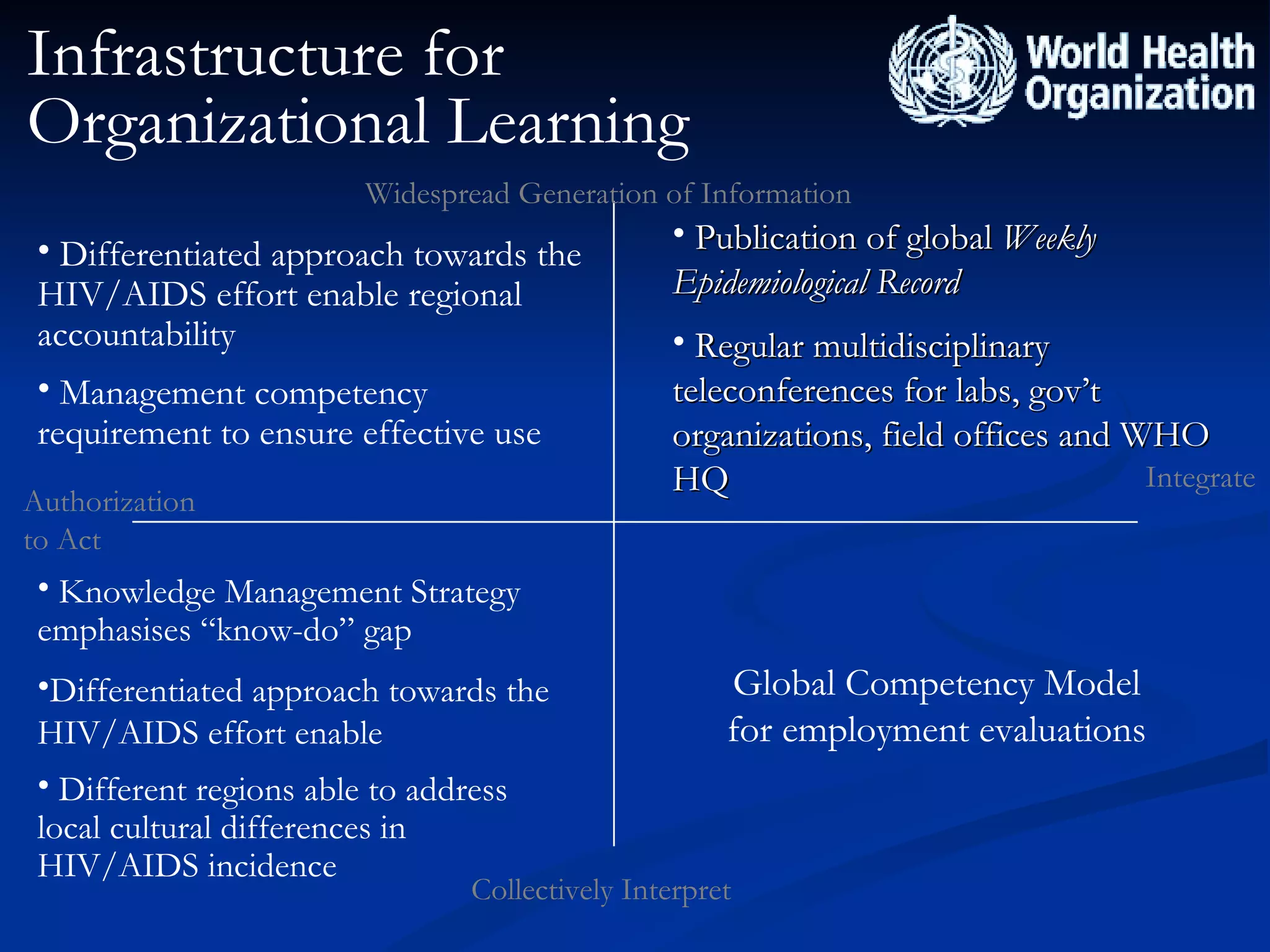
Infrastructure for Organizational Learning Integrate Collectively Interpret Authorization to Act Publication of global  Weekly Epidemiological Record   Regular multidisciplinary teleconferences for labs, gov’t organizations, field offices and WHO HQ Knowledge Management Strategy emphasises “know-do” gap Differentiated approach towards the HIV/AIDS effort enable  Different regions able to address local cultural differences in HIV/AIDS incidence  Differentiated approach towards the HIV/AIDS effort enable regional accountability Management competency requirement to ensure effective use Global Competency Model for employment evaluations Widespread Generation of Information
Application & Debate Form in groups of three Review WHO’s five strategic direction printouts Prioritize in order of significance to WHO’s learning capacity Be prepared to justify ranking
Dixon, N. (1999)  The Organization Learning Cycle: How We Can Learn Collectively.   Hampshire, England: Gower Publishing Limited.  World Health Organization. (n.d.) WHO Competency Model. Retrieved from  http://www.who.int/employment/competencies/WHO_competencies_EN.pdf World Health Organization. (2003)  Health Action in Crises.  Retrieved from  http://www.who.int/hac/about/en/11990.pdf World Health Organization. (2005)  Knowledge Management Strategy, 1 . Retrieved  from  http://www.who.int/kms/about/strategy/kms_strategy.pdf   World Health Organization. (2007)  Working for health: an introduction to the World  Health Organization.  Retrieved from  http://www.who.int/about/brochure_en.pdf. References

Who presentation download

  • 1.
    The World HealthOrganization as a Continuous Learning Organization April Hord Yovhane Metcalfe Amanda Parks Virginia Commonwealth University
  • 2.
    Objectives Summarize organizationalstructure and recent history Compare organizational learning cycle during smallpox effort with that of today Examine WHO’s contemporary infrastructure Apply learning exercise
  • 3.
    A global organizationOur Health, Our Future © Copyright World Health Organization (WHO), 2009. All Rights Reserved.
  • 4.
    Organizational learning ‘the intentional use of learning processes at the individual, group and system level to continuously transform the organization in a direction that is increasingly satisfying to its stakeholders” (Dixon, 1999) © Copyright World Health Organization (WHO), 2009. All Rights Reserved
  • 5.
    Global organization structureConstitution objective: The attainment by all peoples of the highest possible level of health Health – state of complete physical, mental and social well-being; not simply absence of disease or infirmity The World Health Assembly Governing body with delegate representatives from 193 member states meets annually each May in Geneva Work Force 8,000 health experts & support staff serve fixed-term appointments Staff spread across Headquarters + six regional offices + 193 countries
  • 6.
  • 7.
    The WHO LearningCycle 2009 © Copyright World Health Organization (WHO), 2009. All Rights Reserved
  • 8.
    I. Widespread Generationof Information- Internal Documentation – After Action Reviews of projects, initiatives, efforts are catalogued and recorded Translucency - Regional offices integrate open reporting to be analyzed, shared & linked to resources used Daily Emergency Situation Report via the HAC website www.who.int/disasters
  • 9.
    I. Widespread Generationof Information - External Regular multidisciplinary teleconferences for: research labs governmental organizations field offices WHO headquarters Global distribution and execution of 2006-2015 World Health Plan strategic plan August 2009 – H1N1 global monitoring and advising notices
  • 10.
    Operations Strategic OperationsCenter © Copyright World Health Organization (WHO/PAHO), 2009. All Rights Reserved.
  • 11.
    II. Integrate new& local information into organizational context 2009 H1N1 pandemic response October 2009 – assistance response to Western Pacific Region natural disasters HAC Program Global/regional ALERT distribution Blue Trunk program Proclaim as a Knowledge Management (KM) Strategy: Strengthen organizational capacity Advocate adoption of KM in the field of public health Improve capacity implementing KM at country level
  • 12.
    III. Collectively interpretinformation Involve all WHO and local stakeholders: contingency building events external training programs/seminars Knowledge Management Strategy goal: to bridge the “know-do gap” in global health by fostering an environment that encourages the creation, sharing, and effective application of knowledge to improve health Identification of Effective Employee Behaviors: to ensure that knowledge and learning is shared across the organization and that staff learn from each other
  • 13.
    IV. Authority toact on interpreted meaning Proclaim as a Knowledge Management Strategy: Translating knowledge into policy & action Six regional offices with separate governance structure to react to regional level issues Pan American Health Organization covers 35 countries www.paho.org 2002 PAHO implemented annual vaccination week HAC Program – Geneva enables regional offices to be self-sufficient providing all necessary resources communications equipment operational budget to be utilized at regional, sub-regional and/or country levels
  • 14.
    Infrastructure for OrganizationalLearning Integrate Collectively Interpret Authorization to Act Publication of global Weekly Epidemiological Record Regular multidisciplinary teleconferences for labs, gov’t organizations, field offices and WHO HQ Knowledge Management Strategy emphasises “know-do” gap Differentiated approach towards the HIV/AIDS effort enable Different regions able to address local cultural differences in HIV/AIDS incidence Differentiated approach towards the HIV/AIDS effort enable regional accountability Management competency requirement to ensure effective use Global Competency Model for employment evaluations Widespread Generation of Information
  • 15.
    Application & DebateForm in groups of three Review WHO’s five strategic direction printouts Prioritize in order of significance to WHO’s learning capacity Be prepared to justify ranking
  • 16.
    Dixon, N. (1999) The Organization Learning Cycle: How We Can Learn Collectively. Hampshire, England: Gower Publishing Limited. World Health Organization. (n.d.) WHO Competency Model. Retrieved from http://www.who.int/employment/competencies/WHO_competencies_EN.pdf World Health Organization. (2003) Health Action in Crises. Retrieved from http://www.who.int/hac/about/en/11990.pdf World Health Organization. (2005) Knowledge Management Strategy, 1 . Retrieved from http://www.who.int/kms/about/strategy/kms_strategy.pdf World Health Organization. (2007) Working for health: an introduction to the World Health Organization. Retrieved from http://www.who.int/about/brochure_en.pdf. References

Editor's Notes

  • #10 1999 Collected trends in incidence of smallpox, rather tan politically correct data Fieldworkers considered selves also as researchers Continuous collection of data by everyone Continuous development of new methods for surveillance
  • #12 HAC Program: manpower surge at local level cross-pollinating from headquarters/field offices Engaging and informative global website in 6 different languages: Disseminate latest alerts/warnings globally Resources for regional offices Links to shared resources across regional sites Blue Trunk program Qualitative indicators for the monitoring of pandemic (H1N1) 2009 Knowledge Management (KM) Policy Rule #5: strengthening organizational capacity, advocating adoption of KM in the field of public health, and improving capacity implementing KM at country level
  • #16 Give students 5 minutes to review & discuss privately; then 2-3 minutes each to report out Microsoft document – copy 5 strategic directions from KM document without numbering them, and xerox and cut apart into 4 sets. 3 for students and 1 for Dr. Carter.