UN ICEF How can we Help? Pauline Dang | Augustin toma
What is the “UN” The United Nations is an assembly of sovereign nations  It was founded in 1945 in hopes of replacing the ineffective “league of nations” which had failed to impede world war two  The newly founded organization had placed its mandate on the concept of global peace and security- ensuring the basic rights of all humans
What does the UN do? PEACE-KEEPING : When conflicts threaten international security, it provides a forum for negotiation; it can also send peace-keepers to stabilize a crisis however it has no power to compel any action by any government
Continuation HELPING IN EMERGENCIES:  It organizes humanitarian relief and food supplies for millions of refugees and victims of famine and natural disasters FIGHTING POVERTY : It helps the poor to help themselves, through development projects
Continuation PROTECTING THE ENVIRONMENT : It brings governments together to work on climate change, air and water pollution, depletion of natural resources and many other environmental concerns
Continuation IMPROVING HEALTH AND EDUCATION : It helps poorer countries to provide more and better schools and health services, and works to prevent the spread of global diseases like AIDS
How do the UN and UNICEF relate? UNICEF is a branch organization founded by the UN one year after it’s birth UNICEF focuses on the well being of women and children within developed nations In a sense UNICEF can be seen as a specialized branch of the UN
What is UNICEF’s mandate? UNICEF is a branch organization founded by the UN one year after it’s birth UNICEF focuses on the well being of women and children within developed nations In a sense UNICEF can be seen as a specialized branch of the UN
UNICEF’s current goals Goal: Eradicate extreme poverty and hunger Targets by 2015:  Reduce by half the proportion of people living on less than a dollar a day Reduce by half the proportion of people who suffer from hunger
Continuation More than 30 per cent of children in developing countries – about 600 million – live on less than US $1 a day.  Every 3.6 seconds one person dies of starvation. Usually it is a child under the age of 5.
Continuation Goal: Achieve universal primary education Target by 2015:  Ensure that all boys and girls complete a full course of primary schooling As of 2001 estimates around 115 million children of primary school age, the majority of them girls, do not attend school
Continuation Goal: Promote gender equality and empower women Target by 2015: Eliminate gender disparity at all levels of education by 2015 and empower women. Advancing the rights of women and children advances humanity. Two-thirds of the world’s 799 million illiterate adults ages 15 and over are women.
Continuation Goal: Reduce child mortality Targets by 2015: To reduce child mortality by two-thirds, from 93 children of every 1,000 dying before age five in 1990 to 31 of every 1,000 in 2015.
Continuation Target by 2015: Reduce the maternal mortality ratio by three quarters. Healthy children need healthy mothers A woman dies from complications in childbirth every minute – about 529,000 each year -- the vast majority of them in developing countries
Continuation Goal: Combat HIV/AIDS, malaria and other diseases Targets by 2015:  Halt and begin to reverse the spread of HIV/AIDS Halt and begin to reverse the incidence of malaria and other major diseases
UNICEF stands for “United Nations Children’s Fund” It was formed in 1946 UNICEF provides vaccines forty percent of the worlds children- that’s three billion doses annualy The organization is the largest buyer of mosquitoe nets, procuring twenty five million nets in 2005 Quick Facts on UNICEF
Continuation Over twelve million students went back to school in 2006 with the financial support of UNICEF UNICEF is funded entirely by the voluntary contributions of individuals, foundations, businesses and governments UNICEF was awarded the Nobel Peace Prize in 1965
How can I help UNICEF? UNICEF recommends the following ways; Online Donations Fundraisers Supporting your local UNICEF centre with volunteer time
How can I make an Online Donation? Making an online donation to UNICEF is a simple and safe practice All that is needed is a credit card One can choose to have automatic monthly donations or one time lump sums
UNICEF’s website The average user spends two minutes and twenty four seconds on the website www.unicef.org has been active since march 1993 13.2 % of visitors are of U.S. origin, 11.1 % are of Indian, 3.9 percent are of Mexican…
Continued UNICEF received 10-50 million dollars per on average from online donations made at their website
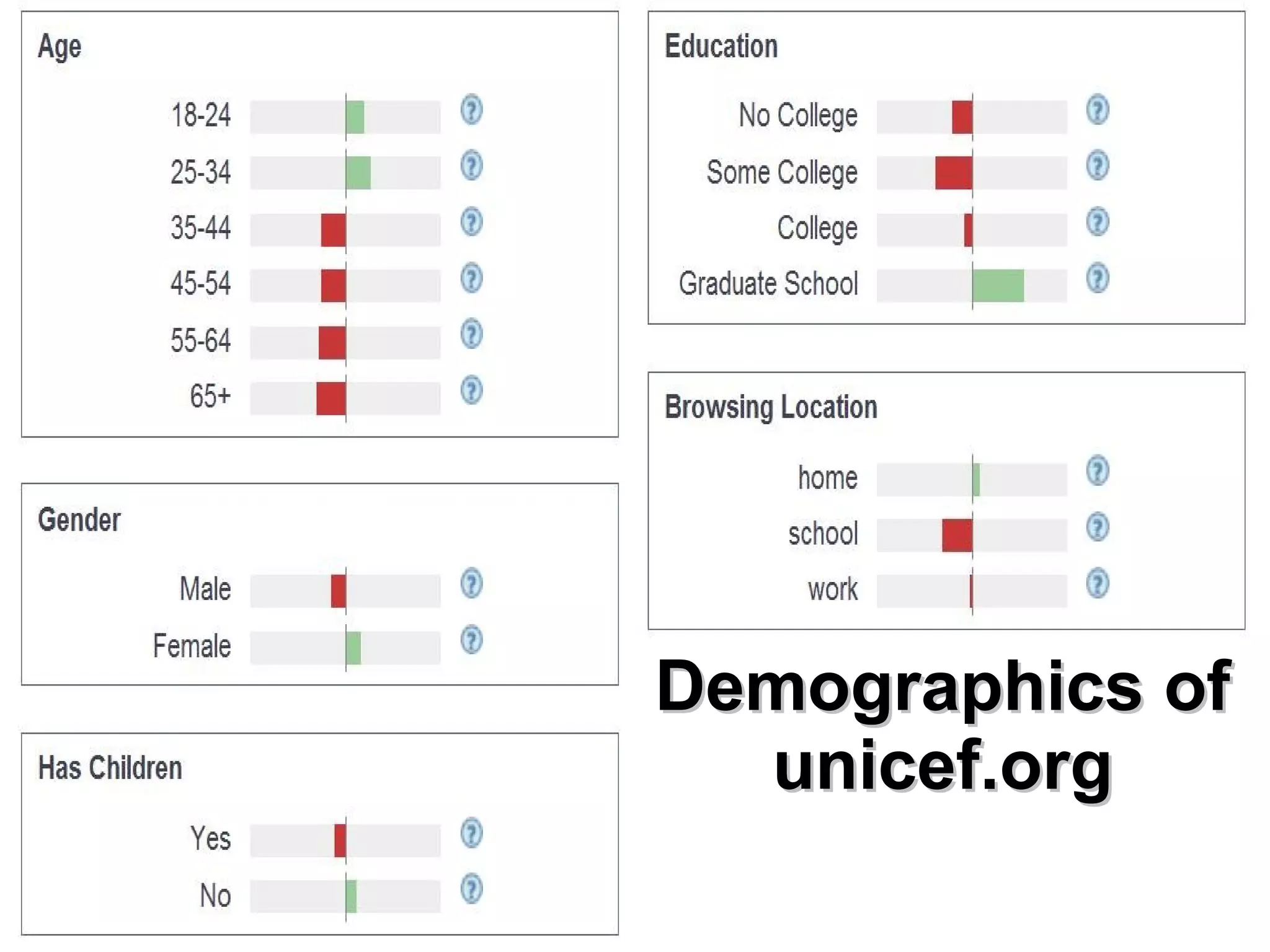
Demographics of unicef.org
Success stories In Brobo Village in the Cote d'Ivoire, Suzanne and Claudia, age 13 and 11 respectively, are eager to show their homework to their teachers.  The routine of going to school, however, is a recent development.  In the past, the girls woke up at four in the morning to get to the nearest water pump (3 miles away) and return home by 7 a.m.  During droughts, fetching water could take a whole day—the only alternative was the nearest pond, often the cause of severe health problems. "We know that drinking water from a pond and cooking with it often makes people sick," says Suzanne.  "But sometimes we just have no choice… If there is nothing else than water coming from ponds, we'd rather get sick than die from thirst." UNICEF has supported installation of two new water pumps in Brobo—including one at the school compound that allows 1,200 pupils to drink potable water. "The clear water we get at school tastes so much better than the muddy water we used to get at the pond," Claudia mentions.  "And now, since we don't have to walk as far as before to fetch water, I finally get to go to school every day," she says. More than eight million people in the Cote d'Ivoire lack appropriate sanitation facilities, and over four million people still use unsafe drinking water sources.  UNICEF repaired around 2,330 village pumps in 2006 and 2007.  In addition, more than 1,833 water–management village committees were reactivated in 2007.  UNICEF also improved the water supply in two hospitals and five health centers while an additional 27 health centers are currently undergoing rehabilitation. 
Continued In Nicaragua, growing environmental degradation and poor hygiene practices exacerbate poverty, diseases and vulnerability to disasters. A third of the population has no access to sustainable sources of drinking water and while it is reported that more than 75 percent of the country’s rural population has access to sanitation facilities, latrine use is low. However, for those living in the northern and southern Atlantic regions of the country, they are far below the national averages, with only 18 percent having access to water and 20 percent having access to sanitation.  Thanks to the support of Tap Project donors like you, UNICEF is working to overcome these challenges in these regions by implementing culturally–sensitive tactics for the promotion of hygiene and environmental sanitation in communities and schools. These programs aim to reach 1,400 people by giving them access to safe sanitation facilities in their households.  In addition, local communications campaigns will stress the importance of a healthy home environment and will seek to increase the knowledge and adoption of proper household hygiene and sanitation. Likewise, the program will provide 400 school children with access to safe water and sanitation facilities in their school. This will coincide with the teaching of healthy hygiene habits by teachers and will be reinforced through promotional materials made available through this program.

Unicefppt

  • 1.
    UN ICEF Howcan we Help? Pauline Dang | Augustin toma
  • 2.
    What is the“UN” The United Nations is an assembly of sovereign nations It was founded in 1945 in hopes of replacing the ineffective “league of nations” which had failed to impede world war two The newly founded organization had placed its mandate on the concept of global peace and security- ensuring the basic rights of all humans
  • 3.
    What does theUN do? PEACE-KEEPING : When conflicts threaten international security, it provides a forum for negotiation; it can also send peace-keepers to stabilize a crisis however it has no power to compel any action by any government
  • 4.
    Continuation HELPING INEMERGENCIES: It organizes humanitarian relief and food supplies for millions of refugees and victims of famine and natural disasters FIGHTING POVERTY : It helps the poor to help themselves, through development projects
  • 5.
    Continuation PROTECTING THEENVIRONMENT : It brings governments together to work on climate change, air and water pollution, depletion of natural resources and many other environmental concerns
  • 6.
    Continuation IMPROVING HEALTHAND EDUCATION : It helps poorer countries to provide more and better schools and health services, and works to prevent the spread of global diseases like AIDS
  • 7.
    How do theUN and UNICEF relate? UNICEF is a branch organization founded by the UN one year after it’s birth UNICEF focuses on the well being of women and children within developed nations In a sense UNICEF can be seen as a specialized branch of the UN
  • 8.
    What is UNICEF’smandate? UNICEF is a branch organization founded by the UN one year after it’s birth UNICEF focuses on the well being of women and children within developed nations In a sense UNICEF can be seen as a specialized branch of the UN
  • 9.
    UNICEF’s current goalsGoal: Eradicate extreme poverty and hunger Targets by 2015: Reduce by half the proportion of people living on less than a dollar a day Reduce by half the proportion of people who suffer from hunger
  • 10.
    Continuation More than30 per cent of children in developing countries – about 600 million – live on less than US $1 a day. Every 3.6 seconds one person dies of starvation. Usually it is a child under the age of 5.
  • 11.
    Continuation Goal: Achieveuniversal primary education Target by 2015: Ensure that all boys and girls complete a full course of primary schooling As of 2001 estimates around 115 million children of primary school age, the majority of them girls, do not attend school
  • 12.
    Continuation Goal: Promotegender equality and empower women Target by 2015: Eliminate gender disparity at all levels of education by 2015 and empower women. Advancing the rights of women and children advances humanity. Two-thirds of the world’s 799 million illiterate adults ages 15 and over are women.
  • 13.
    Continuation Goal: Reducechild mortality Targets by 2015: To reduce child mortality by two-thirds, from 93 children of every 1,000 dying before age five in 1990 to 31 of every 1,000 in 2015.
  • 14.
    Continuation Target by2015: Reduce the maternal mortality ratio by three quarters. Healthy children need healthy mothers A woman dies from complications in childbirth every minute – about 529,000 each year -- the vast majority of them in developing countries
  • 15.
    Continuation Goal: CombatHIV/AIDS, malaria and other diseases Targets by 2015: Halt and begin to reverse the spread of HIV/AIDS Halt and begin to reverse the incidence of malaria and other major diseases
  • 16.
    Continuation Goal: CombatHIV/AIDS, malaria and other diseases Targets by 2015: Halt and begin to reverse the spread of HIV/AIDS Halt and begin to reverse the incidence of malaria and other major diseases
  • 17.
    Continuation Goal: CombatHIV/AIDS, malaria and other diseases Targets by 2015: Halt and begin to reverse the spread of HIV/AIDS Halt and begin to reverse the incidence of malaria and other major diseases
  • 18.
    UNICEF stands for“United Nations Children’s Fund” It was formed in 1946 UNICEF provides vaccines forty percent of the worlds children- that’s three billion doses annualy The organization is the largest buyer of mosquitoe nets, procuring twenty five million nets in 2005 Quick Facts on UNICEF
  • 19.
    Continuation Over twelvemillion students went back to school in 2006 with the financial support of UNICEF UNICEF is funded entirely by the voluntary contributions of individuals, foundations, businesses and governments UNICEF was awarded the Nobel Peace Prize in 1965
  • 20.
    How can Ihelp UNICEF? UNICEF recommends the following ways; Online Donations Fundraisers Supporting your local UNICEF centre with volunteer time
  • 21.
    How can Imake an Online Donation? Making an online donation to UNICEF is a simple and safe practice All that is needed is a credit card One can choose to have automatic monthly donations or one time lump sums
  • 22.
    UNICEF’s website Theaverage user spends two minutes and twenty four seconds on the website www.unicef.org has been active since march 1993 13.2 % of visitors are of U.S. origin, 11.1 % are of Indian, 3.9 percent are of Mexican…
  • 23.
    Continued UNICEF received10-50 million dollars per on average from online donations made at their website
  • 24.
  • 25.
    Success stories InBrobo Village in the Cote d'Ivoire, Suzanne and Claudia, age 13 and 11 respectively, are eager to show their homework to their teachers.  The routine of going to school, however, is a recent development.  In the past, the girls woke up at four in the morning to get to the nearest water pump (3 miles away) and return home by 7 a.m.  During droughts, fetching water could take a whole day—the only alternative was the nearest pond, often the cause of severe health problems. "We know that drinking water from a pond and cooking with it often makes people sick," says Suzanne.  "But sometimes we just have no choice… If there is nothing else than water coming from ponds, we'd rather get sick than die from thirst." UNICEF has supported installation of two new water pumps in Brobo—including one at the school compound that allows 1,200 pupils to drink potable water. "The clear water we get at school tastes so much better than the muddy water we used to get at the pond," Claudia mentions.  "And now, since we don't have to walk as far as before to fetch water, I finally get to go to school every day," she says. More than eight million people in the Cote d'Ivoire lack appropriate sanitation facilities, and over four million people still use unsafe drinking water sources.  UNICEF repaired around 2,330 village pumps in 2006 and 2007.  In addition, more than 1,833 water–management village committees were reactivated in 2007.  UNICEF also improved the water supply in two hospitals and five health centers while an additional 27 health centers are currently undergoing rehabilitation. 
  • 26.
    Continued In Nicaragua,growing environmental degradation and poor hygiene practices exacerbate poverty, diseases and vulnerability to disasters. A third of the population has no access to sustainable sources of drinking water and while it is reported that more than 75 percent of the country’s rural population has access to sanitation facilities, latrine use is low. However, for those living in the northern and southern Atlantic regions of the country, they are far below the national averages, with only 18 percent having access to water and 20 percent having access to sanitation. Thanks to the support of Tap Project donors like you, UNICEF is working to overcome these challenges in these regions by implementing culturally–sensitive tactics for the promotion of hygiene and environmental sanitation in communities and schools. These programs aim to reach 1,400 people by giving them access to safe sanitation facilities in their households. In addition, local communications campaigns will stress the importance of a healthy home environment and will seek to increase the knowledge and adoption of proper household hygiene and sanitation. Likewise, the program will provide 400 school children with access to safe water and sanitation facilities in their school. This will coincide with the teaching of healthy hygiene habits by teachers and will be reinforced through promotional materials made available through this program.