UNICEF
(UNITED NATIONS INTERNATIONAL CHILDREN’S EMERGENCY
FUND)
GROUP MEMBERS
MUHAMMAD UMAR IQBAL 18-ARID-6215
JAVERIA HAMEED ABBASSI 18-ARID-6193
MOMINA BIBI 18-ARID6207
KASHIF MEHMOOD 18-ARID-6195
BUSHRA FIRDOUS 18-ARID-6182
AMNA IJAZ 18-ARID-6172
ALEENA SIKANDAR 18-ARID-6171
NAIMA HAMID 18-ARID-6221
SAMIA KALSOOM 18-ARID-6203
NIGHAT MUSHTAQ 18-ARID-6224
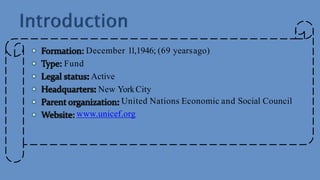
December 11,1946; (69 yearsago)
Fund
Active
New YorkCity
United Nations Economic and Social Council
www.unicef.org
 UNICEF is a leading humanitarian and development agency working
globally for the rights of every child. Child rights begin with safe shelter,
nutrition, protection from disaster and conflict and traverse the life cycle:
pre-natal care for healthy births, clean water and sanitation, health care and
education.
 UNICEF has spent nearly 70 years working to improve the lives of children
and their families. Working with and for children through adolescence and
into adulthood requires a global presence whose goal is to produce results
and monitor their effects. UNICEF also lobbies and partners with leaders,
thinkers and policy makers to help all children realize their rights—
especially the most disadvantaged.
 UNICEF was established on 11 December 1946 by the United Nations to
meet the emergency needs of children in post-war Europe and China. Its
full name was the United Nations International Children's Emergency Fund.
 In 1950, its mandate was broadened to address the long-term needs of children and
women in developing countries everywhere. UNICEF became a permanent part of
the United Nations system in 1953, when its name was shortened to the United
Nations Children's Fund. However, UNICEF retained its original acronym.
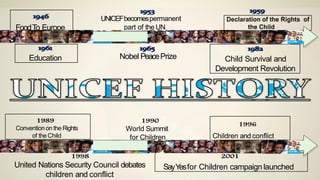
UNICEFbecomespermanent
part of the UNFoodTo Europe
Education Nobel PeacePrize Child Survival and
Development Revolution
Convention on the Rights
of theChild
World Summit
for Children Children and conflict
United Nations Security Council debates
children and conflict
SayYesfor Children campaign launched
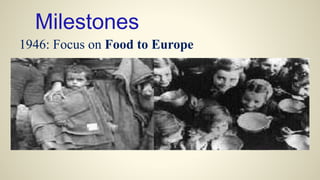
Milestones
1946: Focus on Food to Europe
1953: UNICEF becomes permanent part
Milestones (Cont.)
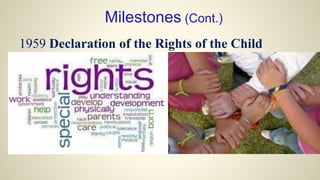
1959 Declaration of the Rights of the Child
Milestones (Cont.)
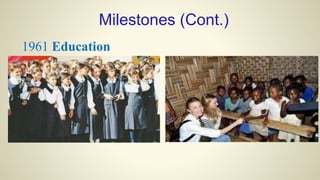
1961 Education
Milestones (Cont.)
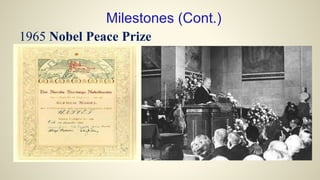
1965 Nobel Peace Prize
Milestones (Cont.)
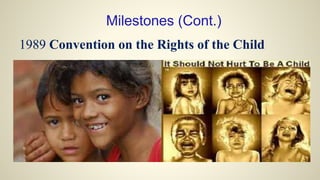
1989 Convention on the Rights of the Child
Milestones (Cont.)
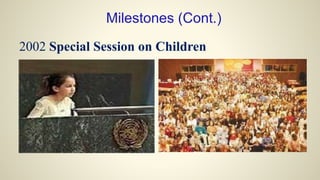
2002 Special Session on Children
Milestones (Cont.)
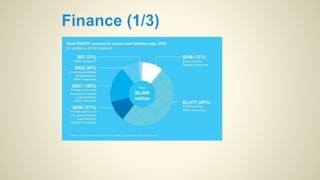
• UNICEF is supported by voluntary funds. Governments
contribute two thirds of the resources; private groups and some
6 million individual donors contribute the rest through National
Committees.
• Country office carries out UNICEF‘s mission through a unique
programme of cooperation developed with the host government.
• Regional offices guide the work and provide technical
assistance to country offices as needed.
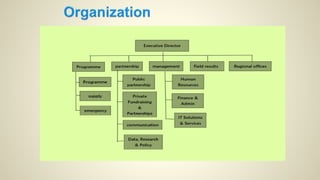
• Overall management and administration takes place at
headquarters.
• Specialized offices include the Supply Division, based in
Copenhagen, which provides essential items as the
majority of life-saving vaccine doses for children in
developing countries.
• It operates the Innocenti Research Center in Florence
• Offices for Japan and Brussels, which assist with fund-
raising and liaison with policy makers.
• 36-member Executive
Board:
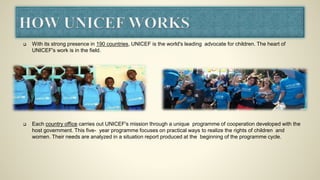
 With its strong presence in 190 countries, UNICEF is the world's leading advocate for children. The heart of
UNICEF's work is in the field.
 Each country office carries out UNICEF's mission through a unique programme of cooperation developed with the
host government. This five- year programme focuses on practical ways to realize the rights of children and
women. Their needs are analyzed in a situation report produced at the beginning of the programme cycle.
•Provide long term humanitarian and development assistances to
children &mothers in developing countries.
•Emphasize developing community level services to promote
health & wellbeing of children.
ORGANISATION
•In 191 countries through country programs & national committees.
•Guided by 36 member executive board.
•Head – executive director.
•Income- contribution by diff govts & private donors
• UNICEF Work
UNICEF works in 190 countries and territories to protect the rights of every child.
UNICEF has spent 70 years working to improve the lives of children and their families.
• UNICEF believes
All children have a right to survive, thrive and fulfill their potential – to the benefit of a
better world.
• UNICEF results
UNICEF works day-in day-out in the world’s toughest places to reach the most
vulnerable and disadvantaged children. Delivering results for children and young
people is our driving force.
• How UNICEF work
UNICEF works with the United Nations and its agencies to make sure that child are
on the global agenda. UNICEF strikes a balance between thorough research and
practical solutions for children.
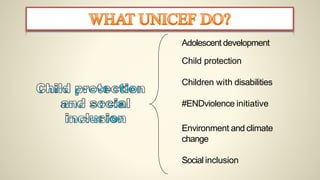
Adolescent development
Child protection
Children with disabilities
#ENDviolence initiative
Environment and climate
change
Social inclusion
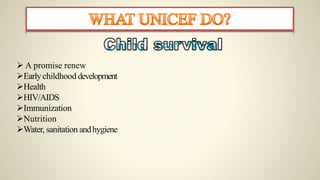
 A promise renew
Early childhood development
Health
HIV/AIDS
Immunization
Nutrition
Water, sanitation andhygiene
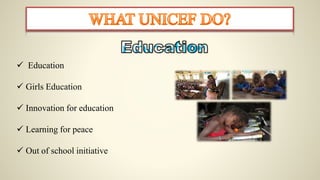
 Education
 Girls Education
 Innovation for education
 Learning for peace
 Out of school initiative
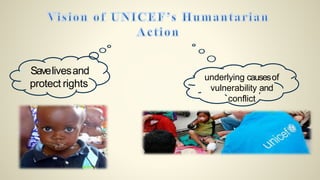
• Savelivesand
protect rights
underlying causesof
vulnerability and
conflict
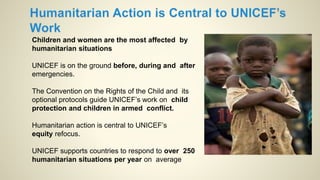
Children and women are the most affected by
humanitarian situations
UNICEF is on the ground before, during and after
emergencies.
The Convention on the Rights of the Child and its
optional protocols guide UNICEF’s work on child
protection and children in armed conflict.
Humanitarian action is central to UNICEF’s
equity refocus.
UNICEF supports countries to respond to over 250
humanitarian situations per year on average
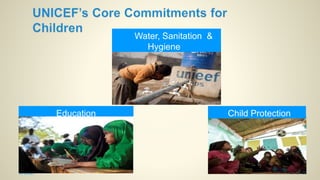
UNICEF
Water, Sanitation &
Hygiene
Child ProtectionEducation
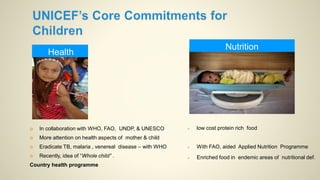
Health
Nutrition
 low cost protein rich food
 With FAO, aided Applied Nutrition Programme
 Enriched food in endemic areas of nutritional def.
 In collaboration with WHO, FAO, UNDP, & UNESCO
 More attention on health aspects of mother & child
 Eradicate TB, malaria , venereal disease – with WHO
 Recently, idea of “Whole child” .
Country health programme
To encourage strategies for
child health revolution
 Growth charts to monitor child
development
 Oral rehydration
 Breast feeding
 Immunisation
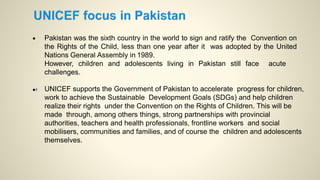
• Pakistan was the sixth country in the world to sign and ratify the Convention on
the Rights of the Child, less than one year after it was adopted by the United
Nations General Assembly in 1989.
However, children and adolescents living in Pakistan still face acute
challenges.
• UNICEF supports the Government of Pakistan to accelerate progress for children,
work to achieve the Sustainable Development Goals (SDGs) and help children
realize their rights under the Convention on the Rights of Children. This will be
made through, among others things, strong partnerships with provincial
authorities, teachers and health professionals, frontline workers and social
mobilisers, communities and families, and of course the children and adolescents
themselves.
In particular, UNICEF will work so that:
• Every child survives and thrives -- being in good health, immunized,
protected from polio and accessing nutritious food.
• Every child learns.
• Every child is protected from violence and exploitation, and
registered at birth.
• Every child lives in a safe and clean environment, with access to safe
drinking water and adequate sanitation
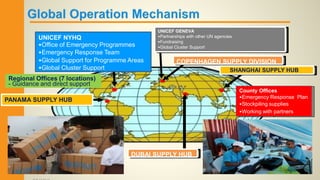
UNICE
F
COPENHAGEN SUPPLY DIVISIONCOPENHAGEN SUPPLY DIVISION
PANAMA SUPPLY HUBPANAMA SUPPLY HUB
UNICEF NYHQ
•Office of Emergency Programmes
•Emergency Response Team
•Global Support for Programme Areas
•Global Cluster Support
UNICEF GENEVA
• Partnerships with other UN agencies
• Fundraising
UNICEF GENEVA
•Partnerships with other UN agencies
•Fundraising
•Global Cluster Support
Regional Offices (7 locations)
- Guidance and direct support
DUBAI SUPPLY HUBDUBAI SUPPLY HUB
SHANGHAI SUPPLY HUBSHANGHAI SUPPLY HUB
County Offices
• Emergency Response
Plan
• Stockpiling supplies
County Offices
•Emergency Response Plan
•Stockpiling supplies
•Working with partners
 Community empowerment, strengthening social service delivery and capacity
development
• Brazil, Ethiopia, Kenya, Niger, Pakistan and Zimbabwe
 Risk-informed programming, including disaster risk reduction and situation analysis
 Focus on education in 13 countries
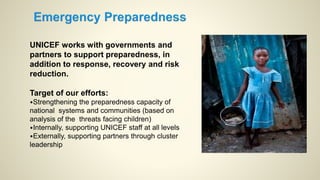
UNICEF works with governments and
partners to support preparedness, in
addition to response, recovery and risk
reduction.
Target of our efforts:
•Strengthening the preparedness capacity of
national systems and communities (based on
analysis of the threats facing children)
•Internally, supporting UNICEF staff at all levels
•Externally, supporting partners through cluster
leadership
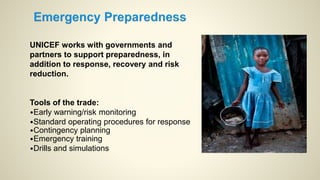
UNICEF works with governments and
partners to support preparedness, in
addition to response, recovery and risk
reduction.
Tools of the trade:
•Early warning/risk monitoring
•Standard operating procedures for response
•Contingency planning
•Emergency training
•Drills and simulations
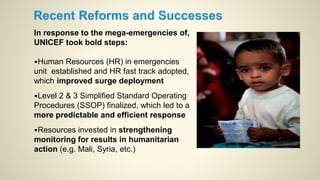
In response to the mega-emergencies of,
UNICEF took bold steps:
•Human Resources (HR) in emergencies
unit established and HR fast track adopted,
which improved surge deployment
•Level 2 & 3 Simplified Standard Operating
Procedures (SSOP) finalized, which led to a
more predictable and efficient response
•Resources invested in strengthening
monitoring for results in humanitarian
action (e.g. Mali, Syria, etc.)
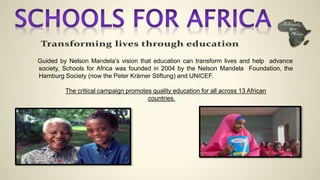
Guided by Nelson Mandela’s vision that education can transform lives and help advance
society, Schools for Africa was founded in 2004 by the Nelson Mandela Foundation, the
Hamburg Society (now the Peter Krämer Stiftung) and UNICEF.
The critical campaign promotes quality education for all across 13 African
countries.
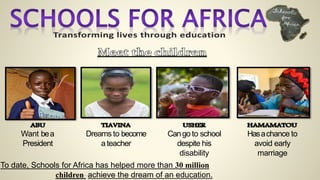
Want bea
President
Dreams to become
a teacher
Cango to school
despite his
disability
Hasachance to
avoid early
marriage
To date, Schools for Africa has helped more than 30 million
children achieve the dream of an education.
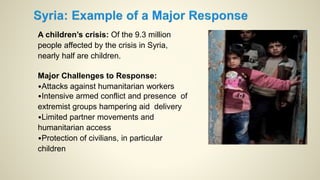
A children’s crisis: Of the 9.3 million
people affected by the crisis in Syria,
nearly half are children.
Major Challenges to Response:
•Attacks against humanitarian workers
•Intensive armed conflict and presence of
extremist groups hampering aid delivery
•Limited partner movements and
humanitarian access
•Protection of civilians, in particular
children
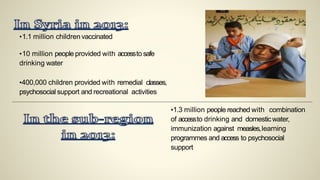
•1.1 million children vaccinated
•10 million people provided with accessto safe
drinking water
•400,000 children provided with remedial classes,
psychosocial support and recreational activities
•1.3 million people reached with combination
of accessto drinking and domesticwater,
immunization against measles,learning
programmes and access to psychosocial
support
18
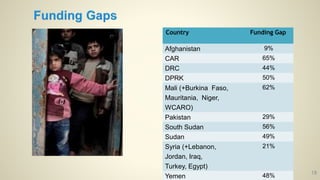
Country Funding Gap
Afghanistan 9%
CAR 65%
DRC 44%
DPRK 50%
Mali (+Burkina Faso,
Mauritania, Niger,
WCARO)
62%
Pakistan 29%
South Sudan 56%
Sudan 49%
Syria (+Lebanon,
Jordan, Iraq,
Turkey, Egypt)
21%
Yemen 48%
• Sponsorship
• Trick-or-Treat UNICEF box
• Art in All of Us
• Corporate Partnership
Digital marketing strategy
• Encouraging public support, participation and action (donations)
• Ensuring greater transparency and accountability
• Increasing and sustaining relationship-building and brand
awareness
Digital marketing strategy
• Encouraging public support, participation and action
(donations)
• Ensuring greater transparency and accountability
• Increasing and sustaining relationship-building and brand
awareness
General information: History
• Website (and seperate Online Shop)
• Display advertising (Banner,
Images, Videos)
• Social Media
• Blogs
• Podcasts
• Open data portal (Statistics)
• E-mail Marketing (Newsletter)
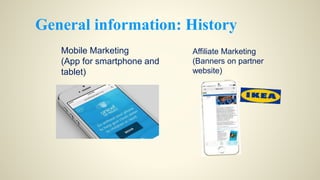
General information: History
Mobile Marketing
(App for smartphone and
tablet)
Affiliate Marketing
(Banners on partner
website)
 Further simplification
 Helping to improve inter-agency responseto non-Level 3 emergencies
 Apractical and inclusive humanitarian partnership system(regional and
South-South)
It is necessary an undergraduate course and several years of work experience to enter the
program of Volunteers of the United Nations programme.
This is a United Nations common programme, which recruits volunteers for assignments
throughout the United Nations system, including UNICEF. Application procedures and information
are available at the UNV Web site.
UNICEF does not recruit volunteers directly. Volunteer opportunities are offered
through the U.S. Fund for UNICEF in the case of US-based volunteer work. Similarly, UNICEF
National Committees in other industrialized countries can provide information on volunteer
activities for their respective citizens.
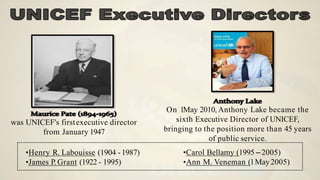
was UNICEF's firstexecutive director
from January 1947
On 1May 2010, Anthony Lake became the
sixth Executive Director of UNICEF,
bringing to the position more than 45 years
of public service.
•Henry R. Labouisse (1904 -1987)
•James P. Grant (1922 - 1995)
•Carol Bellamy (1995 –2005)
•Ann M. Veneman (1May2005)
 UNICEF was established for humanitarian and
developmental assistance to children and mothers
 Recommendation:
•Enhance partnership with research and policy in the regional level
•Strengthen the staff implementation
•Look around all criticism
•Create more fundraising activities
UNICEF PRESENTATION 2020

UNICEF PRESENTATION 2020

  • 1.
    UNICEF (UNITED NATIONS INTERNATIONALCHILDREN’S EMERGENCY FUND)
  • 2.
    GROUP MEMBERS MUHAMMAD UMARIQBAL 18-ARID-6215 JAVERIA HAMEED ABBASSI 18-ARID-6193 MOMINA BIBI 18-ARID6207 KASHIF MEHMOOD 18-ARID-6195 BUSHRA FIRDOUS 18-ARID-6182 AMNA IJAZ 18-ARID-6172 ALEENA SIKANDAR 18-ARID-6171 NAIMA HAMID 18-ARID-6221 SAMIA KALSOOM 18-ARID-6203 NIGHAT MUSHTAQ 18-ARID-6224
  • 3.
    December 11,1946; (69yearsago) Fund Active New YorkCity United Nations Economic and Social Council www.unicef.org
  • 4.
     UNICEF isa leading humanitarian and development agency working globally for the rights of every child. Child rights begin with safe shelter, nutrition, protection from disaster and conflict and traverse the life cycle: pre-natal care for healthy births, clean water and sanitation, health care and education.  UNICEF has spent nearly 70 years working to improve the lives of children and their families. Working with and for children through adolescence and into adulthood requires a global presence whose goal is to produce results and monitor their effects. UNICEF also lobbies and partners with leaders, thinkers and policy makers to help all children realize their rights— especially the most disadvantaged.
  • 5.
     UNICEF wasestablished on 11 December 1946 by the United Nations to meet the emergency needs of children in post-war Europe and China. Its full name was the United Nations International Children's Emergency Fund.  In 1950, its mandate was broadened to address the long-term needs of children and women in developing countries everywhere. UNICEF became a permanent part of the United Nations system in 1953, when its name was shortened to the United Nations Children's Fund. However, UNICEF retained its original acronym.
  • 6.
    UNICEFbecomespermanent part of theUNFoodTo Europe Education Nobel PeacePrize Child Survival and Development Revolution Convention on the Rights of theChild World Summit for Children Children and conflict United Nations Security Council debates children and conflict SayYesfor Children campaign launched
  • 7.
  • 8.
    1953: UNICEF becomespermanent part Milestones (Cont.)
  • 9.
    1959 Declaration ofthe Rights of the Child Milestones (Cont.)
  • 10.
  • 11.
    1965 Nobel PeacePrize Milestones (Cont.)
  • 12.
    1989 Convention onthe Rights of the Child Milestones (Cont.)
  • 13.
    2002 Special Sessionon Children Milestones (Cont.)
  • 17.
    • UNICEF issupported by voluntary funds. Governments contribute two thirds of the resources; private groups and some 6 million individual donors contribute the rest through National Committees. • Country office carries out UNICEF‘s mission through a unique programme of cooperation developed with the host government. • Regional offices guide the work and provide technical assistance to country offices as needed. • Overall management and administration takes place at headquarters.
  • 18.
    • Specialized officesinclude the Supply Division, based in Copenhagen, which provides essential items as the majority of life-saving vaccine doses for children in developing countries. • It operates the Innocenti Research Center in Florence • Offices for Japan and Brussels, which assist with fund- raising and liaison with policy makers. • 36-member Executive Board:
  • 20.
     With itsstrong presence in 190 countries, UNICEF is the world's leading advocate for children. The heart of UNICEF's work is in the field.  Each country office carries out UNICEF's mission through a unique programme of cooperation developed with the host government. This five- year programme focuses on practical ways to realize the rights of children and women. Their needs are analyzed in a situation report produced at the beginning of the programme cycle.
  • 22.
    •Provide long termhumanitarian and development assistances to children &mothers in developing countries. •Emphasize developing community level services to promote health & wellbeing of children. ORGANISATION •In 191 countries through country programs & national committees. •Guided by 36 member executive board. •Head – executive director. •Income- contribution by diff govts & private donors
  • 23.
    • UNICEF Work UNICEFworks in 190 countries and territories to protect the rights of every child. UNICEF has spent 70 years working to improve the lives of children and their families. • UNICEF believes All children have a right to survive, thrive and fulfill their potential – to the benefit of a better world. • UNICEF results UNICEF works day-in day-out in the world’s toughest places to reach the most vulnerable and disadvantaged children. Delivering results for children and young people is our driving force. • How UNICEF work UNICEF works with the United Nations and its agencies to make sure that child are on the global agenda. UNICEF strikes a balance between thorough research and practical solutions for children.
  • 24.
    Adolescent development Child protection Childrenwith disabilities #ENDviolence initiative Environment and climate change Social inclusion
  • 25.
     A promiserenew Early childhood development Health HIV/AIDS Immunization Nutrition Water, sanitation andhygiene
  • 26.
     Education  GirlsEducation  Innovation for education  Learning for peace  Out of school initiative
  • 28.
    • Savelivesand protect rights underlyingcausesof vulnerability and conflict
  • 29.
    Children and womenare the most affected by humanitarian situations UNICEF is on the ground before, during and after emergencies. The Convention on the Rights of the Child and its optional protocols guide UNICEF’s work on child protection and children in armed conflict. Humanitarian action is central to UNICEF’s equity refocus. UNICEF supports countries to respond to over 250 humanitarian situations per year on average
  • 32.
  • 33.
    Health Nutrition  low costprotein rich food  With FAO, aided Applied Nutrition Programme  Enriched food in endemic areas of nutritional def.  In collaboration with WHO, FAO, UNDP, & UNESCO  More attention on health aspects of mother & child  Eradicate TB, malaria , venereal disease – with WHO  Recently, idea of “Whole child” . Country health programme
  • 34.
    To encourage strategiesfor child health revolution  Growth charts to monitor child development  Oral rehydration  Breast feeding  Immunisation
  • 35.
    • Pakistan wasthe sixth country in the world to sign and ratify the Convention on the Rights of the Child, less than one year after it was adopted by the United Nations General Assembly in 1989. However, children and adolescents living in Pakistan still face acute challenges. • UNICEF supports the Government of Pakistan to accelerate progress for children, work to achieve the Sustainable Development Goals (SDGs) and help children realize their rights under the Convention on the Rights of Children. This will be made through, among others things, strong partnerships with provincial authorities, teachers and health professionals, frontline workers and social mobilisers, communities and families, and of course the children and adolescents themselves.
  • 36.
    In particular, UNICEFwill work so that: • Every child survives and thrives -- being in good health, immunized, protected from polio and accessing nutritious food. • Every child learns. • Every child is protected from violence and exploitation, and registered at birth. • Every child lives in a safe and clean environment, with access to safe drinking water and adequate sanitation
  • 37.
    UNICE F COPENHAGEN SUPPLY DIVISIONCOPENHAGENSUPPLY DIVISION PANAMA SUPPLY HUBPANAMA SUPPLY HUB UNICEF NYHQ •Office of Emergency Programmes •Emergency Response Team •Global Support for Programme Areas •Global Cluster Support UNICEF GENEVA • Partnerships with other UN agencies • Fundraising UNICEF GENEVA •Partnerships with other UN agencies •Fundraising •Global Cluster Support Regional Offices (7 locations) - Guidance and direct support DUBAI SUPPLY HUBDUBAI SUPPLY HUB SHANGHAI SUPPLY HUBSHANGHAI SUPPLY HUB County Offices • Emergency Response Plan • Stockpiling supplies County Offices •Emergency Response Plan •Stockpiling supplies •Working with partners
  • 38.
     Community empowerment,strengthening social service delivery and capacity development • Brazil, Ethiopia, Kenya, Niger, Pakistan and Zimbabwe  Risk-informed programming, including disaster risk reduction and situation analysis  Focus on education in 13 countries
  • 39.
    UNICEF works withgovernments and partners to support preparedness, in addition to response, recovery and risk reduction. Target of our efforts: •Strengthening the preparedness capacity of national systems and communities (based on analysis of the threats facing children) •Internally, supporting UNICEF staff at all levels •Externally, supporting partners through cluster leadership
  • 40.
    UNICEF works withgovernments and partners to support preparedness, in addition to response, recovery and risk reduction. Tools of the trade: •Early warning/risk monitoring •Standard operating procedures for response •Contingency planning •Emergency training •Drills and simulations
  • 41.
    In response tothe mega-emergencies of, UNICEF took bold steps: •Human Resources (HR) in emergencies unit established and HR fast track adopted, which improved surge deployment •Level 2 & 3 Simplified Standard Operating Procedures (SSOP) finalized, which led to a more predictable and efficient response •Resources invested in strengthening monitoring for results in humanitarian action (e.g. Mali, Syria, etc.)
  • 43.
    Guided by NelsonMandela’s vision that education can transform lives and help advance society, Schools for Africa was founded in 2004 by the Nelson Mandela Foundation, the Hamburg Society (now the Peter Krämer Stiftung) and UNICEF. The critical campaign promotes quality education for all across 13 African countries.
  • 44.
    Want bea President Dreams tobecome a teacher Cango to school despite his disability Hasachance to avoid early marriage To date, Schools for Africa has helped more than 30 million children achieve the dream of an education.
  • 45.
    A children’s crisis:Of the 9.3 million people affected by the crisis in Syria, nearly half are children. Major Challenges to Response: •Attacks against humanitarian workers •Intensive armed conflict and presence of extremist groups hampering aid delivery •Limited partner movements and humanitarian access •Protection of civilians, in particular children
  • 46.
    •1.1 million childrenvaccinated •10 million people provided with accessto safe drinking water •400,000 children provided with remedial classes, psychosocial support and recreational activities •1.3 million people reached with combination of accessto drinking and domesticwater, immunization against measles,learning programmes and access to psychosocial support
  • 47.
    18 Country Funding Gap Afghanistan9% CAR 65% DRC 44% DPRK 50% Mali (+Burkina Faso, Mauritania, Niger, WCARO) 62% Pakistan 29% South Sudan 56% Sudan 49% Syria (+Lebanon, Jordan, Iraq, Turkey, Egypt) 21% Yemen 48%
  • 48.
    • Sponsorship • Trick-or-TreatUNICEF box • Art in All of Us • Corporate Partnership
  • 49.
    Digital marketing strategy •Encouraging public support, participation and action (donations) • Ensuring greater transparency and accountability • Increasing and sustaining relationship-building and brand awareness
  • 50.
    Digital marketing strategy •Encouraging public support, participation and action (donations) • Ensuring greater transparency and accountability • Increasing and sustaining relationship-building and brand awareness
  • 51.
    General information: History •Website (and seperate Online Shop) • Display advertising (Banner, Images, Videos) • Social Media • Blogs • Podcasts • Open data portal (Statistics) • E-mail Marketing (Newsletter)
  • 52.
    General information: History MobileMarketing (App for smartphone and tablet) Affiliate Marketing (Banners on partner website)
  • 53.
     Further simplification Helping to improve inter-agency responseto non-Level 3 emergencies  Apractical and inclusive humanitarian partnership system(regional and South-South)
  • 54.
    It is necessaryan undergraduate course and several years of work experience to enter the program of Volunteers of the United Nations programme. This is a United Nations common programme, which recruits volunteers for assignments throughout the United Nations system, including UNICEF. Application procedures and information are available at the UNV Web site. UNICEF does not recruit volunteers directly. Volunteer opportunities are offered through the U.S. Fund for UNICEF in the case of US-based volunteer work. Similarly, UNICEF National Committees in other industrialized countries can provide information on volunteer activities for their respective citizens.
  • 55.
    was UNICEF's firstexecutivedirector from January 1947 On 1May 2010, Anthony Lake became the sixth Executive Director of UNICEF, bringing to the position more than 45 years of public service. •Henry R. Labouisse (1904 -1987) •James P. Grant (1922 - 1995) •Carol Bellamy (1995 –2005) •Ann M. Veneman (1May2005)
  • 57.
     UNICEF wasestablished for humanitarian and developmental assistance to children and mothers  Recommendation: •Enhance partnership with research and policy in the regional level •Strengthen the staff implementation •Look around all criticism •Create more fundraising activities