Global organisation
INTRODUCTION
The World Health Organization (WHO) is
a specialized agency of the United
Nations responsible for international public
health.
Formation : 7 APRIL 1948
Headquarter : Geneva , Switzerland
Parent Organisation : United Nations
social and economic Council
Director general – Tadros Adhanom (from2017)
.
WHO publish it’s report : World Health Report
 It begin functioning on April 7 , 1948 – A
date now being celebrated every year as per
World Health Day
 It is an intergovernmental organisation and
work with its member states usually through
thehe Ministries of Health.
OBJECTIVES :
 And professional groups which and the
coordinating authority on international health
work.
 To establish and maintain effective
collaborations with the United Nations
specialised Agencies and governmental health
administrations.
 To provide assistance to the governments upon
request in strengthening Health Services.
 To promote cooperation among scientific and
professional groups which contribute to the
advancement of Health.
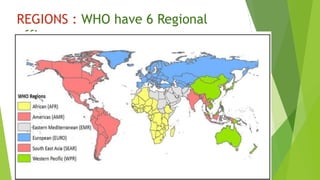
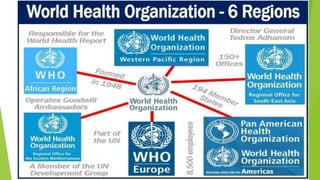
REGIONS : WHO have 6 Regional
office
GOVERNANCE OF WHO
WORLD HEALTH ASSEMBLY –
 The Health Assembly is composed of
delegates representing Members.
 Each Member is represented by not more than
three delegates, one of whom is designated by
the Member as chief delegate.
Functions
The Health Assembly determines the
policies of the Organization.
It supervises the financial policies of the
Organization and reviews and approves the
budget.
The Secretariat
 The Secretariat comprises of the Director-General
and such technical and administrative staff as the
Organization may require.
 The Director-General is appointed by the Health
Assembly on the nomination of the Board on such
terms as the Health Assembly may determine.
MEMBERSHIP
 Members of the United Nations may become
Members of the Organization.
 Member country - 194
EXECUTIVE BOARD
 The executive board is Composed Of 34 members
technically qualified in the field of health.
 Members are elected for 3 years
 The main functions of the board is give effect to
the decisions and policies of health assembly,to
advice it and generally fetelite the work.
 India elected chair of WHO’s 147th Executive
Board from 2021 to 2023
 Present chairman – Dr. Harshvardhan Singh
(minister of Health and Family welfare of India )
WHO’S AGENDA
 Promoting Health Development
 Encourage Health Security
 Strengthening Health Systems
 Encouraging Health Research, information, evidence etc.
 Enhancing Partnership about Health
 Improving performance of Health development
organizations
 World Health Report
WHO’S WORK
 Prevention and control of specific Disease
 Development of Health Services
 To improve the Family Health, Environmental
Health,Health statistics etc.
 To improve Health technologies & Biomedical Research
 Give the Knowledge about the Disease & give some
instructions for it’s prevention
 Cooperation with other Organizations to get the
equilibrium In improved health status (I.e. Red cross
society, UNICEF etc.)
ADVANTAGE OF WHO
 Neutral organization for all state members
 Universal membership,Globally presence
and Networking.
 No parallel organization for tackling disease
 Large No. Of Expertise for all health issues
 Strong Coordination with member Countries
& strong fund collection
WHO’S CONTRIBUTION TO WORLD
 During the first decade (1948-58), the WHO focused major
attention on specific infectious diseases afflicting millions of
people in the developing countries.
 The period (1958 to 68) was much influenced by the national
liberation in Africa of several former colonies, which became voting
members of the Organization.
 The third decade (1968–78) of WHO included the great victory of
eradicating smallpox from the earth.
 The fourth decade (1978–88) was ushered in by a great world
conferenceof WHO and UNICEF in Alma Ata, a city of the Asiatic
part of the Soviet Union.
 Relief work in Nepal during 2015 earthquake.
 Global public health intelligence Network (GPHIN)
WHO & INDIA
 India became a party to the WHO on 12 January 1948.
 Regional office for South East Asia is located in New Delhi
 In 1967, the WHO launched the Intensified Smallpox Eradication
Programme bcz india was largely affected by smallpox (65%)
 Polio Campaign-2012: The Indian Government, in partnership with
UNICEF, the World Health Organization (WHO), the Bill & Melinda
Gates Foundation, Rotary International and the Centers for Disease
Control and Prevention contributed to almost universal awareness
of the need to vaccinate all children under five against polio.
WORLD HEALTH CONCERNS & WHO
 Air pollution and Climate Change
 Communicable & non-communicable disease
 Communicable disease :
 Non communicable disease :
 Global Influenza Pandemic, Ebola and Other High-
Threat Pathogens,HIV,AIDS,Cancer,TB Dangue etc.
 Weak primary Healthcare
 Vaccine hesitancy (we can see in covid 19 pandemic)
Challenges faced by WHO
Funding
 Totally depend on member countries
 Assessed & Voluntary Contribution
Role of other NGO
 GAVI ,Global fund to fight AIDS,TB,Maleria
New Diseases : I.e. COVID 19,SARS etc.
 Globalization & higher spreading
References & links
 https://www.drishtiias.com/important-
institutions/drishti-specials-important-institutions-
international-institution/world-health-organization-who
 https://www.who.int/about/who-we-are/history
 https://www.who.int/
 https://en.m.wikipedia.org/wiki/World_Health_Organizat
ion
Thank you
keep learning
“You don’t have to be great to start. But you have
to start to be great.”

World Health organization Ppt

  • 1.
  • 2.
    INTRODUCTION The World HealthOrganization (WHO) is a specialized agency of the United Nations responsible for international public health. Formation : 7 APRIL 1948 Headquarter : Geneva , Switzerland Parent Organisation : United Nations social and economic Council
  • 3.
    Director general –Tadros Adhanom (from2017) . WHO publish it’s report : World Health Report  It begin functioning on April 7 , 1948 – A date now being celebrated every year as per World Health Day  It is an intergovernmental organisation and work with its member states usually through thehe Ministries of Health.
  • 4.
    OBJECTIVES :  Andprofessional groups which and the coordinating authority on international health work.  To establish and maintain effective collaborations with the United Nations specialised Agencies and governmental health administrations.  To provide assistance to the governments upon request in strengthening Health Services.  To promote cooperation among scientific and professional groups which contribute to the advancement of Health.
  • 5.
    REGIONS : WHOhave 6 Regional office
  • 7.
    GOVERNANCE OF WHO WORLDHEALTH ASSEMBLY –  The Health Assembly is composed of delegates representing Members.  Each Member is represented by not more than three delegates, one of whom is designated by the Member as chief delegate. Functions The Health Assembly determines the policies of the Organization. It supervises the financial policies of the Organization and reviews and approves the budget.
  • 8.
    The Secretariat  TheSecretariat comprises of the Director-General and such technical and administrative staff as the Organization may require.  The Director-General is appointed by the Health Assembly on the nomination of the Board on such terms as the Health Assembly may determine. MEMBERSHIP  Members of the United Nations may become Members of the Organization.  Member country - 194
  • 9.
    EXECUTIVE BOARD  Theexecutive board is Composed Of 34 members technically qualified in the field of health.  Members are elected for 3 years  The main functions of the board is give effect to the decisions and policies of health assembly,to advice it and generally fetelite the work.  India elected chair of WHO’s 147th Executive Board from 2021 to 2023  Present chairman – Dr. Harshvardhan Singh (minister of Health and Family welfare of India )
  • 10.
    WHO’S AGENDA  PromotingHealth Development  Encourage Health Security  Strengthening Health Systems  Encouraging Health Research, information, evidence etc.  Enhancing Partnership about Health  Improving performance of Health development organizations  World Health Report
  • 11.
    WHO’S WORK  Preventionand control of specific Disease  Development of Health Services  To improve the Family Health, Environmental Health,Health statistics etc.  To improve Health technologies & Biomedical Research  Give the Knowledge about the Disease & give some instructions for it’s prevention  Cooperation with other Organizations to get the equilibrium In improved health status (I.e. Red cross society, UNICEF etc.)
  • 12.
    ADVANTAGE OF WHO Neutral organization for all state members  Universal membership,Globally presence and Networking.  No parallel organization for tackling disease  Large No. Of Expertise for all health issues  Strong Coordination with member Countries & strong fund collection
  • 13.
    WHO’S CONTRIBUTION TOWORLD  During the first decade (1948-58), the WHO focused major attention on specific infectious diseases afflicting millions of people in the developing countries.  The period (1958 to 68) was much influenced by the national liberation in Africa of several former colonies, which became voting members of the Organization.  The third decade (1968–78) of WHO included the great victory of eradicating smallpox from the earth.  The fourth decade (1978–88) was ushered in by a great world conferenceof WHO and UNICEF in Alma Ata, a city of the Asiatic part of the Soviet Union.  Relief work in Nepal during 2015 earthquake.  Global public health intelligence Network (GPHIN)
  • 14.
    WHO & INDIA India became a party to the WHO on 12 January 1948.  Regional office for South East Asia is located in New Delhi  In 1967, the WHO launched the Intensified Smallpox Eradication Programme bcz india was largely affected by smallpox (65%)  Polio Campaign-2012: The Indian Government, in partnership with UNICEF, the World Health Organization (WHO), the Bill & Melinda Gates Foundation, Rotary International and the Centers for Disease Control and Prevention contributed to almost universal awareness of the need to vaccinate all children under five against polio.
  • 15.
    WORLD HEALTH CONCERNS& WHO  Air pollution and Climate Change  Communicable & non-communicable disease  Communicable disease :  Non communicable disease :  Global Influenza Pandemic, Ebola and Other High- Threat Pathogens,HIV,AIDS,Cancer,TB Dangue etc.  Weak primary Healthcare  Vaccine hesitancy (we can see in covid 19 pandemic)
  • 16.
    Challenges faced byWHO Funding  Totally depend on member countries  Assessed & Voluntary Contribution Role of other NGO  GAVI ,Global fund to fight AIDS,TB,Maleria New Diseases : I.e. COVID 19,SARS etc.  Globalization & higher spreading
  • 17.
    References & links https://www.drishtiias.com/important- institutions/drishti-specials-important-institutions- international-institution/world-health-organization-who  https://www.who.int/about/who-we-are/history  https://www.who.int/  https://en.m.wikipedia.org/wiki/World_Health_Organizat ion
  • 18.
    Thank you keep learning “Youdon’t have to be great to start. But you have to start to be great.”