WHISKY
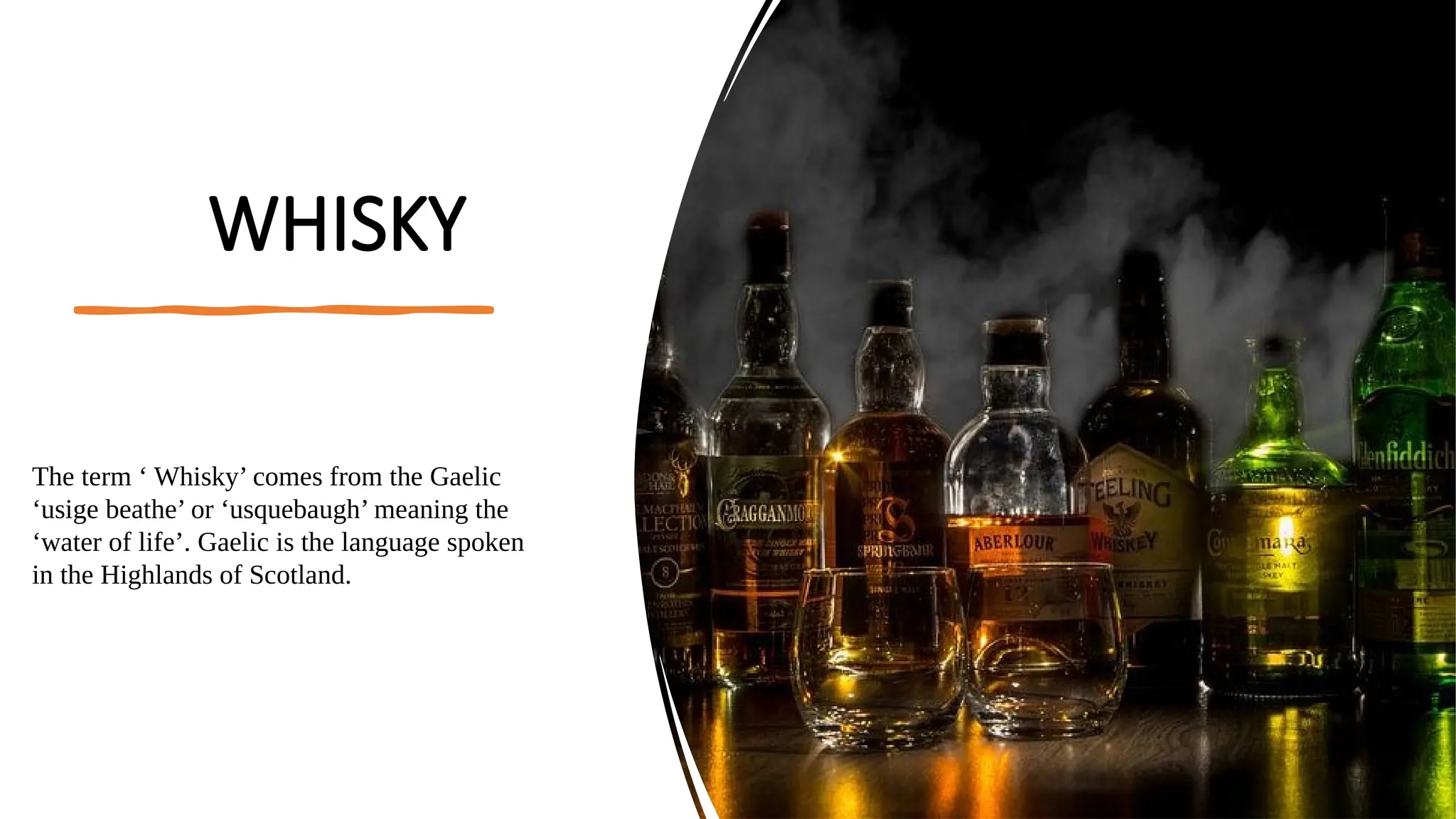
The term ‘Whisky’ comes from the Gaelic
‘usige beathe’ or ‘usquebaugh’ meaning the
‘water of life’. Gaelic is the language spoken
in the Highlands of Scotland.
2.
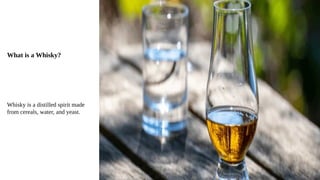
What is aWhisky?
Whisky is a distilled spirit made
from cereals, water, and yeast.
3.
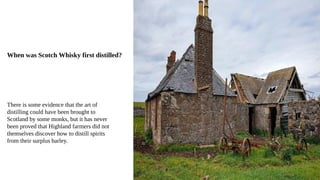
When was ScotchWhisky first distilled?
There is some evidence that the art of
distilling could have been brought to
Scotland by some monks, but it has never
been proved that Highland farmers did not
themselves discover how to distill spirits
from their surplus barley.
4.
How to makea whisky?
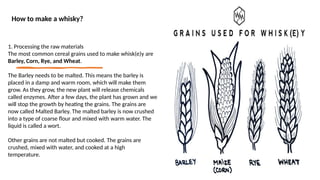
1. Processing the raw materials
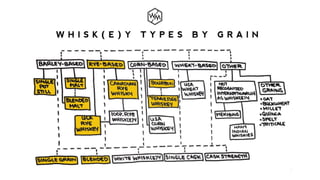
The most common cereal grains used to make whisk(e)y are
Barley, Corn, Rye, and Wheat.
The Barley needs to be malted. This means the barley is
placed in a damp and warm room, which will make them
grow. As they grow, the new plant will release chemicals
called enzymes. After a few days, the plant has grown and we
will stop the growth by heating the grains. The grains are
now called Malted Barley. The malted barley is now crushed
into a type of coarse flour and mixed with warm water. The
liquid is called a wort.
Other grains are not malted but cooked. The grains are
crushed, mixed with water, and cooked at a high
temperature.
5.
How to makea whisky?
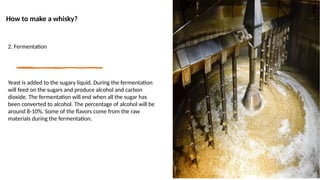
2. Fermentation
Yeast is added to the sugary liquid. During the fermentation
will feed on the sugars and produce alcohol and carbon
dioxide. The fermentation will end when all the sugar has
been converted to alcohol. The percentage of alcohol will be
around 8-10%. Some of the flavors come from the raw
materials during the fermentation.
6.
How to makea whisky?
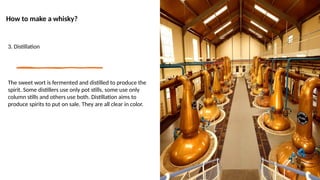
3. Distillation
The sweet wort is fermented and distilled to produce the
spirit. Some distillers use only pot stills, some use only
column stills and others use both. Distillation aims to
produce spirits to put on sale. They are all clear in color.
7.
How to makea whisky?
4. Post Distillation
The aim of this part is to ensure that the whisky has color
aromas, sweetness, and alcoholic strength.
Post-distillation can be broken into four major operations:
[i]. Maturation: The oak maturation will add color and
aromas to the whisky
[ii]. Blending: The whiskies are blended using different
barrels and ages to have consistency and complexity.
[iii]. Finishing: Finishing is the process of preparing the
bottling and sales
9.
Whisky Regions
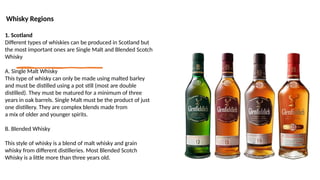
1. Scotland
Differenttypes of whiskies can be produced in Scotland but
the most important ones are Single Malt and Blended Scotch
Whisky
A. Single Malt Whisky
This type of whisky can only be made using malted barley
and must be distilled using a pot still (most are double
distilled). They must be matured for a minimum of three
years in oak barrels. Single Malt must be the product of just
one distillery. They are complex blends made from
a mix of older and younger spirits.
B. Blended Whisky
This style of whisky is a blend of malt whisky and grain
whisky from different distilleries. Most Blended Scotch
Whisky is a little more than three years old.
10.
Whisky Regions
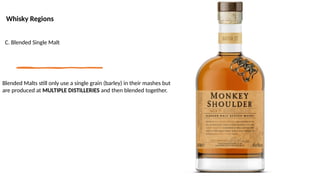
C. BlendedSingle Malt
Blended Malts still only use a single grain (barley) in their mashes but
are produced at MULTIPLE DISTILLERIES and then blended together.
11.
Whisky Regions
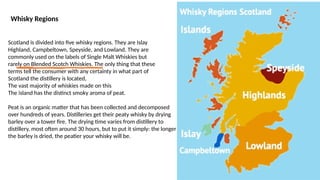
Scotland isdivided into five whisky regions. They are Islay
Highland, Campbeltown, Speyside, and Lowland. They are
commonly used on the labels of Single Malt Whiskies but
rarely on Blended Scotch Whiskies. The only thing that these
terms tell the consumer with any certainty in what part of
Scotland the distillery is located,
The vast majority of whiskies made on this
The island has the distinct smoky aroma of peat.
Peat is an organic matter that has been collected and decomposed
over hundreds of years. Distilleries get their peaty whisky by drying
barley over a tower fire. The drying time varies from distillery to
distillery, most often around 30 hours, but to put it simply: the longer
the barley is dried, the peatier your whisky will be.
12.
Whisky Regions
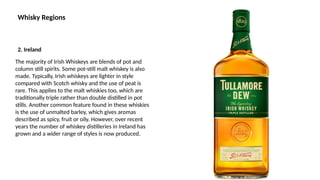
The majorityof Irish Whiskeys are blends of pot and
column still spirits. Some pot-still malt whiskey is also
made. Typically, Irish whiskeys are lighter in style
compared with Scotch whisky and the use of peat is
rare. This applies to the malt whiskies too, which are
traditionally triple rather than double distilled in pot
stills. Another common feature found in these whiskies
is the use of unmalted barley, which gives aromas
described as spicy, fruit or oily. However, over recent
years the number of whiskey distilleries in Ireland has
grown and a wider range of styles is now produced.
2. Ireland
13.
Whisky Regions
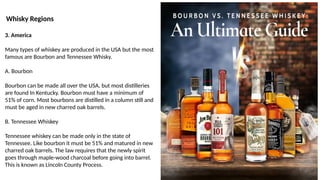
3. America
Manytypes of whiskey are produced in the USA but the most
famous are Bourbon and Tennessee Whisky.
A. Bourbon
Bourbon can be made all over the USA, but most distilleries
are found In Kentucky. Bourbon must have a minimum of
51% of corn. Most bourbons are distilled in a column still and
must be aged in new charred oak barrels.
B. Tennessee Whiskey
Tennessee whiskey can be made only in the state of
Tennessee. Like bourbon it must be 51% and matured in new
charred oak barrels. The law requires that the newly spirit
goes through maple-wood charcoal before going into barrel.
This is known as Lincoln County Process.
14.
William Grants &Sons
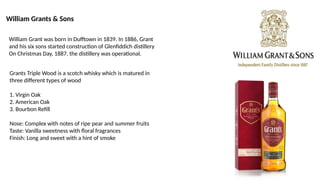
Grants Triple Wood is a scotch whisky which is matured in
three different types of wood
1. Virgin Oak
2. American Oak
3. Bourbon Refill
Nose: Complex with notes of ripe pear and summer fruits
Taste: Vanilla sweetness with floral fragrances
Finish: Long and sweet with a hint of smoke
William Grant was born in Dufftown in 1839. In 1886, Grant
and his six sons started construction of Glenfiddich distillery
On Christmas Day, 1887, the distillery was operational.
15.
Glenmorangie
Glenmorangie was foundedin 1843 by William Matheson
and his wife Anne, situated near the town of Tain in
Northeast Scotland.
Glenmorangie is categorized as a Highland distillery and
boasts the tallest stills in Scotland which is 8 meters long
compared to a giraffe. This extra height ensures a high
amount of reflux, meaning the vapor have to work overtime
to reach the top vaporizing and condensing several times
before finally reaching the Lync arm and to the condenser.
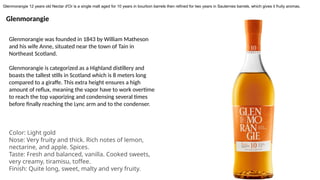
Color: Light gold
Nose: Very fruity and thick. Rich notes of lemon,
nectarine, and apple. Spices.
Taste: Fresh and balanced, vanilla. Cooked sweets,
very creamy, tiramisu, toffee.
Finish: Quite long, sweet, malty and very fruity.
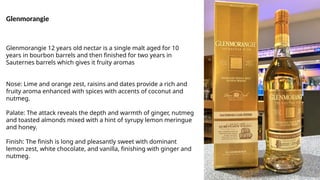
Glenmorangie 12 years old Nectar d'Or is a single malt aged for 10 years in bourbon barrels then refined for two years in Sauternes barrels, which gives it fruity aromas.
16.
Glenmorangie
Glenmorangie 12 yearsold nectar is a single malt aged for 10
years in bourbon barrels and then finished for two years in
Sauternes barrels which gives it fruity aromas
Nose: Lime and orange zest, raisins and dates provide a rich and
fruity aroma enhanced with spices with accents of coconut and
nutmeg.
Palate: The attack reveals the depth and warmth of ginger, nutmeg
and toasted almonds mixed with a hint of syrupy lemon meringue
and honey.
Finish: The finish is long and pleasantly sweet with dominant
lemon zest, white chocolate, and vanilla, finishing with ginger and
nutmeg.
17.
How to drinkWhisky?
As for drinking whisky, you can drink it however the hell you want.
•Neat: Just as it was made. Poured straight from the bottle, into a glass. No
additives are required.
•With Water: Always ask for the water on the side so you can add as much or
as little as you’d like. If possible, go with bottled water as opposed to tap –
not because you want to be a snob but because there are less impurities in
bottled that will affect the flavor of the whisk(e)y.
•On the Rocks: This means with ice. You can also specify how many ice cubes
you’d like or ask your bartender if they have large cubed/spherical ice. The
larger the cube, the slower it will melt which means the slower it will dilute
the whisk(e)y.
•As a Shot: Reserve this for cheaper whiskies. Whether it’s a straight shot or a
mixed one, you can get some creative shot ideas here.
•With Coke: The “gateway drink” to enjoying whisky. The acidity and
sweetness from the coke compliments whiskey well.
•With Ginger ale: A “rye and ginger” is a common order. The spiciness of the
rye is complemented by the kick from the ginger ale. It works well together.
Ask for a bit of bitters in it too. It’s a game-changer.
•In a Cocktail: There are many well-known whisk(e)y-based cocktails.

![How to make a whisky?
4. Post Distillation
The aim of this part is to ensure that the whisky has color
aromas, sweetness, and alcoholic strength.
Post-distillation can be broken into four major operations:
[i]. Maturation: The oak maturation will add color and
aromas to the whisky
[ii]. Blending: The whiskies are blended using different
barrels and ages to have consistency and complexity.
[iii]. Finishing: Finishing is the process of preparing the
bottling and sales](https://image.slidesharecdn.com/riteshwhiskypresentation1-250706170100-f0f53c30/85/Whisky-Presentation-on-singlemalt-and-blended-7-320.jpg)