CONTENTS
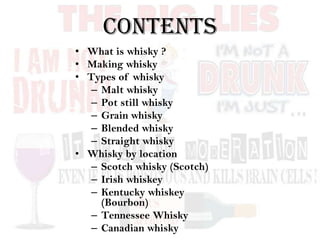
• What is whisky ?
• Making whisky
• Types of whisky
– Malt whisky
– Pot still whisky
– Grain whisky
– Blended whisky
– Straight whisky
• Whisky by location
– Scotch whisky (Scotch)
– Irish whiskey
– Kentucky whiskey
(Bourbon)
– Tennessee Whisky
– Canadian whisky
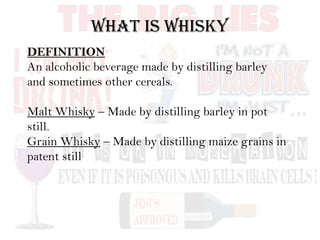
DEFINITION
An alcoholic beverage made by distilling barley
and sometimes other cereals.
Malt Whisky – Made by distilling barley in pot
still.
Grain Whisky – Made by distilling maize grains in
patent still
WHAT IS WHISKY
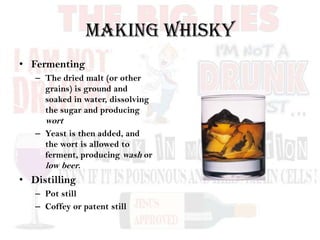
Making Whisky
• Fermenting
– The dried malt (or other
grains) is ground and
soaked in water, dissolving
the sugar and producing
wort
– Yeast is then added, and
the wort is allowed to
ferment, producing wash or
low beer.
• Distilling
– Pot still
– Coffey or patent still
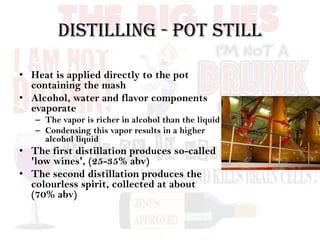
Distilling - Pot Still
• Heat is applied directly to the pot
containing the mash
• Alcohol, water and flavor components
evaporate
– The vapor is richer in alcohol than the liquid
– Condensing this vapor results in a higher
alcohol liquid
• The first distillation produces so-called
'low wines', (25-35% abv)
• The second distillation produces the
colourless spirit, collected at about
(70% abv)
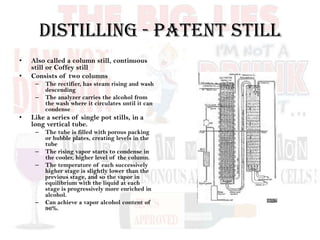
Distilling - Patent Still
• Also called a column still, continuous
still or Coffey still
• Consists of two columns
– The rectifier, has steam rising and wash
descending
– The analyzer carries the alcohol from
the wash where it circulates until it can
condense
• Like a series of single pot stills, in a
long vertical tube.
– The tube is filled with porous packing
or bubble plates, creating levels in the
tube
– The rising vapor starts to condense in
the cooler, higher level of the column.
– The temperature of each successively
higher stage is slightly lower than the
previous stage, and so the vapor in
equilibrium with the liquid at each
stage is progressively more enriched in
alcohol.
– Can achieve a vapor alcohol content of
96%.
Making Whisky (cont.)
• Aging
– In new (for Bourbon) or old, charred (Bourbon & Scotch) or
uncharred (Irish Whiskey) oak barrels/casks
– Typically causes the brown color to develop over time
– 0.5 – 2.0% volume evaporates each year of aging (making
long-aged whiskies more expensive to produce)
• Bottling
– Mature whisky is usually blended
– Water is usually added (to reduce alcohol content)
• Chill Filtration
– Whisky is chilled to near 0°C (32°F) and passed through a
fine filter
– Removes some of the compounds accumulated during
distillation or aging, prevents the whisky from becoming
hazy when chilled
– Can also remove some of the flavor and body from the
whisky
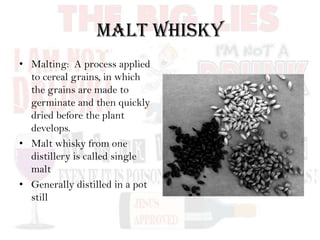
Malt Whisky
• Malting: A process applied
to cereal grains, in which
the grains are made to
germinate and then quickly
dried before the plant
develops.
• Malt whisky from one
distillery is called single
malt
• Generally distilled in a pot
still
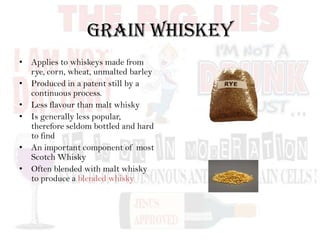
Grain Whiskey
• Applies to whiskeys made from
rye, corn, wheat, unmalted barley
• Produced in a patent still by a
continuous process.
• Less flavour than malt whisky
• Is generally less popular,
therefore seldom bottled and hard
to find
• An important component of most
Scotch Whisky
• Often blended with malt whisky
to produce a blended whisky
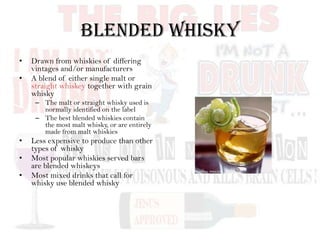
Blended Whisky
• Drawn from whiskies of differing
vintages and/or manufacturers
• A blend of either single malt or
straight whiskey together with grain
whisky
– The malt or straight whisky used is
normally identified on the label
– The best blended whiskies contain
the most malt whisky, or are entirely
made from malt whiskies
• Less expensive to produce than other
types of whisky
• Most popular whiskies served bars
are blended whiskeys
• Most mixed drinks that call for
whisky use blended whisky
Straight Whisky
• Straight whiskies must be
made with a minimum of
51% of the grain that
identifies that particular
whiskey.
– Rye
– Wheat
– Corn
– Unmalted barley
• Straight whiskey must be
aged a minimum of 2 years.
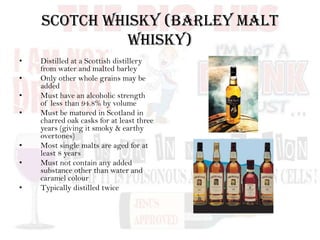
Scotch Whisky (Barley Malt
Whisky)
• Distilled at a Scottish distillery
from water and malted barley
• Only other whole grains may be
added
• Must have an alcoholic strength
of less than 94.8% by volume
• Must be matured in Scotland in
charred oak casks for at least three
years (giving it smoky & earthy
overtones)
• Most single malts are aged for at
least 8 years
• Must not contain any added
substance other than water and
caramel colour
• Typically distilled twice
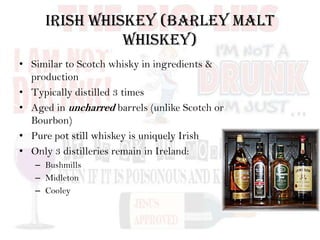
Irish Whiskey (Barley Malt
Whiskey)
• Similar to Scotch whisky in ingredients &
production
• Typically distilled 3 times
• Aged in uncharred barrels (unlike Scotch or
Bourbon)
• Pure pot still whiskey is uniquely Irish
• Only 3 distilleries remain in Ireland:
– Bushmills
– Midleton
– Cooley
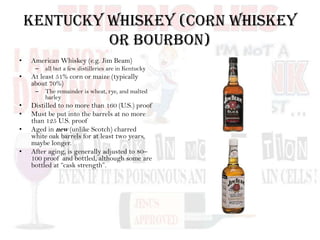
Kentucky Whiskey (Corn Whiskey
or Bourbon)
• American Whiskey (e.g. Jim Beam)
– all but a few distilleries are in Kentucky
• At least 51% corn or maize (typically
about 70%)
– The remainder is wheat, rye, and malted
barley
• Distilled to no more than 160 (U.S.) proof
• Must be put into the barrels at no more
than 125 U.S. proof
• Aged in new (unlike Scotch) charred
white oak barrels for at least two years,
maybe longer.
• After aging, is generally adjusted to 80–
100 proof and bottled, although some are
bottled at “cask strength”.
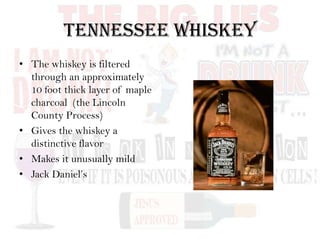
Tennessee Whiskey
• The whiskey is filtered
through an approximately
10 foot thick layer of maple
charcoal (the Lincoln
County Process)
• Gives the whiskey a
distinctive flavor
• Makes it unusually mild
• Jack Daniel’s
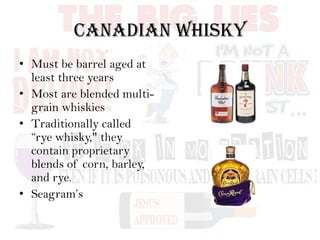
Canadian Whisky
• Must be barrel aged at
least three years
• Most are blended multi-
grain whiskies
• Traditionally called
“rye whisky," they
contain proprietary
blends of corn, barley,
and rye.
• Seagram’s
BE RESPONSIBLE FOR WHAT
YOU DO
DRINK RESPONSIBLY

Whisky

  • 3.
    CONTENTS • What iswhisky ? • Making whisky • Types of whisky – Malt whisky – Pot still whisky – Grain whisky – Blended whisky – Straight whisky • Whisky by location – Scotch whisky (Scotch) – Irish whiskey – Kentucky whiskey (Bourbon) – Tennessee Whisky – Canadian whisky
  • 4.
    DEFINITION An alcoholic beveragemade by distilling barley and sometimes other cereals. Malt Whisky – Made by distilling barley in pot still. Grain Whisky – Made by distilling maize grains in patent still WHAT IS WHISKY
  • 5.
    Making Whisky • Fermenting –The dried malt (or other grains) is ground and soaked in water, dissolving the sugar and producing wort – Yeast is then added, and the wort is allowed to ferment, producing wash or low beer. • Distilling – Pot still – Coffey or patent still
  • 6.
    Distilling - PotStill • Heat is applied directly to the pot containing the mash • Alcohol, water and flavor components evaporate – The vapor is richer in alcohol than the liquid – Condensing this vapor results in a higher alcohol liquid • The first distillation produces so-called 'low wines', (25-35% abv) • The second distillation produces the colourless spirit, collected at about (70% abv)
  • 7.
    Distilling - PatentStill • Also called a column still, continuous still or Coffey still • Consists of two columns – The rectifier, has steam rising and wash descending – The analyzer carries the alcohol from the wash where it circulates until it can condense • Like a series of single pot stills, in a long vertical tube. – The tube is filled with porous packing or bubble plates, creating levels in the tube – The rising vapor starts to condense in the cooler, higher level of the column. – The temperature of each successively higher stage is slightly lower than the previous stage, and so the vapor in equilibrium with the liquid at each stage is progressively more enriched in alcohol. – Can achieve a vapor alcohol content of 96%.
  • 8.
    Making Whisky (cont.) •Aging – In new (for Bourbon) or old, charred (Bourbon & Scotch) or uncharred (Irish Whiskey) oak barrels/casks – Typically causes the brown color to develop over time – 0.5 – 2.0% volume evaporates each year of aging (making long-aged whiskies more expensive to produce) • Bottling – Mature whisky is usually blended – Water is usually added (to reduce alcohol content) • Chill Filtration – Whisky is chilled to near 0°C (32°F) and passed through a fine filter – Removes some of the compounds accumulated during distillation or aging, prevents the whisky from becoming hazy when chilled – Can also remove some of the flavor and body from the whisky
  • 9.
    Malt Whisky • Malting:A process applied to cereal grains, in which the grains are made to germinate and then quickly dried before the plant develops. • Malt whisky from one distillery is called single malt • Generally distilled in a pot still
  • 10.
    Grain Whiskey • Appliesto whiskeys made from rye, corn, wheat, unmalted barley • Produced in a patent still by a continuous process. • Less flavour than malt whisky • Is generally less popular, therefore seldom bottled and hard to find • An important component of most Scotch Whisky • Often blended with malt whisky to produce a blended whisky
  • 11.
    Blended Whisky • Drawnfrom whiskies of differing vintages and/or manufacturers • A blend of either single malt or straight whiskey together with grain whisky – The malt or straight whisky used is normally identified on the label – The best blended whiskies contain the most malt whisky, or are entirely made from malt whiskies • Less expensive to produce than other types of whisky • Most popular whiskies served bars are blended whiskeys • Most mixed drinks that call for whisky use blended whisky
  • 12.
    Straight Whisky • Straightwhiskies must be made with a minimum of 51% of the grain that identifies that particular whiskey. – Rye – Wheat – Corn – Unmalted barley • Straight whiskey must be aged a minimum of 2 years.
  • 13.
    Scotch Whisky (BarleyMalt Whisky) • Distilled at a Scottish distillery from water and malted barley • Only other whole grains may be added • Must have an alcoholic strength of less than 94.8% by volume • Must be matured in Scotland in charred oak casks for at least three years (giving it smoky & earthy overtones) • Most single malts are aged for at least 8 years • Must not contain any added substance other than water and caramel colour • Typically distilled twice
  • 14.
    Irish Whiskey (BarleyMalt Whiskey) • Similar to Scotch whisky in ingredients & production • Typically distilled 3 times • Aged in uncharred barrels (unlike Scotch or Bourbon) • Pure pot still whiskey is uniquely Irish • Only 3 distilleries remain in Ireland: – Bushmills – Midleton – Cooley
  • 15.
    Kentucky Whiskey (CornWhiskey or Bourbon) • American Whiskey (e.g. Jim Beam) – all but a few distilleries are in Kentucky • At least 51% corn or maize (typically about 70%) – The remainder is wheat, rye, and malted barley • Distilled to no more than 160 (U.S.) proof • Must be put into the barrels at no more than 125 U.S. proof • Aged in new (unlike Scotch) charred white oak barrels for at least two years, maybe longer. • After aging, is generally adjusted to 80– 100 proof and bottled, although some are bottled at “cask strength”.
  • 16.
    Tennessee Whiskey • Thewhiskey is filtered through an approximately 10 foot thick layer of maple charcoal (the Lincoln County Process) • Gives the whiskey a distinctive flavor • Makes it unusually mild • Jack Daniel’s
  • 17.
    Canadian Whisky • Mustbe barrel aged at least three years • Most are blended multi- grain whiskies • Traditionally called “rye whisky," they contain proprietary blends of corn, barley, and rye. • Seagram’s
  • 19.
    BE RESPONSIBLE FORWHAT YOU DO DRINK RESPONSIBLY