SCOTCH
HISTORY
• It is believed that the roots of Scottish whisky
lie in the Ireland.
• First official mention appears in 1494 which
record the provision of malt to a certain Friar
John Cor to make ‘acqua vitae’ - the Latin
equivalent of the Gaelic ‘usige beathe’, or ‘
water of life’.
• By 16th & 17th century it had become the true
spirit of Scotland.
HISTORY
• In 1644 the Scottish Parliament levied the first
excise tax on whisky.
• In 1713 ‘malt tax’ was imposed in Scotland.
• This in fact led to the ‘illicit distilling’ and
producing whisky of better quality than the
legally produced ones since the distillers used a
higher grain content to avoid the malt tax.
HISTORY
• In 1823, an act was passed as suggested by Duke of
Gordon ( one of Britain’s largest landowners). Legal
production of whisky was encouraged, and taxes
reduced.
• Within 20 - 30 years the illegal distilling declined
drastically.
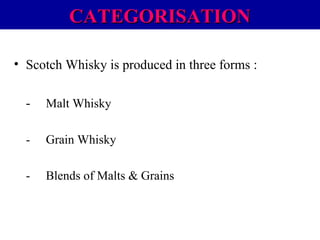
CATEGORISATION
• Scotch Whisky is produced in three forms :
-

Malt Whisky

-

Grain Whisky

-

Blends of Malts & Grains
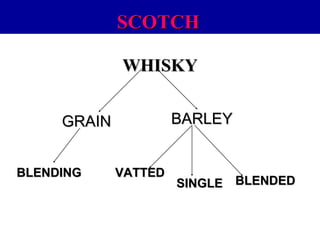
SCOTCH
WHISKY
BARLEY

GRAIN
BLENDING

VATTED

SINGLE BLENDED
TYPES OF SCOTCH
GRAIN WHISKY
• It is essentially made from unmalted corn & malted
barley cooked in a pressure chamber to break down the
sugars.
• The wash produced after fermentation is distilled in a
patent still at 95 % alcohol.
• Grain whisky has particularly no flavour of its own. Is
rarely sold and mainly used in blends.
TYPES OF SCOTCH
SINGLE MALT WHISKY

• The whisky that is produced in one distillery and is not
blended or mixed with any other whisky.
• Sold as a produce of that one single distillery.
• It is exclusive & expensive.
TYPES OF SCOTCH
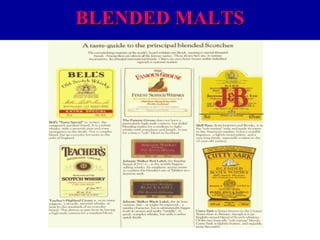
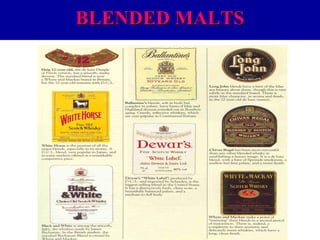
BLENDED MALT
• Blending of malt whisky and grain whisky of different
vintages & provinces. A “standard blend” can consist of
around 40 different whiskies. (Can be one or more malt
and one or more grain)
• Usually 35-40% is malt whisky, 60-65% is grain
whisky.
TYPES OF SCOTCH
VATTED MALT WHISKY :

• Single malts taken from 2 or more distilleries and
blended is called vatted malt whisky.
• Eg. Royal Culross, Glenleven, Dewar’s 12 year old
vatted, Findlater’s Marlodge.
FACTORS EFFECTING SCOTCH
• Malt whisky is the unique result of the effects of
– malted barley
– Scottish water
– pot distilling
– wood maturation in the damp air.
MALTING
• Single malts are made from Barley only.
• Most of the barley used comes from the continent
itself or California or Australia.
• Ideally barley should be

- Fully ripened
- Plump
- Dry (moisture- 10%)

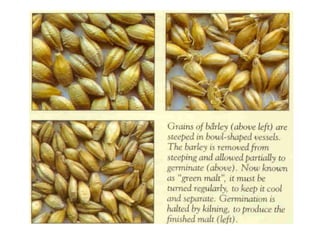
• Malting is done by soaking dried barley in large tanks
(steeps) for between 48-70 hours.
MALTING
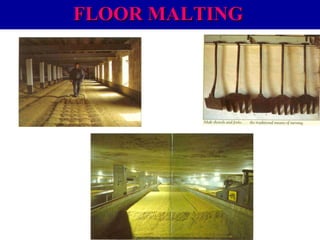
• Water is drained of and the wet barley is spread on the
germination tanks to germinate.
• The barley is continuously turned by the maltsman
using long handled wooden shovel, called skips.
• In modern times, mechanical agitators or saladin box
are being used.
• After 2 or 3 days the barley sprouts rootlets, which in
another 4-5 days starts to wither.
FLOOR MALTING
MALTING
• The barley which is now soft, straw coloured
moisture laden is called the green malt.

and

• It goes to the kiln and spread on a floor of perforated
metal plates or wire mesh.
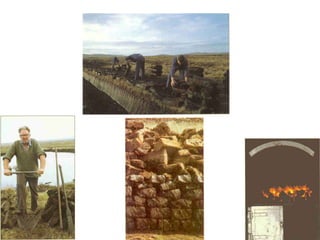
• Ten-fifteen feet below is a slow peat fire. Peat is a
partially decomposed, compacted vegetable matter.
Usually mosses, used as fertiliser and fuel.
MALTING
• The peat gives a pungent, earthy smoke, with its own
particular fragrance, which permeates the green malt.
This gives the whisky its peat reek.
• Coal and Anthracite are later added to the fire to raise
the temperature to around 160 deg. F.
• The malt dries out to crispy, crumbly, fragrant grain
quite different from the original barley.
• It is then left to rest for a month or more.
MASHING
• Malt is gristed.
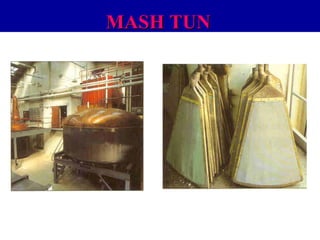
• The grist goes into mash tun in measured quantities and
hot water is added to extract the soluble sugar.
• The water is changed to 3 to 4 times and each time the
temperature is increased.
• The fist two washings form the wort.
MASHING

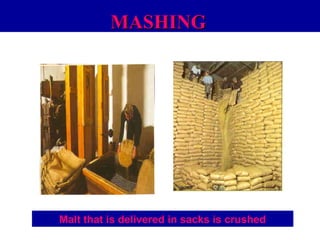
Malt that is delivered in sacks is crushed
MASHING
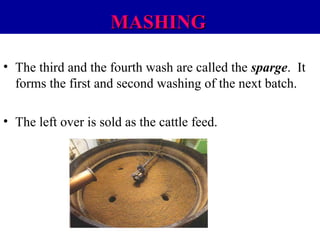
• The third and the fourth wash are called the sparge. It
forms the first and second washing of the next batch.
• The left over is sold as the cattle feed.
MASH TUN
FERMENTATION
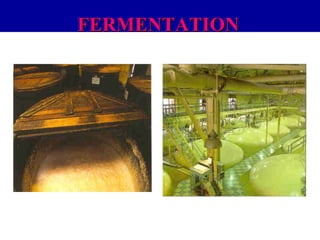
FERMENTATION
• The wort is poured in wash tun and the yeast is added.
• Fermentation lasts for 36-48 hours.
• A clear liquid is obtained called wash at 5% alcoholic
strength.
DISTILLATION
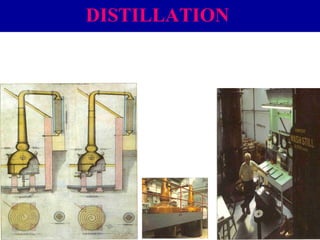
DISTILLATION
• All malt whiskies are distilled in the pot still.
• Each batch of malt whisky requires two pot stills to
produce the finished spirit.
-

The wash still
The low wine still
DISTILLATION
• The wash in the wash still is heated by coal or oil fire.
• The product after distillation and condensation goes into
the low wine still where it is distilled to give spirit of
higher alcoholic strength of 75%.
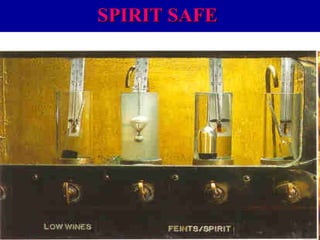
• The purity of the product is controlled by spirit safe.
SPIRIT SAFE
DISTILLATION
• The residue in the wash still the ‘burnt ale’ is used as
fertilizer or animal food.
• The residue in the low wine still called the ‘spent lees’
is dispersed as steam.
• The whisky emerges from the still as, water white, very
pungent fiery spirit around 115 to 120 degree proof.
• It is reduce to around 110 degree proof with pure spring
water.
MATURATION
MATURATION
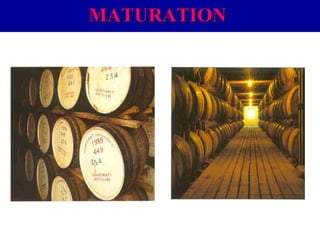
• Maturation is the mellowing of the whisky by its being
stored in oak barrels.
• By law maturation of single malt is for a minimum of 3
years.
• Is matured in Scottish cask (110 gallons) butts
MATURATION
• The cask come from Jerez in Spain.where they have
been used to mature sherry.
• The sherry has taken much of its woodiness ( tannins )
from the oak and left part of its own character in the
wood, that in turn contributes to the mellowness,
colour and taste of the matured malt.
MATURATION
• In the wood the malt whisky :
– Softens
– Loses a lot of its pungent character through oxidation.
– Takes on its colour from pale straw to honey

• After the whisky has reached its optimum maturity it is
diluted using spring water to get the strength of 70-75°
proof.
CHARACTERISTICS
• No two variety of single malts are similar inspite of the
same base ingredient and same process.
• It is impossible to produce scotch outside of scotland.
• It has to be both, distilled & matured in Scotland.
• Distilled at less than 98.4 % in such a way that the
distillate has an aroma and flavour derived from the
materials used.
CLASSIFICATION OF WHISKIES
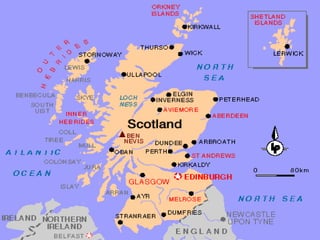
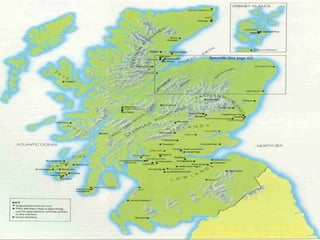
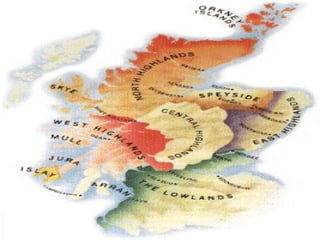
• Single malt whiskies have been categorised as per
following geographic regions:
– Islay
– Campbeltown
– Lowlands
– Highlands
ISLAY
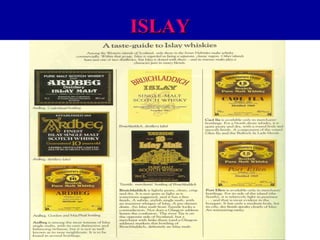
• Located Southernmost of the outer western isles.
• Islay has eight distilleries.
• Distilleries produce malts which are traditionally very
heavily peated to give a pungent whisky with deep
flavour .
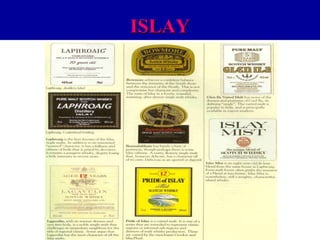
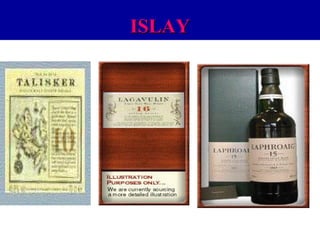
• Laphroaig, Jura, Talisker, Bowmore, Lagavulin, Islay
Mist,
ISLAY
ISLAY
ISLAY
CAMPBELTOWN
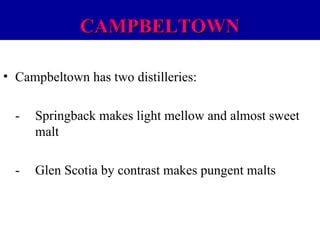
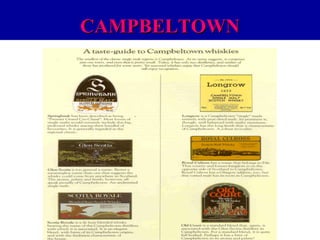
• Campbeltown has two distilleries:
-

Springback makes light mellow and almost sweet
malt

-

Glen Scotia by contrast makes pungent malts
CAMPBELTOWN
HIGHLAND
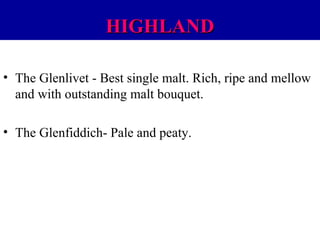
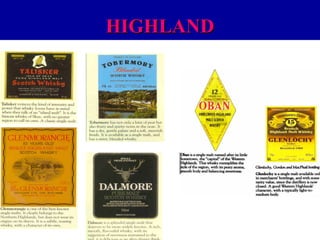
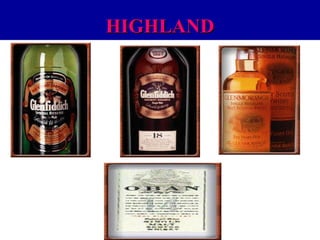
• The Glenlivet - Best single malt. Rich, ripe and mellow
and with outstanding malt bouquet.
• The Glenfiddich- Pale and peaty.
HIGHLAND
HIGHLAND
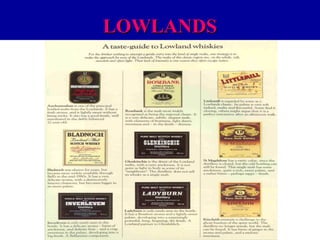
LOWLANDS
• The eleven Lowland malts are mostly used as filler
malts to give weight to a blend.
• As they tend to lack a distinctive malt character, they do
not add much value to the commercial whisky either.
• Rosebank and RJ Mc Dowells are the best, other
brands are Glenkinchie.
LOWLANDS
LOWLANDS
BLENDING
BLENDING
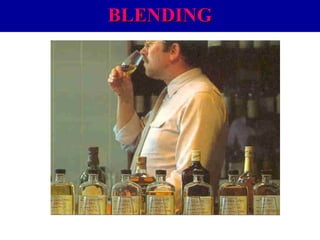
• Blending is the art of combining whiskies from several
distilleries, malt as well as grain.
• Blending has its origin in distant days when distillers
masked the spirit with herbal flavourings.
• Modern blending began around the turn of the century,
when the Scots lightened their whisky with grain spirit,
which became highly popular.
BLENDING
• A blend will consist of anything from 15 to 50 different
single whiskies combined in the formula that is the
secret of the blending company concerned.
• The objective of the blender is to produce a whisky of a
definite and recognizable character and that his blend
should never vary from this standard which customers
all over the world accept.
BLENDING
• A blend of whisky will have 35-40% Sgl malt and 6065% grain whisky.
• The different whiskies are stirred using compressed air
ensuring they are mixed well, and then left to marry,
usually for 6 months or more.
• The final step before bottling is the addition of small
amounts of caramel colouring, to ensure continuity of
colour in the blend.
THE DISTILLERIES
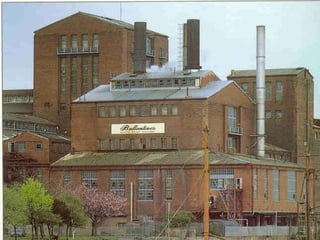
• Scotland possesses 119 distilleries.
• Some of the major companies who manufacture blended
scotch are:
– Haig - Oldest of modern whisky families.
– John Walker - “Born in 1820, still going strong”
– John Dewars - Started as a grocer.
– White Horse - Based his blend on Lagavulin.
– J&B
– VAT 69
– Famous Grouse
THE DISTILLERIES
• The largest company in the world manufacturing scotch
is DCL. Formed by 6 lowland distillers and John Haig
• Their famous brands are
–
–
–
–
–

Johnny Walker
Haig
White Horse
VAT 69
Abbots Choice
THE DISTILLERIES
– Black and white
• Other major companies are:
– Seagrams
– Hiram Walker
– Bells
.
BLENDED MALTS
BLENDED MALTS
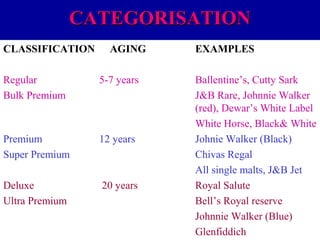
CATEGORISATION
CLASSIFICATION

AGING

Regular
Bulk Premium

5-7 years

Premium
Super Premium

12 years

Deluxe
Ultra Premium

20 years

EXAMPLES
Ballentine’s, Cutty Sark
J&B Rare, Johnnie Walker
(red), Dewar’s White Label
White Horse, Black& White
Johnie Walker (Black)
Chivas Regal
All single malts, J&B Jet
Royal Salute
Bell’s Royal reserve
Johnnie Walker (Blue)
Glenfiddich
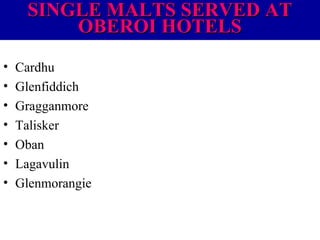
SINGLE MALTS SERVED AT
OBEROI HOTELS
•
•
•
•
•
•
•

Cardhu
Glenfiddich
Gragganmore
Talisker
Oban
Lagavulin
Glenmorangie
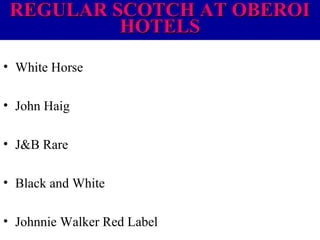
REGULAR SCOTCH AT OBEROI
HOTELS
• White Horse
• John Haig
• J&B Rare
• Black and White
• Johnnie Walker Red Label
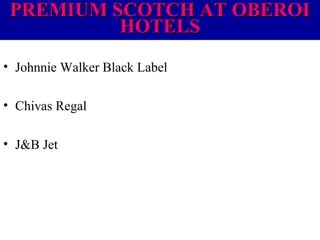
PREMIUM SCOTCH AT OBEROI
HOTELS
• Johnnie Walker Black Label
• Chivas Regal
• J&B Jet
DELUXE SCOTCH AT OBEROI
HOTELS
• Blue Label
• Gold Label
• Royal Salute

Scotch

  • 1.
  • 3.
    HISTORY • It isbelieved that the roots of Scottish whisky lie in the Ireland. • First official mention appears in 1494 which record the provision of malt to a certain Friar John Cor to make ‘acqua vitae’ - the Latin equivalent of the Gaelic ‘usige beathe’, or ‘ water of life’. • By 16th & 17th century it had become the true spirit of Scotland.
  • 4.
    HISTORY • In 1644the Scottish Parliament levied the first excise tax on whisky. • In 1713 ‘malt tax’ was imposed in Scotland. • This in fact led to the ‘illicit distilling’ and producing whisky of better quality than the legally produced ones since the distillers used a higher grain content to avoid the malt tax.
  • 5.
    HISTORY • In 1823,an act was passed as suggested by Duke of Gordon ( one of Britain’s largest landowners). Legal production of whisky was encouraged, and taxes reduced. • Within 20 - 30 years the illegal distilling declined drastically.
  • 6.
    CATEGORISATION • Scotch Whiskyis produced in three forms : - Malt Whisky - Grain Whisky - Blends of Malts & Grains
  • 7.
  • 8.
    TYPES OF SCOTCH GRAINWHISKY • It is essentially made from unmalted corn & malted barley cooked in a pressure chamber to break down the sugars. • The wash produced after fermentation is distilled in a patent still at 95 % alcohol. • Grain whisky has particularly no flavour of its own. Is rarely sold and mainly used in blends.
  • 9.
    TYPES OF SCOTCH SINGLEMALT WHISKY • The whisky that is produced in one distillery and is not blended or mixed with any other whisky. • Sold as a produce of that one single distillery. • It is exclusive & expensive.
  • 10.
    TYPES OF SCOTCH BLENDEDMALT • Blending of malt whisky and grain whisky of different vintages & provinces. A “standard blend” can consist of around 40 different whiskies. (Can be one or more malt and one or more grain) • Usually 35-40% is malt whisky, 60-65% is grain whisky.
  • 11.
    TYPES OF SCOTCH VATTEDMALT WHISKY : • Single malts taken from 2 or more distilleries and blended is called vatted malt whisky. • Eg. Royal Culross, Glenleven, Dewar’s 12 year old vatted, Findlater’s Marlodge.
  • 12.
    FACTORS EFFECTING SCOTCH •Malt whisky is the unique result of the effects of – malted barley – Scottish water – pot distilling – wood maturation in the damp air.
  • 13.
    MALTING • Single maltsare made from Barley only. • Most of the barley used comes from the continent itself or California or Australia. • Ideally barley should be - Fully ripened - Plump - Dry (moisture- 10%) • Malting is done by soaking dried barley in large tanks (steeps) for between 48-70 hours.
  • 15.
    MALTING • Water isdrained of and the wet barley is spread on the germination tanks to germinate. • The barley is continuously turned by the maltsman using long handled wooden shovel, called skips. • In modern times, mechanical agitators or saladin box are being used. • After 2 or 3 days the barley sprouts rootlets, which in another 4-5 days starts to wither.
  • 16.
  • 17.
    MALTING • The barleywhich is now soft, straw coloured moisture laden is called the green malt. and • It goes to the kiln and spread on a floor of perforated metal plates or wire mesh. • Ten-fifteen feet below is a slow peat fire. Peat is a partially decomposed, compacted vegetable matter. Usually mosses, used as fertiliser and fuel.
  • 19.
    MALTING • The peatgives a pungent, earthy smoke, with its own particular fragrance, which permeates the green malt. This gives the whisky its peat reek. • Coal and Anthracite are later added to the fire to raise the temperature to around 160 deg. F. • The malt dries out to crispy, crumbly, fragrant grain quite different from the original barley. • It is then left to rest for a month or more.
  • 20.
    MASHING • Malt isgristed. • The grist goes into mash tun in measured quantities and hot water is added to extract the soluble sugar. • The water is changed to 3 to 4 times and each time the temperature is increased. • The fist two washings form the wort.
  • 21.
    MASHING Malt that isdelivered in sacks is crushed
  • 22.
    MASHING • The thirdand the fourth wash are called the sparge. It forms the first and second washing of the next batch. • The left over is sold as the cattle feed.
  • 23.
  • 24.
  • 25.
    FERMENTATION • The wortis poured in wash tun and the yeast is added. • Fermentation lasts for 36-48 hours. • A clear liquid is obtained called wash at 5% alcoholic strength.
  • 26.
  • 27.
    DISTILLATION • All maltwhiskies are distilled in the pot still. • Each batch of malt whisky requires two pot stills to produce the finished spirit. - The wash still The low wine still
  • 28.
    DISTILLATION • The washin the wash still is heated by coal or oil fire. • The product after distillation and condensation goes into the low wine still where it is distilled to give spirit of higher alcoholic strength of 75%. • The purity of the product is controlled by spirit safe.
  • 29.
  • 30.
    DISTILLATION • The residuein the wash still the ‘burnt ale’ is used as fertilizer or animal food. • The residue in the low wine still called the ‘spent lees’ is dispersed as steam. • The whisky emerges from the still as, water white, very pungent fiery spirit around 115 to 120 degree proof. • It is reduce to around 110 degree proof with pure spring water.
  • 31.
  • 32.
    MATURATION • Maturation isthe mellowing of the whisky by its being stored in oak barrels. • By law maturation of single malt is for a minimum of 3 years. • Is matured in Scottish cask (110 gallons) butts
  • 33.
    MATURATION • The caskcome from Jerez in Spain.where they have been used to mature sherry. • The sherry has taken much of its woodiness ( tannins ) from the oak and left part of its own character in the wood, that in turn contributes to the mellowness, colour and taste of the matured malt.
  • 34.
    MATURATION • In thewood the malt whisky : – Softens – Loses a lot of its pungent character through oxidation. – Takes on its colour from pale straw to honey • After the whisky has reached its optimum maturity it is diluted using spring water to get the strength of 70-75° proof.
  • 35.
    CHARACTERISTICS • No twovariety of single malts are similar inspite of the same base ingredient and same process. • It is impossible to produce scotch outside of scotland. • It has to be both, distilled & matured in Scotland. • Distilled at less than 98.4 % in such a way that the distillate has an aroma and flavour derived from the materials used.
  • 36.
    CLASSIFICATION OF WHISKIES •Single malt whiskies have been categorised as per following geographic regions: – Islay – Campbeltown – Lowlands – Highlands
  • 39.
    ISLAY • Located Southernmostof the outer western isles. • Islay has eight distilleries. • Distilleries produce malts which are traditionally very heavily peated to give a pungent whisky with deep flavour . • Laphroaig, Jura, Talisker, Bowmore, Lagavulin, Islay Mist,
  • 40.
  • 41.
  • 42.
  • 43.
    CAMPBELTOWN • Campbeltown hastwo distilleries: - Springback makes light mellow and almost sweet malt - Glen Scotia by contrast makes pungent malts
  • 44.
  • 45.
    HIGHLAND • The Glenlivet- Best single malt. Rich, ripe and mellow and with outstanding malt bouquet. • The Glenfiddich- Pale and peaty.
  • 46.
  • 47.
  • 48.
    LOWLANDS • The elevenLowland malts are mostly used as filler malts to give weight to a blend. • As they tend to lack a distinctive malt character, they do not add much value to the commercial whisky either. • Rosebank and RJ Mc Dowells are the best, other brands are Glenkinchie.
  • 49.
  • 50.
  • 51.
  • 52.
    BLENDING • Blending isthe art of combining whiskies from several distilleries, malt as well as grain. • Blending has its origin in distant days when distillers masked the spirit with herbal flavourings. • Modern blending began around the turn of the century, when the Scots lightened their whisky with grain spirit, which became highly popular.
  • 53.
    BLENDING • A blendwill consist of anything from 15 to 50 different single whiskies combined in the formula that is the secret of the blending company concerned. • The objective of the blender is to produce a whisky of a definite and recognizable character and that his blend should never vary from this standard which customers all over the world accept.
  • 54.
    BLENDING • A blendof whisky will have 35-40% Sgl malt and 6065% grain whisky. • The different whiskies are stirred using compressed air ensuring they are mixed well, and then left to marry, usually for 6 months or more. • The final step before bottling is the addition of small amounts of caramel colouring, to ensure continuity of colour in the blend.
  • 56.
    THE DISTILLERIES • Scotlandpossesses 119 distilleries. • Some of the major companies who manufacture blended scotch are: – Haig - Oldest of modern whisky families. – John Walker - “Born in 1820, still going strong” – John Dewars - Started as a grocer. – White Horse - Based his blend on Lagavulin. – J&B – VAT 69 – Famous Grouse
  • 57.
    THE DISTILLERIES • Thelargest company in the world manufacturing scotch is DCL. Formed by 6 lowland distillers and John Haig • Their famous brands are – – – – – Johnny Walker Haig White Horse VAT 69 Abbots Choice
  • 58.
    THE DISTILLERIES – Blackand white • Other major companies are: – Seagrams – Hiram Walker – Bells .
  • 59.
  • 60.
  • 61.
    CATEGORISATION CLASSIFICATION AGING Regular Bulk Premium 5-7 years Premium SuperPremium 12 years Deluxe Ultra Premium 20 years EXAMPLES Ballentine’s, Cutty Sark J&B Rare, Johnnie Walker (red), Dewar’s White Label White Horse, Black& White Johnie Walker (Black) Chivas Regal All single malts, J&B Jet Royal Salute Bell’s Royal reserve Johnnie Walker (Blue) Glenfiddich
  • 62.
    SINGLE MALTS SERVEDAT OBEROI HOTELS • • • • • • • Cardhu Glenfiddich Gragganmore Talisker Oban Lagavulin Glenmorangie
  • 63.
    REGULAR SCOTCH ATOBEROI HOTELS • White Horse • John Haig • J&B Rare • Black and White • Johnnie Walker Red Label
  • 64.
    PREMIUM SCOTCH ATOBEROI HOTELS • Johnnie Walker Black Label • Chivas Regal • J&B Jet
  • 65.
    DELUXE SCOTCH ATOBEROI HOTELS • Blue Label • Gold Label • Royal Salute

Editor's Notes

  • #2 {"5":"<number>\n","33":"<number>\n","61":"<number>\n","6":"<number>\n","12":"<number>\n","7":"<number>\n","8":"<number>\n","3":"<number>\n","9":"<number>\n","4":"<number>\n","54":"<number>\n","32":"<number>\n"}