© 2009 McGraw-Hill Higher Education. All rights reserved
Chapter 15: Using Therapeutic
Modalities
© 2009 McGraw-Hill Higher Education. All rights reserved
• Therapeutic modalities can be an effective
adjunct to various techniques of therapeutic
exercise
• Knowledge of the healing process is critical
• A variety of modalities can be utilized by
athletic trainers including cryotherapy,
electrical stimulation, ultrasound, massage,
traction, diathermy, lasers and magnets
© 2009 McGraw-Hill Higher Education. All rights reserved
Classification of Therapeutic
Modalities
• Electromagnetic
– Includes cryotherapy, thermotherapy, electrical
stimulating currents, diathermy and lasers
– Rely on electromagnetic energy, which travels
at the speed of light
– Energy travels in a straight line
– The energy can be absorbed, refracted, reflected
or transmitted
© 2009 McGraw-Hill Higher Education. All rights reserved
• Acoustic
– Ultrasound utilizes acoustic energy
– High frequency sound waves
– Relies on molecular collisions for energy
transfer
– Vibration of tissue produces heat and impacts
cell membrane permeability
• Mechanical
– Traction, intermittent compression, massage
– Involves mechanically stretching, compressing
and manipulating soft tissue and joint structures
© 2009 McGraw-Hill Higher Education. All rights reserved
Electromagnetic Modalities
© 2009 McGraw-Hill Higher Education. All rights reserved
Thermotherapy
• Physiological Effects of Heat
– Dependent on type of heat energy applied,
intensity of energy, duration of exposure and
tissue response
– Heat must be absorbed to increase molecular
activity
– Desired effects
• Increase collagen extensibility; decreasing joint
stiffness; reducing pain; relieving muscle spasm;
reduction of edema and swelling; increasing blood
flow
© 2009 McGraw-Hill Higher Education. All rights reserved
– Extensibility of collagen
• Permits increases in extensibility through stretching
– Pain relief
• Activates gate control mechanism
– Muscle spasm
• Increased blood flow reduces ischemia
– Assistance w/ healing process
• Raises tissue temperature, increases metabolism
resulting in reduction of oxygen tension, lowering
pH, increasing capillary permeability and releasing
bradykinins and histamine resulting in vasodilation
• Parasympathetic impulses stimulated by heat are
also believed to be a reason for vasodilation
© 2009 McGraw-Hill Higher Education. All rights reserved
• Superficial Heat
– Form of electromagnetic energy (infrared
region of spectrum)
– Increases subcutaneous temperature, indirectly
spreading to deeper tissue
– Muscle temperature increases through reflexive
effect of circulation through conduction
– Moist heat versus dry heat
© 2009 McGraw-Hill Higher Education. All rights reserved
Transmission of Thermal Energy
• Conduction
– Heat is transferred from a warmer object to a
cooler one
– Dependent on temperature and exposure time
– Temperatures of 116.6o F will cause tissue
damage and temperatures of 113o F should not
be in contact w/ the skin longer than 30 minutes
– Examples include moist hot packs, paraffin, ice
packs and cold packs
© 2009 McGraw-Hill Higher Education. All rights reserved
• Convection
– Transfer of heat through movement of fluids or
gases
– Temperature, speed of movement, and
conductivity of part impact heating
– Whirlpools
• Radiation
– Heating is transferred from one object through
space to another object
– Shortwave diathermy, infrared heating and
ultraviolet therapy
• Conversion
– Generation of heat from another object (sound,
electricity or chemical agents)
© 2009 McGraw-Hill Higher Education. All rights reserved
• Hydrocollator Packs
– Equipment
• Silicate gel pads submersed in 160-170o F water
• Maintains heat for 20-30 minutes; must use 6 layers of
terry cloth to protect skin
– Indications
• Used for general muscle relaxation and reduction of
pain-spasm-ischemia-hypoxia-pain cycle
• Limitation - unable to heat deeper tissues effectively
– Application
• Pack removed from water; covered w/ 6 layers of
toweling which are removed as cooling occurs; area
treated for 15-20 minutes
• Athlete must be comfortable and should not lay on pack
© 2009 McGraw-Hill Higher Education. All rights reserved
• Whirlpool Bath
– Equipment
• Varying sizes used to treat a variety of body parts
• Tank w/ turbine that regulates flow
• Agitation (amount of movement) is controlled by air
emitted
– Indications
• Combination of massage and water immersion
• Provides conduction and convection
• Swelling, muscle spasm and pain
– Application
• Temperature is set according to treatment goals
• Athlete should be set up to be reached by agitator
(8-12” from agitator)
– Do not place directly on injured site
• Maximum treatment time for acute injuries should
not exceed 20 minutes
© 2009 McGraw-Hill Higher Education. All rights reserved
• Special Considerations
– Must be careful with full-
body immersion
– Proper maintenance is
necessary to avoid
infection
– As volume of body part
immersion increases,
temperature should
decrease
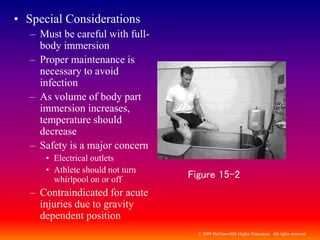
– Safety is a major concern
• Electrical outlets
• Athlete should not turn
whirlpool on or off
– Contraindicated for acute
injuries due to gravity
dependent position
Figure 15-2
© 2009 McGraw-Hill Higher Education. All rights reserved
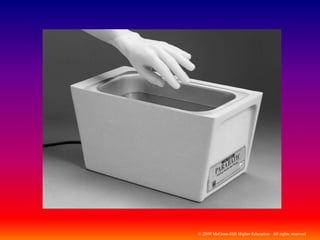
• Paraffin Bath
– Equipment
• A paraffin wax and mineral oil combination, heated
to 126-130o F, plastic bags, paper towels and towels
– Indications
• Useful in treating chronic injuries
• Effective for angular areas of body such as hands,
wrists, elbows, ankles and feet
– Application
• Body part is cleaned and dried
• Dip and wrap technique
– Hand dipped 6-12 times, wrapped in a plastic bag and then
draped w/ a towel to maintain heat for 30 minutes
• Soak technique
– Body part remains in wax 20-30 minutes w/out moving it
© 2009 McGraw-Hill Higher Education. All rights reserved
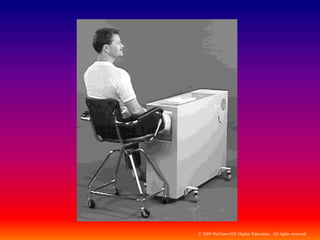
• Fluidotherapy
– Equipment
• Unit which contains cellulose particles through which
warm air is circulated
• Allows for high heating (higher than water and
paraffin)
– Indications
• Used to treat distal extremities in effort to decrease
pain, increase ROM and decrease swelling and spasm
– Application
• Temperature ranges from 100-113o F
• Particle agitation should be controlled for comfort
• Patient should be comfortable
• Treatment time = 15-20 minutes
• Exercise can be performed while in cabinet
© 2009 McGraw-Hill Higher Education. All rights reserved
• Special Consideration w/ Superficial Heat
– Important contraindications
• Never apply heat when there is loss of sensation
• Never apply heat immediately after injury
• Never apply heat when there is decreased arterial
circulation
• Never apply heat directly to eyes or the genitals
• Never heat the abdomen during pregnancy
• Never apply heat to a body part that exhibits signs
of acute inflammation
© 2009 McGraw-Hill Higher Education. All rights reserved
Cryotherapy
• Used in first aid treatment of trauma to the
musculoskeletal system
• When applied intermittently w/
compression, rest and elevation it reduces
many adverse conditions related to
inflammation and the reactive phase of an
acute injury
• RICE (rest, ice compression, elevation) may
be used for the initial days of and injury and
continue up to 2 weeks after injury
© 2009 McGraw-Hill Higher Education. All rights reserved
• Physiological Effects of Cold
– Type of electromagnetic energy (infrared radiation)
– Relies on conduction -- degree of cooling depends
on the medium, length of exposure and conductivity
• At a temperature of 38.3oF, muscle temperature can be
reduced as deep as 4cm
– Tissue w/ a high water content is an excellent
conductor
– Most common means of cold therapy are ice packs
and ice immersion
• Wet ice is a more effective coolant due to the energy
required to melt ice
© 2009 McGraw-Hill Higher Education. All rights reserved
– Vasoconstriction
• Reflex action of smooth muscle due to sympathetic
nervous system and adrenal medulla
– Hunting response
• Intermittent period of vasodilation will occur if
cooling continues for >20 minutes
– Blood viscosity will also increase with extended
cooling
– Decreases extent of hypoxic injury to cells--
• Decreases cell metabolic rate and the need for
oxygen through circulation, resulting in less tissue
damage
– Decreased metabolic rate and vasoconstriction
decreases swelling associated w/ inflammatory
response
© 2009 McGraw-Hill Higher Education. All rights reserved
– Decreases muscle spasm
• Muscle becomes more amenable to stretch as a
result of decreased GTO and muscle spindle activity
– Decreases free nerve ending and peripheral
nerve excitability
• Analgesia caused by raising nerve threshold
– Cold is more penetrating than heat
– Ability to decrease muscle fatigue and increase
and maintain muscular contraction
• Attributed to the decrease of local metabolic rates
and tissue temperature
© 2009 McGraw-Hill Higher Education. All rights reserved
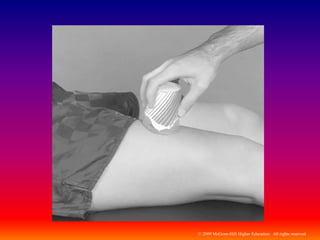
• Ice Massage
– Equipment
• Foam cup with frozen water - creating a cylinder of ice
(towel will be required to absorb water)
– Indications
• Used over small muscle areas (tendons, belly of muscle,
bursa, trigger points)
– Application
• Ice is rubbed over skin in overlapping circles (10-15 cm
diameters) for 5-10 minutes
• Patient should experience sensations of cold, burning,
aching, & numbness --when analgesia is reached athlete can
engage in rehab activities
– Special considerations
• Keep in mind comfort of the athlete during treatment
© 2009 McGraw-Hill Higher Education. All rights reserved
• Cold or Ice Water Immersion
– Equipment
• Variety of basins or containers can be used, small
whirlpool
• Temperature should be 50-60 degrees F
– Indications
• Circumferential cooling of a body part
– Application
• Patient immerses body part in water and goes
through four stages of cold response
• Treatment may last 10-15 minutes
• Once numb, body part can be removed from
immersion and ROM exercise can be performed
• As pain returns re-immersion should take place
• Cycle can be repeated 3 times
© 2009 McGraw-Hill Higher Education. All rights reserved
• Cold or Ice Water Immersion (continued)
– Special Considerations
• Cold treatment makes collagen brittle -- must be
cautious with return to activity following icing
• Be aware of allergic reactions and overcooling
© 2009 McGraw-Hill Higher Education. All rights reserved
• Ice Packs (Bags)
– Equipment
• Wet ice (flaked ice in wet towel)
• Crushed or chipped ice in self sealing bag
– Not as efficient, but less messy
– Useful for approximately 15-20 minutes
– Towel should be placed between skin and pack
• Chemical Cold packs
– Gel pack
– Liquid pack
– Indications
• Athlete experiences four stages of cooling and then
proceeds with ROM exercises
– Special Considerations
• Avoid excessive cold exposure; w/ any indication of
allergy or abnormal pain, treatment should be stopped
© 2009 McGraw-Hill Higher Education. All rights reserved
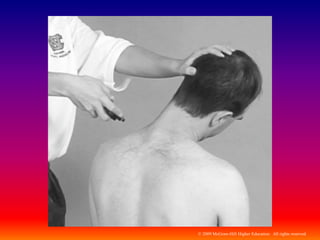
• Vapocoolant Sprays
– Equipment
• Fluori-methane, non-flammable substance that is
released in fine spray from pressurized canister
– Indications
• Reduces muscle spasm, increases ROM, effective on
trigger point
– Application
• For spasm and ROM
– Hold can 12-18 inches from skin, treat entire length of
muscle - covering an area 4 inches/second
– Apply spray 2-3 times, while gradually applying a stretch
© 2009 McGraw-Hill Higher Education. All rights reserved
• Vapocoolant Spray (continued)
– Application
• For trigger points
– Locate trigger point
– Position athlete in relaxed position; place muscle on
stretch; apply spray in specific region and over the
length of the muscle
– Apply passive stretch while spraying
– After first session, heat area and then repeat if
necessary
– When stretch is complete, have athlete move limb
throughout ROM; but do not overload
© 2009 McGraw-Hill Higher Education. All rights reserved
• Cryokinetics
– Technique that combines cryotherapy with exercise
– Goal is to numb region to point of analgesia and
work towards achieving normal ROM
– Equipment
• Treat area with ice pack, massage or immersion
– Application
• When analgesia is experienced, exercises should be
performed (window will last 4-5 minutes)
• As pain returns, process may be repeated
• Sequence can be repeated 5 times
• Exercises should be pain free
• Changes in intensity should be limited by both healing
and patient’s perception of pain
© 2009 McGraw-Hill Higher Education. All rights reserved
• Special Considerations for Cryotherapy
– Cooling for an hour at 15.8o - 30.2o F produces
redness and edema that lasts for 24 hours post
exposure
– Immersion at 41oF increases limb fluid volume
by 15%
– Exposure for 90 minutes at 57.2o -60.8o F can
delay resolution of swelling up to one week
– Some individuals are allergic to cold and react
w/ hives and joint pain
– Icing through a towel or bandage limits the
reduction in temperature -- could limit
effectiveness of treatment
© 2009 McGraw-Hill Higher Education. All rights reserved
– Special medical conditions
• Raynaud’s phenomenon
• Paroxysmal cold hemoglobinuaria
– Application of ice (very rare) can cause nerve
palsy
• Motor nerves close to skin overexposed to cold
(peronial nerve at head of fibula)
© 2009 McGraw-Hill Higher Education. All rights reserved
Electrical Stimulating Currents
• Physical Properties of Electricity
– Electricity displays magnetic, chemical,
mechanical, and thermal effects on tissue
• Volume of current (ampere)
• Rate of flow of 1 amp = 1 coulomb
• Resistance = ohms
• Force that current moves along = voltage
– Electricity is applied to nerve tissue at certain
intensities and duration to reach tissue excitability
thresholds resulting in membrane depolarization
• Target sensory, motor, and pain nerve fibers in an effort
to produce specific physiological effects
© 2009 McGraw-Hill Higher Education. All rights reserved
• Equipment
– Three types of units
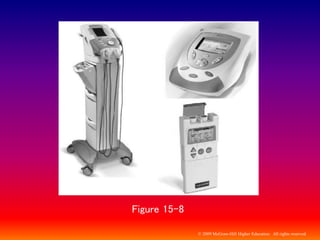
• TENS - transcutaneous electrical nerve stimulators
• NMES/EMS - neuromuscular electrical stimulators
or electrical muscle stimulators
• MENS/LIS - microcurrent electrical nerve
stimulators or low-intensity stimulators
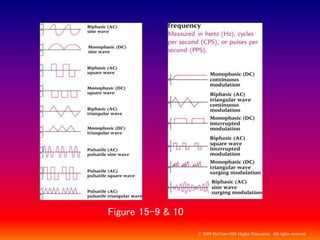
– Generate 3 types of current
• Monophasic
– Direct current or galvanic current - flow in one direction
only from (+) to (-) or vice versa
– Used to produce muscle contraction, pain modulation,
ion movement (determined by specific parameters)
© 2009 McGraw-Hill Higher Education. All rights reserved
Figure 15-8
© 2009 McGraw-Hill Higher Education. All rights reserved
• Biphasic
– Alternating current where direction of flow reverses
during each cycle
– Useful in pain modulation and muscle contractions
• Pulsatile
– Pulsed currents usually contain three or more pulses
grouped together
– Generally interrupted for short periods of time and repeat
themselves at regular intervals
– Used in interferential and so-called Russian currents
• Current Parameters
– Waveforms
• Different generators have differing abilities relative
to the production of various waveforms
• A graphical representation of shape, direction,
amplitude and direction of current
• Can be sine, square or triangular in shape
© 2009 McGraw-Hill Higher Education. All rights reserved
Figure 15-9 & 10
© 2009 McGraw-Hill Higher Education. All rights reserved
– Modulation
• Ability of stim unit to change or alter the
magnitude and duration of a waveform
• May be continuous, interrupted or surged for
both AC and DC currents
– Intensity
• Voltage output of stimulating unit
• High and low voltage units
– Duration (pulse width or pulse duration)
• Refers to the length of time that current is
flowing
• Pre-set on most high voltage DC units
– Frequency
• Number of waveform cycles per second
© 2009 McGraw-Hill Higher Education. All rights reserved
– Polarity
• Direction of flow -- either positive or negative
– Electrode Set-up
• Use of moist electrodes fixed to the skin
• Can include monopolar (active and dispersive
pad) or bipolar set-up
• Current generally felt under and between both
pads unless monopolar set-up is used --then
current is felt under the smaller active pad
© 2009 McGraw-Hill Higher Education. All rights reserved
• Indications
– Pain Modulation
• Gate Control
– Intensity should produce tingling w/out a muscular
contraction
– High frequency and pulse duration
• Descending Pain Control
– High current intensity approaching noxious
– Pulse duration of 10 msec; frequency should be 80 pps
• Opiate Pain Control Theory
– Point stimulator should be used with current intensity set
as tolerable
– Pulse duration should be at maximum; w/ a frequency of
1-5 pps
© 2009 McGraw-Hill Higher Education. All rights reserved
– Muscle Contraction
• Quality of contraction will change according to
current parameters
– Increased frequency results in increased tension (50pps
results in tetany)
– Increased intensity spreads current over larger area
– Increased current duration causes more motor unit
activation
• Muscle pump
– Used to stimulate circulation
– High-volt, DC stimulator; 20-40 pps; surge mode (on/off 5
seconds each; elevation w/ active contraction
– Treatment time 20-30 minutes
© 2009 McGraw-Hill Higher Education. All rights reserved
• Muscle strengthening
– High frequency AC current; 50-60 pps; 10:50
seconds on/off ratio; 10 repetitions 3x per week;
perform with active contractions
• Retardation of atrophy
– High frequency AC current 30-60 pps; w/
voluntary muscle contraction encouraged; 15-20
minutes
• Muscle re-education
– Level of comfortable contraction -- 30-50 pps;
w/ either interrupted or surge current
– Athlete should attempt to contract muscle along
w/ stim
– Treatment time 15-20 minutes and repeated
multiple times over the course of a week
© 2009 McGraw-Hill Higher Education. All rights reserved
• Ionotophoresis
– Introduction of ions into body tissue via direct
electrical current
– Equipment
• Iontophoresis generator which produces a
continuous monophasic current
– Indications
• Used to treat musculoskeletal inflammatory
conditions, analgesic effects, scar modification,
wound healing, calcium deposits, hyperhydrosis
© 2009 McGraw-Hill Higher Education. All rights reserved
– Application
• Reusable or commercially produced electrodes
• Three application techniques
– Active pad over medication saturate gauze
– Body part and active electrode submerged in tub of ion solution
– Special active electrode with medication reservoir
• Utilize large dispersive pad
• Movement of positively and negatively charged ions relative to
electrode charges (poles)
• Treatment last 10-20 minutes depending on current intensity
and ion concentrations in solution
• Requires use of low voltage direct current on continuous mode
w/ a long pulse duration (allows for migration of ions)
• Must be careful to avoid chemical burns and certain to utilize
appropriate medications for specific conditions
© 2009 McGraw-Hill Higher Education. All rights reserved
• Interferential Currents
– Equipment
• Uses 2 separate generators, emitting current at slightly
different frequencies
• Quad polar pad placement is used, creating interference
pattern
• Creates a broader area of stimulation
– Indications
• Pain control (including joints), swelling, neuritis,
retardation of callus formation following fracture &
restricted mobility
– Application
• Pads must be placed to ensure that current is
centered over painful area
• Similar treatment parameters can be used
© 2009 McGraw-Hill Higher Education. All rights reserved
• Low Intensity Stimulators
– Equipment
• Micro-current electrical nerve stimulator
• Operates at low frequencies and intensities (sub-
sensory)
– Indications
• Used to stimulate healing of soft tissue and bone
• Modulate pain, promote wound healing, promote
non-union fracture healing, tendon and ligament
healing
• Based on theory, little research support
– Application
• Utilizes same electrical currents as previously
described
• Using large dispersive pad maintains current density
at thresholds which will not result in sensory nerve
depolarization
© 2009 McGraw-Hill Higher Education. All rights reserved
Shortwave Diathermy
• Physiological Effects
– Generates deep tissue heating
– Higher water content facilitates healing
– Dependent on thickness of subcutaneous tissue
– Heats tissue by introducing high frequency
electrical current
– Heats tissue by introducing high frequency
electrical current
© 2009 McGraw-Hill Higher Education. All rights reserved
– Pulsed diathermy is relatively new
• Not continuous – reduces likelihood of significant
tissue temperature increase
• Utilizes drum electrode
• Produces both thermal and non-thermal effects
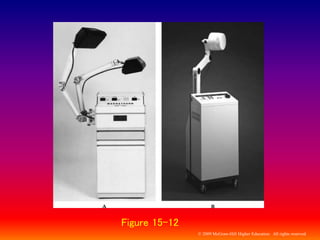
• Equipment
– Frequency generator with an oscillator along
with amplifier for converting AC current to DC
– Also has circuit that tunes to patient
– Treatment applicator is either condenser or
inductive type
• With condenser, patient is part of circuit and
requires use of flexible electrodes
• Inductive – utilizes drum or cable electrodes
© 2009 McGraw-Hill Higher Education. All rights reserved
Figure 15-12
© 2009 McGraw-Hill Higher Education. All rights reserved
• Indications
– Effective for bursitis, capsulitis, osteoarthritis,
deep muscle spasm and strains
– Penetrates up to 2 inches
• Application
– For superficial heating a condenser plate is used
while coil systems are used for deep heating
– Special Considerations
• Can generate heating equal to that achieved via
ultrasound
• Useful for large treatment areas
• Does not require constant monitoring
© 2009 McGraw-Hill Higher Education. All rights reserved
– Special Considerations (continued)
• Difficult to treat local areas
• Dosage is subjective
• Good chance of deep tissue burning
• Toweling is critical
• Avoid use with loss of sensation
• Do not use if patient has metal implants
• Avoid use if patient is pregnant or has open wounds
• Avoid heating eyes, testicle, ovaries, bony
prominences, bone-growth areas
• Deep aching sensation during treatment may
indicate overheating
© 2009 McGraw-Hill Higher Education. All rights reserved
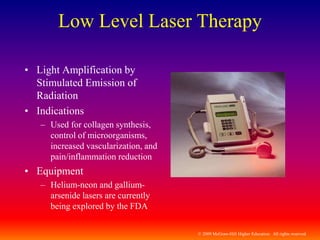
Low Level Laser Therapy
• Light Amplification by
Stimulated Emission of
Radiation
• Indications
– Used for collagen synthesis,
control of microorganisms,
increased vascularization, and
pain/inflammation reduction
• Equipment
– Helium-neon and gallium-
arsenide lasers are currently
being explored by the FDA
© 2009 McGraw-Hill Higher Education. All rights reserved
• Application
– Ideally done with gentle contact – should be
perpendicular to treatment area
– Dosage is critical for desired response – however,
not exactly determined as of yet
– Utilize a grid technique to perform treatment
• Special considerations
– No deleterious effects have been noted
– Contraindications include lasing over cancerous
tissue, over the eyes, pregnancy
– Pain may initially increase – not an indicate for
cessation
– Syncope has occurred in some patients during
treatment (self-resolving)
© 2009 McGraw-Hill Higher Education. All rights reserved
Ultrasound Therapy
• Modality which stimulates repair of soft
tissue and pain relief
• Form of acoustic energy used for deep
tissue heating
– Operates at inaudible frequency
– Sound scatters and is absorbed as it penetrates
tissues -- losing energy = attenuation
– Impedance and penetration are determined by
properties of media (densities)
© 2009 McGraw-Hill Higher Education. All rights reserved
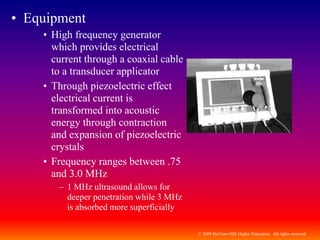
• Equipment
• High frequency generator
which provides electrical
current through a coaxial cable
to a transducer applicator
• Through piezoelectric effect
electrical current is
transformed into acoustic
energy through contraction
and expansion of piezoelectric
crystals
• Frequency ranges between .75
and 3.0 MHz
– 1 MHz ultrasound allows for
deeper penetration while 3 MHz
is absorbed more superficially
© 2009 McGraw-Hill Higher Education. All rights reserved
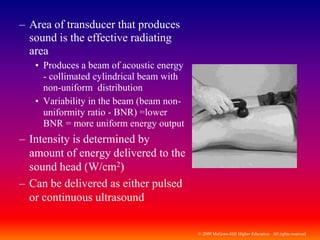
– Area of transducer that produces
sound is the effective radiating
area
• Produces a beam of acoustic energy
- collimated cylindrical beam with
non-uniform distribution
• Variability in the beam (beam non-
uniformity ratio - BNR) =lower
BNR = more uniform energy output
– Intensity is determined by
amount of energy delivered to the
sound head (W/cm2)
– Can be delivered as either pulsed
or continuous ultrasound
© 2009 McGraw-Hill Higher Education. All rights reserved
• Indications
– Produces thermal and non-thermal effects
• Generally used for tissue heating (must increase
tissue temp between 104o and 113oF
• Non-thermal effects include microstreaming and
cavitation which impacts tissue permeability and
fluid movement - useful with acute injuries
– For solely non-thermal effects, intensity must remain
below .2 W/cm2
– Frequency resonance hypothesis relates to alterations in
protein signaling frequency which impact permeability,
healing and protein production
– Acute conditions require more treatments over
a shorter period and chronic conditions require
fewer treatments over a longer period
© 2009 McGraw-Hill Higher Education. All rights reserved
• Application
– Direct skin application
• Requires a coupling medium to provide airtight
contact w/ skin and a low friction surface
– Underwater application
• Used for irregularly shaped structures
• Body part is submerged in water, ultrasound head is
placed 1” from surface
• Water serves as coupling medium, air bubbles
should be continually swept away
• Sound head should be moved in circular or
longitudinal pattern
• Should be performed in non-metal container to
avoid reflection
© 2009 McGraw-Hill Higher Education. All rights reserved
– Gel pad technique
• Used when body part can not be immersed in water
• Gel pad applied to treatment area
• Coated with gel to enhance contact surface
– Moving the transducer
• Leads to more even distribution of energy, reducing
likelihood of hot spots
• Should be moved at a rate of 4cm/second
• Must maintain contact of transducer with surface of
skin
• Circular or stroking patterns should be used
• Should not treat an area larger than 3 times the ERA
© 2009 McGraw-Hill Higher Education. All rights reserved
– Dosage and Time
• Varies according to depth of tissue to be treated and
the state of injury
• Duration tends to last 5-10 minutes
• Intensity varies
– Low 0.1-0.3 W/cm2
– Medium 0.4 - 1.5 W/cm2
– High 1.5 - 3.0 W/cm2
– Special Considerations
• While it is a relatively safe modality, precautions
still must be taken
• Be careful with anesthetized areas, reduced
circulation
• Avoid high fluid regions of the body, acute injuries,
and epiphyseal areas of children
© 2009 McGraw-Hill Higher Education. All rights reserved
Ultrasound in Combination w/
Other Modalities
• Ultrasound can be used w/ a variety of
modalities to accomplish a series of
treatment goals
– Use of hot packs with ultrasound may have an
additive effect on muscle temperature
– Cold packs, while often used in conjunction
with ultrasound, may interfere with heating
– With electrical stimulation, it is often useful for
trigger point treatment (blood flow, muscle
contraction and pain modulation)
© 2009 McGraw-Hill Higher Education. All rights reserved
Phonophoresis
• Method of driving molecules through the skin using
mechanical vibration
– Process which moves medication to injured tissues
• Indications
– Primarily used to drive hydrocortisone and
anesthetics into the tissue
– Used on trigger points, tendinitis and bursitis
– Effectiveness of treatments is still being explored
– Generally involves the use of a 10% hydrocortisone
ointment (rubbed into the area), followed by
application of coupling medium and ultrasound
treatment
– Chem pads are also available
© 2009 McGraw-Hill Higher Education. All rights reserved
Mechanical Modalities
© 2009 McGraw-Hill Higher Education. All rights reserved
Traction
• Drawing tension applied to a body segment
• Physiological Effects
– Produces separation of vertebral bodies
impacting ligaments, capsules, paraspinal
muscles; increases articular facet separation,
and relief of nerve root pain; decreases central
pressure of vertebral disks; increases
proprioceptive changes; relief of joint
compression due to normal posture
© 2009 McGraw-Hill Higher Education. All rights reserved
• Indications
– Spinal nerve root impingement
– Decrease muscle guarding, treat muscle strain
– Treat sprain of spinal ligaments
– Relax discomfort from normal spinal
compression
• Application
– Manual and traction machines can be used
– Manual
• Adaptable and allows for great flexibility
• Changes in force, direction, duration and patient
positioning can be made instantaneously
© 2009 McGraw-Hill Higher Education. All rights reserved
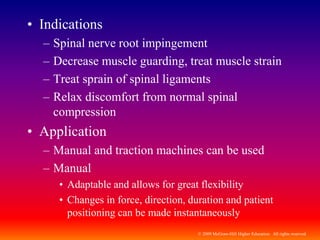
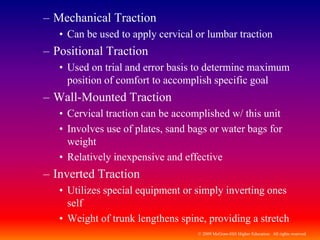
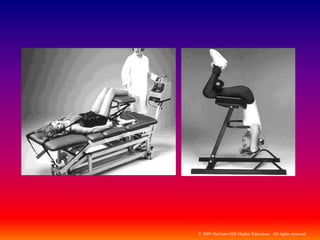
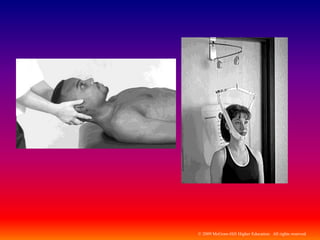
– Mechanical Traction
• Can be used to apply cervical or lumbar traction
– Positional Traction
• Used on trial and error basis to determine maximum
position of comfort to accomplish specific goal
– Wall-Mounted Traction
• Cervical traction can be accomplished w/ this unit
• Involves use of plates, sand bags or water bags for
weight
• Relatively inexpensive and effective
– Inverted Traction
• Utilizes special equipment or simply inverting ones
self
• Weight of trunk lengthens spine, providing a stretch
© 2009 McGraw-Hill Higher Education. All rights reserved
Intermittent Compression Units
• Equipment
– Utilizes nylon inflatable sleeve
– Sleeve is inflated to specific pressure using
either water or air
– Utilized to facilitate movement of lymphatic
fluids
• Parameters
– Able to adjust on/off time, pressure and
treatment time
© 2009 McGraw-Hill Higher Education. All rights reserved
• Indications
– Used for controlling or reducing swelling after
acute injury
– Good for pitting edema, which develops several
hours after injury
– Elevation of extremity is critical to effective
treatment
– With electrical stimulation, muscle pumping
can be incorporated to facilitate lymphatic flow
© 2009 McGraw-Hill Higher Education. All rights reserved
• On/Off Time
– Will often vary (1:2, 2:1, or 4:1)
– Not research based
• Pressures
– Must be mindful of blood pressure
– Upper extremity 30-50 mm Hg
– Lower extremity 30-60 mm Hg
• Some units allow for combining cold along
with compression
• Electric stim can also be combined during
some treatments
© 2009 McGraw-Hill Higher Education. All rights reserved
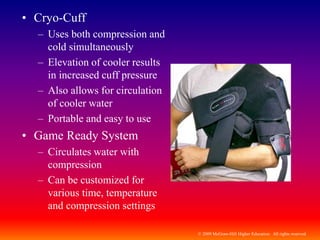
• Cryo-Cuff
– Uses both compression and
cold simultaneously
– Elevation of cooler results
in increased cuff pressure
– Also allows for circulation
of cooler water
– Portable and easy to use
• Game Ready System
– Circulates water with
compression
– Can be customized for
various time, temperature
and compression settings
© 2009 McGraw-Hill Higher Education. All rights reserved
Massage
• Systematic manipulation of soft tissue
• Therapeutic Effects
– Mechanical Responses
• Occur as a direct result of pressures and movements
• Encourages venous flow and mild stretching of
superficial tissue
– Physiological Responses
• Increases circulation aiding circulation, removal of
metabolites, overcoming venostasis
• Reflex effect - response to nerve impulses initiated
through superficial contact
– Impacts body relaxation, stimulation, and increased
circulation
© 2009 McGraw-Hill Higher Education. All rights reserved
• Relaxation can be induced by slow superficial
stroking of skin
• Stimulation achieved by quick brisk strokes,
causing contraction of tissue
– Primarily psychological impacts
• Increased circulation through reflexive and
mechanical stimuli
– Capillary dilation, stimulation of cell metabolism,
decreasing toxins and increase lymphatic and venous
circulation
– Psychological Responses
• Tactile system is one of the most sensitive systems
of the body
• Because the laying on of hands is used w/ massage it
can be an important means of creating a bond of
confidence between the athlete and the clinician
© 2009 McGraw-Hill Higher Education. All rights reserved
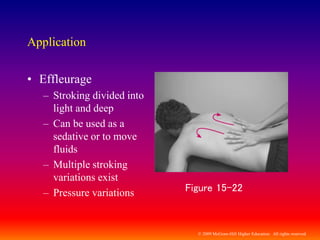
Application
• Effleurage
– Stroking divided into
light and deep
– Can be used as a
sedative or to move
fluids
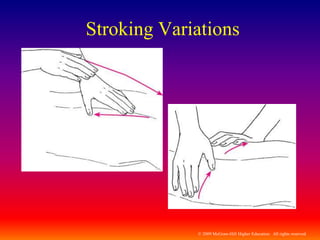
– Multiple stroking
variations exist
– Pressure variations Figure 15-22
© 2009 McGraw-Hill Higher Education. All rights reserved
Stroking Variations
© 2009 McGraw-Hill Higher Education. All rights reserved
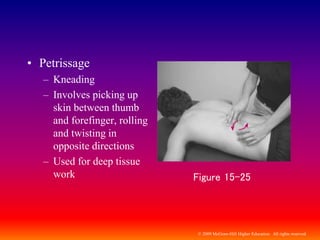
• Petrissage
– Kneading
– Involves picking up
skin between thumb
and forefinger, rolling
and twisting in
opposite directions
– Used for deep tissue
work Figure 15-25
© 2009 McGraw-Hill Higher Education. All rights reserved
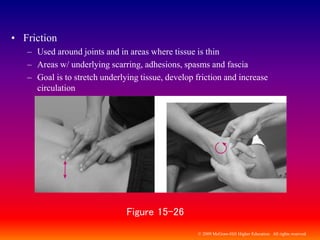
• Friction
– Used around joints and in areas where tissue is thin
– Areas w/ underlying scarring, adhesions, spasms and fascia
– Goal is to stretch underlying tissue, develop friction and increase
circulation
Figure 15-26
© 2009 McGraw-Hill Higher Education. All rights reserved
– Tapotement
• Cupping
– Produces invigorating and stimulating sensation
– Series of percussion movements rapidly duplicated at a
constant tempo
• Hacking
– Used to treat heavy muscle areas, similar to cupping
• Pincing
– Lifting of small amounts of tissue between thumb and first
finger in quick, gentle pinching movements
– Vibration
• Rapid movement that produces quivering or
trembling effect to tissue
• Used to relax and soothe
© 2009 McGraw-Hill Higher Education. All rights reserved
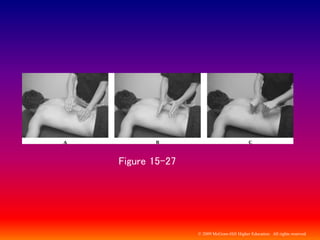
Figure 15-27
© 2009 McGraw-Hill Higher Education. All rights reserved
• Special Considerations
– Make the patient comfortable
• Positioning, padding, temperature, privacy
– Develop confident, gentle approach to massage
• Good body positioning (clinician and athlete) an
develop good technique
– Stroke towards heart to enhance lymphatic and
venous drainage
– Know when to avoid massage
• Acute conditions, skin conditions, areas where clots
can become dislodged
© 2009 McGraw-Hill Higher Education. All rights reserved
• Sports Massage
– Usually confined to a specific area - rarely given to
full body
– Full body massage is time consuming, generally
not feasible
– Five minute treatment can be effective
– Massage lubricants
• Enables hands to slide and move easily over body,
reducing friction
• Rubbing dry area can irritate skin
• Mediums include powder, lotion, oil or liniments
– Positioning of Athlete
• Area must be easily accessible and must be relaxed
– Exhibit Confidence
© 2009 McGraw-Hill Higher Education. All rights reserved
• Ensure Patient Privacy and Athletic Trainer
Integrity
– Due to direct physical contact professionalism
must be maintained at all times
– Critical when dealing with patient of opposite
sex
– Be sure that area being treated is the only area
exposed
– An additional athlete or athletic trainer should
also be present
© 2009 McGraw-Hill Higher Education. All rights reserved
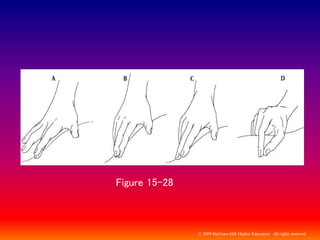
• Deep Transverse Friction Massage
– Transverse or Cyriax method used to treat
muscle, tendon, ligaments and joint capsules
– Goal is mobilization of soft tissue
– Generally precedes activity
– Movement is across the grain of the affected
tissue
– Avoid treatment with acute injuries
– Treatment will produce numbing effect
allowing for exercise mobilization
© 2009 McGraw-Hill Higher Education. All rights reserved
Figure 15-28
© 2009 McGraw-Hill Higher Education. All rights reserved
• Acupressure Massage
– Based on Chinese art of acupuncture
– Physiological explanation and effectiveness may be based
on pain modulation mechanisms
– Clinician can utilize acupuncture points in treatment
– Locate through measurement of electrical impedance or
palpation
– Small circular motions are used to treat points (pressure to
tolerance of athlete = generally more pressure = more
effective treatment)
– Treatment time ranges from 1-5 minutes
– Can treat one or more points, working distal to proximal
– Will produce dulling or numbing sensation w/ results
lasting from minutes to hours
© 2009 McGraw-Hill Higher Education. All rights reserved
Magnet Therapy
• Becoming popular amongst competitive and
recreational athletes
• Used in cases of musculoskeletal ailments
• Limited research on magnetic therapy
• Utilizes magnetic fields to physiologically
impact body
– Change polarity of damaged cells, increase
blood flow, increase muscle strength and
hormone secretion, increase cell division and
enzyme activity, increase lymphatic flow and
alter blood pH
© 2009 McGraw-Hill Higher Education. All rights reserved
Extracorporeal Shock Wave
Therapy (ESWT)
• Used initially for kidney stone
fragmentation
• Involves a pulsed, high-pressured, short-
duration acoustical sound wave with little
attenuation
• Concentrated in focal area (2.8 mm in
diameter)
• Treatment lasts 15-30 minutes
© 2009 McGraw-Hill Higher Education. All rights reserved
• Rarely found in clinical setting – primarily
in hospitals
• Applied to point of maximal tenderness
• Utilized in cases of tennis elbow, plantar
fascitis, non-union fractures, and analgesia
• Enhances metabolism, circulation and
revascularization
• Techniques are not standardized
– Dosages and frequencies have not been studied
extensively
– May require imaging devices to direct treatment
– Use of anesthesia is still uncertain as well
© 2009 McGraw-Hill Higher Education. All rights reserved
Recording Therapeutic Modality
Treatments
• Specifics of treatment should be recorded
on original SOAP note, progress note and
treatment log
• Changes in treatment parameters and
modalities should always be noted
© 2009 McGraw-Hill Higher Education. All rights reserved
Safety in Using Therapeutic
Modalities
• Equipment must be used and maintained in
appropriate manner
• Following manufacturer recommendations
– Regarding use and maintenance
• Failure to follow recommendations =
negligence
© 2009 McGraw-Hill Higher Education. All rights reserved
Evidence-Based Data Regarding
Therapeutic Modality Use
• Clinical effectiveness has yet to be
established for a variety of conditions
• Often rely on efficacy generated by
manufacturers rather than research
• Minimal modality-related evidence-based
information available
– Of that which exists much should be carefully
questioned and considered
– Best evidence should be put into practice

15._Modalities.ppt

  • 1.
    © 2009 McGraw-HillHigher Education. All rights reserved Chapter 15: Using Therapeutic Modalities
  • 2.
    © 2009 McGraw-HillHigher Education. All rights reserved • Therapeutic modalities can be an effective adjunct to various techniques of therapeutic exercise • Knowledge of the healing process is critical • A variety of modalities can be utilized by athletic trainers including cryotherapy, electrical stimulation, ultrasound, massage, traction, diathermy, lasers and magnets
  • 3.
    © 2009 McGraw-HillHigher Education. All rights reserved Classification of Therapeutic Modalities • Electromagnetic – Includes cryotherapy, thermotherapy, electrical stimulating currents, diathermy and lasers – Rely on electromagnetic energy, which travels at the speed of light – Energy travels in a straight line – The energy can be absorbed, refracted, reflected or transmitted
  • 4.
    © 2009 McGraw-HillHigher Education. All rights reserved • Acoustic – Ultrasound utilizes acoustic energy – High frequency sound waves – Relies on molecular collisions for energy transfer – Vibration of tissue produces heat and impacts cell membrane permeability • Mechanical – Traction, intermittent compression, massage – Involves mechanically stretching, compressing and manipulating soft tissue and joint structures
  • 5.
    © 2009 McGraw-HillHigher Education. All rights reserved Electromagnetic Modalities
  • 6.
    © 2009 McGraw-HillHigher Education. All rights reserved Thermotherapy • Physiological Effects of Heat – Dependent on type of heat energy applied, intensity of energy, duration of exposure and tissue response – Heat must be absorbed to increase molecular activity – Desired effects • Increase collagen extensibility; decreasing joint stiffness; reducing pain; relieving muscle spasm; reduction of edema and swelling; increasing blood flow
  • 7.
    © 2009 McGraw-HillHigher Education. All rights reserved – Extensibility of collagen • Permits increases in extensibility through stretching – Pain relief • Activates gate control mechanism – Muscle spasm • Increased blood flow reduces ischemia – Assistance w/ healing process • Raises tissue temperature, increases metabolism resulting in reduction of oxygen tension, lowering pH, increasing capillary permeability and releasing bradykinins and histamine resulting in vasodilation • Parasympathetic impulses stimulated by heat are also believed to be a reason for vasodilation
  • 8.
    © 2009 McGraw-HillHigher Education. All rights reserved • Superficial Heat – Form of electromagnetic energy (infrared region of spectrum) – Increases subcutaneous temperature, indirectly spreading to deeper tissue – Muscle temperature increases through reflexive effect of circulation through conduction – Moist heat versus dry heat
  • 9.
    © 2009 McGraw-HillHigher Education. All rights reserved Transmission of Thermal Energy • Conduction – Heat is transferred from a warmer object to a cooler one – Dependent on temperature and exposure time – Temperatures of 116.6o F will cause tissue damage and temperatures of 113o F should not be in contact w/ the skin longer than 30 minutes – Examples include moist hot packs, paraffin, ice packs and cold packs
  • 10.
    © 2009 McGraw-HillHigher Education. All rights reserved • Convection – Transfer of heat through movement of fluids or gases – Temperature, speed of movement, and conductivity of part impact heating – Whirlpools • Radiation – Heating is transferred from one object through space to another object – Shortwave diathermy, infrared heating and ultraviolet therapy • Conversion – Generation of heat from another object (sound, electricity or chemical agents)
  • 11.
    © 2009 McGraw-HillHigher Education. All rights reserved • Hydrocollator Packs – Equipment • Silicate gel pads submersed in 160-170o F water • Maintains heat for 20-30 minutes; must use 6 layers of terry cloth to protect skin – Indications • Used for general muscle relaxation and reduction of pain-spasm-ischemia-hypoxia-pain cycle • Limitation - unable to heat deeper tissues effectively – Application • Pack removed from water; covered w/ 6 layers of toweling which are removed as cooling occurs; area treated for 15-20 minutes • Athlete must be comfortable and should not lay on pack
  • 12.
    © 2009 McGraw-HillHigher Education. All rights reserved • Whirlpool Bath – Equipment • Varying sizes used to treat a variety of body parts • Tank w/ turbine that regulates flow • Agitation (amount of movement) is controlled by air emitted – Indications • Combination of massage and water immersion • Provides conduction and convection • Swelling, muscle spasm and pain – Application • Temperature is set according to treatment goals • Athlete should be set up to be reached by agitator (8-12” from agitator) – Do not place directly on injured site • Maximum treatment time for acute injuries should not exceed 20 minutes
  • 13.
    © 2009 McGraw-HillHigher Education. All rights reserved • Special Considerations – Must be careful with full- body immersion – Proper maintenance is necessary to avoid infection – As volume of body part immersion increases, temperature should decrease – Safety is a major concern • Electrical outlets • Athlete should not turn whirlpool on or off – Contraindicated for acute injuries due to gravity dependent position Figure 15-2
  • 14.
    © 2009 McGraw-HillHigher Education. All rights reserved • Paraffin Bath – Equipment • A paraffin wax and mineral oil combination, heated to 126-130o F, plastic bags, paper towels and towels – Indications • Useful in treating chronic injuries • Effective for angular areas of body such as hands, wrists, elbows, ankles and feet – Application • Body part is cleaned and dried • Dip and wrap technique – Hand dipped 6-12 times, wrapped in a plastic bag and then draped w/ a towel to maintain heat for 30 minutes • Soak technique – Body part remains in wax 20-30 minutes w/out moving it
  • 15.
    © 2009 McGraw-HillHigher Education. All rights reserved
  • 16.
    © 2009 McGraw-HillHigher Education. All rights reserved • Fluidotherapy – Equipment • Unit which contains cellulose particles through which warm air is circulated • Allows for high heating (higher than water and paraffin) – Indications • Used to treat distal extremities in effort to decrease pain, increase ROM and decrease swelling and spasm – Application • Temperature ranges from 100-113o F • Particle agitation should be controlled for comfort • Patient should be comfortable • Treatment time = 15-20 minutes • Exercise can be performed while in cabinet
  • 17.
    © 2009 McGraw-HillHigher Education. All rights reserved
  • 18.
    © 2009 McGraw-HillHigher Education. All rights reserved • Special Consideration w/ Superficial Heat – Important contraindications • Never apply heat when there is loss of sensation • Never apply heat immediately after injury • Never apply heat when there is decreased arterial circulation • Never apply heat directly to eyes or the genitals • Never heat the abdomen during pregnancy • Never apply heat to a body part that exhibits signs of acute inflammation
  • 19.
    © 2009 McGraw-HillHigher Education. All rights reserved Cryotherapy • Used in first aid treatment of trauma to the musculoskeletal system • When applied intermittently w/ compression, rest and elevation it reduces many adverse conditions related to inflammation and the reactive phase of an acute injury • RICE (rest, ice compression, elevation) may be used for the initial days of and injury and continue up to 2 weeks after injury
  • 20.
    © 2009 McGraw-HillHigher Education. All rights reserved • Physiological Effects of Cold – Type of electromagnetic energy (infrared radiation) – Relies on conduction -- degree of cooling depends on the medium, length of exposure and conductivity • At a temperature of 38.3oF, muscle temperature can be reduced as deep as 4cm – Tissue w/ a high water content is an excellent conductor – Most common means of cold therapy are ice packs and ice immersion • Wet ice is a more effective coolant due to the energy required to melt ice
  • 21.
    © 2009 McGraw-HillHigher Education. All rights reserved – Vasoconstriction • Reflex action of smooth muscle due to sympathetic nervous system and adrenal medulla – Hunting response • Intermittent period of vasodilation will occur if cooling continues for >20 minutes – Blood viscosity will also increase with extended cooling – Decreases extent of hypoxic injury to cells-- • Decreases cell metabolic rate and the need for oxygen through circulation, resulting in less tissue damage – Decreased metabolic rate and vasoconstriction decreases swelling associated w/ inflammatory response
  • 22.
    © 2009 McGraw-HillHigher Education. All rights reserved – Decreases muscle spasm • Muscle becomes more amenable to stretch as a result of decreased GTO and muscle spindle activity – Decreases free nerve ending and peripheral nerve excitability • Analgesia caused by raising nerve threshold – Cold is more penetrating than heat – Ability to decrease muscle fatigue and increase and maintain muscular contraction • Attributed to the decrease of local metabolic rates and tissue temperature
  • 23.
    © 2009 McGraw-HillHigher Education. All rights reserved • Ice Massage – Equipment • Foam cup with frozen water - creating a cylinder of ice (towel will be required to absorb water) – Indications • Used over small muscle areas (tendons, belly of muscle, bursa, trigger points) – Application • Ice is rubbed over skin in overlapping circles (10-15 cm diameters) for 5-10 minutes • Patient should experience sensations of cold, burning, aching, & numbness --when analgesia is reached athlete can engage in rehab activities – Special considerations • Keep in mind comfort of the athlete during treatment
  • 24.
    © 2009 McGraw-HillHigher Education. All rights reserved
  • 25.
    © 2009 McGraw-HillHigher Education. All rights reserved • Cold or Ice Water Immersion – Equipment • Variety of basins or containers can be used, small whirlpool • Temperature should be 50-60 degrees F – Indications • Circumferential cooling of a body part – Application • Patient immerses body part in water and goes through four stages of cold response • Treatment may last 10-15 minutes • Once numb, body part can be removed from immersion and ROM exercise can be performed • As pain returns re-immersion should take place • Cycle can be repeated 3 times
  • 26.
    © 2009 McGraw-HillHigher Education. All rights reserved • Cold or Ice Water Immersion (continued) – Special Considerations • Cold treatment makes collagen brittle -- must be cautious with return to activity following icing • Be aware of allergic reactions and overcooling
  • 27.
    © 2009 McGraw-HillHigher Education. All rights reserved • Ice Packs (Bags) – Equipment • Wet ice (flaked ice in wet towel) • Crushed or chipped ice in self sealing bag – Not as efficient, but less messy – Useful for approximately 15-20 minutes – Towel should be placed between skin and pack • Chemical Cold packs – Gel pack – Liquid pack – Indications • Athlete experiences four stages of cooling and then proceeds with ROM exercises – Special Considerations • Avoid excessive cold exposure; w/ any indication of allergy or abnormal pain, treatment should be stopped
  • 28.
    © 2009 McGraw-HillHigher Education. All rights reserved • Vapocoolant Sprays – Equipment • Fluori-methane, non-flammable substance that is released in fine spray from pressurized canister – Indications • Reduces muscle spasm, increases ROM, effective on trigger point – Application • For spasm and ROM – Hold can 12-18 inches from skin, treat entire length of muscle - covering an area 4 inches/second – Apply spray 2-3 times, while gradually applying a stretch
  • 29.
    © 2009 McGraw-HillHigher Education. All rights reserved • Vapocoolant Spray (continued) – Application • For trigger points – Locate trigger point – Position athlete in relaxed position; place muscle on stretch; apply spray in specific region and over the length of the muscle – Apply passive stretch while spraying – After first session, heat area and then repeat if necessary – When stretch is complete, have athlete move limb throughout ROM; but do not overload
  • 30.
    © 2009 McGraw-HillHigher Education. All rights reserved
  • 31.
    © 2009 McGraw-HillHigher Education. All rights reserved • Cryokinetics – Technique that combines cryotherapy with exercise – Goal is to numb region to point of analgesia and work towards achieving normal ROM – Equipment • Treat area with ice pack, massage or immersion – Application • When analgesia is experienced, exercises should be performed (window will last 4-5 minutes) • As pain returns, process may be repeated • Sequence can be repeated 5 times • Exercises should be pain free • Changes in intensity should be limited by both healing and patient’s perception of pain
  • 32.
    © 2009 McGraw-HillHigher Education. All rights reserved • Special Considerations for Cryotherapy – Cooling for an hour at 15.8o - 30.2o F produces redness and edema that lasts for 24 hours post exposure – Immersion at 41oF increases limb fluid volume by 15% – Exposure for 90 minutes at 57.2o -60.8o F can delay resolution of swelling up to one week – Some individuals are allergic to cold and react w/ hives and joint pain – Icing through a towel or bandage limits the reduction in temperature -- could limit effectiveness of treatment
  • 33.
    © 2009 McGraw-HillHigher Education. All rights reserved – Special medical conditions • Raynaud’s phenomenon • Paroxysmal cold hemoglobinuaria – Application of ice (very rare) can cause nerve palsy • Motor nerves close to skin overexposed to cold (peronial nerve at head of fibula)
  • 34.
    © 2009 McGraw-HillHigher Education. All rights reserved Electrical Stimulating Currents • Physical Properties of Electricity – Electricity displays magnetic, chemical, mechanical, and thermal effects on tissue • Volume of current (ampere) • Rate of flow of 1 amp = 1 coulomb • Resistance = ohms • Force that current moves along = voltage – Electricity is applied to nerve tissue at certain intensities and duration to reach tissue excitability thresholds resulting in membrane depolarization • Target sensory, motor, and pain nerve fibers in an effort to produce specific physiological effects
  • 35.
    © 2009 McGraw-HillHigher Education. All rights reserved • Equipment – Three types of units • TENS - transcutaneous electrical nerve stimulators • NMES/EMS - neuromuscular electrical stimulators or electrical muscle stimulators • MENS/LIS - microcurrent electrical nerve stimulators or low-intensity stimulators – Generate 3 types of current • Monophasic – Direct current or galvanic current - flow in one direction only from (+) to (-) or vice versa – Used to produce muscle contraction, pain modulation, ion movement (determined by specific parameters)
  • 36.
    © 2009 McGraw-HillHigher Education. All rights reserved Figure 15-8
  • 37.
    © 2009 McGraw-HillHigher Education. All rights reserved • Biphasic – Alternating current where direction of flow reverses during each cycle – Useful in pain modulation and muscle contractions • Pulsatile – Pulsed currents usually contain three or more pulses grouped together – Generally interrupted for short periods of time and repeat themselves at regular intervals – Used in interferential and so-called Russian currents • Current Parameters – Waveforms • Different generators have differing abilities relative to the production of various waveforms • A graphical representation of shape, direction, amplitude and direction of current • Can be sine, square or triangular in shape
  • 38.
    © 2009 McGraw-HillHigher Education. All rights reserved Figure 15-9 & 10
  • 39.
    © 2009 McGraw-HillHigher Education. All rights reserved – Modulation • Ability of stim unit to change or alter the magnitude and duration of a waveform • May be continuous, interrupted or surged for both AC and DC currents – Intensity • Voltage output of stimulating unit • High and low voltage units – Duration (pulse width or pulse duration) • Refers to the length of time that current is flowing • Pre-set on most high voltage DC units – Frequency • Number of waveform cycles per second
  • 40.
    © 2009 McGraw-HillHigher Education. All rights reserved – Polarity • Direction of flow -- either positive or negative – Electrode Set-up • Use of moist electrodes fixed to the skin • Can include monopolar (active and dispersive pad) or bipolar set-up • Current generally felt under and between both pads unless monopolar set-up is used --then current is felt under the smaller active pad
  • 41.
    © 2009 McGraw-HillHigher Education. All rights reserved • Indications – Pain Modulation • Gate Control – Intensity should produce tingling w/out a muscular contraction – High frequency and pulse duration • Descending Pain Control – High current intensity approaching noxious – Pulse duration of 10 msec; frequency should be 80 pps • Opiate Pain Control Theory – Point stimulator should be used with current intensity set as tolerable – Pulse duration should be at maximum; w/ a frequency of 1-5 pps
  • 42.
    © 2009 McGraw-HillHigher Education. All rights reserved – Muscle Contraction • Quality of contraction will change according to current parameters – Increased frequency results in increased tension (50pps results in tetany) – Increased intensity spreads current over larger area – Increased current duration causes more motor unit activation • Muscle pump – Used to stimulate circulation – High-volt, DC stimulator; 20-40 pps; surge mode (on/off 5 seconds each; elevation w/ active contraction – Treatment time 20-30 minutes
  • 43.
    © 2009 McGraw-HillHigher Education. All rights reserved • Muscle strengthening – High frequency AC current; 50-60 pps; 10:50 seconds on/off ratio; 10 repetitions 3x per week; perform with active contractions • Retardation of atrophy – High frequency AC current 30-60 pps; w/ voluntary muscle contraction encouraged; 15-20 minutes • Muscle re-education – Level of comfortable contraction -- 30-50 pps; w/ either interrupted or surge current – Athlete should attempt to contract muscle along w/ stim – Treatment time 15-20 minutes and repeated multiple times over the course of a week
  • 44.
    © 2009 McGraw-HillHigher Education. All rights reserved • Ionotophoresis – Introduction of ions into body tissue via direct electrical current – Equipment • Iontophoresis generator which produces a continuous monophasic current – Indications • Used to treat musculoskeletal inflammatory conditions, analgesic effects, scar modification, wound healing, calcium deposits, hyperhydrosis
  • 45.
    © 2009 McGraw-HillHigher Education. All rights reserved – Application • Reusable or commercially produced electrodes • Three application techniques – Active pad over medication saturate gauze – Body part and active electrode submerged in tub of ion solution – Special active electrode with medication reservoir • Utilize large dispersive pad • Movement of positively and negatively charged ions relative to electrode charges (poles) • Treatment last 10-20 minutes depending on current intensity and ion concentrations in solution • Requires use of low voltage direct current on continuous mode w/ a long pulse duration (allows for migration of ions) • Must be careful to avoid chemical burns and certain to utilize appropriate medications for specific conditions
  • 46.
    © 2009 McGraw-HillHigher Education. All rights reserved • Interferential Currents – Equipment • Uses 2 separate generators, emitting current at slightly different frequencies • Quad polar pad placement is used, creating interference pattern • Creates a broader area of stimulation – Indications • Pain control (including joints), swelling, neuritis, retardation of callus formation following fracture & restricted mobility – Application • Pads must be placed to ensure that current is centered over painful area • Similar treatment parameters can be used
  • 47.
    © 2009 McGraw-HillHigher Education. All rights reserved • Low Intensity Stimulators – Equipment • Micro-current electrical nerve stimulator • Operates at low frequencies and intensities (sub- sensory) – Indications • Used to stimulate healing of soft tissue and bone • Modulate pain, promote wound healing, promote non-union fracture healing, tendon and ligament healing • Based on theory, little research support – Application • Utilizes same electrical currents as previously described • Using large dispersive pad maintains current density at thresholds which will not result in sensory nerve depolarization
  • 48.
    © 2009 McGraw-HillHigher Education. All rights reserved Shortwave Diathermy • Physiological Effects – Generates deep tissue heating – Higher water content facilitates healing – Dependent on thickness of subcutaneous tissue – Heats tissue by introducing high frequency electrical current – Heats tissue by introducing high frequency electrical current
  • 49.
    © 2009 McGraw-HillHigher Education. All rights reserved – Pulsed diathermy is relatively new • Not continuous – reduces likelihood of significant tissue temperature increase • Utilizes drum electrode • Produces both thermal and non-thermal effects • Equipment – Frequency generator with an oscillator along with amplifier for converting AC current to DC – Also has circuit that tunes to patient – Treatment applicator is either condenser or inductive type • With condenser, patient is part of circuit and requires use of flexible electrodes • Inductive – utilizes drum or cable electrodes
  • 50.
    © 2009 McGraw-HillHigher Education. All rights reserved Figure 15-12
  • 51.
    © 2009 McGraw-HillHigher Education. All rights reserved • Indications – Effective for bursitis, capsulitis, osteoarthritis, deep muscle spasm and strains – Penetrates up to 2 inches • Application – For superficial heating a condenser plate is used while coil systems are used for deep heating – Special Considerations • Can generate heating equal to that achieved via ultrasound • Useful for large treatment areas • Does not require constant monitoring
  • 52.
    © 2009 McGraw-HillHigher Education. All rights reserved – Special Considerations (continued) • Difficult to treat local areas • Dosage is subjective • Good chance of deep tissue burning • Toweling is critical • Avoid use with loss of sensation • Do not use if patient has metal implants • Avoid use if patient is pregnant or has open wounds • Avoid heating eyes, testicle, ovaries, bony prominences, bone-growth areas • Deep aching sensation during treatment may indicate overheating
  • 53.
    © 2009 McGraw-HillHigher Education. All rights reserved Low Level Laser Therapy • Light Amplification by Stimulated Emission of Radiation • Indications – Used for collagen synthesis, control of microorganisms, increased vascularization, and pain/inflammation reduction • Equipment – Helium-neon and gallium- arsenide lasers are currently being explored by the FDA
  • 54.
    © 2009 McGraw-HillHigher Education. All rights reserved • Application – Ideally done with gentle contact – should be perpendicular to treatment area – Dosage is critical for desired response – however, not exactly determined as of yet – Utilize a grid technique to perform treatment • Special considerations – No deleterious effects have been noted – Contraindications include lasing over cancerous tissue, over the eyes, pregnancy – Pain may initially increase – not an indicate for cessation – Syncope has occurred in some patients during treatment (self-resolving)
  • 55.
    © 2009 McGraw-HillHigher Education. All rights reserved Ultrasound Therapy • Modality which stimulates repair of soft tissue and pain relief • Form of acoustic energy used for deep tissue heating – Operates at inaudible frequency – Sound scatters and is absorbed as it penetrates tissues -- losing energy = attenuation – Impedance and penetration are determined by properties of media (densities)
  • 56.
    © 2009 McGraw-HillHigher Education. All rights reserved • Equipment • High frequency generator which provides electrical current through a coaxial cable to a transducer applicator • Through piezoelectric effect electrical current is transformed into acoustic energy through contraction and expansion of piezoelectric crystals • Frequency ranges between .75 and 3.0 MHz – 1 MHz ultrasound allows for deeper penetration while 3 MHz is absorbed more superficially
  • 57.
    © 2009 McGraw-HillHigher Education. All rights reserved – Area of transducer that produces sound is the effective radiating area • Produces a beam of acoustic energy - collimated cylindrical beam with non-uniform distribution • Variability in the beam (beam non- uniformity ratio - BNR) =lower BNR = more uniform energy output – Intensity is determined by amount of energy delivered to the sound head (W/cm2) – Can be delivered as either pulsed or continuous ultrasound
  • 58.
    © 2009 McGraw-HillHigher Education. All rights reserved • Indications – Produces thermal and non-thermal effects • Generally used for tissue heating (must increase tissue temp between 104o and 113oF • Non-thermal effects include microstreaming and cavitation which impacts tissue permeability and fluid movement - useful with acute injuries – For solely non-thermal effects, intensity must remain below .2 W/cm2 – Frequency resonance hypothesis relates to alterations in protein signaling frequency which impact permeability, healing and protein production – Acute conditions require more treatments over a shorter period and chronic conditions require fewer treatments over a longer period
  • 59.
    © 2009 McGraw-HillHigher Education. All rights reserved • Application – Direct skin application • Requires a coupling medium to provide airtight contact w/ skin and a low friction surface – Underwater application • Used for irregularly shaped structures • Body part is submerged in water, ultrasound head is placed 1” from surface • Water serves as coupling medium, air bubbles should be continually swept away • Sound head should be moved in circular or longitudinal pattern • Should be performed in non-metal container to avoid reflection
  • 60.
    © 2009 McGraw-HillHigher Education. All rights reserved – Gel pad technique • Used when body part can not be immersed in water • Gel pad applied to treatment area • Coated with gel to enhance contact surface – Moving the transducer • Leads to more even distribution of energy, reducing likelihood of hot spots • Should be moved at a rate of 4cm/second • Must maintain contact of transducer with surface of skin • Circular or stroking patterns should be used • Should not treat an area larger than 3 times the ERA
  • 61.
    © 2009 McGraw-HillHigher Education. All rights reserved – Dosage and Time • Varies according to depth of tissue to be treated and the state of injury • Duration tends to last 5-10 minutes • Intensity varies – Low 0.1-0.3 W/cm2 – Medium 0.4 - 1.5 W/cm2 – High 1.5 - 3.0 W/cm2 – Special Considerations • While it is a relatively safe modality, precautions still must be taken • Be careful with anesthetized areas, reduced circulation • Avoid high fluid regions of the body, acute injuries, and epiphyseal areas of children
  • 62.
    © 2009 McGraw-HillHigher Education. All rights reserved Ultrasound in Combination w/ Other Modalities • Ultrasound can be used w/ a variety of modalities to accomplish a series of treatment goals – Use of hot packs with ultrasound may have an additive effect on muscle temperature – Cold packs, while often used in conjunction with ultrasound, may interfere with heating – With electrical stimulation, it is often useful for trigger point treatment (blood flow, muscle contraction and pain modulation)
  • 63.
    © 2009 McGraw-HillHigher Education. All rights reserved Phonophoresis • Method of driving molecules through the skin using mechanical vibration – Process which moves medication to injured tissues • Indications – Primarily used to drive hydrocortisone and anesthetics into the tissue – Used on trigger points, tendinitis and bursitis – Effectiveness of treatments is still being explored – Generally involves the use of a 10% hydrocortisone ointment (rubbed into the area), followed by application of coupling medium and ultrasound treatment – Chem pads are also available
  • 64.
    © 2009 McGraw-HillHigher Education. All rights reserved Mechanical Modalities
  • 65.
    © 2009 McGraw-HillHigher Education. All rights reserved Traction • Drawing tension applied to a body segment • Physiological Effects – Produces separation of vertebral bodies impacting ligaments, capsules, paraspinal muscles; increases articular facet separation, and relief of nerve root pain; decreases central pressure of vertebral disks; increases proprioceptive changes; relief of joint compression due to normal posture
  • 66.
    © 2009 McGraw-HillHigher Education. All rights reserved • Indications – Spinal nerve root impingement – Decrease muscle guarding, treat muscle strain – Treat sprain of spinal ligaments – Relax discomfort from normal spinal compression • Application – Manual and traction machines can be used – Manual • Adaptable and allows for great flexibility • Changes in force, direction, duration and patient positioning can be made instantaneously
  • 67.
    © 2009 McGraw-HillHigher Education. All rights reserved – Mechanical Traction • Can be used to apply cervical or lumbar traction – Positional Traction • Used on trial and error basis to determine maximum position of comfort to accomplish specific goal – Wall-Mounted Traction • Cervical traction can be accomplished w/ this unit • Involves use of plates, sand bags or water bags for weight • Relatively inexpensive and effective – Inverted Traction • Utilizes special equipment or simply inverting ones self • Weight of trunk lengthens spine, providing a stretch
  • 68.
    © 2009 McGraw-HillHigher Education. All rights reserved
  • 69.
    © 2009 McGraw-HillHigher Education. All rights reserved
  • 70.
    © 2009 McGraw-HillHigher Education. All rights reserved Intermittent Compression Units • Equipment – Utilizes nylon inflatable sleeve – Sleeve is inflated to specific pressure using either water or air – Utilized to facilitate movement of lymphatic fluids • Parameters – Able to adjust on/off time, pressure and treatment time
  • 71.
    © 2009 McGraw-HillHigher Education. All rights reserved • Indications – Used for controlling or reducing swelling after acute injury – Good for pitting edema, which develops several hours after injury – Elevation of extremity is critical to effective treatment – With electrical stimulation, muscle pumping can be incorporated to facilitate lymphatic flow
  • 72.
    © 2009 McGraw-HillHigher Education. All rights reserved • On/Off Time – Will often vary (1:2, 2:1, or 4:1) – Not research based • Pressures – Must be mindful of blood pressure – Upper extremity 30-50 mm Hg – Lower extremity 30-60 mm Hg • Some units allow for combining cold along with compression • Electric stim can also be combined during some treatments
  • 73.
    © 2009 McGraw-HillHigher Education. All rights reserved • Cryo-Cuff – Uses both compression and cold simultaneously – Elevation of cooler results in increased cuff pressure – Also allows for circulation of cooler water – Portable and easy to use • Game Ready System – Circulates water with compression – Can be customized for various time, temperature and compression settings
  • 74.
    © 2009 McGraw-HillHigher Education. All rights reserved Massage • Systematic manipulation of soft tissue • Therapeutic Effects – Mechanical Responses • Occur as a direct result of pressures and movements • Encourages venous flow and mild stretching of superficial tissue – Physiological Responses • Increases circulation aiding circulation, removal of metabolites, overcoming venostasis • Reflex effect - response to nerve impulses initiated through superficial contact – Impacts body relaxation, stimulation, and increased circulation
  • 75.
    © 2009 McGraw-HillHigher Education. All rights reserved • Relaxation can be induced by slow superficial stroking of skin • Stimulation achieved by quick brisk strokes, causing contraction of tissue – Primarily psychological impacts • Increased circulation through reflexive and mechanical stimuli – Capillary dilation, stimulation of cell metabolism, decreasing toxins and increase lymphatic and venous circulation – Psychological Responses • Tactile system is one of the most sensitive systems of the body • Because the laying on of hands is used w/ massage it can be an important means of creating a bond of confidence between the athlete and the clinician
  • 76.
    © 2009 McGraw-HillHigher Education. All rights reserved Application • Effleurage – Stroking divided into light and deep – Can be used as a sedative or to move fluids – Multiple stroking variations exist – Pressure variations Figure 15-22
  • 77.
    © 2009 McGraw-HillHigher Education. All rights reserved Stroking Variations
  • 78.
    © 2009 McGraw-HillHigher Education. All rights reserved • Petrissage – Kneading – Involves picking up skin between thumb and forefinger, rolling and twisting in opposite directions – Used for deep tissue work Figure 15-25
  • 79.
    © 2009 McGraw-HillHigher Education. All rights reserved • Friction – Used around joints and in areas where tissue is thin – Areas w/ underlying scarring, adhesions, spasms and fascia – Goal is to stretch underlying tissue, develop friction and increase circulation Figure 15-26
  • 80.
    © 2009 McGraw-HillHigher Education. All rights reserved – Tapotement • Cupping – Produces invigorating and stimulating sensation – Series of percussion movements rapidly duplicated at a constant tempo • Hacking – Used to treat heavy muscle areas, similar to cupping • Pincing – Lifting of small amounts of tissue between thumb and first finger in quick, gentle pinching movements – Vibration • Rapid movement that produces quivering or trembling effect to tissue • Used to relax and soothe
  • 81.
    © 2009 McGraw-HillHigher Education. All rights reserved Figure 15-27
  • 82.
    © 2009 McGraw-HillHigher Education. All rights reserved • Special Considerations – Make the patient comfortable • Positioning, padding, temperature, privacy – Develop confident, gentle approach to massage • Good body positioning (clinician and athlete) an develop good technique – Stroke towards heart to enhance lymphatic and venous drainage – Know when to avoid massage • Acute conditions, skin conditions, areas where clots can become dislodged
  • 83.
    © 2009 McGraw-HillHigher Education. All rights reserved • Sports Massage – Usually confined to a specific area - rarely given to full body – Full body massage is time consuming, generally not feasible – Five minute treatment can be effective – Massage lubricants • Enables hands to slide and move easily over body, reducing friction • Rubbing dry area can irritate skin • Mediums include powder, lotion, oil or liniments – Positioning of Athlete • Area must be easily accessible and must be relaxed – Exhibit Confidence
  • 84.
    © 2009 McGraw-HillHigher Education. All rights reserved • Ensure Patient Privacy and Athletic Trainer Integrity – Due to direct physical contact professionalism must be maintained at all times – Critical when dealing with patient of opposite sex – Be sure that area being treated is the only area exposed – An additional athlete or athletic trainer should also be present
  • 85.
    © 2009 McGraw-HillHigher Education. All rights reserved • Deep Transverse Friction Massage – Transverse or Cyriax method used to treat muscle, tendon, ligaments and joint capsules – Goal is mobilization of soft tissue – Generally precedes activity – Movement is across the grain of the affected tissue – Avoid treatment with acute injuries – Treatment will produce numbing effect allowing for exercise mobilization
  • 86.
    © 2009 McGraw-HillHigher Education. All rights reserved Figure 15-28
  • 87.
    © 2009 McGraw-HillHigher Education. All rights reserved • Acupressure Massage – Based on Chinese art of acupuncture – Physiological explanation and effectiveness may be based on pain modulation mechanisms – Clinician can utilize acupuncture points in treatment – Locate through measurement of electrical impedance or palpation – Small circular motions are used to treat points (pressure to tolerance of athlete = generally more pressure = more effective treatment) – Treatment time ranges from 1-5 minutes – Can treat one or more points, working distal to proximal – Will produce dulling or numbing sensation w/ results lasting from minutes to hours
  • 88.
    © 2009 McGraw-HillHigher Education. All rights reserved Magnet Therapy • Becoming popular amongst competitive and recreational athletes • Used in cases of musculoskeletal ailments • Limited research on magnetic therapy • Utilizes magnetic fields to physiologically impact body – Change polarity of damaged cells, increase blood flow, increase muscle strength and hormone secretion, increase cell division and enzyme activity, increase lymphatic flow and alter blood pH
  • 89.
    © 2009 McGraw-HillHigher Education. All rights reserved Extracorporeal Shock Wave Therapy (ESWT) • Used initially for kidney stone fragmentation • Involves a pulsed, high-pressured, short- duration acoustical sound wave with little attenuation • Concentrated in focal area (2.8 mm in diameter) • Treatment lasts 15-30 minutes
  • 90.
    © 2009 McGraw-HillHigher Education. All rights reserved • Rarely found in clinical setting – primarily in hospitals • Applied to point of maximal tenderness • Utilized in cases of tennis elbow, plantar fascitis, non-union fractures, and analgesia • Enhances metabolism, circulation and revascularization • Techniques are not standardized – Dosages and frequencies have not been studied extensively – May require imaging devices to direct treatment – Use of anesthesia is still uncertain as well
  • 91.
    © 2009 McGraw-HillHigher Education. All rights reserved Recording Therapeutic Modality Treatments • Specifics of treatment should be recorded on original SOAP note, progress note and treatment log • Changes in treatment parameters and modalities should always be noted
  • 92.
    © 2009 McGraw-HillHigher Education. All rights reserved Safety in Using Therapeutic Modalities • Equipment must be used and maintained in appropriate manner • Following manufacturer recommendations – Regarding use and maintenance • Failure to follow recommendations = negligence
  • 93.
    © 2009 McGraw-HillHigher Education. All rights reserved Evidence-Based Data Regarding Therapeutic Modality Use • Clinical effectiveness has yet to be established for a variety of conditions • Often rely on efficacy generated by manufacturers rather than research • Minimal modality-related evidence-based information available – Of that which exists much should be carefully questioned and considered – Best evidence should be put into practice