PTA 200 Modalities and Procedures in Physical Therapy Hydrotherapy
Definition of Hydrotherapy Application of water, internally or externally, for the treatment of physical or psychological dysfunction.
Types of Hydrotherapy Immersion Non-Immersion
Primary Use of Hydrotherapy Treatment of Wounds Enhanced Environment for exercise Pain Edema Health maintenance /disease prevention
Physical Properties of Water High Specific Heat & Thermal Conductivity Transfers heat by Conduction and Convection Can be used as superficial heating and cooling agent
Physical Properties of Water Specific Heat 4 times that of air Water retains 4x as much thermal energy as an equivalent mass of air Thermal Conductivity 25 x air Water transfers thermal energy 25 x more rapidly than air ( at the same temperature )
Physical Properties of Water Transfers heat rapidly, efficiently Advantage of exercising patient in pool  colder  than patient’s body temperature. Immersion dissipates heat generated by exertion
Physical Properties of Water Water that is stationary transfers heat by  Conduction . Moving water transfers heat by  Conduction  and   Convection . Heating (WP)  accelerated  with increased agitation of water. Cooling (swimming)  accelerated  as patient moves more quickly through water.
Physical Properties of Water Buoyancy A force experienced as an upward thrust on the body in the opposite direction to the force of gravity Archimedes Principle When a body is entirely or partially immersed in a fluid at rest..  it experiences an upward thrust equal to weight of fluid it displaces. Principle used for volumetric measurements
Archimedes Principle Amount of fluid depends on density of body relative to density of fluid. If density of body less than density of fluid, it will displace a smaller volume of fluid  (Floats)  Opposite also true If density of body further decreased ( adding salt to water or air-filled objects at rest ), Body will float higher
Clinical Uses of Buoyancy Decrease stress and compression to body tissues ( weight-bearing surfaces ) Assist weak muscles
Physical Properties of Water Resistance Viscosity of water provides resistance to motion Resistance occurs against direction of motion  Resistance increases proportional to… Speed Frontal area of body part in contact with water Varying resistance ( and pressure ) can be beneficial in debriding and cleansing wounds
Physical Properties of Water Hydrostatic Pressure Pressure exerted by fluid on body immersed in fluid. Pascal’s Law A fluid exerts equal pressure on all surfaces of a body at rest, at a given depth… This pressure increases in proportion to depth of fluid
Hydrostatic Pressure Water = 0.73 mmHg/cm of depth (22.4 mmHg/ft) Patient upright Pressure on distal extremities  >  proximal extremities Hydrostatic pressure at patient’s feet…  4 ft of water = 89.6 mmHg
Hydrostatic Pressure  Water can have similar effect as compression devices/ bandages Helpful in decreasing edema If limb in dependent position, counteracts this effect Greatest effects of hydrostatic pressure occur in vertical position NO hydrostatic pressure effects with non-immersion hydrotherapy
Physiological Effects of Hydrotherapy
Physiological Effects  Cleansing Pressure  (Force = Rate of Flow) Dissolved antimicrobial agents, etc. ( Wounds ) Musculoskeletal Effects Decreases weight-bearing ( Arthritis ) 75% immersion  WB 75% Increases blood flow to muscles Strengthening
Physiological Effects  Decreased bone density loss Decreased fat loss Compared to other forms of exercise Good for obese secondary to non-weight bearing exercise  Not  good for general weight loss
Cardiovascular Effects Increased venous circulation Secondary to hydrostatic pressure, increased venous pressure Increased cardiac volume Increased cardiac output Up to 30% while upright to neck Decreases HR and Systolic BP ( cool water ) May increase in warm or hot water
Respiratory Effects Increases work of breathing  Due to hydrostatic pressure on lungs up to 60% May need to be very careful with respiratory and/or cardiac patients Decreases exercise-induced asthma High humidity
Renal Effects Increases urine production Increases sodium and potassium excretion May be used to patient’s advantage with hypertension, peripheral edema
Psychological Effects Relaxing Warm water Invigorating Cold water
Clinical Uses of Hydrotherapy
Superficial Heating and Cooling Advantages Even contact with skin Does not need to be fastened Allows movement of heat/cold Disadvantages Extremity often in dependent position
Wound Care Cleansing properties facilitate  Rehydration  Softening and debridement of necrotic tissue  Removal of wound debris Hydrostatic pressure and heat increase circulation Provides moist environment to optimize healing
Immersion vs. Non-Immersion Non-immersion therapy becoming more popular Concern for increased pressure on regenerating tissues by water and turbine Potential for infection in contaminated tank WP recommended for Extensive thick exudate Slough or necrotic tissue Gross purulence Dry eschar
Immersion versus Non-Immersion Discharge all forms of hydrotherapy when wound is clean Many antimicrobial products are cytoxic to normal tissue ( unless very diluted ) Tank and turbine must be thoroughly cleaned and disinfected
Non-Immersion Techniques Fluid delivered at pressure of  4-15 psi Below this bacteria not removed Above this, wound trauma may occur, or bacteria driven into wound Saline squeeze bottle, Water Pik
Non-Immersion Techniques Recommended for N ecrotic, nonviable tissue or debris Continue until all removed and full granulation bed present Often use both With both types, must thoroughly dry intact skin in surrounding area  prevents maceration
Treatment of Burns Similar, but burns particularly painful when debrided Wounds sometimes less deep, sensory nerves intact Monitor patient closely  often high-dose analgesics Hubbard Tank for large body surface area Chance of contamination Greater loss of sodium ( add salt ) Shower (non-immersion) in early stages After re-epithelialization, water for exercise
Pain Control Increased sensory stimulation to peripheral mechanoreceptors Gait Theory Cold water decreases inflammation Decreases weight-bearing, increases “ease of movement”.
Edema Control Hydrostatic pressure Cool water Vasoconstriction Decreased vascular permeability Hot water   increases edema   Increased arterial blood flow, increased vasodilation.
Edema Control  Contrast Baths “ Trains” smooth muscles of blood vessel; vasoconstriction/vasodilation. No research to solidly support
Contraindications, Precautions and Adverse Effects
Contraindications,   Local Immersion Maceration Increased maceration, increased size of wound Bleeding In or near the area
Precautions,   Local Immersion Impaired thermal sensation Check temperature of water with thermometer first Infection Universal Precautions Clean WP Confusion, impaired cognition Use constant, direct supervision Temperature of water near body temperature Recent Skin Grafts Direct agitator away from graft. Neutral or mild warmth  (96 - 98 0  F)
Contraindications,   Full Body Immersion Cardiac instability Uncontrolled hypertension or heart failure Infectious conditions that spread with water UTI’s, plantar warts, tinea pedis ( pool )  Bowel or bladder incontinence Use non-immersion techniques Severe epilepsy Increased risk of drowning Suicidal patients Increased risk of drowning
Precautions,   Full Body Immersion Confusion, Disorientation Keep head above water Constant supervision Low temperature After ingestion of alcohol Hypotensive effects Drowning Patients with limited strength, endurance, balance, ROM Hands-on approach required
Precautions,   Full Body Immersion Patients on medications Physician clearance sometimes required Patients with fear of water Patients with respiratory problems Watch for signs of respiratory distress, especially in hot or very warm water
Precautions,   Full Body Immersion Patients that are Pregnant 1st trimester ( maternal hyperthermia )  Use normal water temperature Can be very good therapeutic intervention Patients with MS Temperature >88 0  F may cause increase fatigue, weakness. Patients with poor thermal regulation Elderly, infants
Precautions,   Non-Immersion Hydrotherapy Maceration Ineffectiveness Drowning
Adverse Effects of Hydrotherapy Burns, Fainting, Bleeding Check with thermometer, and gloved hand Hypotension Immersion in warm/hot water, hypertension medications Hyponatremia ( burns ) Increased edema Use of hot water Dependent positioning
Application of Hydrotherapy
Application, General Rules Assess problem and set goals of treatment Determine if most appropriate treatment Make sure no contraindications Select appropriate form of hydrotherapy Whirlpool Hubbard Tank Contrast bath Non-immersion device Pool Explain the procedure, purpose, sensations Apply appropriate form of hydrotherapy Assess outcome Document
Selection of Hydrotherapy Base decision on Desired effects Size of area to be treated Allowance for safety, control of infection Cost-effectiveness
Whirlpool Tanks Low-Boy High-Boy Extremity Hubbard Tank
Whirlpool Turbine Agitator Adjustable height, direction, aeration. Should be grounded Do NOT run without water in tank.
Low-Boy
Hubbard Tank
Extremity Tank
Temperature Range Cold   (32-79 0  F) Acute inflammation Tepid  (79-92 0  F)  Exercise  Acute inflammation if cold not tolerated Neutral warmth  (92-96 0  F) Open wound  Medically compromised patients  Decrease tone
Temperature Range Mild warmth   (96-98 0 ) Increase mobility Burn Hot   (99-104 0 )  Pain,  Increase ROM Increase soft tissue extensibility Very Hot   (104-110 0 ) Limited body area Chronic conditions DO NOT  use WP  at temperatures  > 110 0  F  !!
Hubbard Tank 8 feet long x 6 feet wide, 4 feet deep 425 gallons water Turbines, stretcher, hoist Expensive secondary to amount of water, time to clean
Contrast Bath Alternate immersion (distal) First warm/hot water, then cool/cold water Uses Decrease edema Pain relief  Decrease sensitivity (desensitize)
Application, Non-Immersion Irrigation  PulsaVac:  Lab
Application, Pool Temperature 79 - 97 0 Never below 65 0   Impairs muscles ability to contract
Cleaning, WP/Hubbard Tank Wear gloves, goggles, gown Drain tank Rinse with clean water Scrub tank with brush and detergent and rinse again Disinfect Tank
Disinfecting the Tank Levels of disinfection Low level Intact skin  70-90% ethyl alcohol,  sodium hypochloride bleach germicidal solution Intermediate Level   70-90% ethyl alcohol  phenolic germicidal detergent High Level   Chlorine-based products  Can corrode tank
Disinfecting the Tank Change disinfectant periodically to decrease risk of resistant strains Fill tank  Add solution ( hot water ) expose all inside surfaces x 10 minutes Clean and disinfect turbine,  bucket with water/detergent x 5 minutes bucket with disinfectant x 10 minutes
Disinfecting the Tank Drain tank Rinse with clean water Dry thoroughly with towels Culture tank, turbines, drains, and water supply periodically
Aquatic Exercise
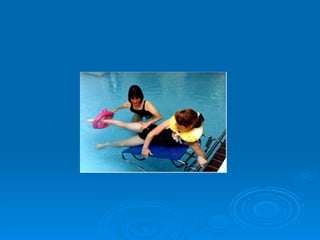
Aquatic Exercise Uses Increase circulation Increase muscle strength Increase joint ROM, flexibility Improve ambulation Improve coordination Increase cardiovascular, respiratory conditioning Decrease pain, spasm Decrease weight-bearing on joints Relaxation/ psychological well-being
Types of Aquatic Exercise Swimming Running ( with or without vest ) Walking Cycling  Stretching Underwater treadmill or parallel bars, etc.


The End

Hydrotherapy

  • 1.
    PTA 200 Modalitiesand Procedures in Physical Therapy Hydrotherapy
  • 2.
    Definition of HydrotherapyApplication of water, internally or externally, for the treatment of physical or psychological dysfunction.
  • 3.
    Types of HydrotherapyImmersion Non-Immersion
  • 4.
    Primary Use ofHydrotherapy Treatment of Wounds Enhanced Environment for exercise Pain Edema Health maintenance /disease prevention
  • 5.
    Physical Properties ofWater High Specific Heat & Thermal Conductivity Transfers heat by Conduction and Convection Can be used as superficial heating and cooling agent
  • 6.
    Physical Properties ofWater Specific Heat 4 times that of air Water retains 4x as much thermal energy as an equivalent mass of air Thermal Conductivity 25 x air Water transfers thermal energy 25 x more rapidly than air ( at the same temperature )
  • 7.
    Physical Properties ofWater Transfers heat rapidly, efficiently Advantage of exercising patient in pool colder than patient’s body temperature. Immersion dissipates heat generated by exertion
  • 8.
    Physical Properties ofWater Water that is stationary transfers heat by Conduction . Moving water transfers heat by Conduction and Convection . Heating (WP) accelerated with increased agitation of water. Cooling (swimming) accelerated as patient moves more quickly through water.
  • 9.
    Physical Properties ofWater Buoyancy A force experienced as an upward thrust on the body in the opposite direction to the force of gravity Archimedes Principle When a body is entirely or partially immersed in a fluid at rest.. it experiences an upward thrust equal to weight of fluid it displaces. Principle used for volumetric measurements
  • 10.
    Archimedes Principle Amountof fluid depends on density of body relative to density of fluid. If density of body less than density of fluid, it will displace a smaller volume of fluid (Floats) Opposite also true If density of body further decreased ( adding salt to water or air-filled objects at rest ), Body will float higher
  • 11.
    Clinical Uses ofBuoyancy Decrease stress and compression to body tissues ( weight-bearing surfaces ) Assist weak muscles
  • 12.
    Physical Properties ofWater Resistance Viscosity of water provides resistance to motion Resistance occurs against direction of motion Resistance increases proportional to… Speed Frontal area of body part in contact with water Varying resistance ( and pressure ) can be beneficial in debriding and cleansing wounds
  • 13.
    Physical Properties ofWater Hydrostatic Pressure Pressure exerted by fluid on body immersed in fluid. Pascal’s Law A fluid exerts equal pressure on all surfaces of a body at rest, at a given depth… This pressure increases in proportion to depth of fluid
  • 14.
    Hydrostatic Pressure Water= 0.73 mmHg/cm of depth (22.4 mmHg/ft) Patient upright Pressure on distal extremities > proximal extremities Hydrostatic pressure at patient’s feet… 4 ft of water = 89.6 mmHg
  • 15.
    Hydrostatic Pressure Water can have similar effect as compression devices/ bandages Helpful in decreasing edema If limb in dependent position, counteracts this effect Greatest effects of hydrostatic pressure occur in vertical position NO hydrostatic pressure effects with non-immersion hydrotherapy
  • 16.
  • 17.
    Physiological Effects Cleansing Pressure (Force = Rate of Flow) Dissolved antimicrobial agents, etc. ( Wounds ) Musculoskeletal Effects Decreases weight-bearing ( Arthritis ) 75% immersion WB 75% Increases blood flow to muscles Strengthening
  • 18.
    Physiological Effects Decreased bone density loss Decreased fat loss Compared to other forms of exercise Good for obese secondary to non-weight bearing exercise Not good for general weight loss
  • 19.
    Cardiovascular Effects Increasedvenous circulation Secondary to hydrostatic pressure, increased venous pressure Increased cardiac volume Increased cardiac output Up to 30% while upright to neck Decreases HR and Systolic BP ( cool water ) May increase in warm or hot water
  • 20.
    Respiratory Effects Increaseswork of breathing Due to hydrostatic pressure on lungs up to 60% May need to be very careful with respiratory and/or cardiac patients Decreases exercise-induced asthma High humidity
  • 21.
    Renal Effects Increasesurine production Increases sodium and potassium excretion May be used to patient’s advantage with hypertension, peripheral edema
  • 22.
    Psychological Effects RelaxingWarm water Invigorating Cold water
  • 23.
    Clinical Uses ofHydrotherapy
  • 24.
    Superficial Heating andCooling Advantages Even contact with skin Does not need to be fastened Allows movement of heat/cold Disadvantages Extremity often in dependent position
  • 25.
    Wound Care Cleansingproperties facilitate Rehydration Softening and debridement of necrotic tissue Removal of wound debris Hydrostatic pressure and heat increase circulation Provides moist environment to optimize healing
  • 26.
    Immersion vs. Non-ImmersionNon-immersion therapy becoming more popular Concern for increased pressure on regenerating tissues by water and turbine Potential for infection in contaminated tank WP recommended for Extensive thick exudate Slough or necrotic tissue Gross purulence Dry eschar
  • 27.
    Immersion versus Non-ImmersionDischarge all forms of hydrotherapy when wound is clean Many antimicrobial products are cytoxic to normal tissue ( unless very diluted ) Tank and turbine must be thoroughly cleaned and disinfected
  • 28.
    Non-Immersion Techniques Fluiddelivered at pressure of 4-15 psi Below this bacteria not removed Above this, wound trauma may occur, or bacteria driven into wound Saline squeeze bottle, Water Pik
  • 29.
    Non-Immersion Techniques Recommendedfor N ecrotic, nonviable tissue or debris Continue until all removed and full granulation bed present Often use both With both types, must thoroughly dry intact skin in surrounding area prevents maceration
  • 30.
    Treatment of BurnsSimilar, but burns particularly painful when debrided Wounds sometimes less deep, sensory nerves intact Monitor patient closely often high-dose analgesics Hubbard Tank for large body surface area Chance of contamination Greater loss of sodium ( add salt ) Shower (non-immersion) in early stages After re-epithelialization, water for exercise
  • 31.
    Pain Control Increasedsensory stimulation to peripheral mechanoreceptors Gait Theory Cold water decreases inflammation Decreases weight-bearing, increases “ease of movement”.
  • 32.
    Edema Control Hydrostaticpressure Cool water Vasoconstriction Decreased vascular permeability Hot water increases edema Increased arterial blood flow, increased vasodilation.
  • 33.
    Edema Control Contrast Baths “ Trains” smooth muscles of blood vessel; vasoconstriction/vasodilation. No research to solidly support
  • 34.
  • 35.
    Contraindications, Local Immersion Maceration Increased maceration, increased size of wound Bleeding In or near the area
  • 36.
    Precautions, Local Immersion Impaired thermal sensation Check temperature of water with thermometer first Infection Universal Precautions Clean WP Confusion, impaired cognition Use constant, direct supervision Temperature of water near body temperature Recent Skin Grafts Direct agitator away from graft. Neutral or mild warmth (96 - 98 0 F)
  • 37.
    Contraindications, Full Body Immersion Cardiac instability Uncontrolled hypertension or heart failure Infectious conditions that spread with water UTI’s, plantar warts, tinea pedis ( pool ) Bowel or bladder incontinence Use non-immersion techniques Severe epilepsy Increased risk of drowning Suicidal patients Increased risk of drowning
  • 38.
    Precautions, Full Body Immersion Confusion, Disorientation Keep head above water Constant supervision Low temperature After ingestion of alcohol Hypotensive effects Drowning Patients with limited strength, endurance, balance, ROM Hands-on approach required
  • 39.
    Precautions, Full Body Immersion Patients on medications Physician clearance sometimes required Patients with fear of water Patients with respiratory problems Watch for signs of respiratory distress, especially in hot or very warm water
  • 40.
    Precautions, Full Body Immersion Patients that are Pregnant 1st trimester ( maternal hyperthermia ) Use normal water temperature Can be very good therapeutic intervention Patients with MS Temperature >88 0 F may cause increase fatigue, weakness. Patients with poor thermal regulation Elderly, infants
  • 41.
    Precautions, Non-Immersion Hydrotherapy Maceration Ineffectiveness Drowning
  • 42.
    Adverse Effects ofHydrotherapy Burns, Fainting, Bleeding Check with thermometer, and gloved hand Hypotension Immersion in warm/hot water, hypertension medications Hyponatremia ( burns ) Increased edema Use of hot water Dependent positioning
  • 43.
  • 44.
    Application, General RulesAssess problem and set goals of treatment Determine if most appropriate treatment Make sure no contraindications Select appropriate form of hydrotherapy Whirlpool Hubbard Tank Contrast bath Non-immersion device Pool Explain the procedure, purpose, sensations Apply appropriate form of hydrotherapy Assess outcome Document
  • 45.
    Selection of HydrotherapyBase decision on Desired effects Size of area to be treated Allowance for safety, control of infection Cost-effectiveness
  • 46.
    Whirlpool Tanks Low-BoyHigh-Boy Extremity Hubbard Tank
  • 47.
    Whirlpool Turbine AgitatorAdjustable height, direction, aeration. Should be grounded Do NOT run without water in tank.
  • 48.
  • 49.
  • 50.
  • 51.
    Temperature Range Cold (32-79 0 F) Acute inflammation Tepid (79-92 0 F) Exercise Acute inflammation if cold not tolerated Neutral warmth (92-96 0 F) Open wound Medically compromised patients Decrease tone
  • 52.
    Temperature Range Mildwarmth (96-98 0 ) Increase mobility Burn Hot (99-104 0 ) Pain, Increase ROM Increase soft tissue extensibility Very Hot (104-110 0 ) Limited body area Chronic conditions DO NOT use WP at temperatures > 110 0 F !!
  • 53.
    Hubbard Tank 8feet long x 6 feet wide, 4 feet deep 425 gallons water Turbines, stretcher, hoist Expensive secondary to amount of water, time to clean
  • 54.
    Contrast Bath Alternateimmersion (distal) First warm/hot water, then cool/cold water Uses Decrease edema Pain relief Decrease sensitivity (desensitize)
  • 55.
  • 56.
    Application, Pool Temperature79 - 97 0 Never below 65 0 Impairs muscles ability to contract
  • 57.
    Cleaning, WP/Hubbard TankWear gloves, goggles, gown Drain tank Rinse with clean water Scrub tank with brush and detergent and rinse again Disinfect Tank
  • 58.
    Disinfecting the TankLevels of disinfection Low level Intact skin 70-90% ethyl alcohol, sodium hypochloride bleach germicidal solution Intermediate Level 70-90% ethyl alcohol phenolic germicidal detergent High Level Chlorine-based products Can corrode tank
  • 59.
    Disinfecting the TankChange disinfectant periodically to decrease risk of resistant strains Fill tank Add solution ( hot water ) expose all inside surfaces x 10 minutes Clean and disinfect turbine, bucket with water/detergent x 5 minutes bucket with disinfectant x 10 minutes
  • 60.
    Disinfecting the TankDrain tank Rinse with clean water Dry thoroughly with towels Culture tank, turbines, drains, and water supply periodically
  • 61.
  • 62.
    Aquatic Exercise UsesIncrease circulation Increase muscle strength Increase joint ROM, flexibility Improve ambulation Improve coordination Increase cardiovascular, respiratory conditioning Decrease pain, spasm Decrease weight-bearing on joints Relaxation/ psychological well-being
  • 63.
    Types of AquaticExercise Swimming Running ( with or without vest ) Walking Cycling Stretching Underwater treadmill or parallel bars, etc.
  • 64.
  • 65.
  • 66.
  • 67.
  • 68.