Erycha       Alexis
Victoria   Sharetha
• ANATOMY: branch of science dealing with the form and
  structure of body parts (structures that can be seen with
  the naked eye)
• PHYSIOLOGY: study of body functions; can be
  approached from a cellular, organismal, or systems point
  of view
• Organization: molecules combine together to form organelles.
  Organelles form cells. Cells form tissues. Tissues form organs.
  Organs form organ cells. And organ cells form organ systems
• Cellular composition: living matter is compartmentalized into
  one or more cells
• Biochemical unity: living things have a universal chemical
  composition that is rare in nonliving matter. This includes DNA,
  proteins, lipids and carbs
• Metabolism: living things use molecules from the environment
  and chemically change them into molecules that form their
  own structures, control their own physiology, or provide them
  with energy. Metabolism is the sum of all this internal change.
• Reproduction: production of offspring
• Responsiveness: the ability of organisms to sense and
  react to stimuli changes in the environment.
• Stability: living organisms maintain a relatively stability
  internal environment while the surrounding environment
  continuously changes.
• Development: a change in form or function over the
  lifetime of the organism
• Growth: an increase in size through chemical change
• Evolution: genetic changes passed from generation to
  generation
• The body can be considered conceptually at seven structural
  levels: chemicals (atom, molecule, macromolecules, organelle
  , cell, tissue, organ, organ system, and complete organism).
• Chemical: interactions between atoms and their combination
  into molecules
• Organelles: microscopic structures in the cell, composed of
  molecules that are specialized to carry out functions of the
  cell.
• Cells: the basics units of living organisms. Cells are organized
  into tissues ( skin cells, nerve cells, and red blood cells)
• Tissues: a group of cells with similar structure and function,
  together with the extra cellular substances located between
  them
• Organ composed of two or more tissue types
• Organ systems: groups of organs with a unique collective
  function
• Organism: a single complete individual
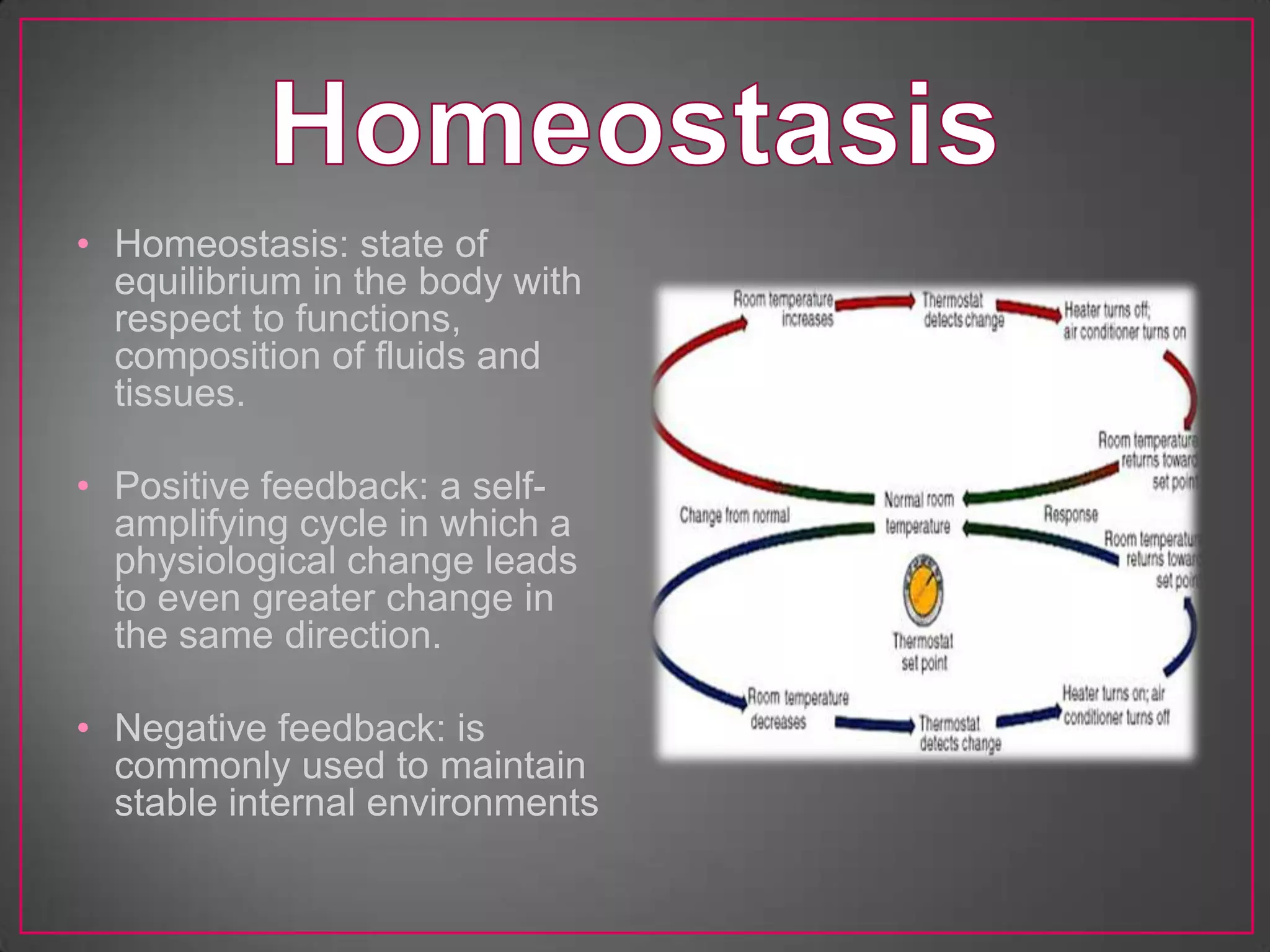
• Homeostasis: state of
  equilibrium in the body with
  respect to functions,
  composition of fluids and
  tissues.

• Positive feedback: a self-
  amplifying cycle in which a
  physiological change leads
  to even greater change in
  the same direction.

• Negative feedback: is
  commonly used to maintain
  stable internal environments
•   Ventral (toward the belly)
•   Dorsal (toward the back)
•   Anterior (front)
•   Posterior (back)
•   Superior (above)
•   Inferior (below)
•   Medial (toward the midsagittal plane)
•   Lateral (away from the midsagittal plane)
•   Proximal (near the point of attachment orgin)
•   Distal (farther from the point of attachment orgin)
•   Central (toward the middle of the body)
•   Peripheral (away from the midline of the body)
•   Superficial (near the surface)
•   Deep (farther from the surface)
• Sagittal- refers to a cut that divides the body from left to
  right
• Midsagittal or Median- refers to a sagittal line through the
  midline of the body and divides it equally
• Transverse- refers to a horizontal cut that divides the
  body Superior (toward the head) and Inferior (toward the
  feet)
• Coronal or Frontal- refers to a cut that divides the body
  anterior (front) and posterior (back)
• Parasagittal- refers to a section that is parallel to the
  midsagittal but either on the left or right side and causes
  uneven left and right parts.
• Otic (ear)                • Abdominal (Abdomen)
• Nasal (Nose)              • Genital (Reproductive
• Oral (Mouth)                organs)
• Cervical (Neck)           • Carpal (wrist)
• Acromial (Should point)   • Palmar (Palm)
• Axillary (Armpit)         • Digital (Finger)
• Mammary (Breast)          • Tarsal (Ankle)
• Brachial (Arm)            • Cephalic (Head)
• Antecubital (Front of     • Frontal (Forehead)
  elbow)                    • Orbital (Eye cavity)
• Antebrachial (Forearm)    • Buccal (Cheek
                            • Mental (Chin)
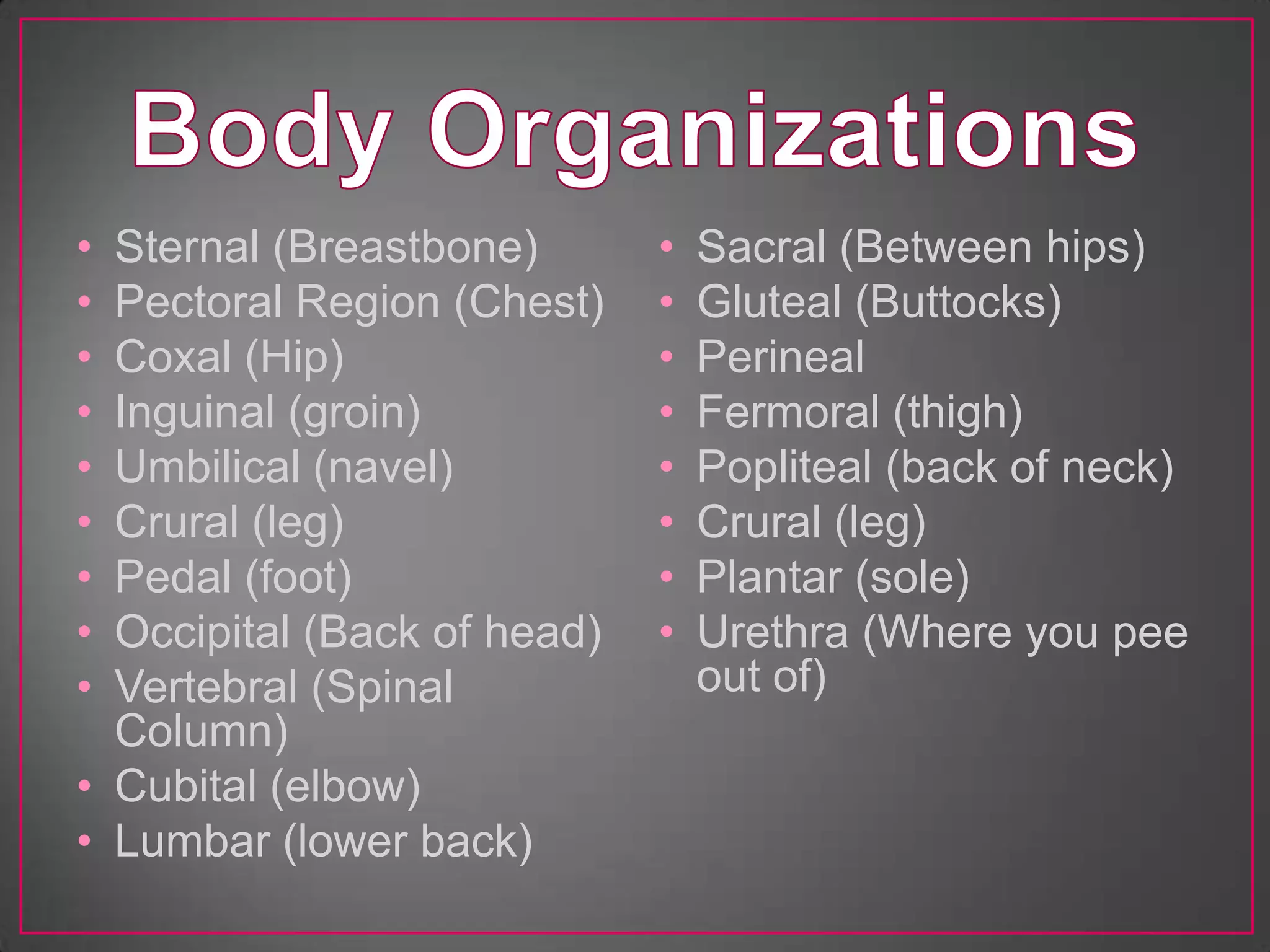
• Sternal (Breastbone)       •   Sacral (Between hips)
• Pectoral Region (Chest)    •   Gluteal (Buttocks)
• Coxal (Hip)                •   Perineal
• Inguinal (groin)           •   Fermoral (thigh)
• Umbilical (navel)          •   Popliteal (back of neck)
• Crural (leg)               •   Crural (leg)
• Pedal (foot)               •   Plantar (sole)
• Occipital (Back of head)   •   Urethra (Where you pee
• Vertebral (Spinal              out of)
  Column)
• Cubital (elbow)
• Lumbar (lower back)

Where is it

  • 1.
    Erycha Alexis Victoria Sharetha
  • 2.
    • ANATOMY: branchof science dealing with the form and structure of body parts (structures that can be seen with the naked eye) • PHYSIOLOGY: study of body functions; can be approached from a cellular, organismal, or systems point of view
  • 3.
    • Organization: moleculescombine together to form organelles. Organelles form cells. Cells form tissues. Tissues form organs. Organs form organ cells. And organ cells form organ systems • Cellular composition: living matter is compartmentalized into one or more cells • Biochemical unity: living things have a universal chemical composition that is rare in nonliving matter. This includes DNA, proteins, lipids and carbs • Metabolism: living things use molecules from the environment and chemically change them into molecules that form their own structures, control their own physiology, or provide them with energy. Metabolism is the sum of all this internal change. • Reproduction: production of offspring
  • 4.
    • Responsiveness: theability of organisms to sense and react to stimuli changes in the environment. • Stability: living organisms maintain a relatively stability internal environment while the surrounding environment continuously changes. • Development: a change in form or function over the lifetime of the organism • Growth: an increase in size through chemical change • Evolution: genetic changes passed from generation to generation
  • 5.
    • The bodycan be considered conceptually at seven structural levels: chemicals (atom, molecule, macromolecules, organelle , cell, tissue, organ, organ system, and complete organism). • Chemical: interactions between atoms and their combination into molecules • Organelles: microscopic structures in the cell, composed of molecules that are specialized to carry out functions of the cell. • Cells: the basics units of living organisms. Cells are organized into tissues ( skin cells, nerve cells, and red blood cells) • Tissues: a group of cells with similar structure and function, together with the extra cellular substances located between them • Organ composed of two or more tissue types • Organ systems: groups of organs with a unique collective function • Organism: a single complete individual
  • 6.
    • Homeostasis: stateof equilibrium in the body with respect to functions, composition of fluids and tissues. • Positive feedback: a self- amplifying cycle in which a physiological change leads to even greater change in the same direction. • Negative feedback: is commonly used to maintain stable internal environments
  • 7.
    Ventral (toward the belly) • Dorsal (toward the back) • Anterior (front) • Posterior (back) • Superior (above) • Inferior (below) • Medial (toward the midsagittal plane) • Lateral (away from the midsagittal plane) • Proximal (near the point of attachment orgin) • Distal (farther from the point of attachment orgin) • Central (toward the middle of the body) • Peripheral (away from the midline of the body) • Superficial (near the surface) • Deep (farther from the surface)
  • 8.
    • Sagittal- refersto a cut that divides the body from left to right • Midsagittal or Median- refers to a sagittal line through the midline of the body and divides it equally • Transverse- refers to a horizontal cut that divides the body Superior (toward the head) and Inferior (toward the feet) • Coronal or Frontal- refers to a cut that divides the body anterior (front) and posterior (back) • Parasagittal- refers to a section that is parallel to the midsagittal but either on the left or right side and causes uneven left and right parts.
  • 9.
    • Otic (ear) • Abdominal (Abdomen) • Nasal (Nose) • Genital (Reproductive • Oral (Mouth) organs) • Cervical (Neck) • Carpal (wrist) • Acromial (Should point) • Palmar (Palm) • Axillary (Armpit) • Digital (Finger) • Mammary (Breast) • Tarsal (Ankle) • Brachial (Arm) • Cephalic (Head) • Antecubital (Front of • Frontal (Forehead) elbow) • Orbital (Eye cavity) • Antebrachial (Forearm) • Buccal (Cheek • Mental (Chin)
  • 10.
    • Sternal (Breastbone) • Sacral (Between hips) • Pectoral Region (Chest) • Gluteal (Buttocks) • Coxal (Hip) • Perineal • Inguinal (groin) • Fermoral (thigh) • Umbilical (navel) • Popliteal (back of neck) • Crural (leg) • Crural (leg) • Pedal (foot) • Plantar (sole) • Occipital (Back of head) • Urethra (Where you pee • Vertebral (Spinal out of) Column) • Cubital (elbow) • Lumbar (lower back)