Introduction
                  • Click on the question
                    marks to reveal the
                    answer.
Marchelle Davis   • Click BACK to go to the
Courtney Zuber      list of words
Nicole Coetzer    • Click NEXT to go to the
                    next topic
Madison Hall
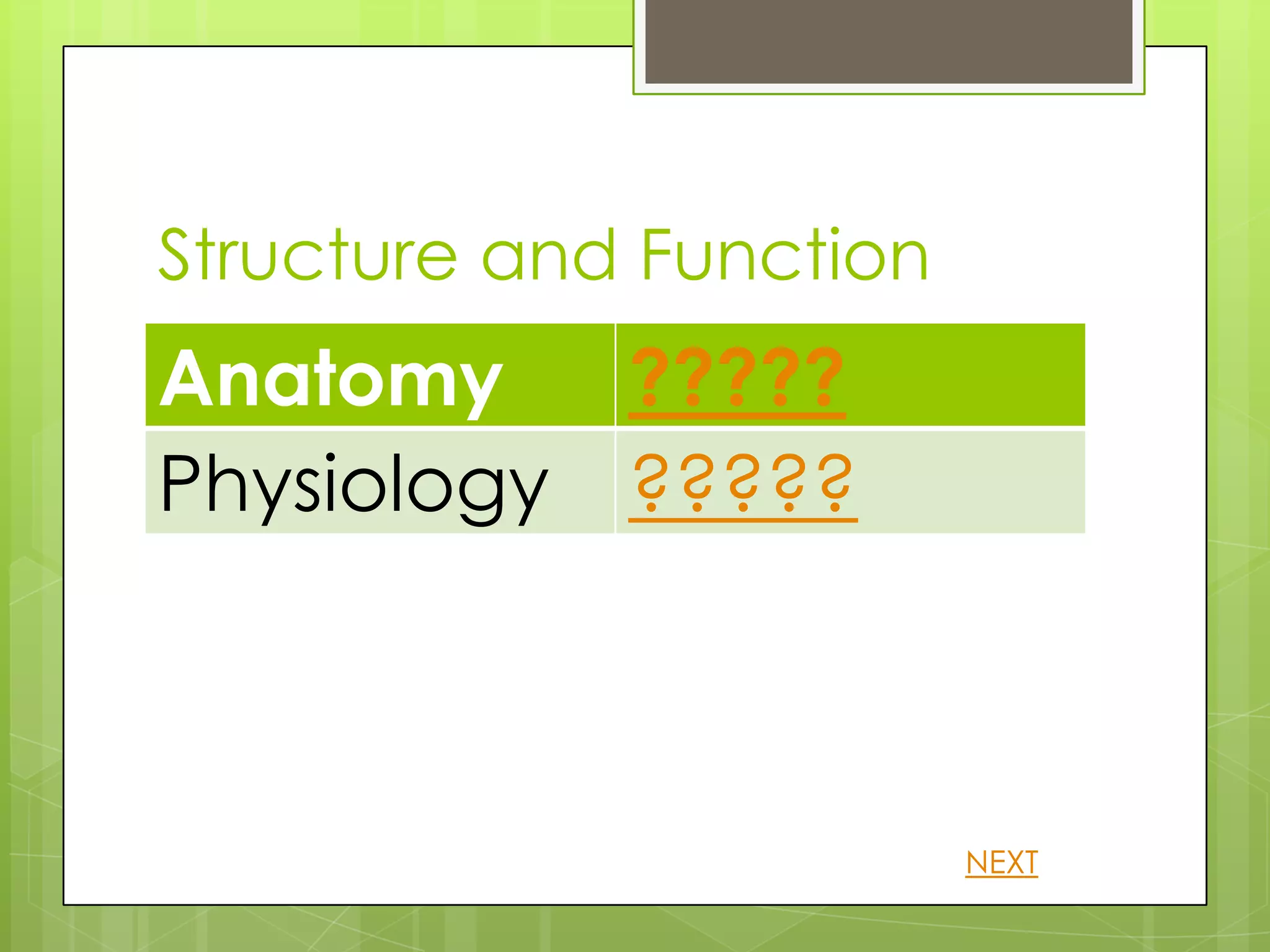
Structure and Function
Anatomy      ?????
Physiology   ?????


                         NEXT
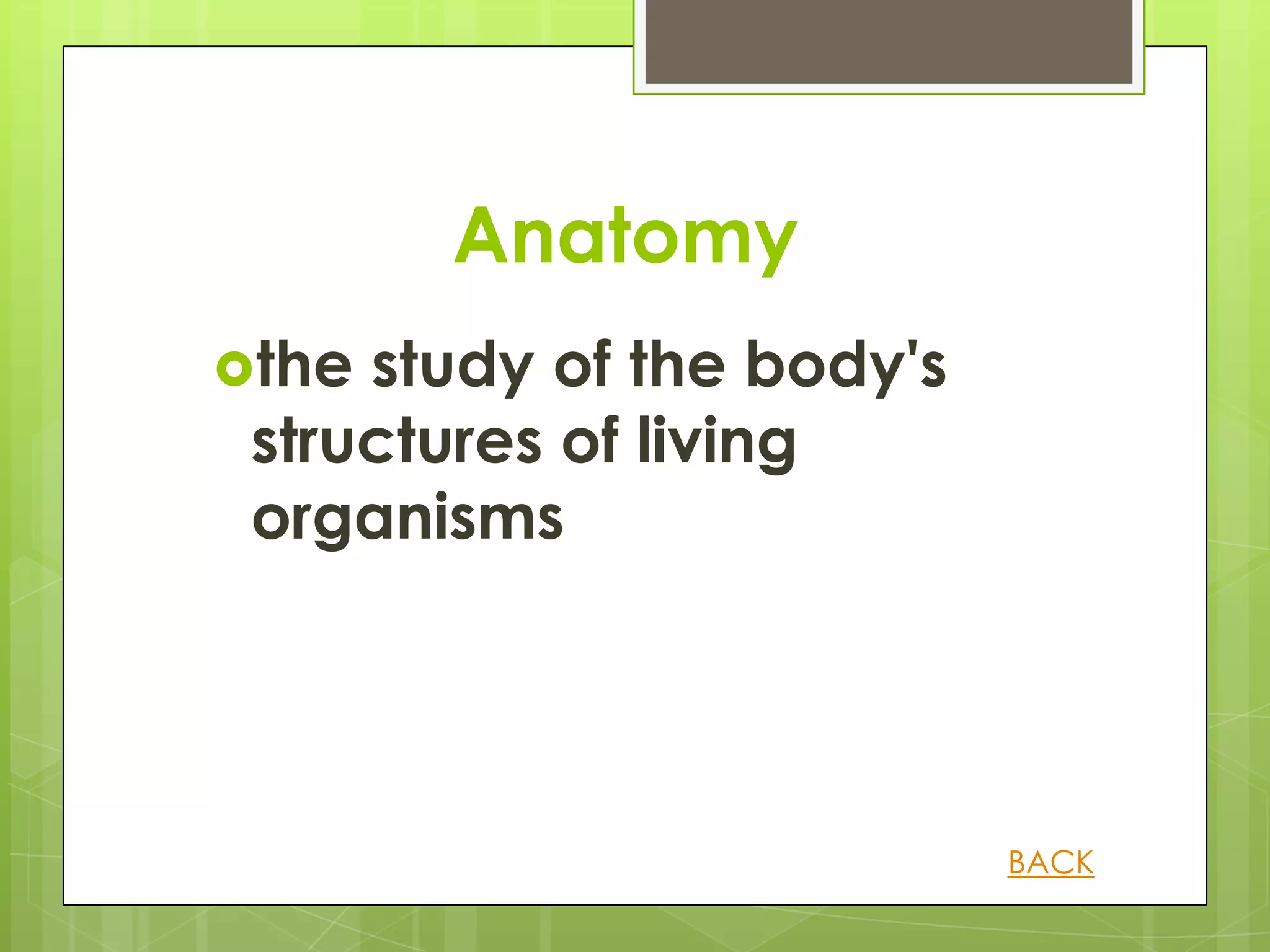
Anatomy
the study of the body's
 structures of living
 organisms


                           BACK
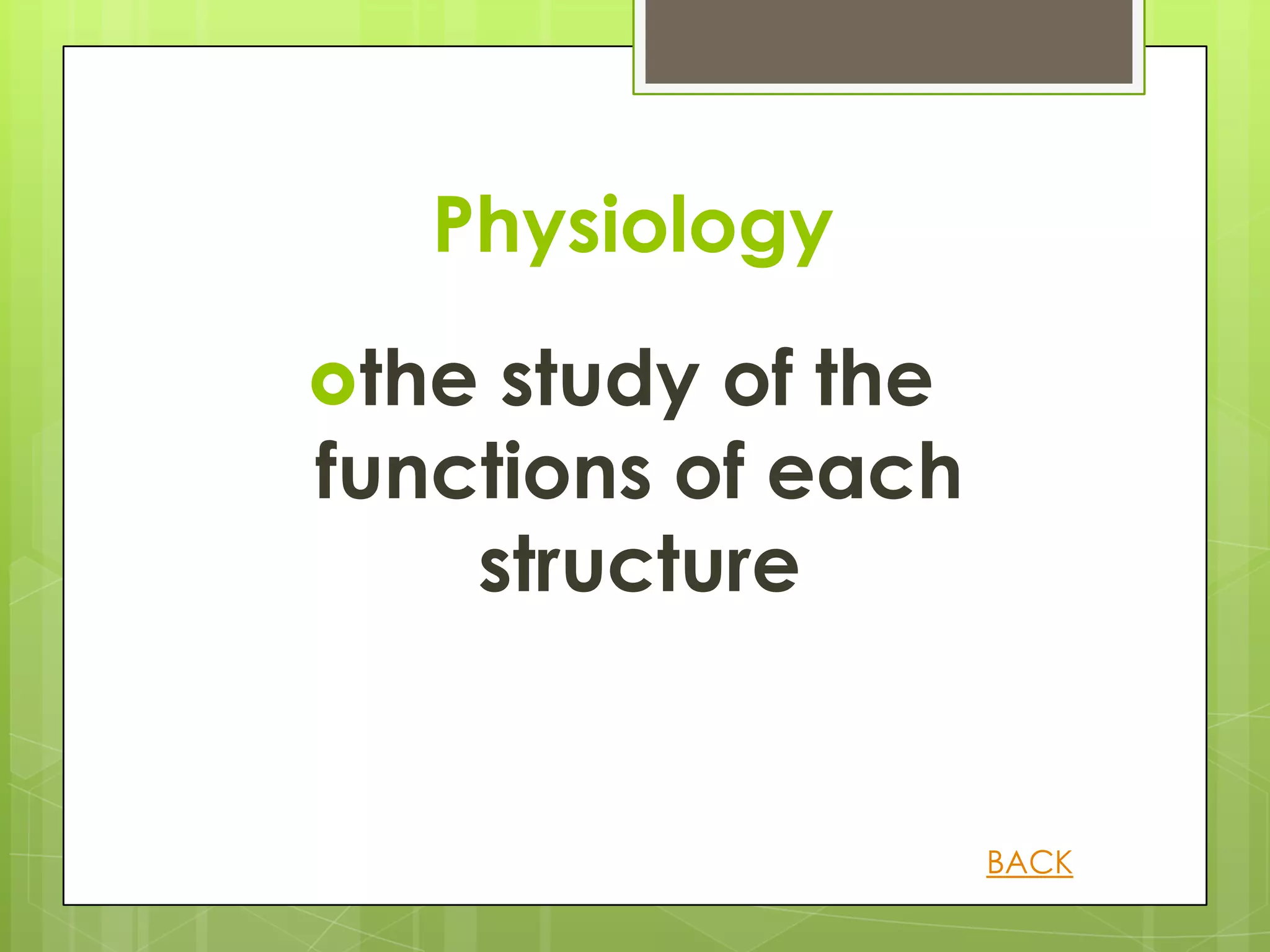
Physiology
the study of the
functions of each
    structure


                    BACK
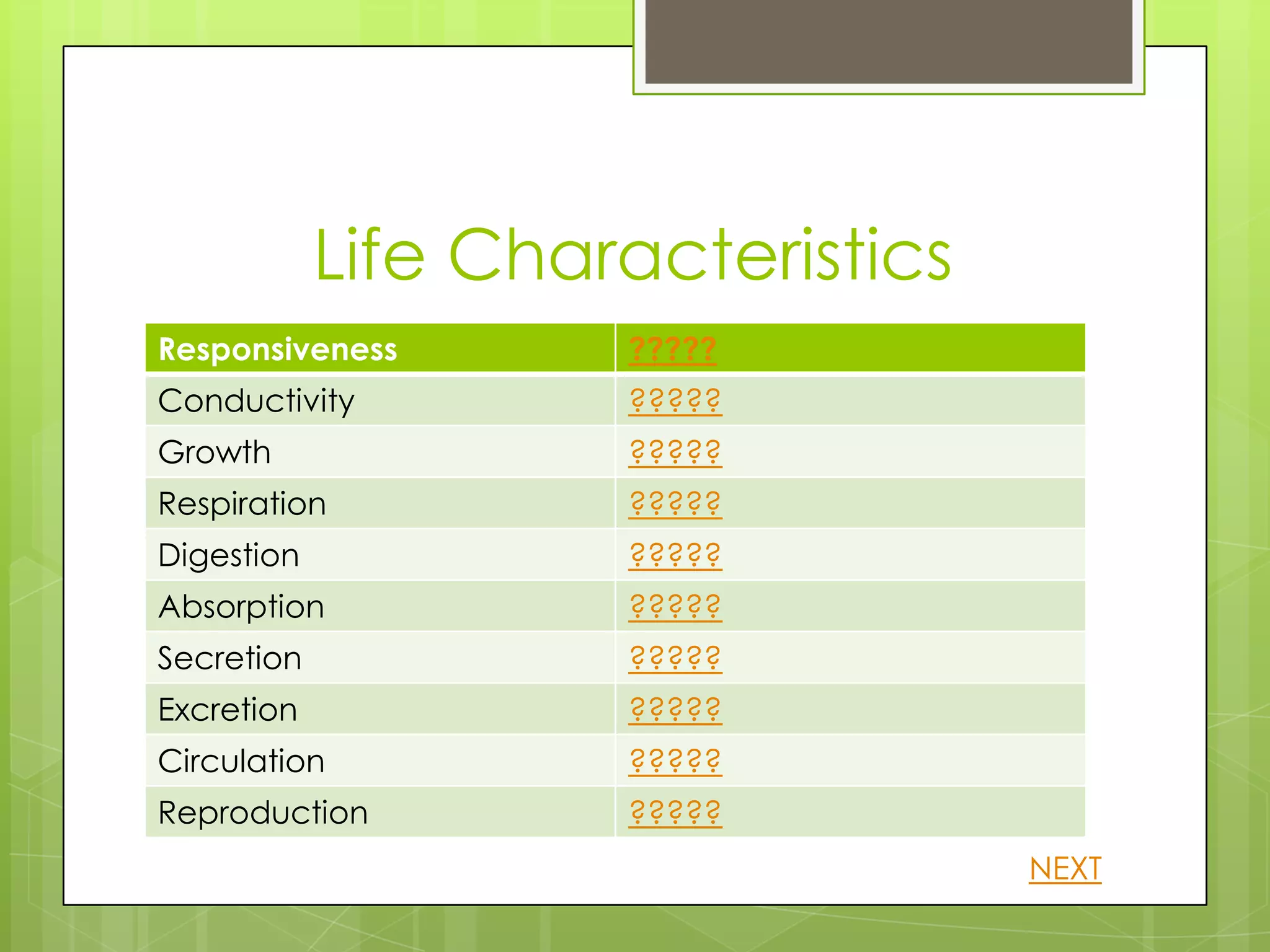
Life Characteristics
Responsiveness       ?????
Conductivity         ?????
Growth               ?????
Respiration          ?????
Digestion            ?????
Absorption           ?????
Secretion            ?????
Excretion            ?????
Circulation          ?????
Reproduction         ?????
                                   NEXT
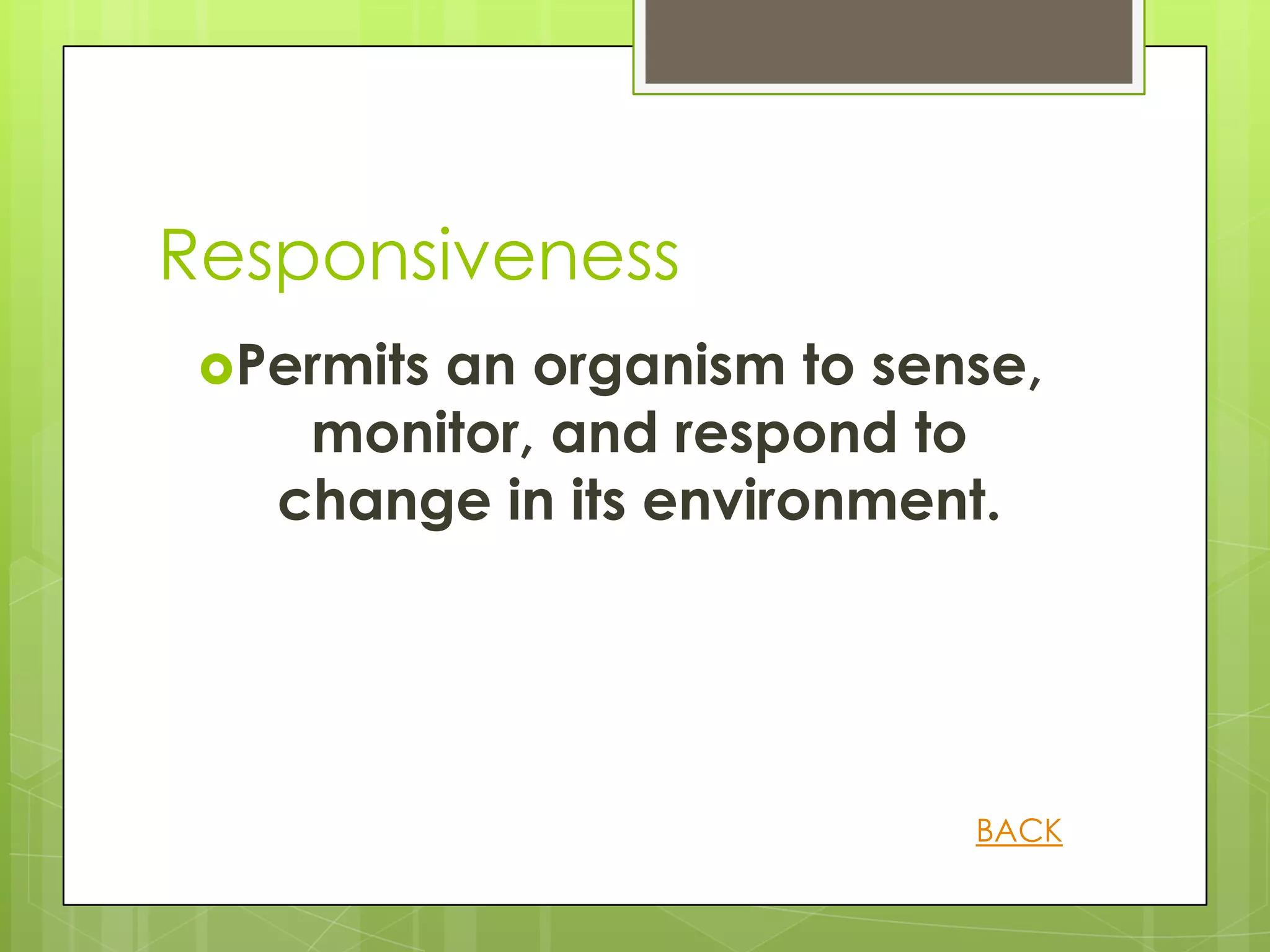
Responsiveness
 Permits
        an organism to sense,
    monitor, and respond to
   change in its environment.


                          BACK
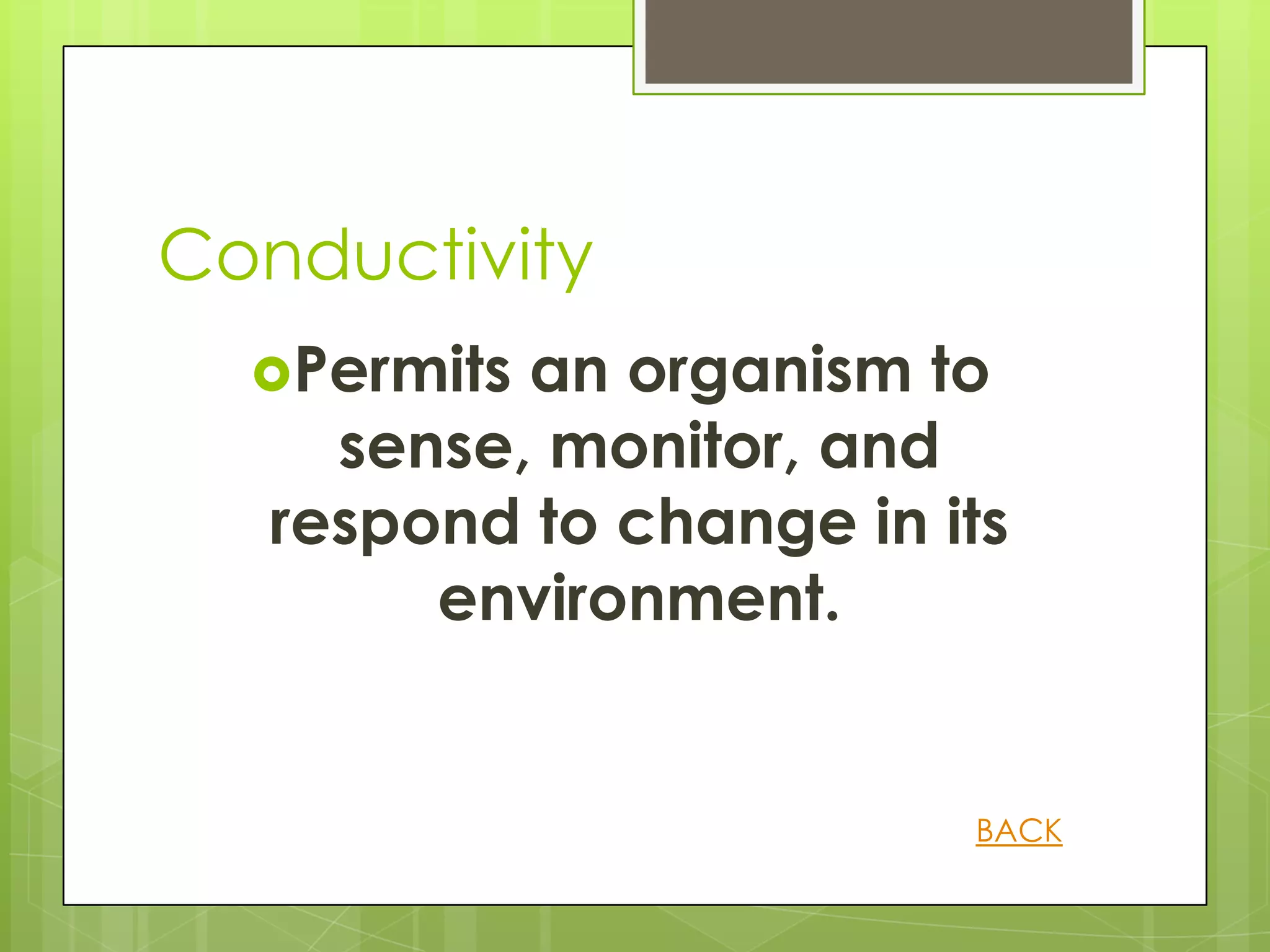
Conductivity
  Permits an organism to
     sense, monitor, and
   respond to change in its
        environment.


                         BACK
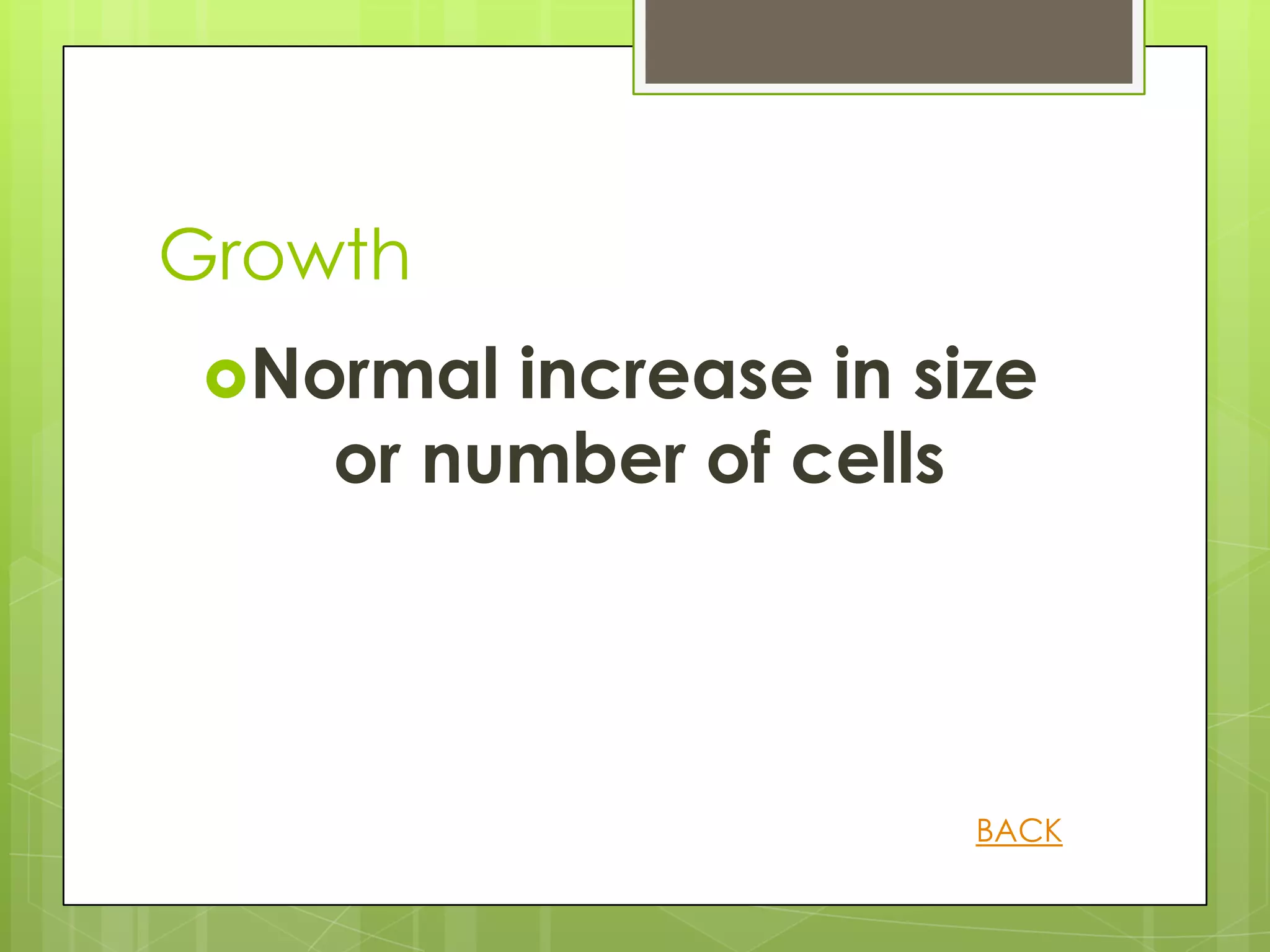
Growth
 Normal increase in size
    or number of cells


                       BACK
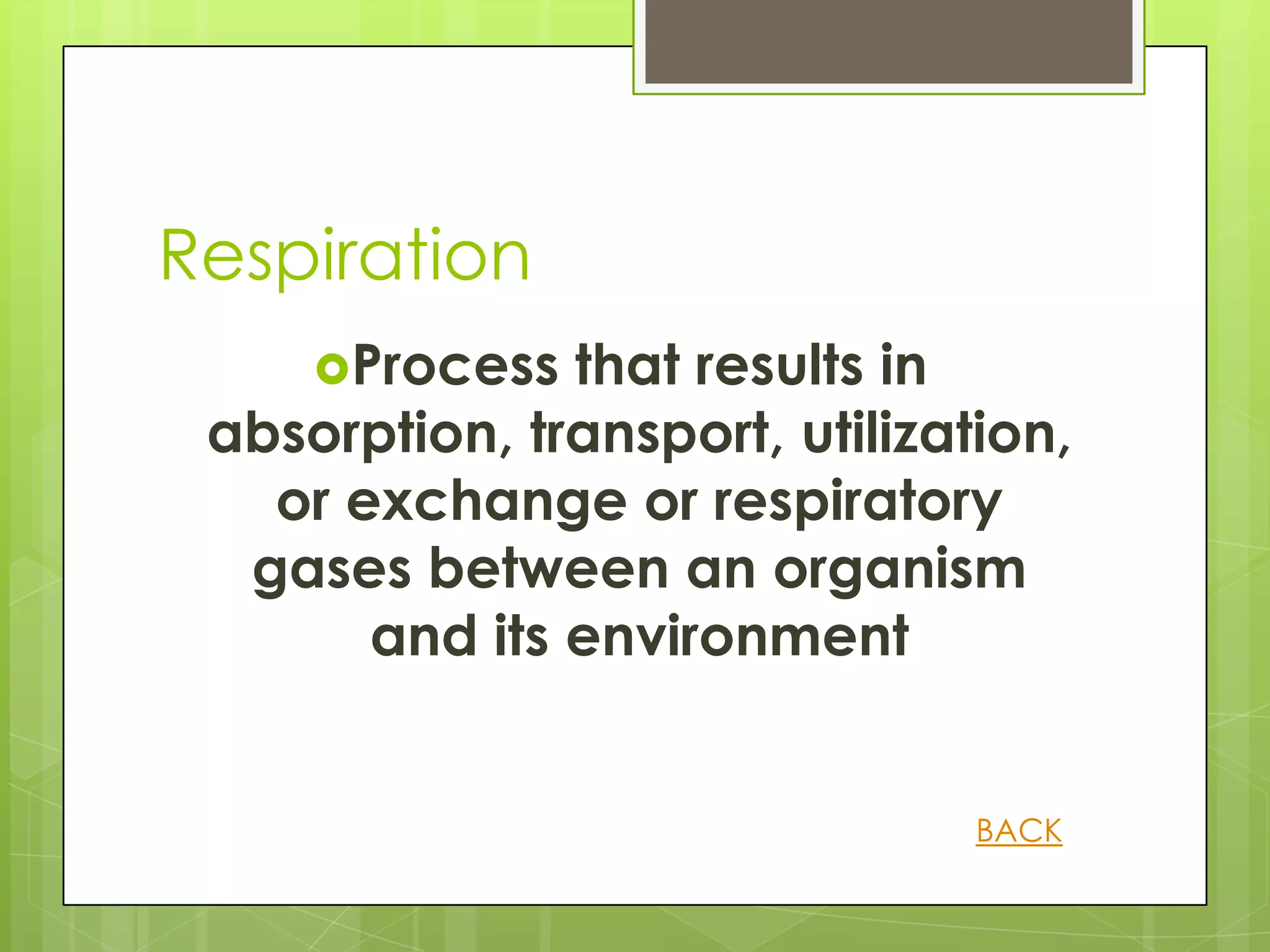
Respiration
     Process  that results in
 absorption, transport, utilization,
   or exchange or respiratory
  gases between an organism
       and its environment


                                BACK
Digestion
  Process by which complex
   food products are broken
  down into simpler substances


                           BACK
Absorption
  Process by which complex
   food products are broken
  down into simpler substances


                           BACK
Secretion
  Production and delivery of
   specialized substances for
     diverse body functions


                            BACK
Excretion
  Removal of waste products
    produced during body
          functions


                          BACK
Circulation
 Refers   to the movement of
            body fluids


                          BACK
Reproduction
Involves   the formation of a new
              individual


                              BACK
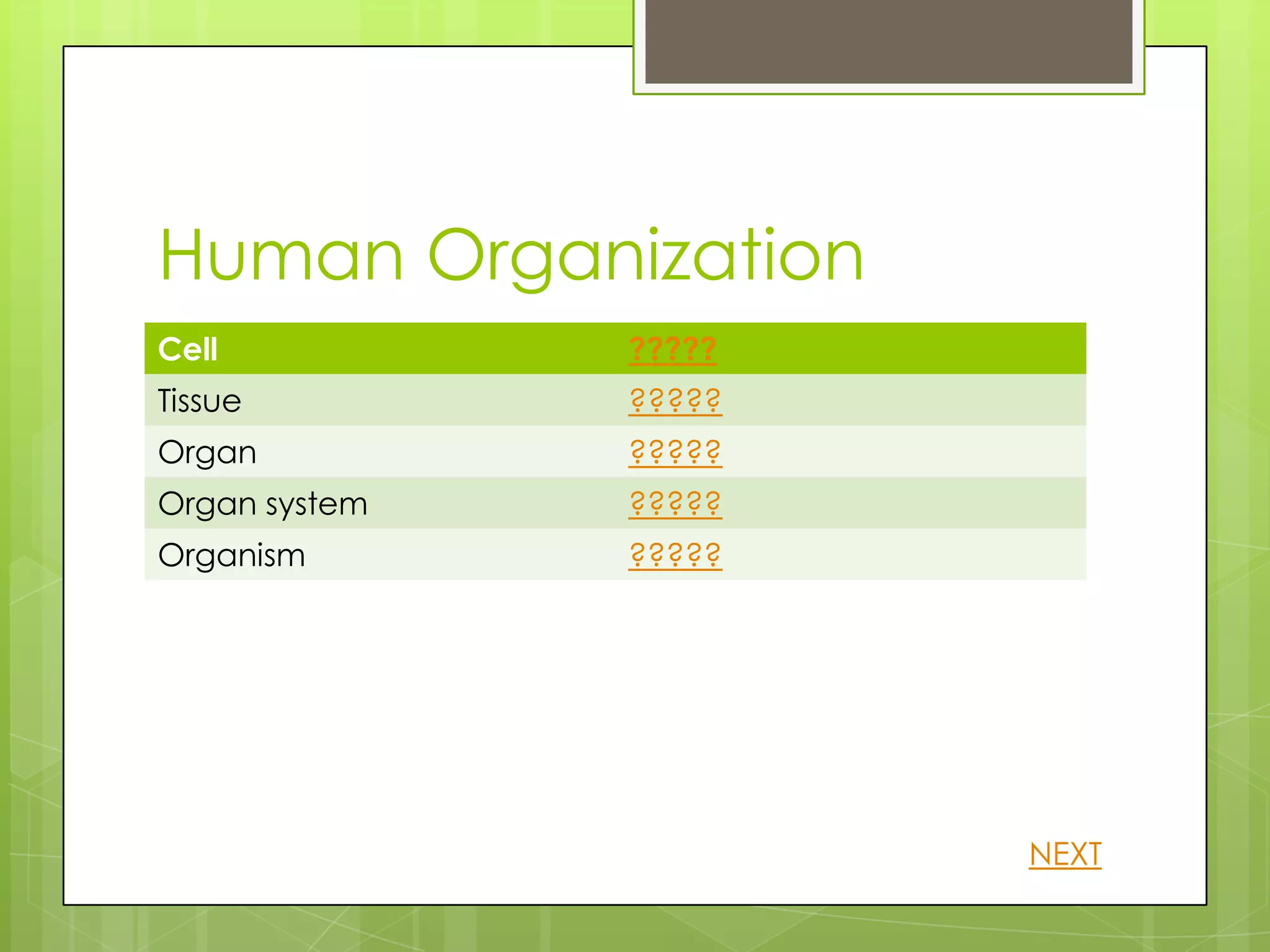
Human Organization
Cell           ?????
Tissue         ?????
Organ          ?????
Organ system   ?????
Organism       ?????


                       NEXT
Cell
 The  basic unit of structure and function in
  living things
 May serve a specific function within the
  organism
 Examples: blood cells, nervous cells, bone
  cells, etc.


                                           BACK
Tissue
 Made   up of cells that are similar in
  structure and function and which work
  together to preform a specific activity
 Humans have 4 basic tissues: connective,
  epithelial, muscle, and nerve.
 Examples: blood, nerves, bone, etc.


                                       BACK
Organ
 Made  up of tissues that work together to
  perform a specific activity
 Examples - heart, brain, skin, etc.


                                         BACK
Organ System
 Groups  of two or more tissues that work
  together to perform a specific function for
  the organism
 The human body has 11 organ systems:
  circulatory, digestive, endocrine,
  excretory,


                                          BACK
Organism
   Entire living things that can carry out all basic
    life processes. Meaning they can take in
    materials, release energy from food, release
    wastes, grow, respond to the environment,
    and reproduce.
   Usually made up of organ systems, but an
    organism may be made up of only one cell
    such as bacteria or protist.
   Examples - bacteria, amoeba, mushroom,
    sunflower, human

                                                  BACK
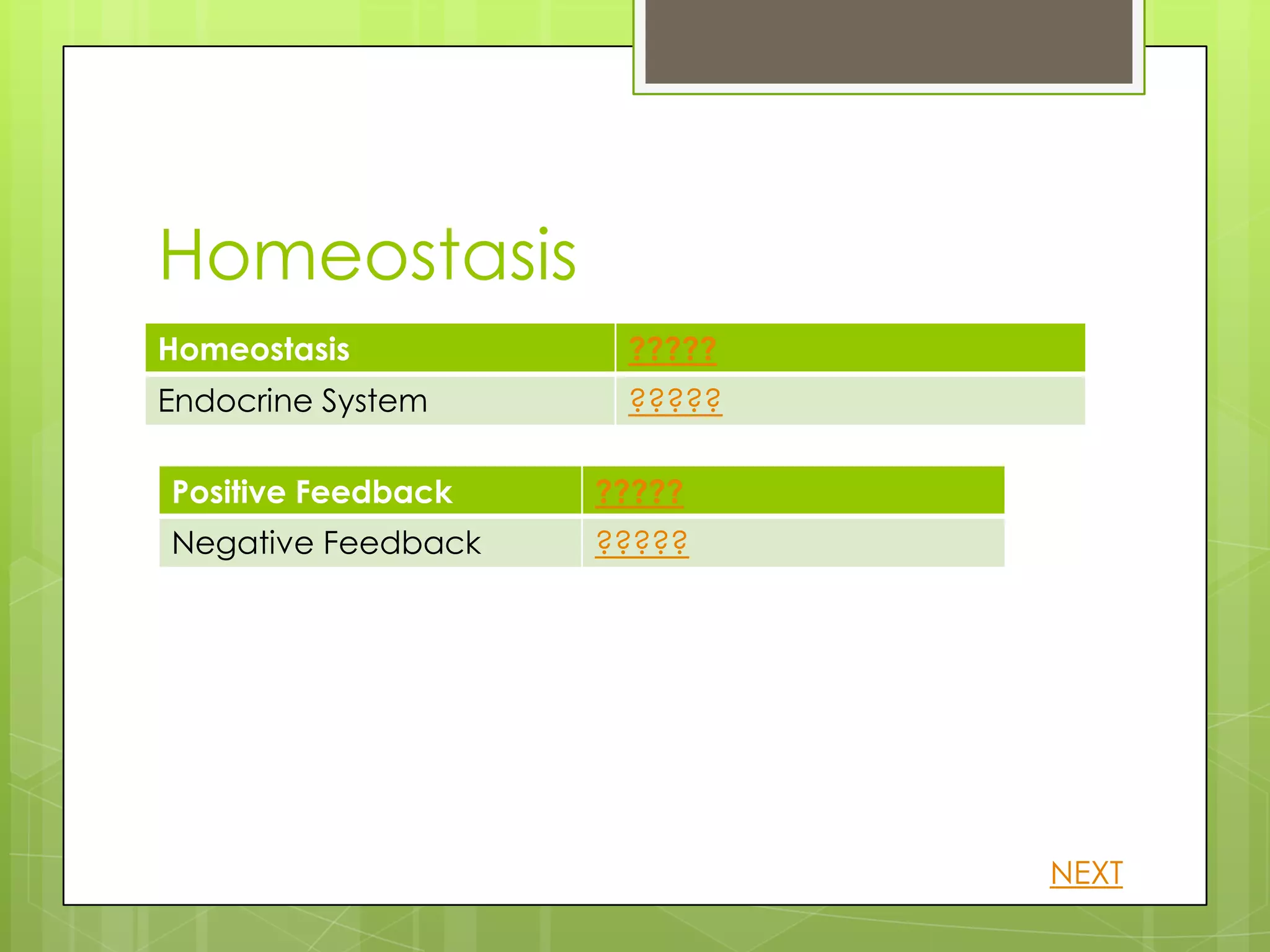
Homeostasis
Homeostasis          ?????
Endocrine System     ?????

Positive Feedback   ?????
Negative Feedback   ?????


                             NEXT
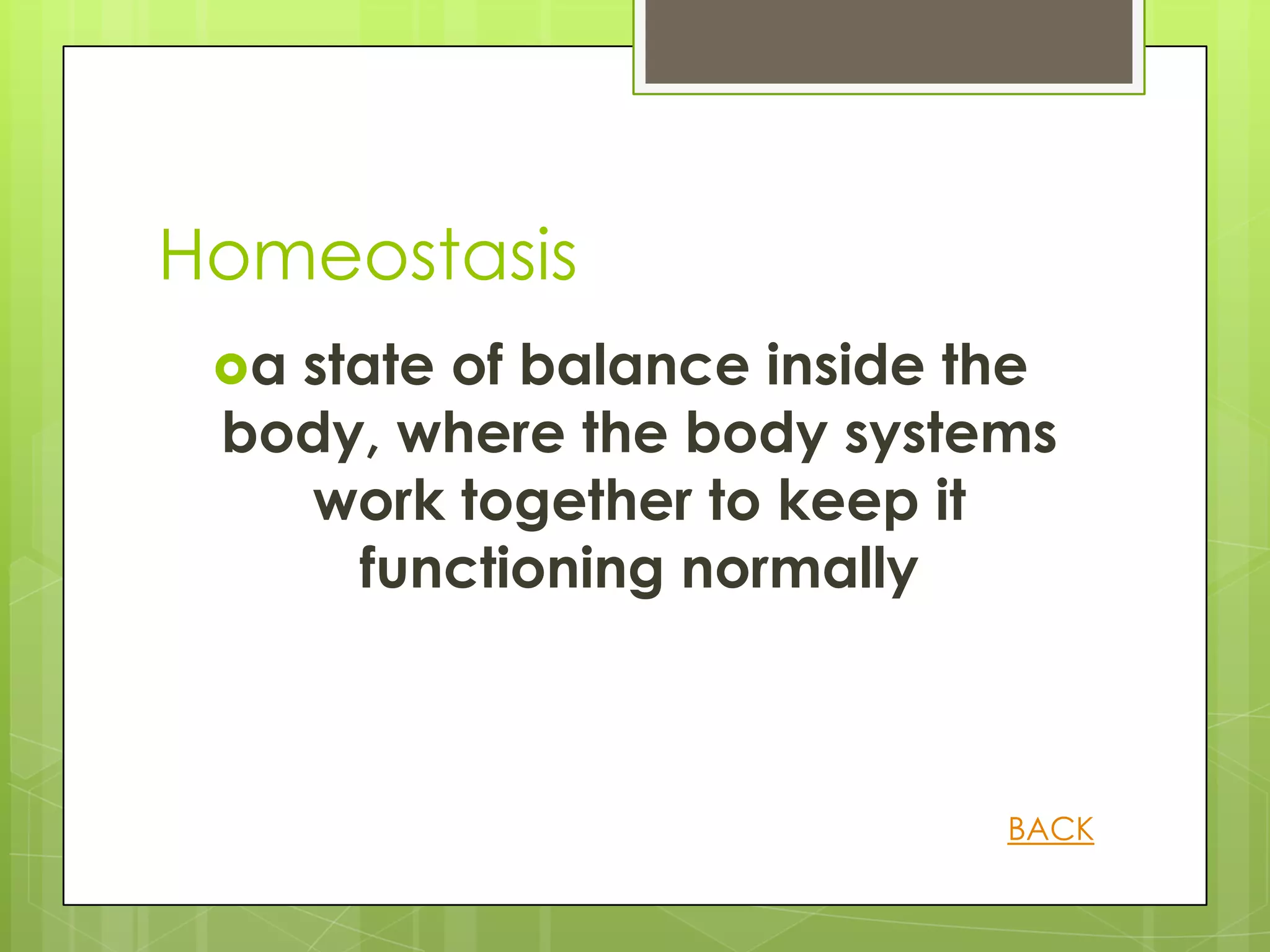
Homeostasis
 astate of balance inside the
 body, where the body systems
   work together to keep it
     functioning normally


                            BACK
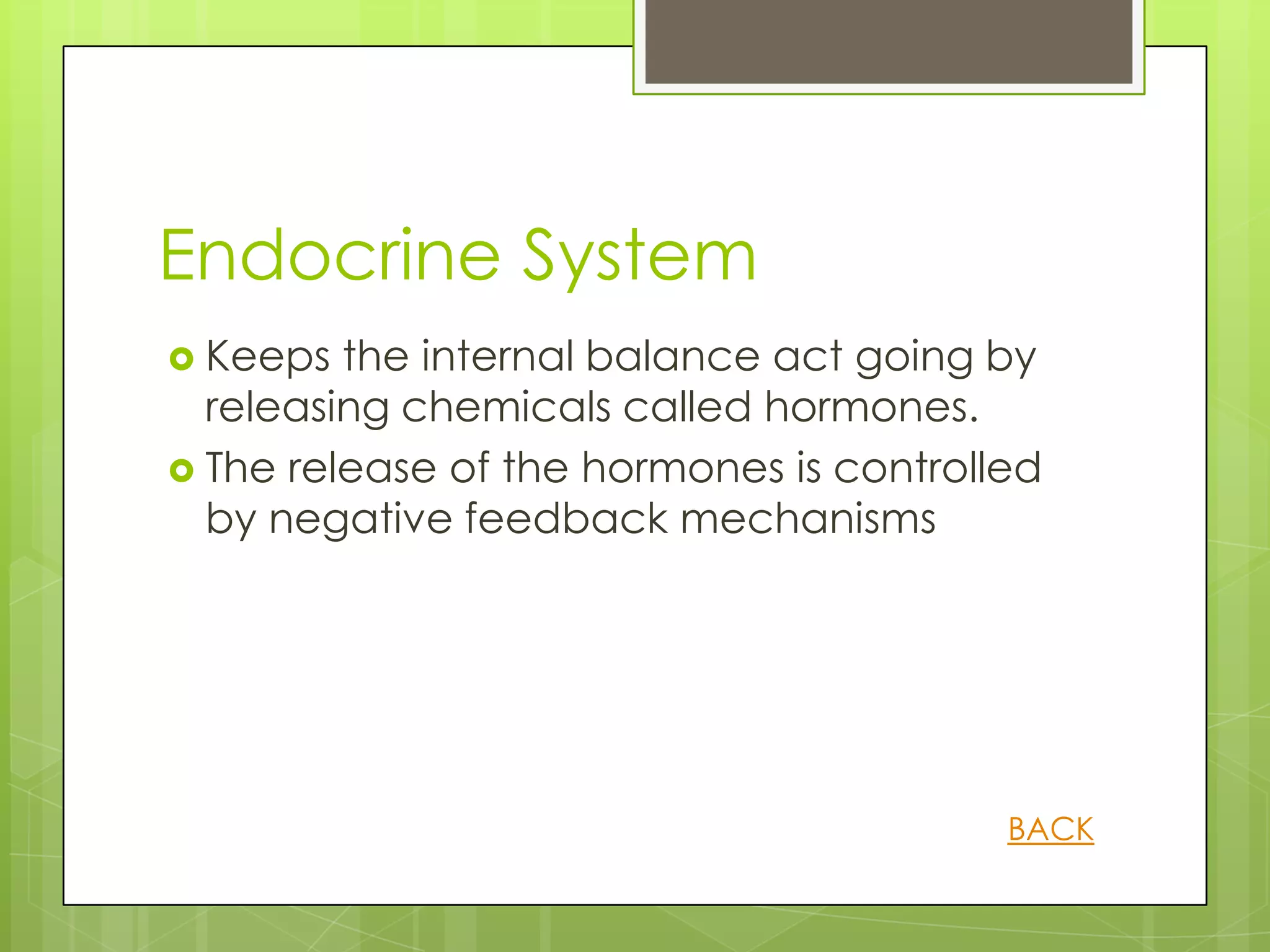
Endocrine System
 Keeps  the internal balance act going by
  releasing chemicals called hormones.
 The release of the hormones is controlled
  by negative feedback mechanisms


                                         BACK
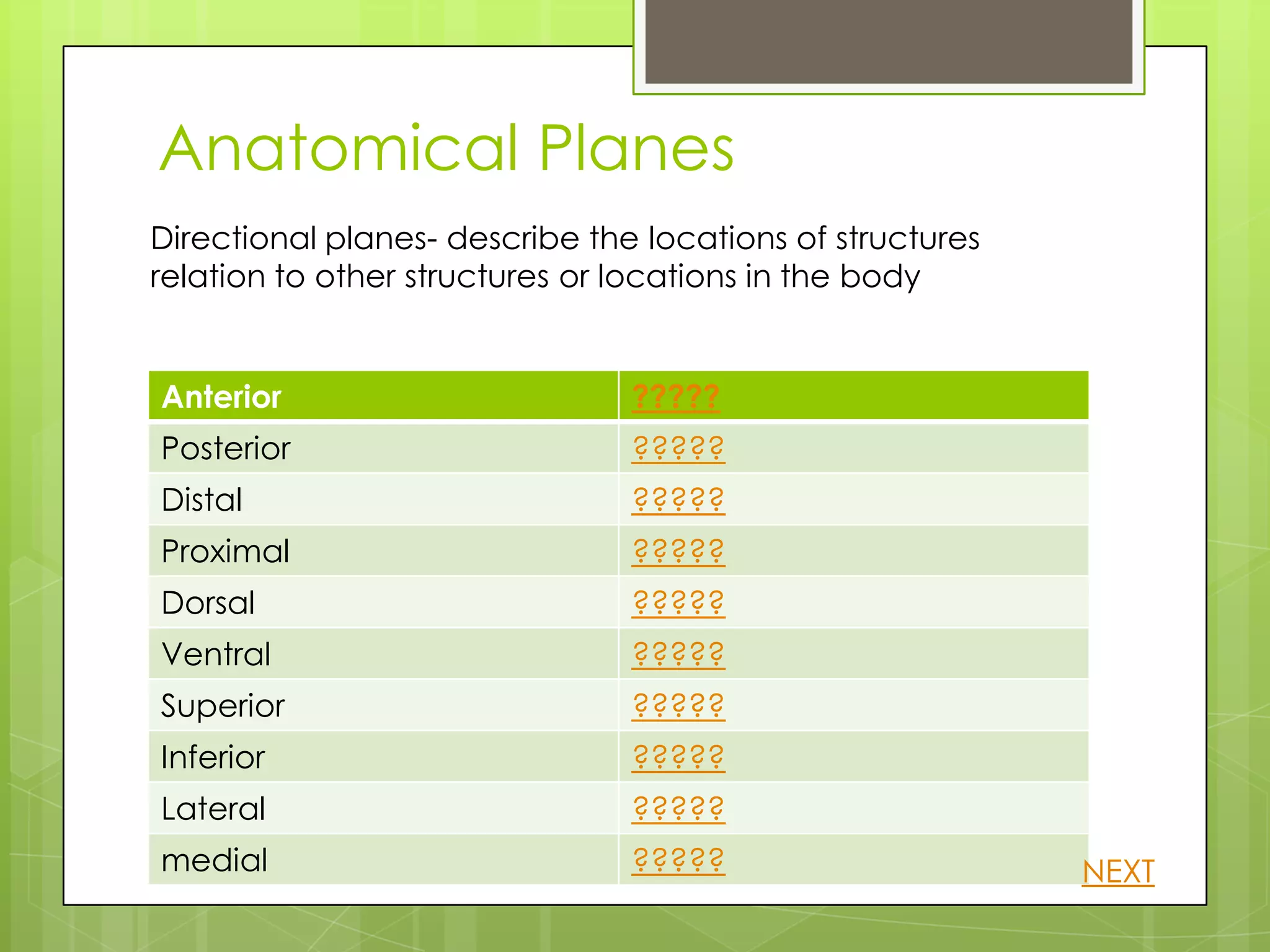
Anatomical Planes
Directional planes- describe the locations of structures
relation to other structures or locations in the body


Anterior                        ?????
Posterior                       ?????
Distal                          ?????
Proximal                        ?????
Dorsal                          ?????
Ventral                         ?????
Superior                        ?????
Inferior                        ?????
Lateral                         ?????
medial                          ?????                      NEXT
Anterior
   Toward the front of the body
    Example: The nose is on the
       anterior of the head


                               BACK
Posterior
 Toward the back (rear) Example:
  The heel is posterior to the head


                                BACK
Distal
  Away  from the trunk or point of
  attachment Example: The hand is
         distal to the elbow.


                               BACK
Proximal
 Toward   an internal organ; away
   from the outer wall (describes
 relative position in a limb or other
 appendage) Example: The joint is
       proximal to the toenail.


                                 BACK
Dorsal
 Along  (or toward) the vertebral
 surface of the body Example: Her
  scar is along the dorsal surface


                              BACK
Ventral
 Along(toward) the belly surface of
 the body Example: The navel is on
        the ventral surface.


                                BACK
Superior
   Towardthe top of the body
   Example: The shoulders are
      superior to the hips


                            BACK
Inferior
  Toward the bottom of the body
  Example: The stomach is inferior
            to the heart


                               BACK
Lateral
 Toward the side; away from the
  midsagittal plane Example: The
   eyes are lateral to the nose.


                             BACK
Medial
  Toward the midsagittal plane;
 away from the side Example: The
   eyes are medial to the ears.


                            BACK
Anatomical Planes
 Body planes- a person standing in an upright position then
 dissecting this person with vertical and horizontal planes

Lateral or Sagittal Plane     ?????
Parasagittal Plane            ?????
Midsagittal Plane             ?????
Frontal or Coronal Plane      ?????
Transverse Plane              ?????


                                                          NEXT
Lateral or Sagittal Plane
  Imagine  a vertical plane that runs
   through your body from front to
   back or back to front. This plane
  divides the body into right and left
                regions


                                     BACK
Parasagittal Plane
 Sagittalplane that divides the
 body into unequal right and left
             regions


                               BACK
Midsagittal Plane
 Sagittal
         plane that divides the body into
 equal right and left regions.


                                            BACK
Frontal or Coronal Plane
  Imagine a vertical plane that runs
    through the center of your body
 from side to side. This plane divides
   the body into front (anterior) and
        back (posterior) regions


                                     BACK
Transverse Plane
 Imagine a horizontal plane that runs
   through the midsection of your
  body. This plane divides the body
   into upper (superior) and lower
           (inferior) regions


                                    BACK
Directional terms
Caudal          ?????
Cephalad        ?????
Visceral        ?????
Parietal        ?????
Deep            ?????
Superficial     ?????
Medullary       ?????
Cortical        ?????
Ipsilateral     ?????
Contralateral   ?????
                        NEXT
Caudal
 Toward  the tail Example: The
   neck is caudal to the skull.


                                  BACK
Cephalad
Toward the head Example: The
  neck is cephalad to the tail


                             BACK
Visceral
Toward   an internal organ; away
  from the outer wall (describes
 positions inside a body cavity)
 Example: This organ is covered
   with the visceral layer of the
            membrane


                               BACK
Parietal
  Toward   the wall; away from
 internal structures Example: The
  abdominal cavity is lined with
      the parietal peritoneal
            membrane.


                               BACK
Deep
 Toward  the inside of a part;
    away from the surface
 Example: The thigh muscles are
       deep to the skin.


                             BACK
Superficial
 Toward  the surface of a part;
 away from the inside Example:
 The skin is a superficial organ.


                                BACK
Medullary
 Refersto an inner region, or
    medulla Example: The
 medullary portion of the organ
    contains nerve tissue.


                              BACK
Cortical
  Refers to an outer region or
  cortex. Example: The cortical
   area produces hormones.


                                  BACK
Ipsilateral
On the same side (of the body)
   as Example: The left knee is
   ipsilateral to the left ankle.


                                BACK
Contralateral
  On the opposite side of the
 body Example: The left knee is
 contralateral to the right knee.


                                BACK
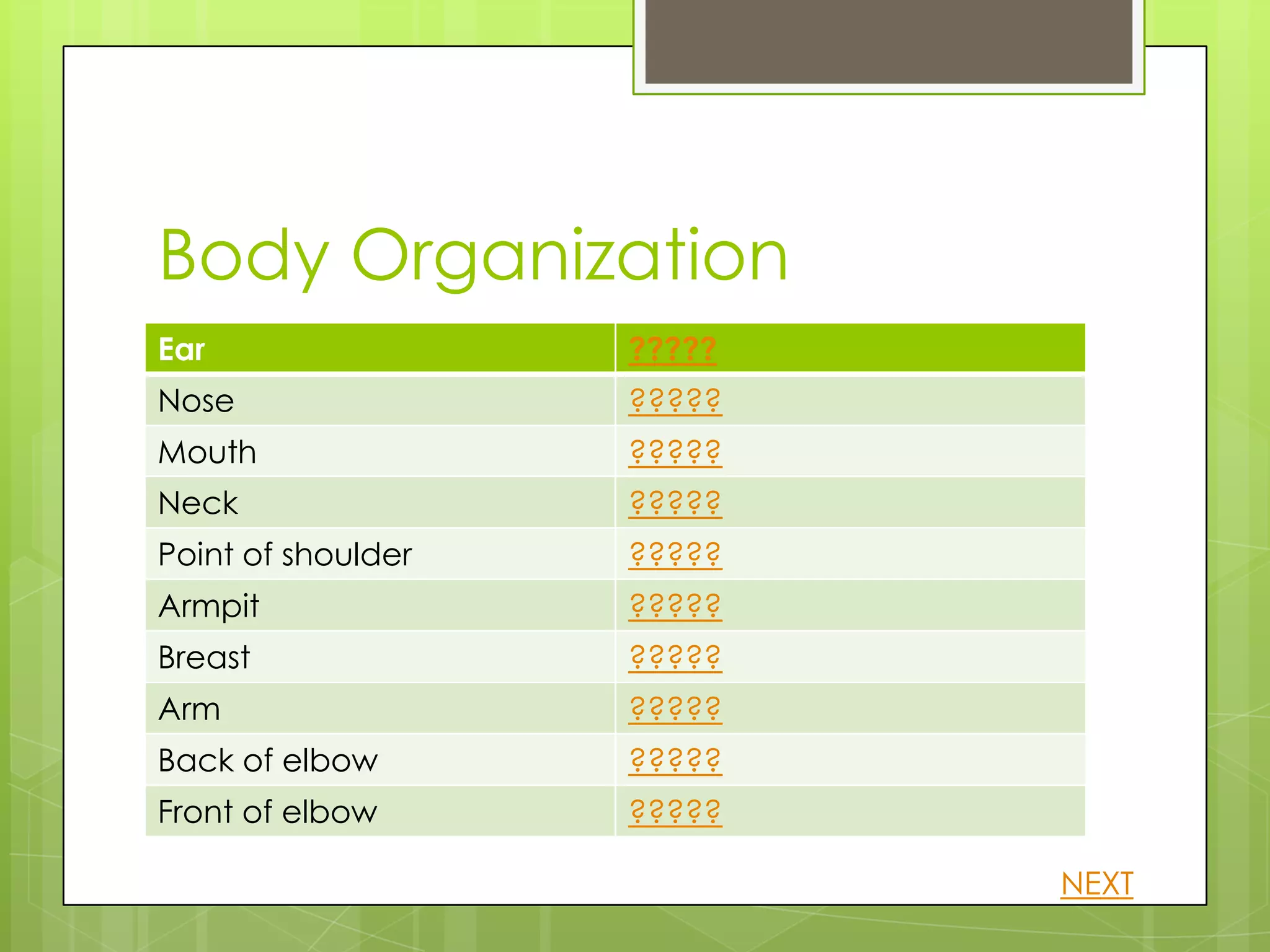
Body Organization
Ear                 ?????
Nose                ?????
Mouth               ?????
Neck                ?????
Point of shoulder   ?????
Armpit              ?????
Breast              ?????
Arm                 ?????
Back of elbow       ?????
Front of elbow      ?????

                            NEXT
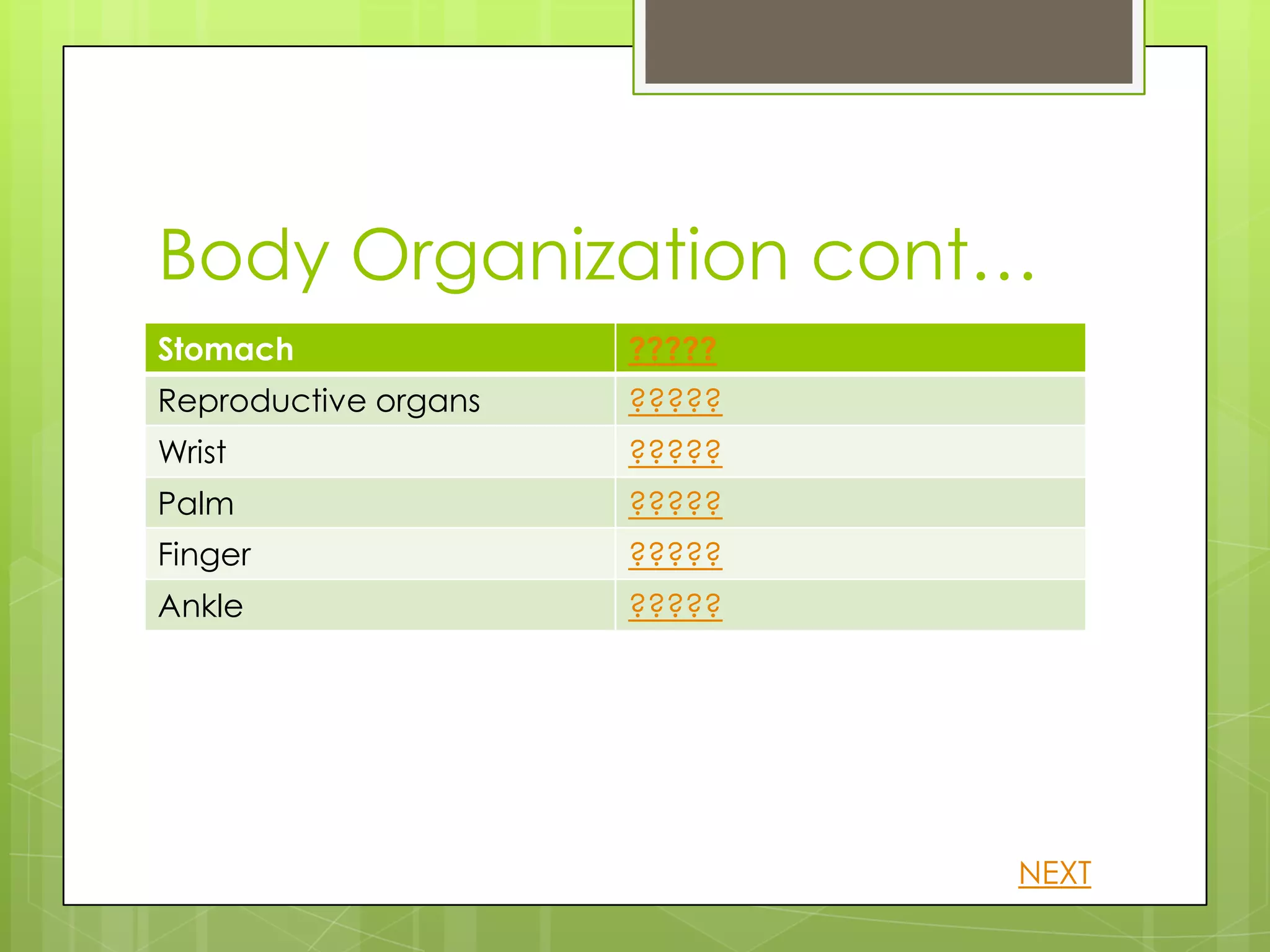
Body Organization cont…
Stomach               ?????
Reproductive organs   ?????
Wrist                 ?????
Palm                  ?????
Finger                ?????
Ankle                 ?????


                              NEXT
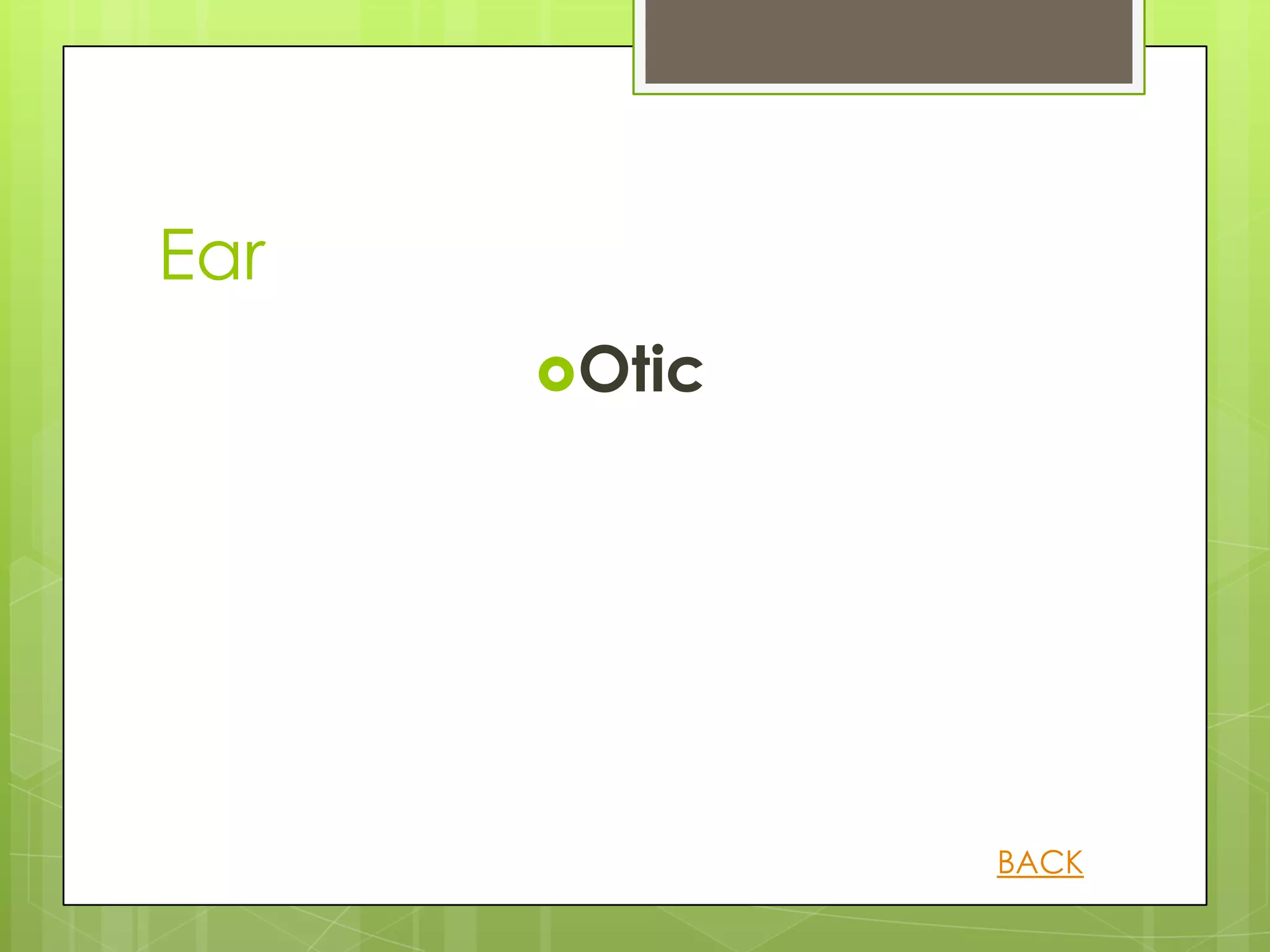
Ear
      Otic


              BACK
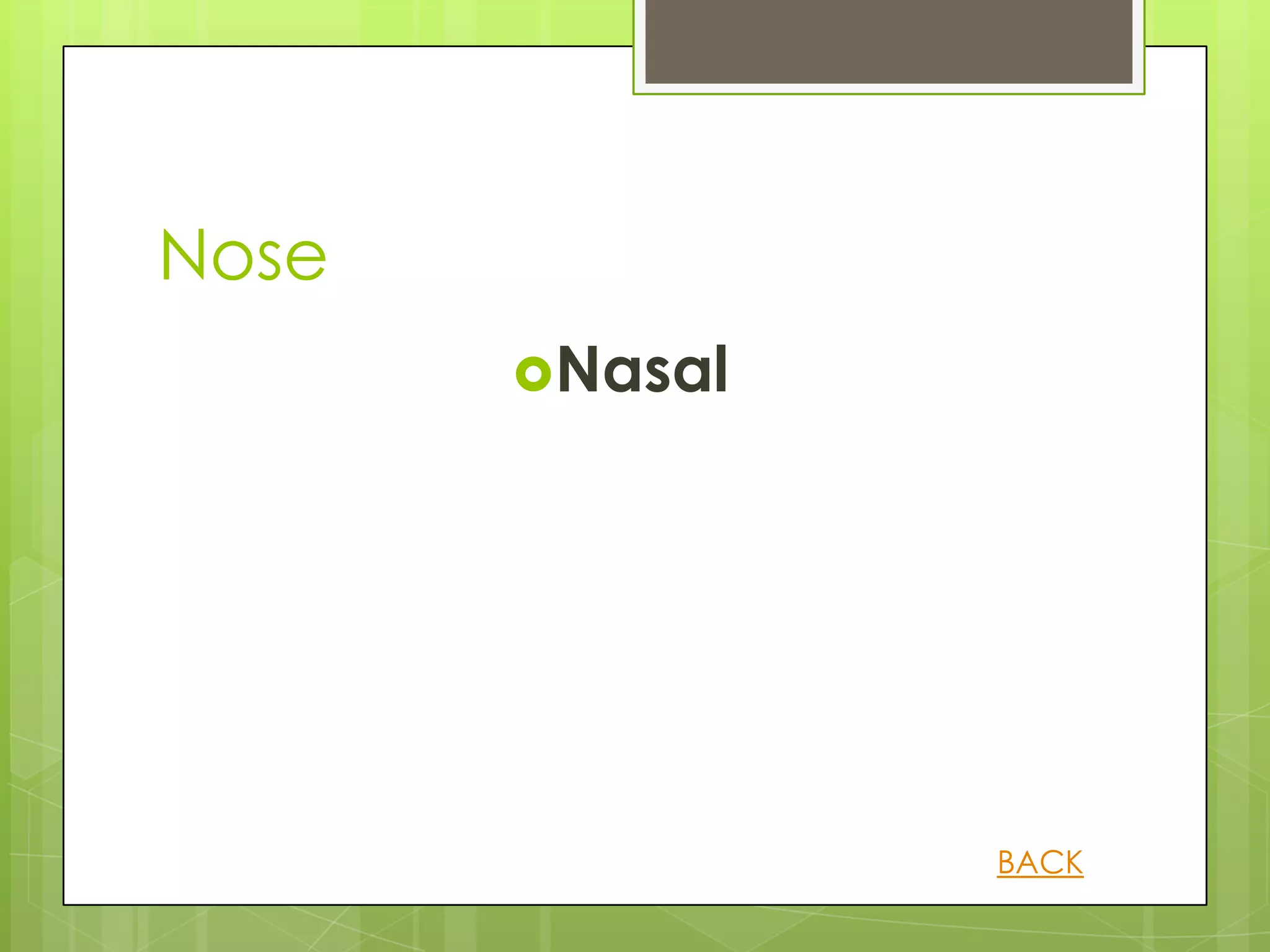
Nose
       Nasal


                BACK
Mouth
        Oral


                BACK
Neck
       Cervical


                   BACK
Point of shoulder
         Acromial


                     BACK
Armpit
         Axillary


                     BACK
Breast
         Mammary


                    BACK
Arm
      Brachial


                  BACK
Back of Elbow
       Antecubital


                      BACK
Front of elbow
      Antebrachial


                      BACK
Stomach
      Abdominal


                   BACK
Reproductive Organs
        Genital


                      BACK
Wrist
        Carpal


                  BACK
Palm
       Palmer


                 BACK
Finger
         Digital


                    BACK
Ankle
        Tarsal


                  BACK
Where is it? artifact

Where is it? artifact

  • 1.
    Introduction • Click on the question marks to reveal the answer. Marchelle Davis • Click BACK to go to the Courtney Zuber list of words Nicole Coetzer • Click NEXT to go to the next topic Madison Hall
  • 2.
    Structure and Function Anatomy ????? Physiology ????? NEXT
  • 3.
    Anatomy the study ofthe body's structures of living organisms BACK
  • 4.
    Physiology the study ofthe functions of each structure BACK
  • 5.
    Life Characteristics Responsiveness ????? Conductivity ????? Growth ????? Respiration ????? Digestion ????? Absorption ????? Secretion ????? Excretion ????? Circulation ????? Reproduction ????? NEXT
  • 6.
    Responsiveness Permits an organism to sense, monitor, and respond to change in its environment. BACK
  • 7.
    Conductivity Permitsan organism to sense, monitor, and respond to change in its environment. BACK
  • 8.
    Growth Normal increasein size or number of cells BACK
  • 9.
    Respiration Process that results in absorption, transport, utilization, or exchange or respiratory gases between an organism and its environment BACK
  • 10.
    Digestion Processby which complex food products are broken down into simpler substances BACK
  • 11.
    Absorption Processby which complex food products are broken down into simpler substances BACK
  • 12.
    Secretion Productionand delivery of specialized substances for diverse body functions BACK
  • 13.
    Excretion Removalof waste products produced during body functions BACK
  • 14.
    Circulation Refers to the movement of body fluids BACK
  • 15.
    Reproduction Involves the formation of a new individual BACK
  • 16.
    Human Organization Cell ????? Tissue ????? Organ ????? Organ system ????? Organism ????? NEXT
  • 17.
    Cell  The basic unit of structure and function in living things  May serve a specific function within the organism  Examples: blood cells, nervous cells, bone cells, etc. BACK
  • 18.
    Tissue  Made up of cells that are similar in structure and function and which work together to preform a specific activity  Humans have 4 basic tissues: connective, epithelial, muscle, and nerve.  Examples: blood, nerves, bone, etc. BACK
  • 19.
    Organ  Made up of tissues that work together to perform a specific activity  Examples - heart, brain, skin, etc. BACK
  • 20.
    Organ System  Groups of two or more tissues that work together to perform a specific function for the organism  The human body has 11 organ systems: circulatory, digestive, endocrine, excretory, BACK
  • 21.
    Organism  Entire living things that can carry out all basic life processes. Meaning they can take in materials, release energy from food, release wastes, grow, respond to the environment, and reproduce.  Usually made up of organ systems, but an organism may be made up of only one cell such as bacteria or protist.  Examples - bacteria, amoeba, mushroom, sunflower, human BACK
  • 22.
    Homeostasis Homeostasis ????? Endocrine System ????? Positive Feedback ????? Negative Feedback ????? NEXT
  • 23.
    Homeostasis astate ofbalance inside the body, where the body systems work together to keep it functioning normally BACK
  • 24.
    Endocrine System  Keeps the internal balance act going by releasing chemicals called hormones.  The release of the hormones is controlled by negative feedback mechanisms BACK
  • 25.
    Anatomical Planes Directional planes-describe the locations of structures relation to other structures or locations in the body Anterior ????? Posterior ????? Distal ????? Proximal ????? Dorsal ????? Ventral ????? Superior ????? Inferior ????? Lateral ????? medial ????? NEXT
  • 26.
    Anterior Toward the front of the body Example: The nose is on the anterior of the head BACK
  • 27.
    Posterior Toward theback (rear) Example: The heel is posterior to the head BACK
  • 28.
    Distal Away from the trunk or point of attachment Example: The hand is distal to the elbow. BACK
  • 29.
    Proximal Toward an internal organ; away from the outer wall (describes relative position in a limb or other appendage) Example: The joint is proximal to the toenail. BACK
  • 30.
    Dorsal Along (or toward) the vertebral surface of the body Example: Her scar is along the dorsal surface BACK
  • 31.
    Ventral  Along(toward) thebelly surface of the body Example: The navel is on the ventral surface. BACK
  • 32.
    Superior Towardthe top of the body Example: The shoulders are superior to the hips BACK
  • 33.
    Inferior Towardthe bottom of the body Example: The stomach is inferior to the heart BACK
  • 34.
    Lateral Toward theside; away from the midsagittal plane Example: The eyes are lateral to the nose. BACK
  • 35.
    Medial Towardthe midsagittal plane; away from the side Example: The eyes are medial to the ears. BACK
  • 36.
    Anatomical Planes Bodyplanes- a person standing in an upright position then dissecting this person with vertical and horizontal planes Lateral or Sagittal Plane ????? Parasagittal Plane ????? Midsagittal Plane ????? Frontal or Coronal Plane ????? Transverse Plane ????? NEXT
  • 37.
    Lateral or SagittalPlane  Imagine a vertical plane that runs through your body from front to back or back to front. This plane divides the body into right and left regions BACK
  • 38.
    Parasagittal Plane Sagittalplanethat divides the body into unequal right and left regions BACK
  • 39.
    Midsagittal Plane  Sagittal plane that divides the body into equal right and left regions. BACK
  • 40.
    Frontal or CoronalPlane  Imagine a vertical plane that runs through the center of your body from side to side. This plane divides the body into front (anterior) and back (posterior) regions BACK
  • 41.
    Transverse Plane  Imaginea horizontal plane that runs through the midsection of your body. This plane divides the body into upper (superior) and lower (inferior) regions BACK
  • 42.
    Directional terms Caudal ????? Cephalad ????? Visceral ????? Parietal ????? Deep ????? Superficial ????? Medullary ????? Cortical ????? Ipsilateral ????? Contralateral ????? NEXT
  • 43.
    Caudal Toward the tail Example: The neck is caudal to the skull. BACK
  • 44.
    Cephalad Toward the headExample: The neck is cephalad to the tail BACK
  • 45.
    Visceral Toward an internal organ; away from the outer wall (describes positions inside a body cavity) Example: This organ is covered with the visceral layer of the membrane BACK
  • 46.
    Parietal Toward the wall; away from internal structures Example: The abdominal cavity is lined with the parietal peritoneal membrane. BACK
  • 47.
    Deep Toward the inside of a part; away from the surface Example: The thigh muscles are deep to the skin. BACK
  • 48.
    Superficial Toward the surface of a part; away from the inside Example: The skin is a superficial organ. BACK
  • 49.
    Medullary Refersto aninner region, or medulla Example: The medullary portion of the organ contains nerve tissue. BACK
  • 50.
    Cortical Refersto an outer region or cortex. Example: The cortical area produces hormones. BACK
  • 51.
    Ipsilateral On the sameside (of the body) as Example: The left knee is ipsilateral to the left ankle. BACK
  • 52.
    Contralateral Onthe opposite side of the body Example: The left knee is contralateral to the right knee. BACK
  • 53.
    Body Organization Ear ????? Nose ????? Mouth ????? Neck ????? Point of shoulder ????? Armpit ????? Breast ????? Arm ????? Back of elbow ????? Front of elbow ????? NEXT
  • 54.
    Body Organization cont… Stomach ????? Reproductive organs ????? Wrist ????? Palm ????? Finger ????? Ankle ????? NEXT
  • 55.
    Ear Otic BACK
  • 56.
    Nose Nasal BACK
  • 57.
    Mouth Oral BACK
  • 58.
    Neck Cervical BACK
  • 59.
    Point of shoulder Acromial BACK
  • 60.
    Armpit Axillary BACK
  • 61.
    Breast Mammary BACK
  • 62.
    Arm Brachial BACK
  • 63.
    Back of Elbow Antecubital BACK
  • 64.
    Front of elbow Antebrachial BACK
  • 65.
    Stomach Abdominal BACK
  • 66.
    Reproductive Organs Genital BACK
  • 67.
    Wrist Carpal BACK
  • 68.
    Palm Palmer BACK
  • 69.
    Finger Digital BACK
  • 70.
    Ankle Tarsal BACK