Antisocial Personality Disorder

Ashley Wheeler

University of South Florida St. Petersburg
Fall 2013
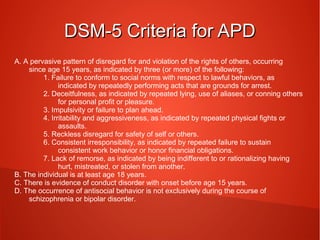
DSM-5 Criteria for APD
A. A pervasive pattern of disregard for and violation of the rights of others, occurring
since age 15 years, as indicated by three (or more) of the following:
1. Failure to conform to social norms with respect to lawful behaviors, as
indicated by repeatedly performing acts that are grounds for arrest.
2. Deceitfulness, as indicated by repeated lying, use of aliases, or conning others
for personal profit or pleasure.
3. Impulsivity or failure to plan ahead.
4. Irritability and aggressiveness, as indicated by repeated physical fights or
assaults.
5. Reckless disregard for safety of self or others.
6. Consistent irresponsibility, as indicated by repeated failure to sustain
consistent work behavior or honor financial obligations.
7. Lack of remorse, as indicated by being indifferent to or rationalizing having
hurt, mistreated, or stolen from another.
B. The individual is at least age 18 years.
C. There is evidence of conduct disorder with onset before age 15 years.
D. The occurrence of antisocial behavior is not exclusively during the course of
schizophrenia or bipolar disorder.
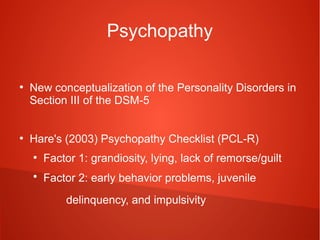
Psychopathy
●

●

New conceptualization of the Personality Disorders in
Section III of the DSM-5
Hare's (2003) Psychopathy Checklist (PCL-R)
●

Factor 1: grandiosity, lying, lack of remorse/guilt

●

Factor 2: early behavior problems, juvenile
delinquency, and impulsivity
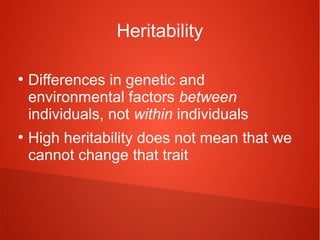
Heritability
●

●

Differences in genetic and
environmental factors between
individuals, not within individuals
High heritability does not mean that we
cannot change that trait
Risk Factors
DSM-5:
●

Biological predisposition

●

Environment:
●

Abuse or neglect

●

Unstable or erratic parenting or discipline

Kendler et al. (2012)
●

Genetic: aggressive disregard & disinhibition

●

Environmental: lack of remorse
From Conduct Disorder to APD
Frick (2012):
●

Preadolescent-onset Conduct Disorder:
●

●

More neurological and cognitive deficits

●

More impulsivity and emotional regulation issues

●

●

More violence and aggression

More likely to develop APD

Adolescent-onset Conduct Disorder:
●

More likely to come from stable and financially secure homes

●

Most concerned with defying authority

●

May not display lack of remorse
Treatment
●

●

Pharmocological: focus on reduction of
substance abuse
Psychological:
●

Mentalization-Based Treatment (MBT)
–

Mentalization is “the process by which we
make sense of each other and ourselves,
implicitly and explicitly, in terms of
subjective states and mental processes”
Bateman and Fonagy (2010).
Where do we go from here?
●

●

Prevention through early treatment via
IDEA
Research for psychological and
pharmacological interventions

Wheeler - Antisocial Personality Disorder

  • 1.
    Antisocial Personality Disorder AshleyWheeler University of South Florida St. Petersburg Fall 2013
  • 2.
    DSM-5 Criteria forAPD A. A pervasive pattern of disregard for and violation of the rights of others, occurring since age 15 years, as indicated by three (or more) of the following: 1. Failure to conform to social norms with respect to lawful behaviors, as indicated by repeatedly performing acts that are grounds for arrest. 2. Deceitfulness, as indicated by repeated lying, use of aliases, or conning others for personal profit or pleasure. 3. Impulsivity or failure to plan ahead. 4. Irritability and aggressiveness, as indicated by repeated physical fights or assaults. 5. Reckless disregard for safety of self or others. 6. Consistent irresponsibility, as indicated by repeated failure to sustain consistent work behavior or honor financial obligations. 7. Lack of remorse, as indicated by being indifferent to or rationalizing having hurt, mistreated, or stolen from another. B. The individual is at least age 18 years. C. There is evidence of conduct disorder with onset before age 15 years. D. The occurrence of antisocial behavior is not exclusively during the course of schizophrenia or bipolar disorder.
  • 3.
    Psychopathy ● ● New conceptualization ofthe Personality Disorders in Section III of the DSM-5 Hare's (2003) Psychopathy Checklist (PCL-R) ● Factor 1: grandiosity, lying, lack of remorse/guilt ● Factor 2: early behavior problems, juvenile delinquency, and impulsivity
  • 4.
    Heritability ● ● Differences in geneticand environmental factors between individuals, not within individuals High heritability does not mean that we cannot change that trait
  • 5.
    Risk Factors DSM-5: ● Biological predisposition ● Environment: ● Abuseor neglect ● Unstable or erratic parenting or discipline Kendler et al. (2012) ● Genetic: aggressive disregard & disinhibition ● Environmental: lack of remorse
  • 6.
    From Conduct Disorderto APD Frick (2012): ● Preadolescent-onset Conduct Disorder: ● ● More neurological and cognitive deficits ● More impulsivity and emotional regulation issues ● ● More violence and aggression More likely to develop APD Adolescent-onset Conduct Disorder: ● More likely to come from stable and financially secure homes ● Most concerned with defying authority ● May not display lack of remorse
  • 7.
    Treatment ● ● Pharmocological: focus onreduction of substance abuse Psychological: ● Mentalization-Based Treatment (MBT) – Mentalization is “the process by which we make sense of each other and ourselves, implicitly and explicitly, in terms of subjective states and mental processes” Bateman and Fonagy (2010).
  • 8.
    Where do wego from here? ● ● Prevention through early treatment via IDEA Research for psychological and pharmacological interventions