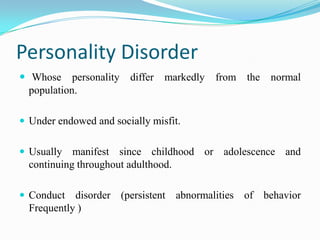
Personality Disorder
 Whose personality differ markedly from the normal
population.
 Under endowed and socially misfit.
 Usually manifest since childhood or adolescence and
continuing throughout adulthood.
 Conduct disorder (persistent abnormalities of behavior
Frequently )
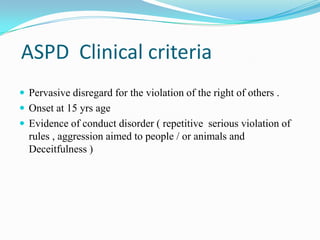
ASPD Clinical criteria
 Pervasive disregard for the violation of the right of others .
 Onset at 15 yrs age
 Evidence of conduct disorder ( repetitive serious violation of
rules , aggression aimed to people / or animals and
Deceitfulness )
Diagnostic features
 Failure to confirm social norms
 Dishonest , including lying and conning other for personal
profit or pleasure.
 Impulsivity or failure to plan ahead
 Irritability and aggressive including physical fights
 Recklessness and disregard for the safety of self and others
 Irresponsibility , indicated by the failure to honor financial
obligation
 Lack of remorse
Diagnostic features
 Associated features
 Promiscuity
Lack of empathy
Inflated and arrogant self appraisal
 abusiveness and irresponsibility towards children
 The APA Diagnostics and statistics manual of mental Disorder
, fourth edition (DSM-IV-TR), defines antisocial personality
disorder (in Axis II cluster B)
 Tenth edition (ICD-10), has a diagnosis called dissocial
personality disorder ( F60.2)
Complication
 Dysphoria
 Depressed mood
 Low tolerance for boredom
 tension
 Premature violent Death
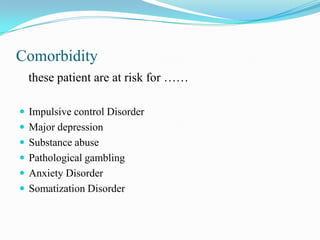
Comorbidity
these patient are at risk for ……
 Impulsive control Disorder
 Major depression
 Substance abuse
 Pathological gambling
 Anxiety Disorder
 Somatization Disorder
Epidemiology
 Prevalence rates 3 % male and 1% for female in general
population
 According to ( DSM-IV-TR), commonly (3:1)
diagnosed in male.
 High frequency is associated with low socioeconomic
Status and urban setting
Differential Diagnosis
 Antisocial Personality can be distinguished from Bipolar
Disorder
 Narcissistic (rarely manifest serious criminal aggression
and deceit )
 Histrionic (which include seductiveness and attention
seeking )
 Borderline ( which include manipulativeness to gain
nurturance )
 Paranoid(which include suspiciousness)
 Adult antisocial behavior ( with no personality pathology in
back ground )
Familial pattern and genitics
 ASPD more frequent with first degree of biological
relatives
 Biological relative of female with ASPD are at more
risk compare to male relatives
 Genetics suggest substance use and somatization is
first two characteristic of male and only last in female .
 Both adopted and biological children are increased
risk of ASPD.
Clinical Criteria
 Pervasive
 Excessive self dramatization
 Excessive emotionally
 Attention seeking
 The APA Diagnostics and statistics manual of mental Disorder
, fourth edition (DSM-IV-TR), defines antisocial personality disorder
(in Axis II cluster B)
 Tenth edition (ICD-10), has a diagnosis called dissocial personality
disorder ( F60.4)
Diagnostic feature
 Inappropriate Sexual seductiveness or provocativeness.
 Excessive need to be at the centre of attention
 Rapidly shifting and shallow expression of emotion .
 Suggestibility
 Use of physical appearance for attention seeking purposes
 Impressionistic speech lacking details
 Self dramatization, theatricality, exaggerated
expression of emotions
Associated Features
 Difficulties in achieving emotional intimacy in
romantic or sexual relationship.
 Craving for excitement and stimulation.
 Promiscuity or complete sexual naivete
 low tolerance for delayed gratification.
Complication
 Frequent suicidal gesture and threats to coerce better
care giving
 Interpersonal relation are unstable
 Shallow and ungratifying
 Marital problems ( secondary to tendency to neglect
long term of relationship for the excitement of new
relationship)
Comorbidity
 Major depression
 Conversion disorder
 Somatization disorder
 Most common
 Narcissistic
 Border line
 Antisocial
 Dependent
Epidemiology
 The DSM-IV-TR report prevalence rates 2 - 3 %in the
general population
 10- 15 % in psychiatric inpatient and outpatient
Differential diagnosis
 ASPD ( which includes antisocial Behavior and crime
to gain profit , power . No excessive self
dramatization, no exaggerated emotional expression)
 Borderline ( which include unstable self concept
, chaotic behavior , self destructive gesture)
 Narcissistic ( which include fear of having hidden
imperfections and flaws revealed , sense of grandiosity
and specialness0
Familial pattern and genetics
 Genetic link connecting histrionic , antisocial
personality disorder and alcohol has been suggested
Spectrum disorder
1- Anti Social
2-Histrionic
3- Narcissistic
 Three disorder have been
shown to aggregate in the
same family and co-occur in
same person
 Some time reflect differential
expression of the same
liability
 Anti social behavior increase
in severity as one proceed
from histrionic via
narcissistic to antisocial
Assessment of Disorders
 Categorical
 MMPI (self report )
 PDQ-R (self report )
 SIDP- IV( interview )
 Dimensional
 Temperament and
character inventory
scale
Both self reports and interviews depends on the p/t accuracy honest and level of
insightfulness . Hence collection of data from collateral informant and expert rating
is usually is considered critical to ensuring high quality personality diagnosis
Clinical and psychometric issues
 Ego-syntonic(patient blame others for circumstances )
 Alloplastic ( try to change others )
 Social or clinical diagnosis?
 Categorical vs. dimensional approach
( categorical model is medical model which suggest disorder is
absent or present and individual is affected or not affected )
(dimensional models define a number of graded and continuous
behavior dimension and specify individual differences as
quantitative variation along these dimension )
Treatment
Self awareness and well being
 PD p/t do not recognized that they are ill and seldom
seek Help.
 In general p/t with PD require multi faceted Treatment
Plan that combine with psychotherapy &
Pharmacotherapy.
Stages of self awareness
 0- immature child like ego state
1-purposeful but egocentric
2-Aware of own subconscious , mindfulness
Effortless calm
Treatment
 Crisis management or stabilization
 Awakening of positive perspective
 Other centered awareness
 Integrated intelligence
Thank you

Histrionic and antisocial personality

  • 2.
    Personality Disorder  Whosepersonality differ markedly from the normal population.  Under endowed and socially misfit.  Usually manifest since childhood or adolescence and continuing throughout adulthood.  Conduct disorder (persistent abnormalities of behavior Frequently )
  • 3.
    ASPD Clinical criteria Pervasive disregard for the violation of the right of others .  Onset at 15 yrs age  Evidence of conduct disorder ( repetitive serious violation of rules , aggression aimed to people / or animals and Deceitfulness )
  • 4.
    Diagnostic features  Failureto confirm social norms  Dishonest , including lying and conning other for personal profit or pleasure.  Impulsivity or failure to plan ahead  Irritability and aggressive including physical fights  Recklessness and disregard for the safety of self and others  Irresponsibility , indicated by the failure to honor financial obligation  Lack of remorse
  • 5.
    Diagnostic features  Associatedfeatures  Promiscuity Lack of empathy Inflated and arrogant self appraisal  abusiveness and irresponsibility towards children  The APA Diagnostics and statistics manual of mental Disorder , fourth edition (DSM-IV-TR), defines antisocial personality disorder (in Axis II cluster B)  Tenth edition (ICD-10), has a diagnosis called dissocial personality disorder ( F60.2)
  • 6.
    Complication  Dysphoria  Depressedmood  Low tolerance for boredom  tension  Premature violent Death
  • 7.
    Comorbidity these patient areat risk for ……  Impulsive control Disorder  Major depression  Substance abuse  Pathological gambling  Anxiety Disorder  Somatization Disorder
  • 8.
    Epidemiology  Prevalence rates3 % male and 1% for female in general population  According to ( DSM-IV-TR), commonly (3:1) diagnosed in male.  High frequency is associated with low socioeconomic Status and urban setting
  • 9.
    Differential Diagnosis  AntisocialPersonality can be distinguished from Bipolar Disorder  Narcissistic (rarely manifest serious criminal aggression and deceit )  Histrionic (which include seductiveness and attention seeking )  Borderline ( which include manipulativeness to gain nurturance )  Paranoid(which include suspiciousness)  Adult antisocial behavior ( with no personality pathology in back ground )
  • 10.
    Familial pattern andgenitics  ASPD more frequent with first degree of biological relatives  Biological relative of female with ASPD are at more risk compare to male relatives  Genetics suggest substance use and somatization is first two characteristic of male and only last in female .  Both adopted and biological children are increased risk of ASPD.
  • 12.
    Clinical Criteria  Pervasive Excessive self dramatization  Excessive emotionally  Attention seeking  The APA Diagnostics and statistics manual of mental Disorder , fourth edition (DSM-IV-TR), defines antisocial personality disorder (in Axis II cluster B)  Tenth edition (ICD-10), has a diagnosis called dissocial personality disorder ( F60.4)
  • 13.
    Diagnostic feature  InappropriateSexual seductiveness or provocativeness.  Excessive need to be at the centre of attention  Rapidly shifting and shallow expression of emotion .  Suggestibility  Use of physical appearance for attention seeking purposes  Impressionistic speech lacking details  Self dramatization, theatricality, exaggerated expression of emotions
  • 14.
    Associated Features  Difficultiesin achieving emotional intimacy in romantic or sexual relationship.  Craving for excitement and stimulation.  Promiscuity or complete sexual naivete  low tolerance for delayed gratification.
  • 15.
    Complication  Frequent suicidalgesture and threats to coerce better care giving  Interpersonal relation are unstable  Shallow and ungratifying  Marital problems ( secondary to tendency to neglect long term of relationship for the excitement of new relationship)
  • 16.
    Comorbidity  Major depression Conversion disorder  Somatization disorder  Most common  Narcissistic  Border line  Antisocial  Dependent
  • 17.
    Epidemiology  The DSM-IV-TRreport prevalence rates 2 - 3 %in the general population  10- 15 % in psychiatric inpatient and outpatient
  • 18.
    Differential diagnosis  ASPD( which includes antisocial Behavior and crime to gain profit , power . No excessive self dramatization, no exaggerated emotional expression)  Borderline ( which include unstable self concept , chaotic behavior , self destructive gesture)  Narcissistic ( which include fear of having hidden imperfections and flaws revealed , sense of grandiosity and specialness0
  • 19.
    Familial pattern andgenetics  Genetic link connecting histrionic , antisocial personality disorder and alcohol has been suggested
  • 20.
    Spectrum disorder 1- AntiSocial 2-Histrionic 3- Narcissistic  Three disorder have been shown to aggregate in the same family and co-occur in same person  Some time reflect differential expression of the same liability  Anti social behavior increase in severity as one proceed from histrionic via narcissistic to antisocial
  • 21.
    Assessment of Disorders Categorical  MMPI (self report )  PDQ-R (self report )  SIDP- IV( interview )  Dimensional  Temperament and character inventory scale Both self reports and interviews depends on the p/t accuracy honest and level of insightfulness . Hence collection of data from collateral informant and expert rating is usually is considered critical to ensuring high quality personality diagnosis
  • 22.
    Clinical and psychometricissues  Ego-syntonic(patient blame others for circumstances )  Alloplastic ( try to change others )  Social or clinical diagnosis?  Categorical vs. dimensional approach ( categorical model is medical model which suggest disorder is absent or present and individual is affected or not affected ) (dimensional models define a number of graded and continuous behavior dimension and specify individual differences as quantitative variation along these dimension )
  • 23.
    Treatment Self awareness andwell being  PD p/t do not recognized that they are ill and seldom seek Help.  In general p/t with PD require multi faceted Treatment Plan that combine with psychotherapy & Pharmacotherapy. Stages of self awareness  0- immature child like ego state 1-purposeful but egocentric 2-Aware of own subconscious , mindfulness Effortless calm
  • 24.
    Treatment  Crisis managementor stabilization  Awakening of positive perspective  Other centered awareness  Integrated intelligence
  • 25.