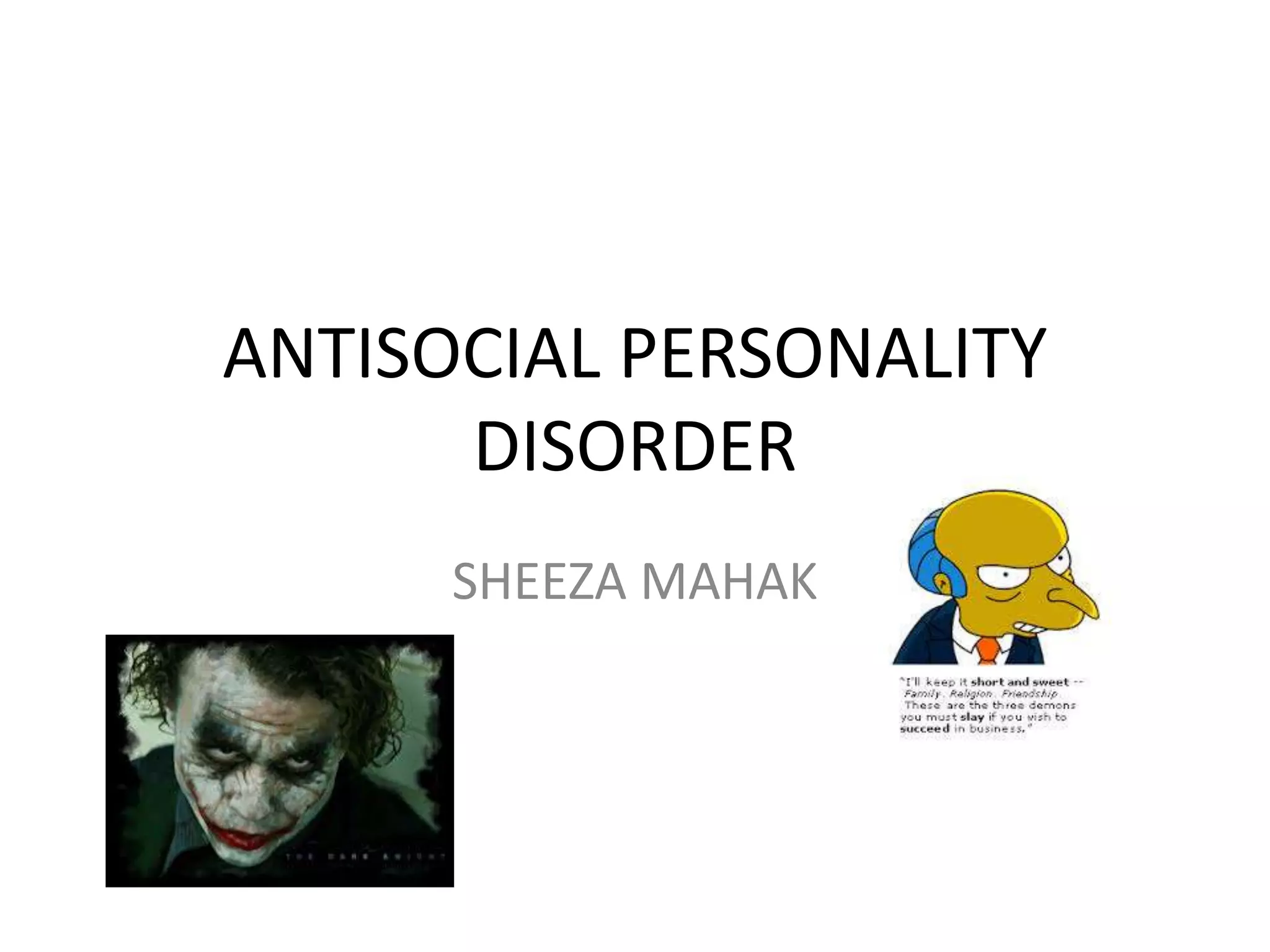

ANTISOCIAL PERSONALITY
DISORDER
SHEEZA MAHAK
overview
• An anti social personality disorder is
characterized by a long standing pattern of a
disregards for other people’s rights, often
crossing the line and violating those rights.
• It usually begin in childhood as a teen and
continues in to their adult lives
Cont…
• have no regard for right and wrong
• antagonize, manipulate or treat others either
harshly or with callous indifference
• unable to fulfill responsibilities related to
family, work or school
• Antisocial personality disorder symptoms may
begin in childhood and are fully evident for
most people during their 20s and 30s.
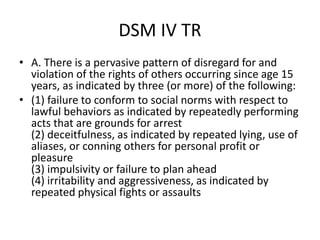
DSM IV TR
• A. There is a pervasive pattern of disregard for and
violation of the rights of others occurring since age 15
years, as indicated by three (or more) of the following:
• (1) failure to conform to social norms with respect to
lawful behaviors as indicated by repeatedly performing
acts that are grounds for arrest
(2) deceitfulness, as indicated by repeated lying, use of
aliases, or conning others for personal profit or
pleasure
(3) impulsivity or failure to plan ahead
(4) irritability and aggressiveness, as indicated by
repeated physical fights or assaults
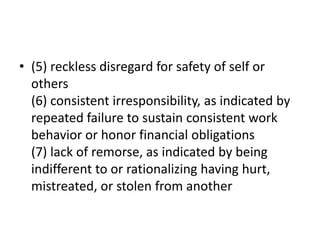
• (5) reckless disregard for safety of self or
others
(6) consistent irresponsibility, as indicated by
repeated failure to sustain consistent work
behavior or honor financial obligations
(7) lack of remorse, as indicated by being
indifferent to or rationalizing having hurt,
mistreated, or stolen from another
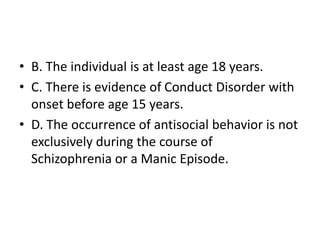
• B. The individual is at least age 18 years.
• C. There is evidence of Conduct Disorder with
onset before age 15 years.
• D. The occurrence of antisocial behavior is not
exclusively during the course of
Schizophrenia or a Manic Episode.
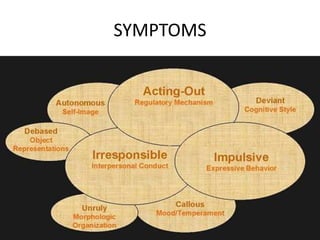
SYMPTOMS
SYMPTOMS
• Disregard for right and wrong
• Persistent lying or deceit to exploit others
• Using charm or wit to manipulate others for
personal gain or for sheer personal pleasure
• Intense egocentrism, sense of superiority and
exhibitionism
• Recurring difficulties with the law
• Repeatedly violating the rights of others by the
use of intimidation, dishonesty and
misrepresentation
Cont…
• Child abuse or neglect
• Hostility, significant irritability, agitation,
impulsiveness, aggression or violence
• Lack of empathy for others and lack of remorse
about harming others
• Unnecessary risk-taking or dangerous behaviors
• Poor or abusive relationships
• Irresponsible work behavior
• Failure to learn from the negative consequences
of behavior
COMORBIDITY
The following conditions commonly coexist with ASPD:
• Anxiety disorders
• Depressive disorder
• Impulse control disorders
• Substance-related disorders
• Somatization disorder
• Attention deficit hyperactivity disorder
• Borderline personality disorder
• Histrionic personality disorder
• Narcissistic personality disorder
• Sadistic personality disorder
Epidemiology
• 3% in men
• 1% in women.
• among prisoners is less than 50%.
• 47% of male prisoners
• 21% of female prisoners had ASPD
• 47% have arrest records.
ETIOLOGY
• Influences from the environment
• Genetic (inherited) or biological factors
Antisocial personality

Antisocial personality

  • 1.
  • 2.
    overview • An antisocial personality disorder is characterized by a long standing pattern of a disregards for other people’s rights, often crossing the line and violating those rights. • It usually begin in childhood as a teen and continues in to their adult lives
  • 3.
    Cont… • have noregard for right and wrong • antagonize, manipulate or treat others either harshly or with callous indifference • unable to fulfill responsibilities related to family, work or school • Antisocial personality disorder symptoms may begin in childhood and are fully evident for most people during their 20s and 30s.
  • 4.
    DSM IV TR •A. There is a pervasive pattern of disregard for and violation of the rights of others occurring since age 15 years, as indicated by three (or more) of the following: • (1) failure to conform to social norms with respect to lawful behaviors as indicated by repeatedly performing acts that are grounds for arrest (2) deceitfulness, as indicated by repeated lying, use of aliases, or conning others for personal profit or pleasure (3) impulsivity or failure to plan ahead (4) irritability and aggressiveness, as indicated by repeated physical fights or assaults
  • 5.
    • (5) recklessdisregard for safety of self or others (6) consistent irresponsibility, as indicated by repeated failure to sustain consistent work behavior or honor financial obligations (7) lack of remorse, as indicated by being indifferent to or rationalizing having hurt, mistreated, or stolen from another
  • 6.
    • B. Theindividual is at least age 18 years. • C. There is evidence of Conduct Disorder with onset before age 15 years. • D. The occurrence of antisocial behavior is not exclusively during the course of Schizophrenia or a Manic Episode.
  • 7.
  • 8.
    SYMPTOMS • Disregard forright and wrong • Persistent lying or deceit to exploit others • Using charm or wit to manipulate others for personal gain or for sheer personal pleasure • Intense egocentrism, sense of superiority and exhibitionism • Recurring difficulties with the law • Repeatedly violating the rights of others by the use of intimidation, dishonesty and misrepresentation
  • 9.
    Cont… • Child abuseor neglect • Hostility, significant irritability, agitation, impulsiveness, aggression or violence • Lack of empathy for others and lack of remorse about harming others • Unnecessary risk-taking or dangerous behaviors • Poor or abusive relationships • Irresponsible work behavior • Failure to learn from the negative consequences of behavior
  • 10.
    COMORBIDITY The following conditionscommonly coexist with ASPD: • Anxiety disorders • Depressive disorder • Impulse control disorders • Substance-related disorders • Somatization disorder • Attention deficit hyperactivity disorder • Borderline personality disorder • Histrionic personality disorder • Narcissistic personality disorder • Sadistic personality disorder
  • 11.
    Epidemiology • 3% inmen • 1% in women. • among prisoners is less than 50%. • 47% of male prisoners • 21% of female prisoners had ASPD • 47% have arrest records.
  • 12.
    ETIOLOGY • Influences fromthe environment • Genetic (inherited) or biological factors