What is Zero Trust?
In the past, organizations protected
themselves by putting a perimeter
around their network.
© Okta and/or its affiliates. All rights reserved. Okta Confidential 3
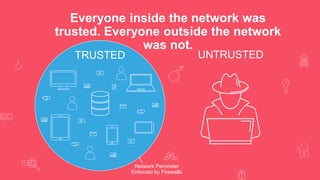
Network Perimeter
Enforced by Firewalls
TRUSTED UNTRUSTED
Everyone inside the network was
trusted. Everyone outside the network
was not.
That was problematic, because if a
hacker breached the network, they
had access to everything inside of
the company: including its most
highly sensitive data.
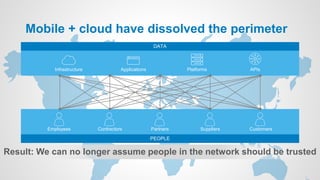
Mobile + cloud have dissolved the perimeter
Result: We can no longer assume people in the network should be trusted
PEOPLE
Employees Contractors Partners Suppliers Customers
DATA
Infrastructure Applications Platforms APIs
PEOPLE
Employees Contractors Partners Suppliers Customers
DATA
Infrastructure Applications Platforms APIs
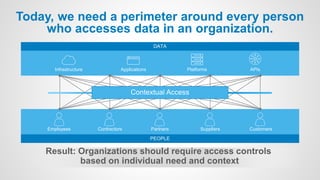
Today, we need a perimeter around every person
who accesses data in an organization.
Contextual Access
Result: Organizations should require access controls
based on individual need and context
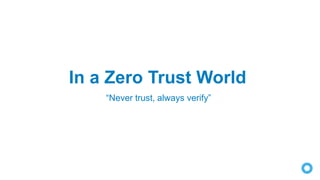
“Never trust, always verify”
In a Zero Trust World
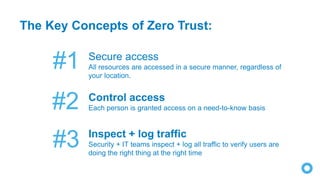
Secure access
All resources are accessed in a secure manner, regardless of
your location.
Control access
Each person is granted access on a need-to-know basis
Inspect + log traffic
Security + IT teams inspect + log all traffic to verify users are
doing the right thing at the right time
The Key Concepts of Zero Trust:
#1
#2
#3
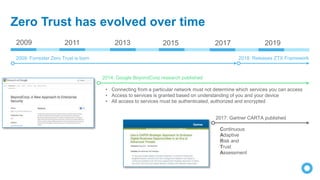
Zero Trust has evolved over time
2009 2011 2013 2015 2017 2019
2009: Forrester Zero Trust is born 2018: Releases ZTX Framework
2014: Google BeyondCorp research published
2017: Gartner CARTA published
• Connecting from a particular network must not determine which services you can access
• Access to services is granted based on understanding of you and your device
• All access to services must be authenticated, authorized and encrypted
Continuous
Adaptive
Risk and
Trust
Assessment
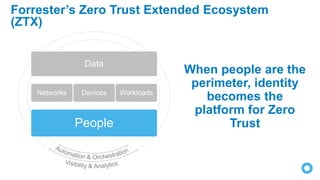
Workloads
Data
Networks
People
Devices
Data
People
Networks WorkloadsDevices
When people are the
perimeter, identity
becomes the
platform for Zero
Trust
Forrester’s Zero Trust Extended Ecosystem
(ZTX)
© Okta and/or its affiliates. All rights reserved. Okta Confidential
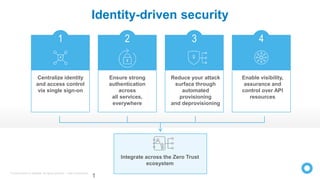
Identity-driven security
1
Centralize identity
and access control
via single sign-on
1
Ensure strong
authentication
across
all services,
everywhere
2
Reduce your attack
surface through
automated
provisioning
and deprovisioning
3
Enable visibility,
assurance and
control over API
resources
4
Integrate across the Zero Trust
ecosystem
Learn more about the
role of identity in Zero Trust
at Okta.com/ZeroTrust

What is Zero Trust

  • 1.
  • 2.
    In the past,organizations protected themselves by putting a perimeter around their network.
  • 3.
    © Okta and/orits affiliates. All rights reserved. Okta Confidential 3 Network Perimeter Enforced by Firewalls TRUSTED UNTRUSTED Everyone inside the network was trusted. Everyone outside the network was not.
  • 4.
    That was problematic,because if a hacker breached the network, they had access to everything inside of the company: including its most highly sensitive data.
  • 5.
    Mobile + cloudhave dissolved the perimeter Result: We can no longer assume people in the network should be trusted PEOPLE Employees Contractors Partners Suppliers Customers DATA Infrastructure Applications Platforms APIs
  • 6.
    PEOPLE Employees Contractors PartnersSuppliers Customers DATA Infrastructure Applications Platforms APIs Today, we need a perimeter around every person who accesses data in an organization. Contextual Access Result: Organizations should require access controls based on individual need and context
  • 7.
    “Never trust, alwaysverify” In a Zero Trust World
  • 8.
    Secure access All resourcesare accessed in a secure manner, regardless of your location. Control access Each person is granted access on a need-to-know basis Inspect + log traffic Security + IT teams inspect + log all traffic to verify users are doing the right thing at the right time The Key Concepts of Zero Trust: #1 #2 #3
  • 9.
    Zero Trust hasevolved over time 2009 2011 2013 2015 2017 2019 2009: Forrester Zero Trust is born 2018: Releases ZTX Framework 2014: Google BeyondCorp research published 2017: Gartner CARTA published • Connecting from a particular network must not determine which services you can access • Access to services is granted based on understanding of you and your device • All access to services must be authenticated, authorized and encrypted Continuous Adaptive Risk and Trust Assessment
  • 10.
    Workloads Data Networks People Devices Data People Networks WorkloadsDevices When peopleare the perimeter, identity becomes the platform for Zero Trust Forrester’s Zero Trust Extended Ecosystem (ZTX)
  • 11.
    © Okta and/orits affiliates. All rights reserved. Okta Confidential Identity-driven security 1 Centralize identity and access control via single sign-on 1 Ensure strong authentication across all services, everywhere 2 Reduce your attack surface through automated provisioning and deprovisioning 3 Enable visibility, assurance and control over API resources 4 Integrate across the Zero Trust ecosystem
  • 12.
    Learn more aboutthe role of identity in Zero Trust at Okta.com/ZeroTrust

Editor's Notes

  • #3 Zero Trust is the security framework developed by John Kindervag in 2009 while he was at Forrester Research
  • #4  the old way assumes a trusted network protected by the network perimeter And an untrusted network outside the perimeter where the bad guys live. This security model is problematic because, when that perimeter is breached, an attacker has relatively easy access to a company’s privileged intranet
  • #5 Zero Trust is the security framework developed by John Kindervag in 2009 while he was at Forrester Research
  • #6  , as modern organizations adopt mobile and cloud technologies, the perimeter is becoming increasingly difficult to enforce Effectively there is no longer a “perimeter” around your sensitive assets Employees, contractors, partners, suppliers all accessing that data from across the traditional perimeter, representing potential threats. The result is that you can no longer assume trust across any part of the IT stack
  • #8 Key concepts: Never trust, always verify All resources are accessed in a secure manner, regardless of location. Access control is on a “need-to-know” basis and is strictly enforced Inspect and log all traffic to verify users are doing the right thing Led to next generation firewall
  • #9 Key concepts: Never trust, always verify All resources are accessed in a secure manner, regardless of location. Access control is on a “need-to-know” basis and is strictly enforced Inspect and log all traffic to verify users are doing the right thing Led to next generation firewall
  • #12 Identity represents a critical control point in today’s modern work environments. With a diverse and mobile workforce, use of personal devices, and data residing outside of an organization’s premises, identity becomes the new perimeter. This requires a new identity-led security strategy focused on: Centralizing identity and access control using single sign-on [Click] Ensuring strong authentication everywhere using MFA [Click] Reducing the attack surface through automated provisioning and deprovisioning using lifecycle management [Click] And visibility, assurance and control over API resources through API Access Management. [Click] All while enabling rapid response to compromise by integrating into your security ecosystem.