Motivation Chapter 10
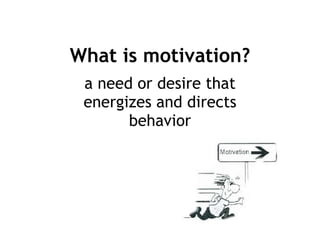
What is motivation? a need or desire that energizes and directs behavior
Theories of Motivation Instinct Theory Drive Theory Incentive Theory Arousal Theory Maslow's Humanistic Theory Cognitive Theory
Instinct Theory What is Instinct ? Behavior that is inherited by  all members of the species
Instinct Theory Developed theory to explain human behavior People could modify their behavior by learning and experiences Theory Disappeared In America but continued in European Zoologists called ethnologists (Williams James 1890)
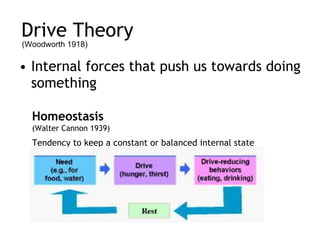
Drive Theory Internal forces that push us towards doing something (Woodworth 1918) Homeostasis  (Walter Cannon 1939) Tendency to keep a constant or balanced internal state
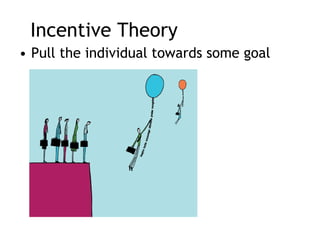
Incentive Theory Pull the individual towards some goal
Arousal Theory state of being awake   Optimum level of Arousal We are motivated to maintain an optimum level of arousal Sensation Seeking We are motivated to maintain an optimum level of arousal Arousal and Performance Sensation seeking focuses on the need for new and varied experiences
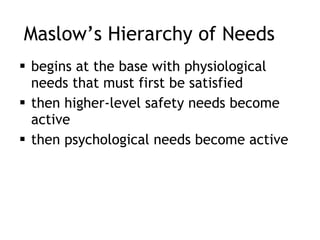
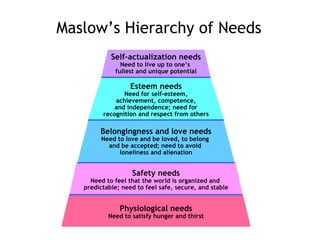
begins at the base with physiological needs that must first be satisfied then higher-level safety needs become active  then psychological needs become active Maslow’s Hierarchy of Needs
Maslow’s Hierarchy of Needs Self-actualization needs Need to live up to one’s  fullest and unique potential Esteem needs Need for self-esteem, achievement, competence, and independence; need for recognition and respect from others Safety needs Need to feel that the world is organized and  predictable; need to feel safe, secure, and stable Belongingness and love needs Need to love and be loved, to belong  and be accepted; need to avoid  loneliness and alienation Physiological needs Need to satisfy hunger and thirst
Cognitive Theory Cognitive motivation Individual that learn certain behaviors lead to certain goods they develop cognitive expectancy that motivate them to exhibit those behavior
Cognitive Theory Expectancy value Julian rotter developed this theory in 1954. He argued that behavior is the result of our expectations of achieving goals and the value that those goals have for us. We are motivated to maximize the value of our behavior choice  Attributes  The cognitive process of determining the motives of someone’s behavior
Biological Motives Hunger Eating Disorder Thirst
 
Motivation-Hunger Hunger is a complicated motivation; people eat only because they need food.
Eating Disorders Anorexia Nervosa when a normal-weight person diets and becomes significantly ( > 15%) underweight, yet, still feeling fat, continues to starve usually an adolescent female Bulimia Nervosa disorder characterized by episodes of overeating, usually of high-calorie foods, followed by vomiting, laxative use, fasting, or excessive exercise
Thirst Thirst  is the basic  instinct  of humans or animals to  drink .  Thirst  motivation, is like that of hunger
Stimulus Motives Sensory Stimuliation Exploration & Curosity Competence
Sensory Stimuliation It is excitement or motivation to learn or do something  Being excited or motivated through the five senses: seeing, hearing, smelling, touching, and tasting.
Curiosity and Exploration  Curiosity Curiosity is defined as a need, thirst or desire for knowledge  Berlyne (1966)  Exploration Exploration refers to all activities concerned with gathering information  about the environment.
Competence  Competence is the ability to perform some task. Incompetence is its opposite  Intrinsic Intrinsic motivation refers to motivation that comes from inside an  individual rather than from any external or outside rewards,  such as money or grades  Extrinsic Extrinsic motivation refers to motivation that comes from outside an  individual. The motivating factors are external, or outside, rewards  such as money or grades. These rewards provide satisfaction and  pleasure that the task itself may not provide.
Learned Social Motives Achievement Power Affliation
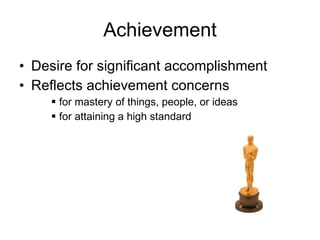
Achievement Desire for significant accomplishment Reflects achievement concerns for mastery of things, people, or ideas for attaining a high standard
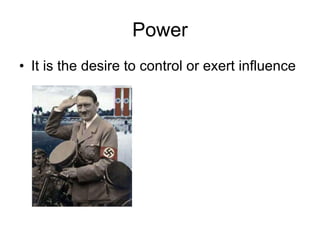
Power It is the desire to control or exert influence
Affliation to describe a partnership between two or more parties

What Is Motivation

  • 1.
  • 2.
    What is motivation?a need or desire that energizes and directs behavior
  • 3.
    Theories of MotivationInstinct Theory Drive Theory Incentive Theory Arousal Theory Maslow's Humanistic Theory Cognitive Theory
  • 4.
    Instinct Theory Whatis Instinct ? Behavior that is inherited by all members of the species
  • 5.
    Instinct Theory Developedtheory to explain human behavior People could modify their behavior by learning and experiences Theory Disappeared In America but continued in European Zoologists called ethnologists (Williams James 1890)
  • 6.
    Drive Theory Internalforces that push us towards doing something (Woodworth 1918) Homeostasis (Walter Cannon 1939) Tendency to keep a constant or balanced internal state
  • 7.
    Incentive Theory Pullthe individual towards some goal
  • 8.
    Arousal Theory stateof being awake Optimum level of Arousal We are motivated to maintain an optimum level of arousal Sensation Seeking We are motivated to maintain an optimum level of arousal Arousal and Performance Sensation seeking focuses on the need for new and varied experiences
  • 9.
    begins at thebase with physiological needs that must first be satisfied then higher-level safety needs become active then psychological needs become active Maslow’s Hierarchy of Needs
  • 10.
    Maslow’s Hierarchy ofNeeds Self-actualization needs Need to live up to one’s fullest and unique potential Esteem needs Need for self-esteem, achievement, competence, and independence; need for recognition and respect from others Safety needs Need to feel that the world is organized and predictable; need to feel safe, secure, and stable Belongingness and love needs Need to love and be loved, to belong and be accepted; need to avoid loneliness and alienation Physiological needs Need to satisfy hunger and thirst
  • 11.
    Cognitive Theory Cognitivemotivation Individual that learn certain behaviors lead to certain goods they develop cognitive expectancy that motivate them to exhibit those behavior
  • 12.
    Cognitive Theory Expectancyvalue Julian rotter developed this theory in 1954. He argued that behavior is the result of our expectations of achieving goals and the value that those goals have for us. We are motivated to maximize the value of our behavior choice Attributes The cognitive process of determining the motives of someone’s behavior
  • 13.
    Biological Motives HungerEating Disorder Thirst
  • 14.
  • 15.
    Motivation-Hunger Hunger isa complicated motivation; people eat only because they need food.
  • 16.
    Eating Disorders AnorexiaNervosa when a normal-weight person diets and becomes significantly ( > 15%) underweight, yet, still feeling fat, continues to starve usually an adolescent female Bulimia Nervosa disorder characterized by episodes of overeating, usually of high-calorie foods, followed by vomiting, laxative use, fasting, or excessive exercise
  • 17.
    Thirst Thirst is the basic instinct of humans or animals to drink . Thirst motivation, is like that of hunger
  • 18.
    Stimulus Motives SensoryStimuliation Exploration & Curosity Competence
  • 19.
    Sensory Stimuliation Itis excitement or motivation to learn or do something Being excited or motivated through the five senses: seeing, hearing, smelling, touching, and tasting.
  • 20.
    Curiosity and Exploration Curiosity Curiosity is defined as a need, thirst or desire for knowledge Berlyne (1966) Exploration Exploration refers to all activities concerned with gathering information about the environment.
  • 21.
    Competence Competenceis the ability to perform some task. Incompetence is its opposite Intrinsic Intrinsic motivation refers to motivation that comes from inside an individual rather than from any external or outside rewards, such as money or grades Extrinsic Extrinsic motivation refers to motivation that comes from outside an individual. The motivating factors are external, or outside, rewards such as money or grades. These rewards provide satisfaction and pleasure that the task itself may not provide.
  • 22.
    Learned Social MotivesAchievement Power Affliation
  • 23.
    Achievement Desire forsignificant accomplishment Reflects achievement concerns for mastery of things, people, or ideas for attaining a high standard
  • 24.
    Power It isthe desire to control or exert influence
  • 25.
    Affliation to describea partnership between two or more parties