Pakistan Review of Economic Performance
Pakistan : Quick FACTS ISLAMIC REPUBLIC OF PAKISTAN Area:  796,095 sq km Population : 165 mln  Capital City:  Islamabad Religion:  97% Muslim, 3% Christian and Hindu Government:  Federal Republic Head of State:  Mr. Asif Ali Zardari Real GDP Growth rate – FY08:  5.8% Annual Per Capita Income:  US $ 1085 Inflation:  12.0%%  Legal System:  Common Law Major Industries:  Textiles, sugar, vegetable oils, agricultural products, cement, fertilizers, steel, chemicals, sporting goods, light engineering Major trade partners for exports:  U.S., U.A.E, U.K, Germany, and Hong Kong Major trade partners for imports:  U.A.E, Saudi Arabia, Kuwait, U.S, and Japan
PAKISTAN: PAST ECONOMIC PERFORMANCE
Real GDP Growth GDP growth of over 5% has been witnessed 9 times during the last 18 years period (FY91 to FY08).Out of this, the most consistent pattern of high GDP growth was experienced during the Musharraf era.  Other instances of high GDP growth were seen during the 90s, under the government of Nawaz Sharif (FY91 & FY92) and Benazir Bhutto (FY95 and FY96). A slowdown in economic activity was experienced during the period FY97 to FY02 due to the deteriorating economic condition of the country during this period.
Sectoral Share in GDP Our economy is heavily dependent on the service sector, which has a share of about 53% in the GDP of Pakistan Agriculture remains the second important contributor in GDP, with a share of 21% (FY08).  The share of manufacturing sector, the third largest contributor, has increased from 15% to 19% during the same period, which can partly be attributed to the rising consumerism during this period which led to increased production and sales by manufacturing sector (e.g. Automobile sector)
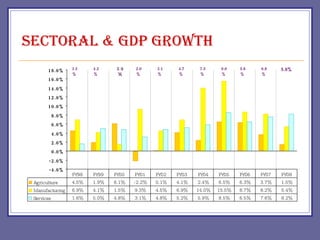
Sectoral & GDP Growth 3.5% 4.2% 3.9% 2.0% 3.1% 4.7% 7.5% 9.0% 5.8% 6.8% 5.8%
Foreign Private Investment - (US Mln $)
Monetary Assets(M2) Growth M2, which includes cash in circulation and deposits, has experienced high growth FY02 onwards with a average growth of 17.4% during the period. The high M2 growth has resulted in excess demand and is partly responsible for the high inflationary pressures currently being experienced by our country The high interest rates prevalent in the economy will however result in controlling the M2 growth going forward, which is  targeted  to be curtailed to 10% in the FY09 as per the  agreement with IMF.
BREAK OF BUDGET DEFICIT FINANCING Privatization Proceeds Non-Bank Bank External Financing (in Billions) FY08P FY07 FY06 FY05 FY04 FY03 FY02 FY01 FY00 FY99 -  71  97  28  11  4  8  -  -  -  100  57  8  8  61  120  85  92  97  156  464  102  71  60  64  (56) 14  (33) 40  (74) 119  147  149  120  (6) 113  83  121  70  97
Trade Balance The trade balance of Pakistan has grown by more than 7 times during the 10 year period FY98 to FY08. The imports of the country picked up pace  from FY05 onwards The increased imports during the last year are largely to Petroleum products, Edible Oil and  import of Wheat and Fertilizer. * Source:  State Bank Of Pakistan
Remittances -  (us mln $) 1490 1060 984 1,087 2,389 3,872 4,237 4,169 4,600 5,494 6,451 2,966
Current Account Deficit Source: State Bank of Pakistan, Economic Survey 2007-08
External Debt -  (US mln $) * Source: SBP website
Inflation
Subsidies -  (PKR mln)
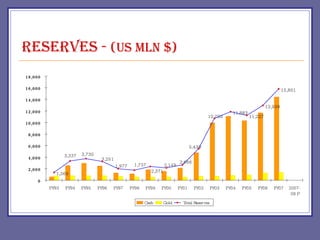
Reserves -  (US mln $)
Per Capita Income ($)
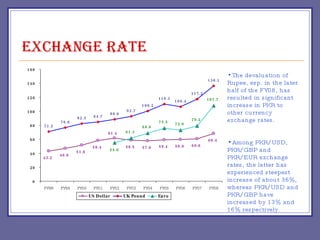
Exchange Rate The devaluation of Rupee, esp. in the later half of the FY08, has resulted in significant increase in PKR to other currency exchange rates. Among PKR/USD, PKR/GBP and PKR/EUR exchange rates, the latter has experienced steepest increase of about 36%, whereas PKR/USD and PKR/GBP have increased by 13% and 16% respectively .
SECTOR-WISE PERFORMANCE
AUTO SECTOR
 
Fertilizer sector
 
Cement Sector
ENERGY SECTOR * Source: Economic Survey 2007-08 and ADB website
 
BANKING SECTOR
Lending Rate Deposit Rate Spread

Economic indicators -_pakistan2

  • 1.
    Pakistan Review ofEconomic Performance
  • 2.
    Pakistan : QuickFACTS ISLAMIC REPUBLIC OF PAKISTAN Area: 796,095 sq km Population : 165 mln Capital City: Islamabad Religion: 97% Muslim, 3% Christian and Hindu Government: Federal Republic Head of State: Mr. Asif Ali Zardari Real GDP Growth rate – FY08: 5.8% Annual Per Capita Income: US $ 1085 Inflation: 12.0%% Legal System: Common Law Major Industries: Textiles, sugar, vegetable oils, agricultural products, cement, fertilizers, steel, chemicals, sporting goods, light engineering Major trade partners for exports: U.S., U.A.E, U.K, Germany, and Hong Kong Major trade partners for imports: U.A.E, Saudi Arabia, Kuwait, U.S, and Japan
  • 3.
  • 4.
    Real GDP GrowthGDP growth of over 5% has been witnessed 9 times during the last 18 years period (FY91 to FY08).Out of this, the most consistent pattern of high GDP growth was experienced during the Musharraf era. Other instances of high GDP growth were seen during the 90s, under the government of Nawaz Sharif (FY91 & FY92) and Benazir Bhutto (FY95 and FY96). A slowdown in economic activity was experienced during the period FY97 to FY02 due to the deteriorating economic condition of the country during this period.
  • 5.
    Sectoral Share inGDP Our economy is heavily dependent on the service sector, which has a share of about 53% in the GDP of Pakistan Agriculture remains the second important contributor in GDP, with a share of 21% (FY08). The share of manufacturing sector, the third largest contributor, has increased from 15% to 19% during the same period, which can partly be attributed to the rising consumerism during this period which led to increased production and sales by manufacturing sector (e.g. Automobile sector)
  • 6.
    Sectoral & GDPGrowth 3.5% 4.2% 3.9% 2.0% 3.1% 4.7% 7.5% 9.0% 5.8% 6.8% 5.8%
  • 7.
  • 8.
    Monetary Assets(M2) GrowthM2, which includes cash in circulation and deposits, has experienced high growth FY02 onwards with a average growth of 17.4% during the period. The high M2 growth has resulted in excess demand and is partly responsible for the high inflationary pressures currently being experienced by our country The high interest rates prevalent in the economy will however result in controlling the M2 growth going forward, which is targeted to be curtailed to 10% in the FY09 as per the agreement with IMF.
  • 9.
    BREAK OF BUDGETDEFICIT FINANCING Privatization Proceeds Non-Bank Bank External Financing (in Billions) FY08P FY07 FY06 FY05 FY04 FY03 FY02 FY01 FY00 FY99 - 71 97 28 11 4 8 - - - 100 57 8 8 61 120 85 92 97 156 464 102 71 60 64 (56) 14 (33) 40 (74) 119 147 149 120 (6) 113 83 121 70 97
  • 10.
    Trade Balance Thetrade balance of Pakistan has grown by more than 7 times during the 10 year period FY98 to FY08. The imports of the country picked up pace from FY05 onwards The increased imports during the last year are largely to Petroleum products, Edible Oil and import of Wheat and Fertilizer. * Source: State Bank Of Pakistan
  • 11.
    Remittances - (us mln $) 1490 1060 984 1,087 2,389 3,872 4,237 4,169 4,600 5,494 6,451 2,966
  • 12.
    Current Account DeficitSource: State Bank of Pakistan, Economic Survey 2007-08
  • 13.
    External Debt - (US mln $) * Source: SBP website
  • 14.
  • 15.
    Subsidies - (PKR mln)
  • 16.
    Reserves - (US mln $)
  • 17.
  • 18.
    Exchange Rate Thedevaluation of Rupee, esp. in the later half of the FY08, has resulted in significant increase in PKR to other currency exchange rates. Among PKR/USD, PKR/GBP and PKR/EUR exchange rates, the latter has experienced steepest increase of about 36%, whereas PKR/USD and PKR/GBP have increased by 13% and 16% respectively .
  • 19.
  • 20.
  • 21.
  • 22.
  • 23.
  • 24.
  • 25.
    ENERGY SECTOR *Source: Economic Survey 2007-08 and ADB website
  • 26.
  • 27.
  • 28.