What is Media Literacy? Renee Hobbs Temple University Philadelphia PA
  TECHNOLOGY
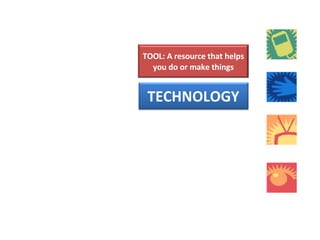
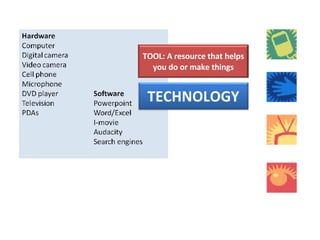
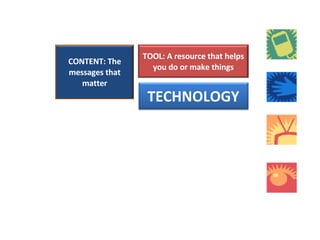
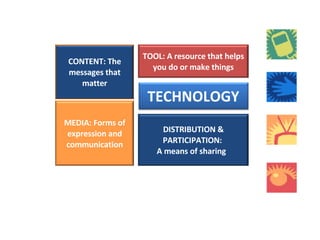
  TOOL: A resource that helps you do or make things TECHNOLOGY
  TOOL: A resource that helps you do or make things TECHNOLOGY
  TOOL: A resource that helps you do or make things TECHNOLOGY CONTENT: The messages that matter
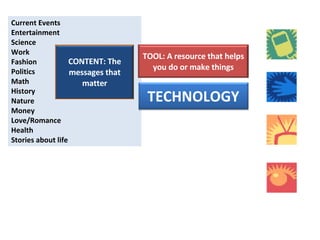
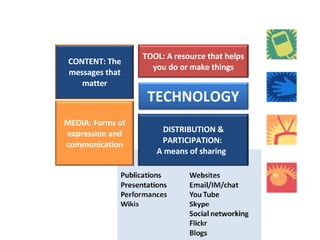
  Current Events Entertainment Science Work Fashion Politics Math History Nature Money Love/Romance Health Stories about life TOOL: A resource that helps you do or make things TECHNOLOGY CONTENT: The messages that matter
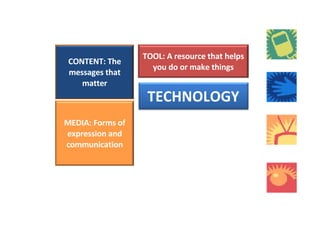
MEDIA: Forms of expression and communication TOOL: A resource that helps you do or make things TECHNOLOGY CONTENT: The messages that matter
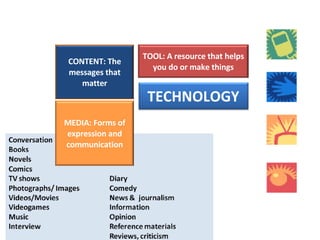
TOOL: A resource that helps you do or make things TECHNOLOGY CONTENT: The messages that matter MEDIA: Forms of expression and communication
DISTRIBUTION & PARTICIPATION:  A means of sharing  TOOL: A resource that helps you do or make things TECHNOLOGY CONTENT: The messages that matter MEDIA: Forms of expression and communication
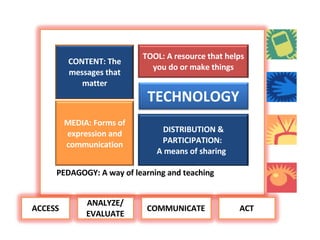
  PEDAGOGY: A way of learning and teaching  ACCESS ANALYZE/ EVALUATE COMMUNICATE ACT TOOL: A resource that helps you do or make things TECHNOLOGY CONTENT: The messages that matter DISTRIBUTION & PARTICIPATION:  A means of sharing  MEDIA: Forms of expression and communication
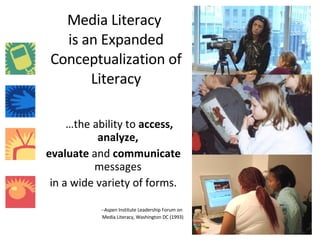
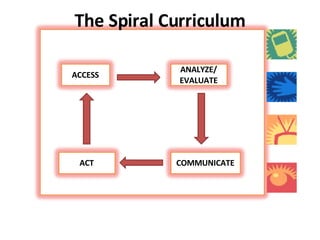
Media Literacy  is an Expanded Conceptualization of Literacy … the ability to  access,   analyze,  evaluate  and  communicate  messages  in a wide variety of forms. --Aspen Institute Leadership Forum on  Media Literacy, Washington DC (1993)
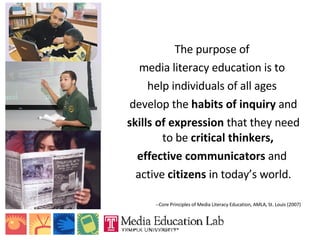
The purpose of  media literacy education is to  help individuals of all ages  develop the  habits of inquiry  and skills of expression  that they need to be  critical thinkers,  effective communicators  and  active  citizens  in today’s world. --Core Principles of Media Literacy Education, AMLA, St. Louis (2007)
The Spiral Curriculum ACCESS ANALYZE/ EVALUATE COMMUNICATE ACT
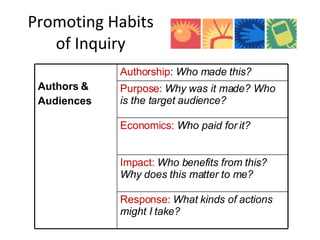
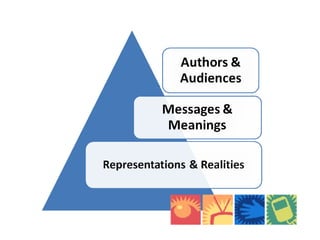
Promoting Habits of Inquiry Authors &  Audiences Authorship :  Who made this? Purpose:   Why was it made? Who is the target audience? Economics:   Who paid for it? Impact:  Who benefits from this? Why does this matter to me? Response:  What kinds of actions might I take?
Promoting Habits of Inquiry Messages & Meanings Content:  What is this about? What values and points of view are expressed?  What is omitted? Techniques:   How was this constructed?  What tools and techniques were used?  Interpretations:   How might different people understand this message? What is my interpretation and what do I learn about myself from my reaction?
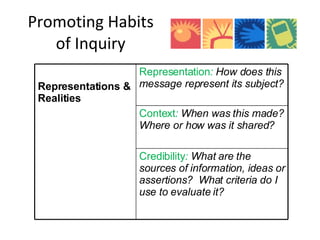
Promoting Habits of Inquiry Representations & Realities Representation :  How does this message represent its subject? Context :  When was this made? Where or how was it shared? Credibility :  What are the sources of information, ideas or assertions?  What criteria do I use to evaluate it?
 
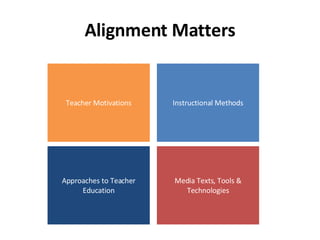
Alignment Matters Teacher Motivations Approaches to Teacher Education Instructional Methods Media Texts, Tools & Technologies
Teacher Education and  Media/Technology Integration   Independently initiated by teacher enthusiast who is: comfortable with technology & risk-taking motivated by a passionate interest  responsive and respectful of students confident in the recursive process of curriculum development
Teacher Education and  Media/Technology Integration   Independently initiated by teacher enthusiast who is: comfortable with technology & risk-taking motivated by a passionate interest  responsive and respectful of students confident in the recursive process of curriculum development Introduced through staff development with teachers who may be: unclear about the purposes and goals of integrating media/technology uncomfortable when feeling loss of expertise or loss of control unfamiliar with or uninterested in technology confused about what can/should be done
Renee Hobbs Founder, Media Education Lab Professor, Department of Broadcasting, Telecommunications and Mass Media School of Communications & Theater | College of Education Temple University Philadelphia PA 19122 Email:  [email_address] http://mediaeducationab.com

What Is Media Literacy?

  • 1.
    What is MediaLiteracy? Renee Hobbs Temple University Philadelphia PA
  • 2.
  • 3.
      TOOL: Aresource that helps you do or make things TECHNOLOGY
  • 4.
      TOOL: Aresource that helps you do or make things TECHNOLOGY
  • 5.
      TOOL: Aresource that helps you do or make things TECHNOLOGY CONTENT: The messages that matter
  • 6.
      Current EventsEntertainment Science Work Fashion Politics Math History Nature Money Love/Romance Health Stories about life TOOL: A resource that helps you do or make things TECHNOLOGY CONTENT: The messages that matter
  • 7.
    MEDIA: Forms ofexpression and communication TOOL: A resource that helps you do or make things TECHNOLOGY CONTENT: The messages that matter
  • 8.
    TOOL: A resourcethat helps you do or make things TECHNOLOGY CONTENT: The messages that matter MEDIA: Forms of expression and communication
  • 9.
    DISTRIBUTION & PARTICIPATION: A means of sharing TOOL: A resource that helps you do or make things TECHNOLOGY CONTENT: The messages that matter MEDIA: Forms of expression and communication
  • 10.
    DISTRIBUTION & PARTICIPATION: A means of sharing TOOL: A resource that helps you do or make things TECHNOLOGY CONTENT: The messages that matter MEDIA: Forms of expression and communication
  • 11.
      PEDAGOGY: Away of learning and teaching ACCESS ANALYZE/ EVALUATE COMMUNICATE ACT TOOL: A resource that helps you do or make things TECHNOLOGY CONTENT: The messages that matter DISTRIBUTION & PARTICIPATION: A means of sharing MEDIA: Forms of expression and communication
  • 12.
    Media Literacy is an Expanded Conceptualization of Literacy … the ability to access, analyze, evaluate and communicate messages in a wide variety of forms. --Aspen Institute Leadership Forum on Media Literacy, Washington DC (1993)
  • 13.
    The purpose of media literacy education is to help individuals of all ages develop the habits of inquiry and skills of expression that they need to be critical thinkers, effective communicators and active citizens in today’s world. --Core Principles of Media Literacy Education, AMLA, St. Louis (2007)
  • 14.
    The Spiral CurriculumACCESS ANALYZE/ EVALUATE COMMUNICATE ACT
  • 15.
    Promoting Habits ofInquiry Authors & Audiences Authorship : Who made this? Purpose: Why was it made? Who is the target audience? Economics: Who paid for it? Impact: Who benefits from this? Why does this matter to me? Response: What kinds of actions might I take?
  • 16.
    Promoting Habits ofInquiry Messages & Meanings Content: What is this about? What values and points of view are expressed? What is omitted? Techniques: How was this constructed? What tools and techniques were used? Interpretations: How might different people understand this message? What is my interpretation and what do I learn about myself from my reaction?
  • 17.
    Promoting Habits ofInquiry Representations & Realities Representation : How does this message represent its subject? Context : When was this made? Where or how was it shared? Credibility : What are the sources of information, ideas or assertions? What criteria do I use to evaluate it?
  • 18.
  • 19.
    Alignment Matters TeacherMotivations Approaches to Teacher Education Instructional Methods Media Texts, Tools & Technologies
  • 20.
    Teacher Education and Media/Technology Integration   Independently initiated by teacher enthusiast who is: comfortable with technology & risk-taking motivated by a passionate interest responsive and respectful of students confident in the recursive process of curriculum development
  • 21.
    Teacher Education and Media/Technology Integration   Independently initiated by teacher enthusiast who is: comfortable with technology & risk-taking motivated by a passionate interest responsive and respectful of students confident in the recursive process of curriculum development Introduced through staff development with teachers who may be: unclear about the purposes and goals of integrating media/technology uncomfortable when feeling loss of expertise or loss of control unfamiliar with or uninterested in technology confused about what can/should be done
  • 22.
    Renee Hobbs Founder,Media Education Lab Professor, Department of Broadcasting, Telecommunications and Mass Media School of Communications & Theater | College of Education Temple University Philadelphia PA 19122 Email: [email_address] http://mediaeducationab.com