Digital and Media LiteracyRedeeming the promise of technology
Why literacy?“Acquiring literacy does not involve memorising sentences, words or syllables … but rather an attitude of creation and re-creation, a self-transformation producing a stance of intervention in one's context."  Paulo Freire, Education: The Practice of Freedom (1973)
Why digital?The 3 r’s are no longer enough :Digital technologies are changing:How we do businessHow we do researchHow we interact with each otherAll demand a new literacy for successful participation in a democratic society.
What is digital literacy?cognitive, emotional and social competencies that include:the use of texts, tools and technologiesthe skills of critical thinking and analysisthe practice of message composition and creativitythe ability to engage in reflection and ethical thinkingactive participation through teamwork and collaboration.From: Digital and Media Literacy: A plan of action. (Hobbs, 2011)
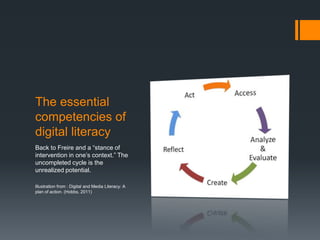
The essential competencies of digital literacyBack to Freire and a “stance of intervention in one’s context.” The uncompleted cycle is the unrealized potential.Illustration from : Digital and Media Literacy: A plan of action. (Hobbs, 2011)
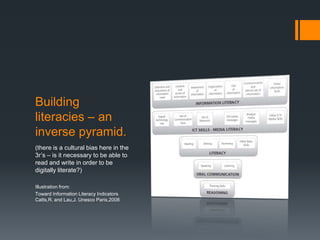
Building literacies – an inverse pyramid.(there is a cultural bias here in the 3r’s – is it necessary to be able to read and write in order to be digitally literate?)Illustration from:Toward Information Literacy Indicators Catts,R. and Lau,J. Unesco Paris,2008
How we learn about technology Most adults born before 1968 learn computer skills informally, or at work, while younger users are taught in school.Strawn,C. The Relationship Between Literacy Proficiency and the Digital Divide Among Adults With Low Education Attainment. 2008What are the implications of this for any digital literacy work?
A concernWill people be able to transfer self-developed digital skills beyond their affinity groups, etc…?What is necessary to facilitate the “skillful use” of digital technologies?
Acceptable technologies?Revive audio as a delivery formExplore games as learningUnite what is learned online with what is enacted locallyCreatively engage in a variety of bandwidthsNot just desktop or videoconferencingText messaging, audiocasting for mobile phones
A questionable statement?“Digital and media literacy education requires and supports the practices of reading comprehension and writing.”From: Digital and Media Literacy: A plan of action. (Hobbs, 2011)
Digital and localWhile technologies may “collapse distance”, we still live in a particular place at a specific timeBalancing literacy educations to respect both the interconnectedness, and locality, of life is the challenge facing us today.
Challenges New literacies bridge local and global knowledge and concernsWe already participate in some facets of this workIs new literacy education consistent with our mission?
ContactPaul Treadwellpt36@cornell.edu@ptreadwellhttp://pt36.posterous.com/Digital literacy and extension: bookmarkshttp://groups.diigo.com/group/digital-literacy_extension

Digital and media literacy

  • 1.
    Digital and MediaLiteracyRedeeming the promise of technology
  • 2.
    Why literacy?“Acquiring literacydoes not involve memorising sentences, words or syllables … but rather an attitude of creation and re-creation, a self-transformation producing a stance of intervention in one's context."  Paulo Freire, Education: The Practice of Freedom (1973)
  • 3.
    Why digital?The 3r’s are no longer enough :Digital technologies are changing:How we do businessHow we do researchHow we interact with each otherAll demand a new literacy for successful participation in a democratic society.
  • 4.
    What is digitalliteracy?cognitive, emotional and social competencies that include:the use of texts, tools and technologiesthe skills of critical thinking and analysisthe practice of message composition and creativitythe ability to engage in reflection and ethical thinkingactive participation through teamwork and collaboration.From: Digital and Media Literacy: A plan of action. (Hobbs, 2011)
  • 5.
    The essential competenciesof digital literacyBack to Freire and a “stance of intervention in one’s context.” The uncompleted cycle is the unrealized potential.Illustration from : Digital and Media Literacy: A plan of action. (Hobbs, 2011)
  • 6.
    Building literacies –an inverse pyramid.(there is a cultural bias here in the 3r’s – is it necessary to be able to read and write in order to be digitally literate?)Illustration from:Toward Information Literacy Indicators Catts,R. and Lau,J. Unesco Paris,2008
  • 7.
    How we learnabout technology Most adults born before 1968 learn computer skills informally, or at work, while younger users are taught in school.Strawn,C. The Relationship Between Literacy Proficiency and the Digital Divide Among Adults With Low Education Attainment. 2008What are the implications of this for any digital literacy work?
  • 8.
    A concernWill peoplebe able to transfer self-developed digital skills beyond their affinity groups, etc…?What is necessary to facilitate the “skillful use” of digital technologies?
  • 9.
    Acceptable technologies?Revive audioas a delivery formExplore games as learningUnite what is learned online with what is enacted locallyCreatively engage in a variety of bandwidthsNot just desktop or videoconferencingText messaging, audiocasting for mobile phones
  • 10.
    A questionable statement?“Digitaland media literacy education requires and supports the practices of reading comprehension and writing.”From: Digital and Media Literacy: A plan of action. (Hobbs, 2011)
  • 11.
    Digital and localWhiletechnologies may “collapse distance”, we still live in a particular place at a specific timeBalancing literacy educations to respect both the interconnectedness, and locality, of life is the challenge facing us today.
  • 12.
    Challenges New literaciesbridge local and global knowledge and concernsWe already participate in some facets of this workIs new literacy education consistent with our mission?
  • 13.
    ContactPaul Treadwellpt36@cornell.edu@ptreadwellhttp://pt36.posterous.com/Digital literacyand extension: bookmarkshttp://groups.diigo.com/group/digital-literacy_extension

Editor's Notes

  • #5 In this report, the term “digital and media literacy” is used to encompass the full range of cognitive, emotional and social competencies that includes the use of texts, tools and technologies; the skills of critical thinking and analysis; the practice of message composition and creativity; the ability to engage in reflection and ethical thinking; as well as active participation through teamwork and collaboration. When people have digital and media literacy competencies, they recognize personal, corporate and political agendas and are empowered to speak out on behalf of the missing voices and omitted perspectives in our communities. By identifying and attempting to solve problems, people use their powerful voices and their rights under the law to improve the world around them.