Lecturer: Duong Vo Nhi Anh, VNU-
HCM
Office: Room O2-602
Email: dvnanh@hcmiu.edu.vn
1
Course Objectives
 Understand the definitions Logistics and Supply Chain
 Understand the concept and key points of Supply Chain
Management.
 Understand how to manage Supply Chain and Logistics in
real companies.
 Apply to a group project.
2
References
 Text book: Logistics - An Introduction to Supply
Chain Management, Donald Waters, PALGRAVE MACMILLAN, 2003.
 Reference books: Supply Chain Logistics Management, Donald J.
Bowersox, David J. Closs and M. Bixby Cooper, McGraw Hill, 2002.
 Lecture Notes: Logistics and Supply Chain Management
Grading
 Midterm Exam 30%
 Assignment 30%
-Quiz, Home works 25%
-Group Project 75%
 Final Exam 40%
3
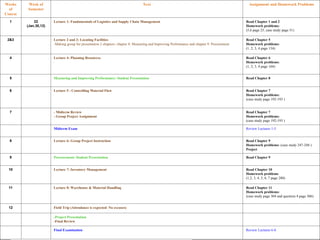
Weeks
of
Course
Week of
Semester
Text Assignment and Homework Problems
1 22
(Jan.30,12)
Lecture 1: Fundamentals of Logistics and Supply Chain Management Read Chapter 1 and 2
Homework problems:
(5,6 page 25, case study page 51)
2&3 Lecture 2 and 3: Locating Facilities
-Making group for presentation 2 chapters: chapter 8: Measuring and Improving Performance and chapter 9: Procurement
Read Chapter 5
Homework problems:
(1, 2, 3, 4 page 134)
4 Lecture 4: Planning Resources Read Chapter 6
Homework problems:
(1, 2, 3, 4 page 164)
5 Measuring and Improving Performance: Student Presentation Read Chapter 8
6 Lecture 5 : Controlling Material Flow Read Chapter 7
Homework problems:
(case study page 192-193 )
7 - Midterm Review
- Group Project Assignment
Read Chapter 7
Homework problems:
(case study page 192-193 )
Midterm Exam Review Lectures 1-5
8 Lecture 6: Group Project Instruction Read Chapter 9
Homework problems: (case study 247-248 )
Project
9 Procurement: Student Presentation Read Chapter 9
10 Lecture 7: Inventory Management Read Chapter 10
Homework problems
(1,2, 3, 4, 5, 6, 7 page 280)
11 Lecture 8: Warehouse & Material Handling Read Chapter 11
Homework problems:
(case study page 304 and question 4 page 306)
12 Field Trip (Attendance is expected- No excuses)
-Project Presentation
-Final Review
Final Examination Review Lectures 6-8
Chapter 1
Fundamentals of
Logistics
5
Learning Objectives
 DEFINE ‘logistics’ and associated terms
 UNDERSTAND the role and structure of supply chains
 LIST different activities of logistics and understand
the relationships between them
 DISCUSS the aims of logistics
 SHOW how logistics contributes to customer
satisfaction
 RECOGNISE the importance of logistics to every
organization.
6
1. Basics Definition
 All organizations move materials.
Manufacturers: raw materials finished goods.
 Definition of Logistics: Logistics is the function that is
responsible for the movement of materials (and information).
It is responsible for the transport and storage of materials
between suppliers and customers.
 According to the
Council of Supply Chain Management Professionals (CSCMP), a
professional organization for Logistics and SCM professionals,
logistics is defined as: “the process of planning, implementing and
controlling the efficient, effective flow and storage of goods, services
and related information from point of origin to point of consumption
for the purpose of conforming to customer requirements”
7
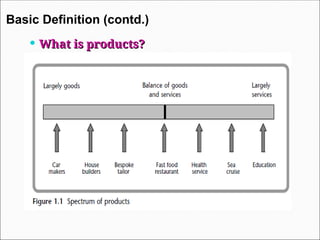
 what is products?
what is products?
 What is products?
What is products?
Basic Definition (contd.)
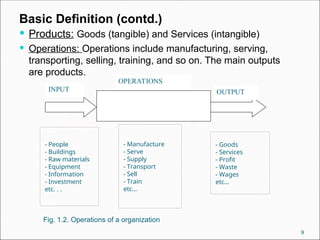
 Products: Goods (tangible) and Services (intangible)
 Operations: Operations include manufacturing, serving,
transporting, selling, training, and so on. The main outputs
are products.
9
- People
- Buildings
- Raw materials
- Equipment
- Information
- Investment
etc. . .
INPUT OUTPUT
OPERATIONS
- Manufacture
- Serve
- Supply
- Transport
- Sell
- Train
etc…
- Goods
- Services
- Profit
- Waste
- Wages
etc…
Fig. 1.2. Operations of a organization
Basics Definition (contd.)
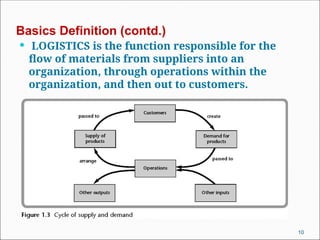
 LOGISTICS is the function responsible for the
flow of materials from suppliers into an
organization, through operations within the
organization, and then out to customers.
10
11
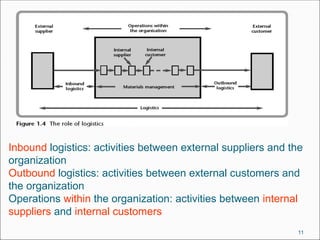
Inbound logistics: activities between external suppliers and the
organization
Outbound logistics: activities between external customers and
the organization
Operations within the organization: activities between internal
suppliers and internal customers
Link:
http://www.youtube.com/watch?v=V4JRH3e4xrg&featur
e=related
12
2. THE SUPPLY CHAIN
-Different names for these chains of activities and organizations.
emphasize the operations, refer to the process;
emphasize marketing, call it a logistics channel;
look at the value added, call it a value chain,
see how customer demands are satisfied, call it a demand chain.
---Here we are emphasizing the movement of materials and will
use the most general term of supply chain.
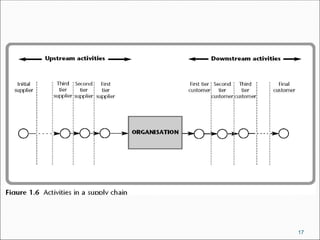
A SUPPLY CHAIN consists of the series of activities and
organizations that materials move through on their journey
from initial suppliers to final customers.
2. role and structure of supply
chains
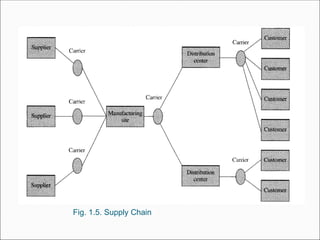
 Inbound logistics: activities between external
suppliers and the organisation
 Outbound logistics: activities between external
customers and the organisation
 Operations within the organisation: activities
between internal suppliers and internal
customers
Fig. 1.5. Supply Chain
16
Structure of the supply chain
 SUPPLY CHAIN = a series of activities and
organizations that move materials from initial
suppliers to final customers
 Upstream supply chain activities: involve initial
supplier, third tier supplier, second tier supplier, first
tier supplier
 Downstream supply chain activities: involve first tier
customer, second tier customer, third tier customer,
final customer
17
18
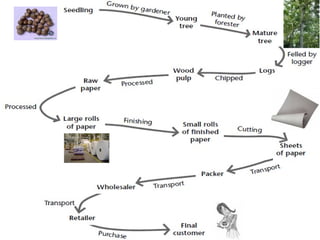
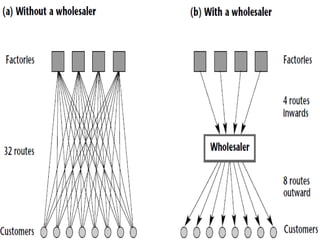
 Do you want to avoid supply chain?
Do you want to avoid supply chain?
EG: The market of vegetables
the sugar and sugar cane, beet
Well , You can get answer from figure!
Benefit from Supply Chain
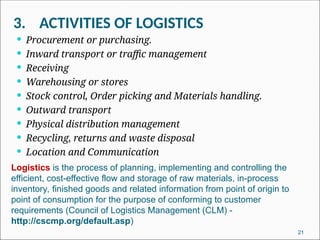
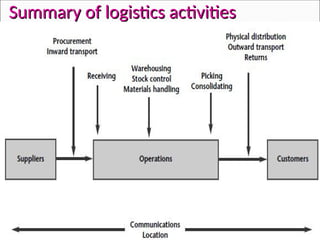
3. ACTIVITIES OF LOGISTICS
21
 Procurement or purchasing.
 Inward transport or traffic management
 Receiving
 Warehousing or stores
 Stock control, Order picking and Materials handling.
 Outward transport
 Physical distribution management
 Recycling, returns and waste disposal
 Location and Communication
Logistics is the process of planning, implementing and controlling the
efficient, cost-effective flow and storage of raw materials, in-process
inventory, finished goods and related information from point of origin to
point of consumption for the purpose of conforming to customer
requirements (Council of Logistics Management (CLM) -
http://cscmp.org/default.asp)
Summary of logistics activities

Case Study
 NIKE logistics center
http://www.youtube.com/watch?
v=NkfHVYv5nUo&feature=related
 How UPS Cargo Containers Work
http://www.youtube.com/watch?v=MyeqlieHhi4
 Simulation http://www.youtube.com/watch?
v=_0UJ0lKnn_o&feature=related
23
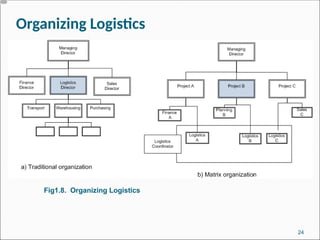
Organizing Logistics
24
Fig1.8. Organizing Logistics
4. Aims of logistics
 When you buy an item, what kind of contents will be take
into your consider?
Aims of Logistics
 Logistics is responsible for the flow of materials
through a supply chain. This function is also called
supply chain management.
 LOGISTICS is the time-related positioning of resources,
or the strategic manage­
ment of the total supply-chain
 The SUPPLY-CHAIN is a sequence of events intended to
satisfy a customer.
 The overall AIM OF LOGISTICS is to achieve high
customer satisfaction. It must provide a high quality
service with low – or acceptable – costs.
26
27
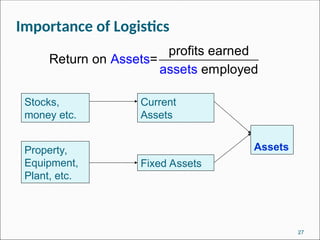
profits earne
Assets
asse
d
Re
ts
turn on =
employed
Stocks,
money etc.
Property,
Equipment,
Plant, etc.
Current
Assets
Fixed Assets
Assets
Importance of Logistics
28
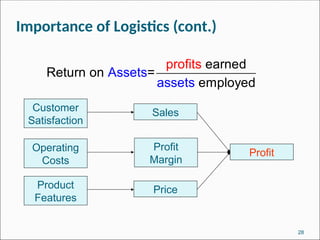
profits earne
Assets
asse
d
Re
ts
turn on =
employed
Customer
Satisfaction
Operating
Costs
Product
Features
Sales
Profit
Margin
Price
Profit
Importance of Logistics (cont.)
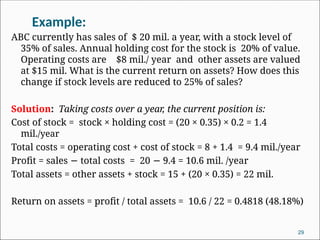
Example:
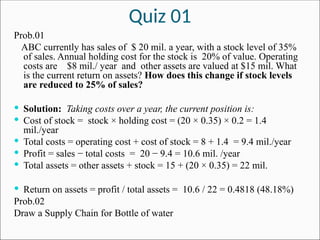
ABC currently has sales of $ 20 mil. a year, with a stock level of
35% of sales. Annual holding cost for the stock is 20% of value.
Operating costs are $8 mil./ year and other assets are valued
at $15 mil. What is the current return on assets? How does this
change if stock levels are reduced to 25% of sales?
Solution: Taking costs over a year, the current position is:
Cost of stock = stock × holding cost = (20 × 0.35) × 0.2 = 1.4
mil./year
Total costs = operating cost + cost of stock = 8 + 1.4 = 9.4 mil./year
Profit = sales total costs = 20 9.4 = 10.6 mil. /year
− −
Total assets = other assets + stock = 15 + (20 × 0.35) = 22 mil.
Return on assets = profit / total assets = 10.6 / 22 = 0.4818 (48.18%)
29
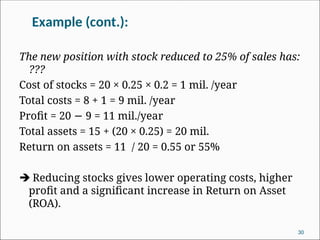
The new position with stock reduced to 25% of sales has:
???
Cost of stocks = 20 × 0.25 × 0.2 = 1 mil. /year
Total costs = 8 + 1 = 9 mil. /year
Profit = 20 9 = 11 mil./year
−
Total assets = 15 + (20 × 0.25) = 20 mil.
Return on assets = 11 / 20 = 0.55 or 55%
 Reducing stocks gives lower operating costs, higher
profit and a significant increase in Return on Asset
(ROA).
30
Example (cont.):
Development of logistics
pressures to the use of logistics
 Changes of Customers.
 Changes of Competition
 Other changes in retail markets
 International trade continues to grow.
 Organizations become to outsource peripheral activities and
concentrate on their core operations.
Current trends
 Improving communication
 Electronic data interchange (EDI)
 Electronic point-of-sales data (EPOS)
 e-purchasing of e-procurement
 …
 Support of EDI:
 Item coding (often bar-coding)
 Electronic Fund Transfer (EFT)
32
Current trends
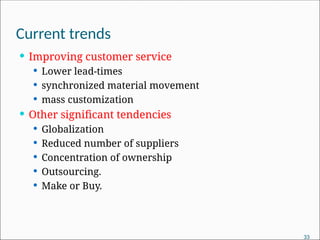
 Improving customer service
 Lower lead-times
 synchronized material movement
 mass customization
 Other significant tendencies
 Globalization
 Reduced number of suppliers
 Concentration of ownership
 Outsourcing.
 Make or Buy.
33
Current trends
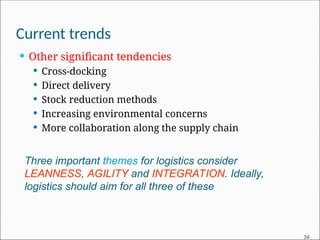
 Other significant tendencies
 Cross-docking
 Direct delivery
 Stock reduction methods
 Increasing environmental concerns
 More collaboration along the supply chain
Three important themes for logistics consider
LEANNESS, AGILITY and INTEGRATION. Ideally,
logistics should aim for all three of these
34
Current themes
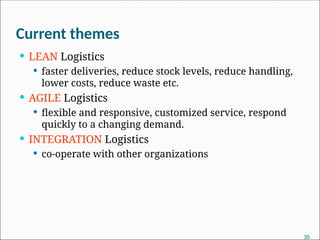
 LEAN Logistics
 faster deliveries, reduce stock levels, reduce handling,
lower costs, reduce waste etc.
 AGILE Logistics
 flexible and responsive, customized service, respond
quickly to a changing demand.
 INTEGRATION Logistics
 co-operate with other organizations
35
Summary
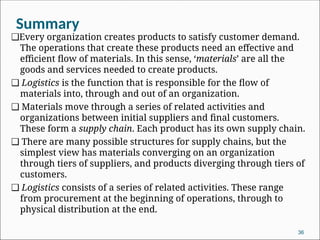
❑Every organization creates products to satisfy customer demand.
The operations that create these products need an effective and
efficient flow of materials. In this sense, ‘materials’ are all the
goods and services needed to create products.
❑ Logistics is the function that is responsible for the flow of
materials into, through and out of an organization.
❑ Materials move through a series of related activities and
organizations between initial suppliers and final customers.
These form a supply chain. Each product has its own supply chain.
❑ There are many possible structures for supply chains, but the
simplest view has materials converging on an organization
through tiers of suppliers, and products diverging through tiers of
customers.
❑ Logistics consists of a series of related activities. These range
from procurement at the beginning of operations, through to
physical distribution at the end.
36
Summary (cont.)
❑ An overall aim for logistics is to achieve high customer
satisfaction or perceived product value. This must be
achieved with acceptable costs.
❑ Every organization depends on the movement of
materials, and the way this is done affects costs, profits,
relations with suppliers and customers, customer service,
and virtually every other measure of performance.
❑ There are a lot of pressures for improving logistics.
Current trends are: Improving communication, Improving
customer service, some other significant tendencies.
❑ Current themes:
LEAN logistics, AGILE logistics, INTEGRATION logistics.
37
Quiz 01
Prob.01
ABC currently has sales of $ 20 mil. a year, with a stock level of 35%
of sales. Annual holding cost for the stock is 20% of value. Operating
costs are $8 mil./ year and other assets are valued at $15 mil. What
is the current return on assets? How does this change if stock levels
are reduced to 25% of sales?
 Solution: Taking costs over a year, the current position is:
 Cost of stock = stock × holding cost = (20 × 0.35) × 0.2 = 1.4
mil./year
 Total costs = operating cost + cost of stock = 8 + 1.4 = 9.4 mil./year
 Profit = sales − total costs = 20 − 9.4 = 10.6 mil. /year
 Total assets = other assets + stock = 15 + (20 × 0.35) = 22 mil.
 Return on assets = profit / total assets = 10.6 / 22 = 0.4818 (48.18%)
Prob.02
Draw a Supply Chain for Bottle of water
Home work 01
(Due: next class)
 5. The cost of logistics varies widely from organization to organization. What factors
affect these costs? Are the costs fixed or can they be controlled
 6. How could you find the best balance between service level and costs?
measures of service, perhaps emphasising an internal view rather than an external one.
 1.5 The cost of logistics varies widely from organisation to
organisation. What factors affect these costs? Are the costs fixed or
can they be controlled?
There can be a huge variety of logistics costs in different types of
organisation. The usual ones are the type of materials moved, its
weight, volume, perishability, value, special handling, packaging,
distances moved, and so on. Some of these are under the control of
logistics managers, but the majority are not (but perhaps logistic
manages can influence them).

1.7 How can a company find the best balance between service level and
costs?
This is a difficult question for which there is no simple answer.
Balancing costs and benefits is a key theme in logistics, and we return
to it frequently in the book.
Production Inventory &
Warehousing
Transportation
Customers
Manufacturers
Suppliers
Material
Transportation
Fig. 1.3. Logistics Network
Transportation
41
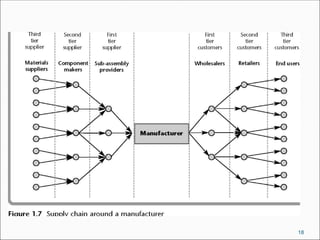
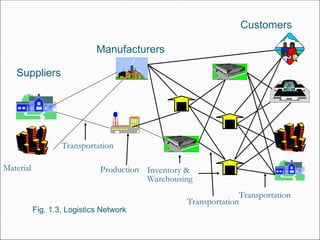
 In practice, most organizations get materials from
many different suppliers, and sell products to many
different customers.
 The supply chain converges as raw materials move
in through the tiers of suppliers, and diverges as
products move out through tiers of customers.
 A manufacturer might see sub-assembly providers as
first tier suppliers, component makers as second tier
suppliers, materials suppliers as third tier suppliers,
and so on. It might see whole­
salers as first tier
customers, retailers as second tier customers, and
end users as third tier customers .
Quiz 01
Draw a
Supply Chain for
Milk Products.

Logistics_Section_01_Introduction_nhi anh.ppt

  • 1.
    Lecturer: Duong VoNhi Anh, VNU- HCM Office: Room O2-602 Email: dvnanh@hcmiu.edu.vn 1
  • 2.
    Course Objectives  Understandthe definitions Logistics and Supply Chain  Understand the concept and key points of Supply Chain Management.  Understand how to manage Supply Chain and Logistics in real companies.  Apply to a group project. 2
  • 3.
    References  Text book:Logistics - An Introduction to Supply Chain Management, Donald Waters, PALGRAVE MACMILLAN, 2003.  Reference books: Supply Chain Logistics Management, Donald J. Bowersox, David J. Closs and M. Bixby Cooper, McGraw Hill, 2002.  Lecture Notes: Logistics and Supply Chain Management Grading  Midterm Exam 30%  Assignment 30% -Quiz, Home works 25% -Group Project 75%  Final Exam 40% 3
  • 4.
    Weeks of Course Week of Semester Text Assignmentand Homework Problems 1 22 (Jan.30,12) Lecture 1: Fundamentals of Logistics and Supply Chain Management Read Chapter 1 and 2 Homework problems: (5,6 page 25, case study page 51) 2&3 Lecture 2 and 3: Locating Facilities -Making group for presentation 2 chapters: chapter 8: Measuring and Improving Performance and chapter 9: Procurement Read Chapter 5 Homework problems: (1, 2, 3, 4 page 134) 4 Lecture 4: Planning Resources Read Chapter 6 Homework problems: (1, 2, 3, 4 page 164) 5 Measuring and Improving Performance: Student Presentation Read Chapter 8 6 Lecture 5 : Controlling Material Flow Read Chapter 7 Homework problems: (case study page 192-193 ) 7 - Midterm Review - Group Project Assignment Read Chapter 7 Homework problems: (case study page 192-193 ) Midterm Exam Review Lectures 1-5 8 Lecture 6: Group Project Instruction Read Chapter 9 Homework problems: (case study 247-248 ) Project 9 Procurement: Student Presentation Read Chapter 9 10 Lecture 7: Inventory Management Read Chapter 10 Homework problems (1,2, 3, 4, 5, 6, 7 page 280) 11 Lecture 8: Warehouse & Material Handling Read Chapter 11 Homework problems: (case study page 304 and question 4 page 306) 12 Field Trip (Attendance is expected- No excuses) -Project Presentation -Final Review Final Examination Review Lectures 6-8
  • 5.
  • 6.
    Learning Objectives  DEFINE‘logistics’ and associated terms  UNDERSTAND the role and structure of supply chains  LIST different activities of logistics and understand the relationships between them  DISCUSS the aims of logistics  SHOW how logistics contributes to customer satisfaction  RECOGNISE the importance of logistics to every organization. 6
  • 7.
    1. Basics Definition All organizations move materials. Manufacturers: raw materials finished goods.  Definition of Logistics: Logistics is the function that is responsible for the movement of materials (and information). It is responsible for the transport and storage of materials between suppliers and customers.  According to the Council of Supply Chain Management Professionals (CSCMP), a professional organization for Logistics and SCM professionals, logistics is defined as: “the process of planning, implementing and controlling the efficient, effective flow and storage of goods, services and related information from point of origin to point of consumption for the purpose of conforming to customer requirements” 7
  • 8.
     what isproducts? what is products?  What is products? What is products? Basic Definition (contd.)
  • 9.
    Basic Definition (contd.) Products: Goods (tangible) and Services (intangible)  Operations: Operations include manufacturing, serving, transporting, selling, training, and so on. The main outputs are products. 9 - People - Buildings - Raw materials - Equipment - Information - Investment etc. . . INPUT OUTPUT OPERATIONS - Manufacture - Serve - Supply - Transport - Sell - Train etc… - Goods - Services - Profit - Waste - Wages etc… Fig. 1.2. Operations of a organization
  • 10.
    Basics Definition (contd.) LOGISTICS is the function responsible for the flow of materials from suppliers into an organization, through operations within the organization, and then out to customers. 10
  • 11.
    11 Inbound logistics: activitiesbetween external suppliers and the organization Outbound logistics: activities between external customers and the organization Operations within the organization: activities between internal suppliers and internal customers
  • 12.
  • 13.
    2. THE SUPPLYCHAIN -Different names for these chains of activities and organizations. emphasize the operations, refer to the process; emphasize marketing, call it a logistics channel; look at the value added, call it a value chain, see how customer demands are satisfied, call it a demand chain. ---Here we are emphasizing the movement of materials and will use the most general term of supply chain. A SUPPLY CHAIN consists of the series of activities and organizations that materials move through on their journey from initial suppliers to final customers.
  • 14.
    2. role andstructure of supply chains
  • 15.
     Inbound logistics:activities between external suppliers and the organisation  Outbound logistics: activities between external customers and the organisation  Operations within the organisation: activities between internal suppliers and internal customers Fig. 1.5. Supply Chain
  • 16.
    16 Structure of thesupply chain  SUPPLY CHAIN = a series of activities and organizations that move materials from initial suppliers to final customers  Upstream supply chain activities: involve initial supplier, third tier supplier, second tier supplier, first tier supplier  Downstream supply chain activities: involve first tier customer, second tier customer, third tier customer, final customer
  • 17.
  • 18.
  • 19.
     Do youwant to avoid supply chain? Do you want to avoid supply chain? EG: The market of vegetables the sugar and sugar cane, beet Well , You can get answer from figure! Benefit from Supply Chain
  • 21.
    3. ACTIVITIES OFLOGISTICS 21  Procurement or purchasing.  Inward transport or traffic management  Receiving  Warehousing or stores  Stock control, Order picking and Materials handling.  Outward transport  Physical distribution management  Recycling, returns and waste disposal  Location and Communication Logistics is the process of planning, implementing and controlling the efficient, cost-effective flow and storage of raw materials, in-process inventory, finished goods and related information from point of origin to point of consumption for the purpose of conforming to customer requirements (Council of Logistics Management (CLM) - http://cscmp.org/default.asp)
  • 22.
    Summary of logisticsactivities Summary of logistics activities 
  • 23.
    Case Study  NIKElogistics center http://www.youtube.com/watch? v=NkfHVYv5nUo&feature=related  How UPS Cargo Containers Work http://www.youtube.com/watch?v=MyeqlieHhi4  Simulation http://www.youtube.com/watch? v=_0UJ0lKnn_o&feature=related 23
  • 24.
  • 25.
    4. Aims oflogistics  When you buy an item, what kind of contents will be take into your consider?
  • 26.
    Aims of Logistics Logistics is responsible for the flow of materials through a supply chain. This function is also called supply chain management.  LOGISTICS is the time-related positioning of resources, or the strategic manage­ ment of the total supply-chain  The SUPPLY-CHAIN is a sequence of events intended to satisfy a customer.  The overall AIM OF LOGISTICS is to achieve high customer satisfaction. It must provide a high quality service with low – or acceptable – costs. 26
  • 27.
    27 profits earne Assets asse d Re ts turn on= employed Stocks, money etc. Property, Equipment, Plant, etc. Current Assets Fixed Assets Assets Importance of Logistics
  • 28.
    28 profits earne Assets asse d Re ts turn on= employed Customer Satisfaction Operating Costs Product Features Sales Profit Margin Price Profit Importance of Logistics (cont.)
  • 29.
    Example: ABC currently hassales of $ 20 mil. a year, with a stock level of 35% of sales. Annual holding cost for the stock is 20% of value. Operating costs are $8 mil./ year and other assets are valued at $15 mil. What is the current return on assets? How does this change if stock levels are reduced to 25% of sales? Solution: Taking costs over a year, the current position is: Cost of stock = stock × holding cost = (20 × 0.35) × 0.2 = 1.4 mil./year Total costs = operating cost + cost of stock = 8 + 1.4 = 9.4 mil./year Profit = sales total costs = 20 9.4 = 10.6 mil. /year − − Total assets = other assets + stock = 15 + (20 × 0.35) = 22 mil. Return on assets = profit / total assets = 10.6 / 22 = 0.4818 (48.18%) 29
  • 30.
    The new positionwith stock reduced to 25% of sales has: ??? Cost of stocks = 20 × 0.25 × 0.2 = 1 mil. /year Total costs = 8 + 1 = 9 mil. /year Profit = 20 9 = 11 mil./year − Total assets = 15 + (20 × 0.25) = 20 mil. Return on assets = 11 / 20 = 0.55 or 55%  Reducing stocks gives lower operating costs, higher profit and a significant increase in Return on Asset (ROA). 30 Example (cont.):
  • 31.
    Development of logistics pressuresto the use of logistics pressures to the use of logistics  Changes of Customers.  Changes of Competition  Other changes in retail markets  International trade continues to grow.  Organizations become to outsource peripheral activities and concentrate on their core operations.
  • 32.
    Current trends  Improvingcommunication  Electronic data interchange (EDI)  Electronic point-of-sales data (EPOS)  e-purchasing of e-procurement  …  Support of EDI:  Item coding (often bar-coding)  Electronic Fund Transfer (EFT) 32
  • 33.
    Current trends  Improvingcustomer service  Lower lead-times  synchronized material movement  mass customization  Other significant tendencies  Globalization  Reduced number of suppliers  Concentration of ownership  Outsourcing.  Make or Buy. 33
  • 34.
    Current trends  Othersignificant tendencies  Cross-docking  Direct delivery  Stock reduction methods  Increasing environmental concerns  More collaboration along the supply chain Three important themes for logistics consider LEANNESS, AGILITY and INTEGRATION. Ideally, logistics should aim for all three of these 34
  • 35.
    Current themes  LEANLogistics  faster deliveries, reduce stock levels, reduce handling, lower costs, reduce waste etc.  AGILE Logistics  flexible and responsive, customized service, respond quickly to a changing demand.  INTEGRATION Logistics  co-operate with other organizations 35
  • 36.
    Summary ❑Every organization createsproducts to satisfy customer demand. The operations that create these products need an effective and efficient flow of materials. In this sense, ‘materials’ are all the goods and services needed to create products. ❑ Logistics is the function that is responsible for the flow of materials into, through and out of an organization. ❑ Materials move through a series of related activities and organizations between initial suppliers and final customers. These form a supply chain. Each product has its own supply chain. ❑ There are many possible structures for supply chains, but the simplest view has materials converging on an organization through tiers of suppliers, and products diverging through tiers of customers. ❑ Logistics consists of a series of related activities. These range from procurement at the beginning of operations, through to physical distribution at the end. 36
  • 37.
    Summary (cont.) ❑ Anoverall aim for logistics is to achieve high customer satisfaction or perceived product value. This must be achieved with acceptable costs. ❑ Every organization depends on the movement of materials, and the way this is done affects costs, profits, relations with suppliers and customers, customer service, and virtually every other measure of performance. ❑ There are a lot of pressures for improving logistics. Current trends are: Improving communication, Improving customer service, some other significant tendencies. ❑ Current themes: LEAN logistics, AGILE logistics, INTEGRATION logistics. 37
  • 38.
    Quiz 01 Prob.01 ABC currentlyhas sales of $ 20 mil. a year, with a stock level of 35% of sales. Annual holding cost for the stock is 20% of value. Operating costs are $8 mil./ year and other assets are valued at $15 mil. What is the current return on assets? How does this change if stock levels are reduced to 25% of sales?  Solution: Taking costs over a year, the current position is:  Cost of stock = stock × holding cost = (20 × 0.35) × 0.2 = 1.4 mil./year  Total costs = operating cost + cost of stock = 8 + 1.4 = 9.4 mil./year  Profit = sales − total costs = 20 − 9.4 = 10.6 mil. /year  Total assets = other assets + stock = 15 + (20 × 0.35) = 22 mil.  Return on assets = profit / total assets = 10.6 / 22 = 0.4818 (48.18%) Prob.02 Draw a Supply Chain for Bottle of water
  • 39.
    Home work 01 (Due:next class)  5. The cost of logistics varies widely from organization to organization. What factors affect these costs? Are the costs fixed or can they be controlled  6. How could you find the best balance between service level and costs? measures of service, perhaps emphasising an internal view rather than an external one.  1.5 The cost of logistics varies widely from organisation to organisation. What factors affect these costs? Are the costs fixed or can they be controlled? There can be a huge variety of logistics costs in different types of organisation. The usual ones are the type of materials moved, its weight, volume, perishability, value, special handling, packaging, distances moved, and so on. Some of these are under the control of logistics managers, but the majority are not (but perhaps logistic manages can influence them).  1.7 How can a company find the best balance between service level and costs? This is a difficult question for which there is no simple answer. Balancing costs and benefits is a key theme in logistics, and we return to it frequently in the book.
  • 40.
  • 41.
    41  In practice,most organizations get materials from many different suppliers, and sell products to many different customers.  The supply chain converges as raw materials move in through the tiers of suppliers, and diverges as products move out through tiers of customers.  A manufacturer might see sub-assembly providers as first tier suppliers, component makers as second tier suppliers, materials suppliers as third tier suppliers, and so on. It might see whole­ salers as first tier customers, retailers as second tier customers, and end users as third tier customers .
  • 42.
    Quiz 01 Draw a SupplyChain for Milk Products.

Editor's Notes

  • #7 CSCMP-This definition includes the flows of matls and services in both the manufacturing and services sector The services sector include entities gov., hospital, restaurants,…