

Current, Potential Difference
and Resistance


           Jurongville Secondary School
           Secondary 3A
           Science
Topic Overview
1.   Introduction
2.   Electric Current
3.   Potential Difference
4.   Resistance
5.   Factors Affecting Resistance
INTRODUCTION
Who Discovered Electricity?
 The history of electricity goes back more than two thousand years, to the
 time the Ancient Greeks discovered that rubbing fur on amber caused an
 attraction between the two. By the 17th century, many electricity-related
 discoveries had been made, such as the invention of an early
 electrostatic generator, the differentiation between positive and negative
 currents, and the classification of materials as conductors or insulators.
 In the year 1600, English physician William Gilbert conned the term
 electric, from the Greek elektron, to identify the force that certain
 substances exert when rubbed against each other.

 While many believe Benjamin Franklin to be the father of electricity,
 current findings seem to show otherwise. In 1752, Franklin is said to
 have performed the famous experiment of flying a kite during a
 thunderstorm, which led to the discovery that lightning and electricity
 were somehow related. Modern scientists know this to be something of a
 tall tale, since being hit by lightning would have been fatal. It's likely that
 Franklin was actually insulated, away from the path of lightning.
Who Discovered Electricity?
          The kite experiment helped Franklin establish a relationship
between lightning and electricity, which led to the invention of the lightning
rod. Benjamin Franklin went on to observe other phenomena related to
electricity, but many believe that he didn't actually discover its true nature.
          In 1800, Italian-born physicist Alessandro Volta constructed the
voltaic pile, later known as the electric battery, the first device to produce a
steady electric current. It was Volta, not Franklin, who discovered that
certain chemical reactions could produce electricity. Volta also created the
first transmission of electricity by linking positively-charged and negatively-
charged connectors and driving an electrical charge, or voltage, through
them.
          It wasn't until 1831 that electricity became viable for use in
technology. English scientist Michael Faraday created the electric dynamo,
a crude precursor of modern power generators. This invention opened the
door to the new era of electricity. A few decades later, in 1879, Thomas Alva
Edison invented the light bulb.
Famous Scientists
- Click on the links below to read more about them…


      Coulomb          Volta           Ampere


 Charles Augustin de Coulomb 70yrs
 Alessandro Giuseppe Antonio Anastasio Volta 82yrs
 André Marie Ampère 61yrs
1. Electric Current
Electric Current
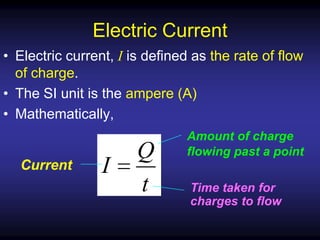
• Electric current, I is defined as the rate of flow
  of charge.
• The SI unit is the ampere (A)
• Mathematically,
                               Amount of charge
                       Q       flowing past a point
  Current        I
                       t        Time taken for
                                charges to flow
C


Charges flowing slowly – small current
Charges flowing quickly – large current
Video on Electric Current
• Click here to view a video on current.
Electric Current
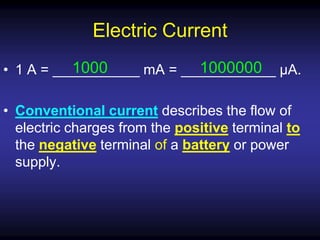
          1000             1000000
• 1 A = ___________ mA = ____________ μA.

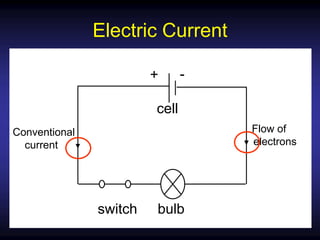
• Conventional current describes the flow of
  electric charges from the positive terminal to
  the negative terminal of a battery or power
  supply.
Electric Current

                        +      -

                        cell
Conventional                       Flow of
  current                          electrons


               switch   bulb
Electric Current

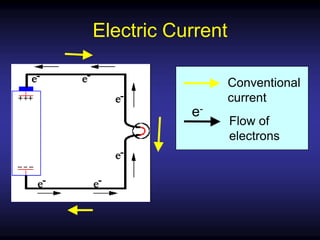
                   Conventional
                   current
           e-
                   Flow of
                   electrons
Measuring Electric Current
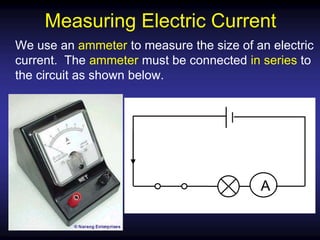
We use an ammeter to measure the size of an electric
current. The ammeter must be connected in series to
the circuit as shown below.


                                          A
Measuring Electric Current


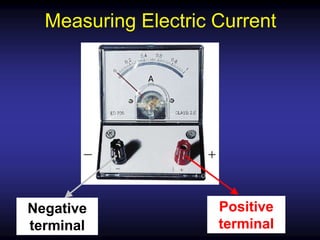
Negative             Positive
terminal             terminal
Measuring Electric Current
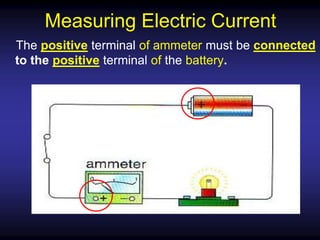
The positive terminal of ammeter must be connected
to the positive terminal of the battery.
Measuring Electric Current


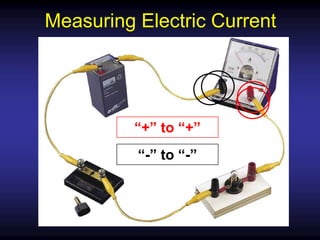
          “+” to “+”
          “-” to “-”
Example 1
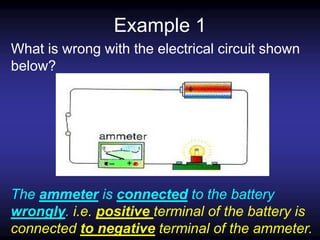
What is wrong with the electrical circuit shown
below?


                –   +


The ammeter is connected to the battery
wrongly. i.e. positive terminal of the battery is
connected to negative terminal of the ammeter.
Example 2
What is the reading on the ammeter shown
below?


10 divisions  0.2 A
1 division  0.2 / 10 = 0.02 A
Ammeter reading = 14 divisions
                    = 0.02 x 14 = 0.28 A
2. POTENTIAL DIFFERENCE
          (p.d.)
2. Potential Difference (p.d.)
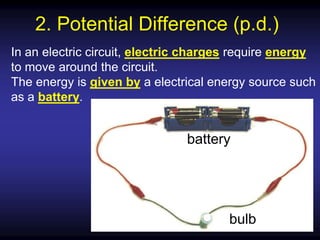
In an electric circuit, electric charges require energy
to move around the circuit.
The energy is given by a electrical energy source such
as a battery.


                               battery


                                       bulb
Potential Difference (p.d.)
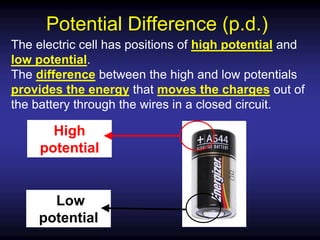
The electric cell has positions of high potential and
low potential.
The difference between the high and low potentials
provides the energy that moves the charges out of
the battery through the wires in a closed circuit.

       High
     potential


       Low
     potential
Potential Difference (p.d.)
• When there is a potential difference across a
  conductor, a current will flow through the
  conductor.
• The SI unit is the volt (V)
Measuring Potential difference.
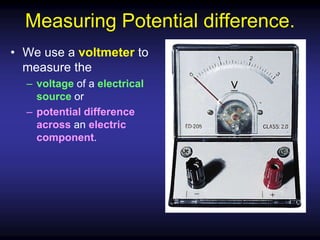
• We use a voltmeter to
  measure the
  – voltage of a electrical
    source or
  – potential difference
    across an electric
    component.
Measuring Potential Difference


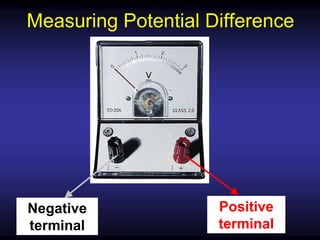
Negative             Positive
terminal             terminal
Measuring Potential Difference
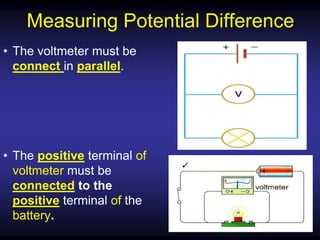
• The voltmeter must be
  connect in parallel.


• The positive terminal of
  voltmeter must be
  connected to the
  positive terminal of the
  battery.
Example 3
What is wrong with the electrical circuit shown
below?


              voltmeter

                –   +


The voltmeter is connected wrongly. i.e. it
should be connected in parallel with the bulb.
Example 4
What is the reading on the voltmeter shown
below?


10 divisions  1 V
1 division  1 / 10 = 0.1 V
Voltmeter reading = 12 divisions
                    = 0.1 x 12 = 1.2 V
3. RESISTANCE
What is resistance?
• Resistance is a measure of how difficult it is
  for an electric current to pass through a
  material.
• It is a property of the material that restricts
  the movement of charges in the material.
Optional: Video on Resistance
Click on links to view videos on
resistance.
• Video 1
• Video 2
Resistance
Resistance is defined as the ratio of the
potential difference across the resistor to the
current flowing through it.

                               Volt, V
                   V
                 R
                   I            Ampere, A

The SI Unit of resistance is ohm (Ω).
Example 5
A coil of wire is connected across a 6 V batter. If the
current in the wire is 0.3 A, what is the resistance of
the wire?


              V 6
            R                       20
              I 0.3
The resistance of the wire is 20 Ω

9 current, potential difference & resistance hbl (edited )

  • 1.
    Current, Potential Difference andResistance Jurongville Secondary School Secondary 3A Science
  • 2.
    Topic Overview 1. Introduction 2. Electric Current 3. Potential Difference 4. Resistance 5. Factors Affecting Resistance
  • 3.
  • 4.
    Who Discovered Electricity? The history of electricity goes back more than two thousand years, to the time the Ancient Greeks discovered that rubbing fur on amber caused an attraction between the two. By the 17th century, many electricity-related discoveries had been made, such as the invention of an early electrostatic generator, the differentiation between positive and negative currents, and the classification of materials as conductors or insulators. In the year 1600, English physician William Gilbert conned the term electric, from the Greek elektron, to identify the force that certain substances exert when rubbed against each other. While many believe Benjamin Franklin to be the father of electricity, current findings seem to show otherwise. In 1752, Franklin is said to have performed the famous experiment of flying a kite during a thunderstorm, which led to the discovery that lightning and electricity were somehow related. Modern scientists know this to be something of a tall tale, since being hit by lightning would have been fatal. It's likely that Franklin was actually insulated, away from the path of lightning.
  • 5.
    Who Discovered Electricity? The kite experiment helped Franklin establish a relationship between lightning and electricity, which led to the invention of the lightning rod. Benjamin Franklin went on to observe other phenomena related to electricity, but many believe that he didn't actually discover its true nature. In 1800, Italian-born physicist Alessandro Volta constructed the voltaic pile, later known as the electric battery, the first device to produce a steady electric current. It was Volta, not Franklin, who discovered that certain chemical reactions could produce electricity. Volta also created the first transmission of electricity by linking positively-charged and negatively- charged connectors and driving an electrical charge, or voltage, through them. It wasn't until 1831 that electricity became viable for use in technology. English scientist Michael Faraday created the electric dynamo, a crude precursor of modern power generators. This invention opened the door to the new era of electricity. A few decades later, in 1879, Thomas Alva Edison invented the light bulb.
  • 6.
    Famous Scientists - Clickon the links below to read more about them… Coulomb Volta Ampere Charles Augustin de Coulomb 70yrs Alessandro Giuseppe Antonio Anastasio Volta 82yrs André Marie Ampère 61yrs
  • 7.
  • 8.
    Electric Current • Electriccurrent, I is defined as the rate of flow of charge. • The SI unit is the ampere (A) • Mathematically, Amount of charge Q flowing past a point Current I t Time taken for charges to flow
  • 9.
    C Charges flowing slowly– small current Charges flowing quickly – large current
  • 10.
    Video on ElectricCurrent • Click here to view a video on current.
  • 11.
    Electric Current 1000 1000000 • 1 A = ___________ mA = ____________ μA. • Conventional current describes the flow of electric charges from the positive terminal to the negative terminal of a battery or power supply.
  • 12.
    Electric Current + - cell Conventional Flow of current electrons switch bulb
  • 13.
    Electric Current Conventional current e- Flow of electrons
  • 14.
  • 15.
    Measuring Electric Current Weuse an ammeter to measure the size of an electric current. The ammeter must be connected in series to the circuit as shown below. A
  • 16.
    Measuring Electric Current Negative Positive terminal terminal
  • 17.
    Measuring Electric Current Thepositive terminal of ammeter must be connected to the positive terminal of the battery.
  • 18.
    Measuring Electric Current “+” to “+” “-” to “-”
  • 19.
    Example 1 What iswrong with the electrical circuit shown below? – + The ammeter is connected to the battery wrongly. i.e. positive terminal of the battery is connected to negative terminal of the ammeter.
  • 20.
    Example 2 What isthe reading on the ammeter shown below? 10 divisions  0.2 A 1 division  0.2 / 10 = 0.02 A Ammeter reading = 14 divisions = 0.02 x 14 = 0.28 A
  • 21.
  • 22.
    2. Potential Difference(p.d.) In an electric circuit, electric charges require energy to move around the circuit. The energy is given by a electrical energy source such as a battery. battery bulb
  • 23.
    Potential Difference (p.d.) Theelectric cell has positions of high potential and low potential. The difference between the high and low potentials provides the energy that moves the charges out of the battery through the wires in a closed circuit. High potential Low potential
  • 24.
    Potential Difference (p.d.) •When there is a potential difference across a conductor, a current will flow through the conductor. • The SI unit is the volt (V)
  • 25.
    Measuring Potential difference. •We use a voltmeter to measure the – voltage of a electrical source or – potential difference across an electric component.
  • 26.
    Measuring Potential Difference Negative Positive terminal terminal
  • 27.
    Measuring Potential Difference •The voltmeter must be connect in parallel. • The positive terminal of voltmeter must be connected to the positive terminal of the battery.
  • 28.
    Example 3 What iswrong with the electrical circuit shown below? voltmeter – + The voltmeter is connected wrongly. i.e. it should be connected in parallel with the bulb.
  • 29.
    Example 4 What isthe reading on the voltmeter shown below? 10 divisions  1 V 1 division  1 / 10 = 0.1 V Voltmeter reading = 12 divisions = 0.1 x 12 = 1.2 V
  • 30.
  • 31.
    What is resistance? •Resistance is a measure of how difficult it is for an electric current to pass through a material. • It is a property of the material that restricts the movement of charges in the material.
  • 32.
    Optional: Video onResistance Click on links to view videos on resistance. • Video 1 • Video 2
  • 33.
    Resistance Resistance is definedas the ratio of the potential difference across the resistor to the current flowing through it. Volt, V V R I Ampere, A The SI Unit of resistance is ohm (Ω).
  • 34.
    Example 5 A coilof wire is connected across a 6 V batter. If the current in the wire is 0.3 A, what is the resistance of the wire? V 6 R 20 I 0.3 The resistance of the wire is 20 Ω