This document covers potential difference, power, and resistance in electrical circuits. It defines potential difference as another term for voltage and describes how batteries provide potential difference to allow the conversion of electrical energy into other forms like light. It gives examples of electrical energy being converted to energy in a toaster or heat in a wire. It defines power as the rate of doing work, measured in watts, and provides the formulas to calculate power as P=VI, P=I^2R, and P=V^2/R. It describes using data loggers and circuits to measure voltage, current, and calculate power, and how resistance affects current in a circuit. Components that obey Ohm's law are identified.
In this document
Powered by AI
Overview of potential difference, energy transfer, resistance heating, power formulas, and Ohm's law.
Potential difference (voltage) conversion of electrical energy to light energy, defined as work per coulomb.
Illustration of three energy transformations in electrical devices, connecting electrical energy to other forms.
Introduction to power with formulas, emphasizing calculations of power and work in circuits.
Examples involving calculations of electrical energy transfer, current through components, and power in circuits.
Exploration of resistance's effect on current flow, including disruptions in measurement using data loggers.
Discussion of experimental results and component characteristics in relation to Ohm's Law.
Recap of key concepts such as units of work and power, power formulas, and characteristics of diodes.
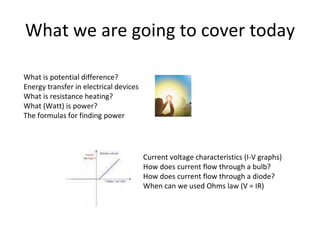
What we aregoing to cover today What is potential difference? Energy transfer in electrical devices What is resistance heating? What (Watt) is power? The formulas for finding power Current voltage characteristics (I-V graphs) How does current flow through a bulb? How does current flow through a diode? When can we used Ohms law (V = IR)
3.
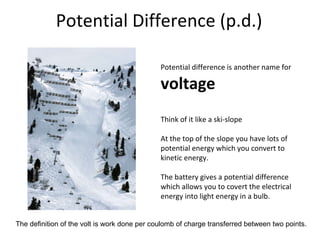
Potential Difference (p.d.)Potential difference is another name for voltage Think of it like a ski-slope At the top of the slope you have lots of potential energy which you convert to kinetic energy. The battery gives a potential difference which allows you to covert the electrical energy into light energy in a bulb. The definition of the volt is work done per coulomb of charge transferred between two points.
4.
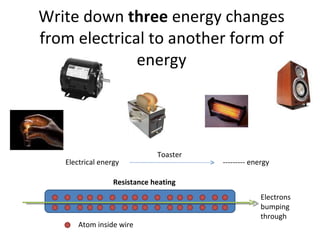
Write down three energy changes from electrical to another form of energy Electrical energy --------- energy Toaster Atom inside wire Electrons bumping through Resistance heating
5.
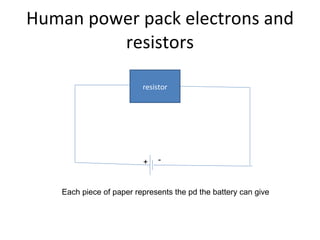
Human power packelectrons and resistors resistor + - Each piece of paper represents the pd the battery can give
6.
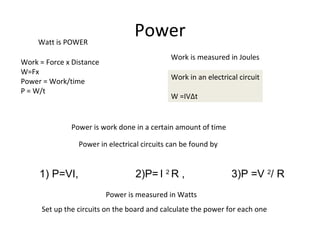
Power Work =Force x Distance W=Fx Power = Work/time P = W/t Watt is POWER Power is work done in a certain amount of time 1) P=VI, 2)P= I 2 R , 3)P =V 2 / R Power in electrical circuits can be found by Set up the circuits on the board and calculate the power for each one Work is measured in Joules Work in an electrical circuit W =IV∆t Power is measured in Watts
7.
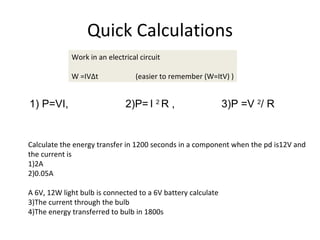
Quick Calculations Workin an electrical circuit W =IV∆t (easier to remember (W=ItV) ) 1) P=VI, 2)P= I 2 R , 3)P =V 2 / R Calculate the energy transfer in 1200 seconds in a component when the pd is12V and the current is 1)2A 2)0.05A A 6V, 12W light bulb is connected to a 6V battery calculate 3)The current through the bulb 4)The energy transferred to bulb in 1800s
8.
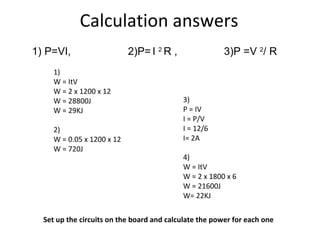
Calculation answers 1)W = ItV W = 2 x 1200 x 12 W = 28800J W = 29KJ 2) W = 0.05 x 1200 x 12 W = 720J 3) P = IV I = P/V I = 12/6 I= 2A 4) W = ItV W = 2 x 1800 x 6 W = 21600J W= 22KJ Set up the circuits on the board and calculate the power for each one 1) P=VI, 2)P= I 2 R , 3)P =V 2 / R
9.
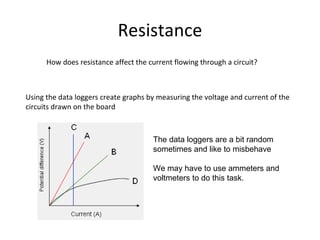
Resistance How doesresistance affect the current flowing through a circuit? Using the data loggers create graphs by measuring the voltage and current of the circuits drawn on the board The data loggers are a bit random sometimes and like to misbehave We may have to use ammeters and voltmeters to do this task.
10.
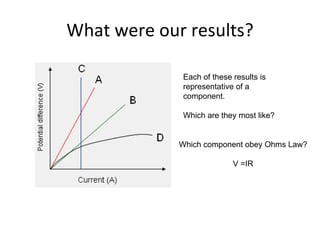
What were ourresults? Each of these results is representative of a component. Which are they most like? Which component obey Ohms Law? V =IR
11.
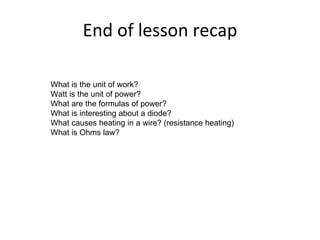
End of lessonrecap What is the unit of work? Watt is the unit of power? What are the formulas of power? What is interesting about a diode? What causes heating in a wire? (resistance heating) What is Ohms law?