Combine Methods andApproaches
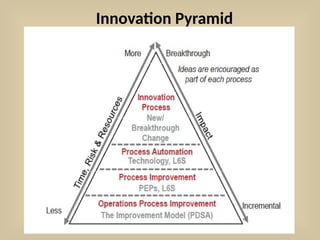
• Innovation
• Design
• TRIZ (“theory of inventive problem solving”)
• Lean Six Sigma
• Human Factors
• Theory of Constraints
• PDSA Continuous Improvement
Breakthrough Innovation
Revolutionary Science
Typicallyinvolves a paradigm shift
• Transistors
• Structure of DNA
• Quartz Watch Movement
1. Non-consumers or
2. Consumers who would not typically used the
products - are now able to consume
6.
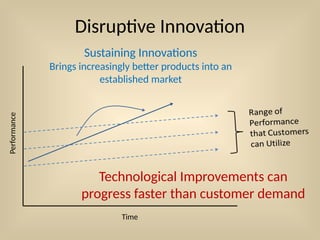
Sustaining Innovation
• Occursnaturally in an industry
• Almost always an improvement to the bottom
line
• If the innovation is not recognized or is
ignored – the company could suffer
• Generally, the innovation is handled well and
there is a natural transition in the industry
• Changes the “rules of the game”
7.
Disruptive Innovation
• Typicallyoriginates from outside of an
organization and frequently outside of the
industry
• It is like a wrecking ball in the way it changes
the industry
• Disruption changes the “the game itself”
• Industry leaders typically try to stop or negate
its impact – a losing proposition
Disruptive Innovation
• Theleading companies were destroyed because it
brought to market a product that was:
– Good Enough
– Simpler
– More Affordable
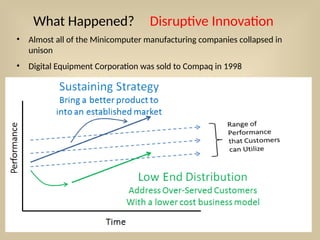
• These innovations inevitably improve, march
up-market and "disrupt" incumbents by
gradually pushing them out of ever more
complex and margin-rich product segments
10.
Disruptive Innovation
The term“Disruptive Innovation” is broadly
misunderstood
Many people think it’s just new and different, or
radical improvements
Instead, disruptive innovation changes industries
because:
1. It makes complicated and expensive
processes simple and
2. Opens them up to a wider audience
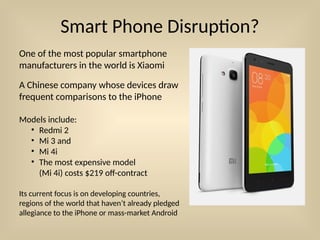
Smart Phone Disruption?
Modelsinclude:
• Redmi 2
• Mi 3 and
• Mi 4i
• The most expensive model
(Mi 4i) costs $219 off-contract
One of the most popular smartphone
manufacturers in the world is Xiaomi
A Chinese company whose devices draw
frequent comparisons to the iPhone
Its current focus is on developing countries,
regions of the world that haven’t already pledged
allegiance to the iPhone or mass-market Android
13.
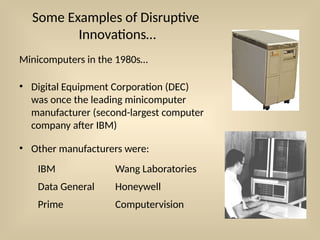
Some Examples ofDisruptive
Innovations…
Minicomputers in the 1980s…
• Digital Equipment Corporation (DEC)
was once the leading minicomputer
manufacturer (second-largest computer
company after IBM)
• Other manufacturers were:
IBM Wang Laboratories
Data General Honeywell
Prime Computervision
14.
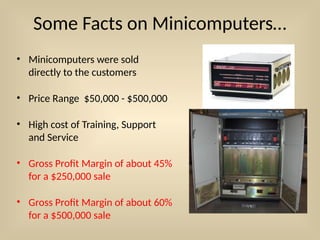
Some Facts onMinicomputers…
• Minicomputers were sold
directly to the customers
• Price Range $50,000 - $500,000
• High cost of Training, Support
and Service
• Gross Profit Margin of about 45%
for a $250,000 sale
• Gross Profit Margin of about 60%
for a $500,000 sale
15.
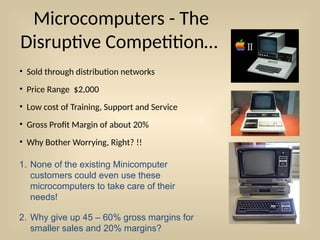
Microcomputers - The
DisruptiveCompetition…
• Sold through distribution networks
• Price Range $2,000
• Low cost of Training, Support and Service
• Gross Profit Margin of about 20%
• Why Bother Worrying, Right? !!
1. None of the existing Minicomputer
customers could even use these
microcomputers to take care of their
needs!
2. Why give up 45 – 60% gross margins for
smaller sales and 20% margins?
16.
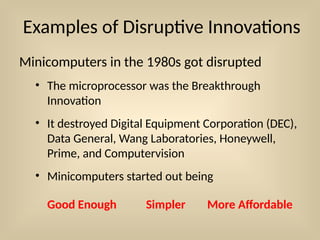
Examples of DisruptiveInnovations
Minicomputers in the 1980s got disrupted
• The microprocessor was the Breakthrough
Innovation
• It destroyed Digital Equipment Corporation (DEC),
Data General, Wang Laboratories, Honeywell,
Prime, and Computervision
• Minicomputers started out being
Good Enough Simpler More Affordable
17.
What Happened?
• Almostall of the Minicomputer manufacturing companies collapsed in
unison
• Digital Equipment Corporation was sold to Compaq in 1998
Disruptive Innovation
18.
Let’s Look atsome Examples
Toyota dominating the “Big 3” American Auto Makers
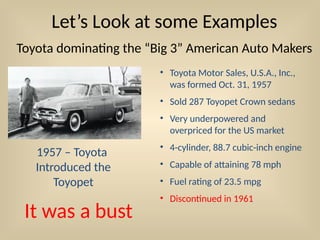
• Toyota Motor Sales, U.S.A., Inc.,
was formed Oct. 31, 1957
• Sold 287 Toyopet Crown sedans
• Very underpowered and
overpriced for the US market
• 4-cylinder, 88.7 cubic-inch engine
• Capable of attaining 78 mph
• Fuel rating of 23.5 mpg
• Discontinued in 1961
1957 – Toyota
Introduced the
Toyopet
It was a bust
19.
Let’s Look atsome other examples…
Next – They tried something different
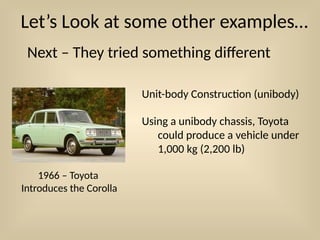
Unit-body Construction (unibody)
Using a unibody chassis, Toyota
could produce a vehicle under
1,000 kg (2,200 lb)
1966 – Toyota
Introduces the Corolla
20.
Disruptive Innovation?
Some Corollaquotes at that time:
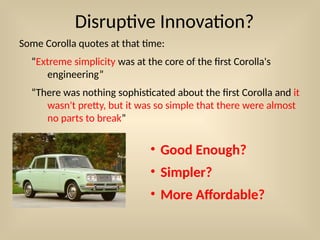
“Extreme simplicity was at the core of the first Corolla's
engineering”
“There was nothing sophisticated about the first Corolla and it
wasn't pretty, but it was so simple that there were almost
no parts to break”
• Good Enough?
• Simpler?
• More Affordable?
21.
Were the Big3 Automakers Worried?
• Not really
• They were happy to keep their higher profits on
the more luxury lines of cars
• They were OK letting Toyota have a share of the
inexpensive, low margin cars
• Remember:
These innovators inevitably improve, march
up-market and "disrupt" incumbents by
gradually pushing them out of ever more
complex and margin-rich product segments
22.
Other Examples ofDisruptive Innovations
Netflix vs. Blockbuster
Netflix drove Blockbuster into bankruptcy
What was the business model that allowed Netflix to
compete?
• The US Postal Service – delivering to your door
• And then – streaming video over the internet
Good Enough?
Simpler?
More Affordable?
23.
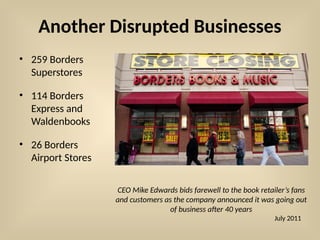
Another Disrupted Businesses
•259 Borders
Superstores
• 114 Borders
Express and
Waldenbooks
• 26 Borders
Airport Stores
CEO Mike Edwards bids farewell to the book retailer’s fans
and customers as the company announced it was going out
of business after 40 years
July 2011
24.
Who Drove BordersOut of Business?
Amazon.com
They drove a 40 year old company out of business
What was the business model that first allowed Netflix to
compete?
• Internet sales
• Delivered to your door
Good Enough
Simpler
More Affordable
25.
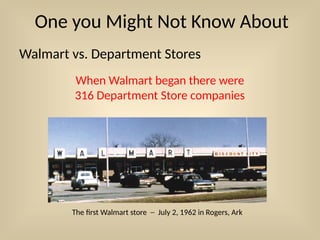
One you MightNot Know About
Walmart vs. Department Stores
When Walmart began there were
316 Department Store companies
The first Walmart store ─ July 2, 1962 in Rogers, Ark
26.
One you MightNot Know About
Walmart vs. Department Stores
A Retail Revolution
Sam Walton's strategy was built on an unshakeable
foundation:
The Lowest Prices Anytime, Anywhere
How many Department Store Companies are there now?
There are now 8 – of which Macy’s is the largest
Good Enough? Simpler? More Affordable?
Their business model is low price and convenience
27.
One Department Storecompany Escaped
The Dayton Hudson Corporation
• John Geisse developed the concept of upscale discount
retailing and approached the company leaders
• They started a separate division and allowed it to compete
with the parent company
• They opened their first upscale discount store on May 1, 1962
What’s the company’s name?
In 2000, Target was the largest
division and the fastest-growing arm
of Dayton Hudson
(75 percent of the company's revenue and profits)
28.
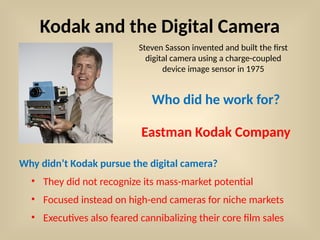
Kodak and theDigital Camera
Who did he work for?
Steven Sasson invented and built the first
digital camera using a charge-coupled
device image sensor in 1975
Eastman Kodak Company
Why didn’t Kodak pursue the digital camera?
• They did not recognize its mass-market potential
• Focused instead on high-end cameras for niche markets
• Executives also feared cannibalizing their core film sales
29.
Change is Inevitable
Changeis inevitable – and is one of
the most stressful things in life
People and companies are reluctant
to change
In times of change - companies that change their
products and business models thrive and prosper
- largely because they have
been successful doing things
a particular way
30.
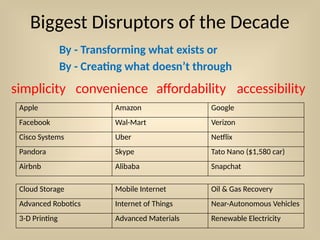
Biggest Disruptors ofthe Decade
By - Transforming what exists or
By - Creating what doesn’t through
Apple Amazon Google
Facebook Wal-Mart Verizon
Cisco Systems Uber Netflix
Pandora Skype Tato Nano ($1,580 car)
Airbnb Alibaba Snapchat
simplicity convenience affordability accessibility
Cloud Storage Mobile Internet Oil & Gas Recovery
Advanced Robotics Internet of Things Near-Autonomous Vehicles
3-D Printing Advanced Materials Renewable Electricity
31.
Why Don’t CompaniesInnovate?
• Good firms are usually aware of the innovations
• Their business environment does not allow them
to pursue the innovation when it first arises
– they may not be profitable enough at first
– their development can take scarce resources away
from that of sustaining innovations
• The company doesn’t place sufficient value on the
innovation to pursue it
31
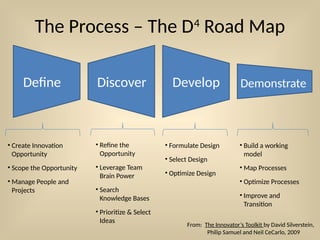
The Process –The D4
Road Map
Define
• Create Innovation
Opportunity
• Scope the Opportunity
• Manage People and
Projects
Discover
• Refine the
Opportunity
• Leverage Team
Brain Power
• Search
Knowledge Bases
• Prioritize & Select
Ideas
Develop Demonstrate
• Formulate Design
• Select Design
• Optimize Design
• Build a working
model
• Map Processes
• Optimize Processes
• Improve and
Transition
From: The Innovator’s Toolkit by David Silverstein,
Philip Samuel and Neil CeCarlo, 2009
35.
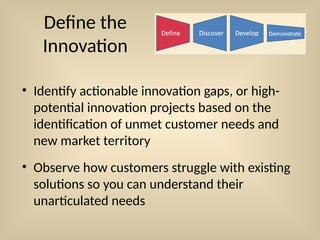
Define the
Innovation
• Identifyactionable innovation gaps, or high-
potential innovation projects based on the
identification of unmet customer needs and
new market territory
• Observe how customers struggle with existing
solutions so you can understand their
unarticulated needs
36.
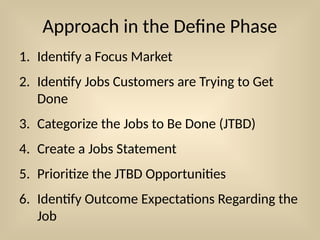
Approach in theDefine Phase
1. Identify a Focus Market
2. Identify Jobs Customers are Trying to Get
Done
3. Categorize the Jobs to Be Done (JTBD)
4. Create a Jobs Statement
5. Prioritize the JTBD Opportunities
6. Identify Outcome Expectations Regarding the
Job
37.
Identify Jobs-to-be-Done
• Customersdon’t buy products and
services
• They hire various solutions at various
times to get a wide variety of jobs done
• It is the higher purpose for which
customers buy products, services, and
solutions
38.
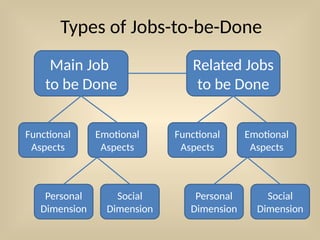
Types of Jobs-to-be-Done
1.Functional Job – describes the task that
customers want to achieve
2. Emotional Job – related to feelings and
perception
3. Ancillary Job – other jobs that
customers want to get done before,
during, or after they get the main job done
Restaurant Experience
39.
Customer Loyalty
• Itcosts FIVE TIMES more to acquire new
customers than it does to keep current ones
• Reducing your customer defection rate by 5%
can increase your profitability by 25% to 125%
• The probability of selling to an existing
customer is 60–70%. The probability of selling
to a new prospect is 5-20%; (that’s up to 14
times more, or 5 on average)
40.
79% ofconsumers will commit to a deeper brand
relationship – through product or service adoption –
after a satisfying online experience
59% of customers will stop doing business with the
brand after just one bad experience in any channel
Why is customer experience
important?
From an IBM customer study
41.
Types of Jobs-to-be-Done
MainJob
to be Done
Related Jobs
to be Done
Functional
Aspects
Emotional
Aspects
Functional
Aspects
Emotional
Aspects
Personal
Dimension
Social
Dimension
Personal
Dimension
Social
Dimension
42.
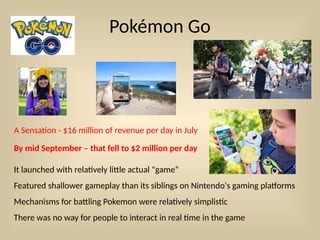
Pokémon Go
A Sensation- $16 million of revenue per day in July
By mid September – that fell to $2 million per day
It launched with relatively little actual "game“
Featured shallower gameplay than its siblings on Nintendo's gaming platforms
Mechanisms for battling Pokemon were relatively simplistic
There was no way for people to interact in real time in the game
43.
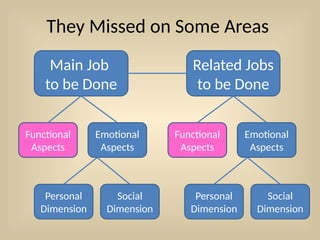
They Missed onSome Areas
Main Job
to be Done
Related Jobs
to be Done
Functional
Aspects
Emotional
Aspects
Functional
Aspects
Emotional
Aspects
Personal
Dimension
Social
Dimension
Personal
Dimension
Social
Dimension
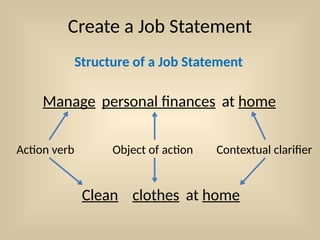
Create a JobStatement
Manage personal finances at home
Clean clothes at home
Object of action
Action verb Contextual clarifier
Structure of a Job Statement
46.
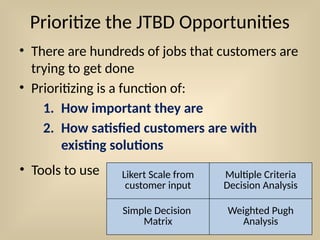
Prioritize the JTBDOpportunities
• There are hundreds of jobs that customers are
trying to get done
• Prioritizing is a function of:
1. How important they are
2. How satisfied customers are with
existing solutions
• Tools to use Likert Scale from
customer input
Multiple Criteria
Decision Analysis
Simple Decision
Matrix
Weighted Pugh
Analysis
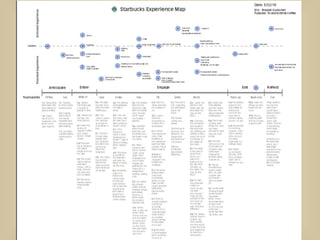
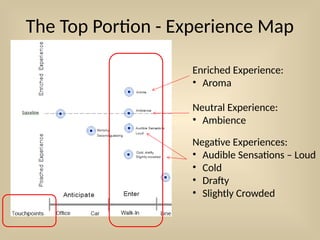
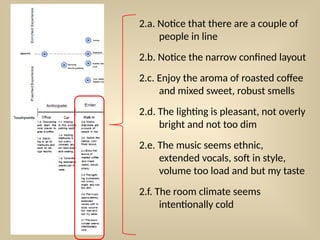
2.a. Notice thatthere are a couple of
people in line
2.b. Notice the narrow confined layout
2.c. Enjoy the aroma of roasted coffee
and mixed sweet, robust smells
2.d. The lighting is pleasant, not overly
bright and not too dim
2.e. The music seems ethnic,
extended vocals, soft in style,
volume too load and but my taste
2.f. The room climate seems
intentionally cold
50.
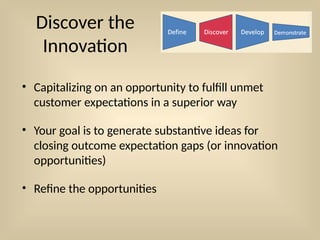
Discover the
Innovation
• Capitalizingon an opportunity to fulfill unmet
customer expectations in a superior way
• Your goal is to generate substantive ideas for
closing outcome expectation gaps (or innovation
opportunities)
• Refine the opportunities
51.
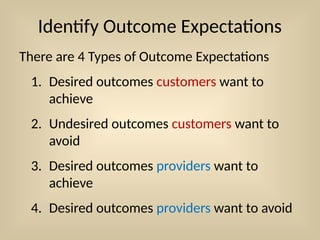
Identify Outcome Expectations
Thereare 4 Types of Outcome Expectations
1. Desired outcomes customers want to
achieve
2. Undesired outcomes customers want to
avoid
3. Desired outcomes providers want to
achieve
4. Desired outcomes providers want to avoid
52.
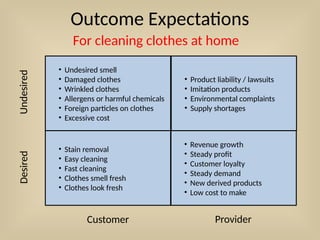
Outcome Expectations
Undesired
Desired
Customer Provider
•Undesired smell
• Damaged clothes
• Wrinkled clothes
• Allergens or harmful chemicals
• Foreign particles on clothes
• Excessive cost
• Stain removal
• Easy cleaning
• Fast cleaning
• Clothes smell fresh
• Clothes look fresh
• Product liability / lawsuits
• Imitation products
• Environmental complaints
• Supply shortages
• Revenue growth
• Steady profit
• Customer loyalty
• Steady demand
• New derived products
• Low cost to make
For cleaning clothes at home
53.
Steps After theOutcome Matrix
1. Identify the Jobs to Be Done
2. List the JTBD Related Outcome Expectations
3. Create Outcome Statements
– The direction of action
– The unit of measure – like time, cost, defects, etc.
– The object of control (what you are influencing)
– The context (where or under what circumstances)
Example: Minimize the time it takes to clean clothes
4. Determine Priority Outcome Expectations
54.
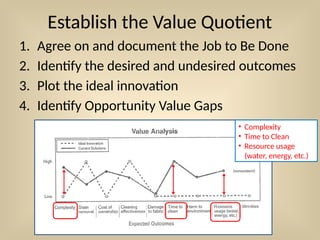
Establish the ValueQuotient
1. Agree on and document the Job to Be Done
2. Identify the desired and undesired outcomes
3. Plot the ideal innovation
4. Identify Opportunity Value Gaps
• Complexity
• Time to Clean
• Resource usage
(water, energy, etc.)
55.
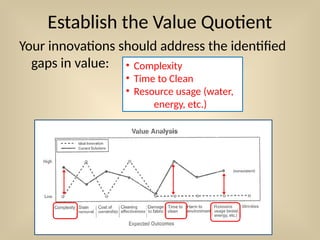
Establish the ValueQuotient
Your innovations should address the identified
gaps in value: • Complexity
• Time to Clean
• Resource usage (water,
energy, etc.)
56.
Additional Focus Areas
HeuristicRedefinition
– A Visual approach for focusing and scoping an
innovation project at the right level in a system
Ethnography
– A science that describes human social
phenomena based on fieldwork and observation
57.
Heuristic Redefinition
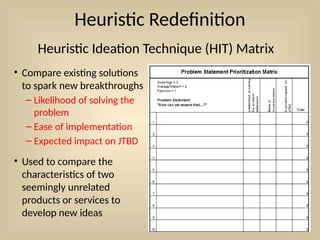
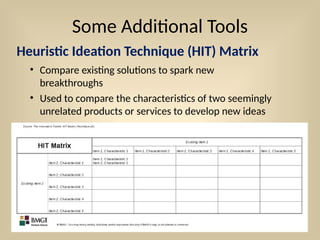
• Compareexisting solutions
to spark new breakthroughs
– Likelihood of solving the
problem
– Ease of implementation
– Expected impact on JTBD
• Used to compare the
characteristics of two
seemingly unrelated
products or services to
develop new ideas
Heuristic Ideation Technique (HIT) Matrix
58.
Ethnography and
Human CenteredDesign (HCD)
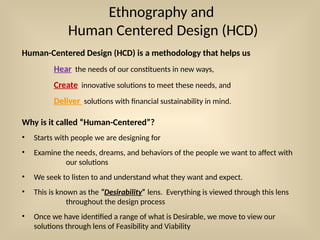
Human-Centered Design (HCD) is a methodology that helps us
Hear the needs of our constituents in new ways,
Create innovative solutions to meet these needs, and
Deliver solutions with financial sustainability in mind.
Why is it called “Human-Centered”?
• Starts with people we are designing for
• Examine the needs, dreams, and behaviors of the people we want to affect with
our solutions
• We seek to listen to and understand what they want and expect.
• This is known as the “Desirability” lens. Everything is viewed through this lens
throughout the design process
• Once we have identified a range of what is Desirable, we move to view our
solutions through lens of Feasibility and Viability
59.
Human Centered DesignProcess
The process of Human-Centered Design starts with
a specific Design Challenge and goes through three
main phases: Hear, Create, and Deliver.
The process will move:
– Concrete observations about people
– Abstract thinking as we uncover insights and themes
– Back to concrete with tangible solutions
60.
Hear - (theDesirability Lens)
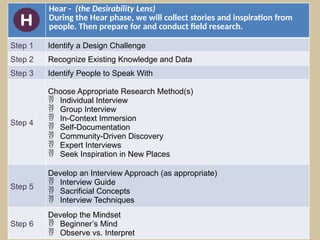
During the Hear phase, we will collect stories and inspiration from
people. Then prepare for and conduct field research.
Step 1 Identify a Design Challenge
Step 2 Recognize Existing Knowledge and Data
Step 3 Identify People to Speak With
Step 4
Choose Appropriate Research Method(s)
Individual Interview
Group Interview
In-Context Immersion
Self-Documentation
Community-Driven Discovery
Expert Interviews
Seek Inspiration in New Places
Step 5
Develop an Interview Approach (as appropriate)
Interview Guide
Sacrificial Concepts
Interview Techniques
Step 6
Develop the Mindset
Beginner’s Mind
Observe vs. Interpret
61.
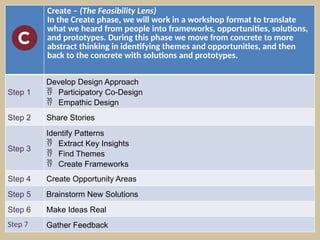
Create – (TheFeasibility Lens)
In the Create phase, we will work in a workshop format to translate
what we heard from people into frameworks, opportunities, solutions,
and prototypes. During this phase we move from concrete to more
abstract thinking in identifying themes and opportunities, and then
back to the concrete with solutions and prototypes.
Step 1
Develop Design Approach
Participatory Co-Design
Empathic Design
Step 2 Share Stories
Step 3
Identify Patterns
Extract Key Insights
Find Themes
Create Frameworks
Step 4 Create Opportunity Areas
Step 5 Brainstorm New Solutions
Step 6 Make Ideas Real
Step 7 Gather Feedback
62.
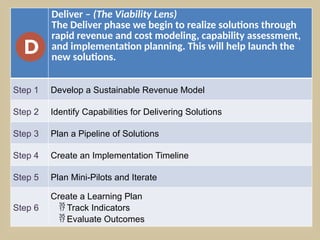
Deliver – (TheViability Lens)
The Deliver phase we begin to realize solutions through
rapid revenue and cost modeling, capability assessment,
and implementation planning. This will help launch the
new solutions.
Step 1 Develop a Sustainable Revenue Model
Step 2 Identify Capabilities for Delivering Solutions
Step 3 Plan a Pipeline of Solutions
Step 4 Create an Implementation Timeline
Step 5 Plan Mini-Pilots and Iterate
Step 6
Create a Learning Plan
Track Indicators
Evaluate Outcomes
63.
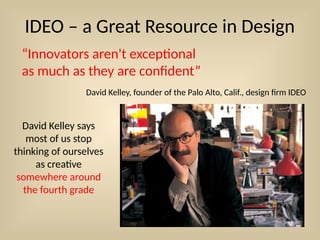
IDEO – aGreat Resource in Design
David Kelley says
most of us stop
thinking of ourselves
as creative
somewhere around
the fourth grade
“Innovators aren't exceptional
as much as they are confident”
David Kelley, founder of the Palo Alto, Calif., design firm IDEO
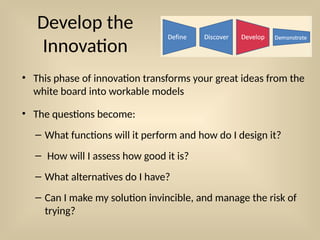
Develop the
Innovation
• Thisphase of innovation transforms your great ideas from the
white board into workable models
• The questions become:
– What functions will it perform and how do I design it?
– How will I assess how good it is?
– What alternatives do I have?
– Can I make my solution invincible, and manage the risk of
trying?
66.
Utilize Process ImprovementTools
• Scoping the Project
• Stakeholder management
• Project charter
• Problem and Goal statements
• Analyze potential income and operating
expense impact
• Gather your team resources
67.
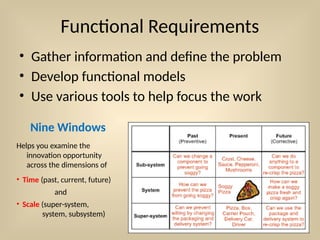
Functional Requirements
• Gatherinformation and define the problem
• Develop functional models
• Use various tools to help focus the work
Nine Windows
Helps you examine the
innovation opportunity
across the dimensions of
• Time (past, current, future)
and
• Scale (super-system,
system, subsystem)
68.
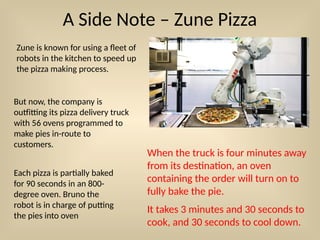
A Side Note– Zune Pizza
Zune is known for using a fleet of
robots in the kitchen to speed up
the pizza making process.
But now, the company is
outfitting its pizza delivery truck
with 56 ovens programmed to
make pies in-route to
customers.
When the truck is four minutes away
from its destination, an oven
containing the order will turn on to
fully bake the pie.
It takes 3 minutes and 30 seconds to
cook, and 30 seconds to cool down.
Each pizza is partially baked
for 90 seconds in an 800-
degree oven. Bruno the
robot is in charge of putting
the pies into oven
69.
Some Additional Tools
HeuristicIdeation Technique (HIT) Matrix
• Compare existing solutions to spark new
breakthroughs
• Used to compare the characteristics of two seemingly
unrelated products or services to develop new ideas
70.
SCAMPER
Worksheet
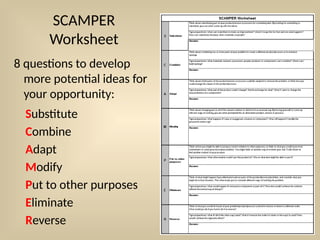
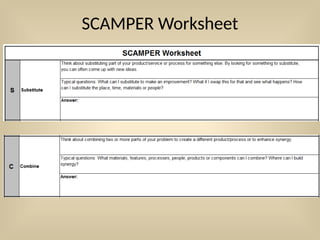
8 questions todevelop
more potential ideas for
your opportunity:
Substitute
Combine
Adapt
Modify
Put to other purposes
Eliminate
Reverse
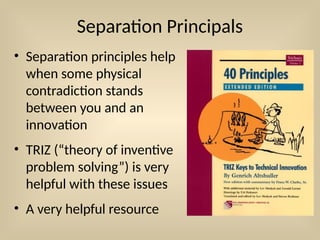
Separation Principals
• Separationprinciples help
when some physical
contradiction stands
between you and an
innovation
• TRIZ (“theory of inventive
problem solving”) is very
helpful with these issues
• A very helpful resource
74.
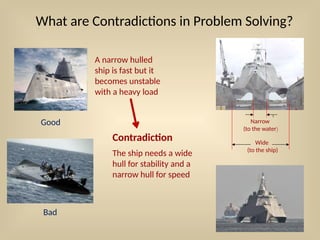
What are Contradictionsin Problem Solving?
A narrow hulled
ship is fast but it
becomes unstable
with a heavy load
Good
Bad
Narrow
(to the water)
Wide
(to the ship)
The ship needs a wide
hull for stability and a
narrow hull for speed
Contradiction
75.
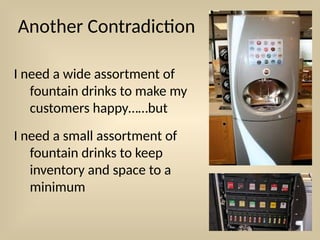
Another Contradiction
I needa wide assortment of
fountain drinks to make my
customers happy……but
I need a small assortment of
fountain drinks to keep
inventory and space to a
minimum
76.
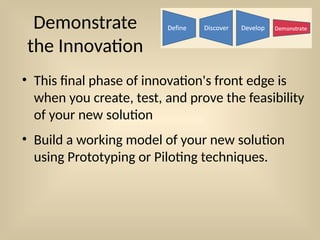
Demonstrate
the Innovation
• Thisfinal phase of innovation's front edge is
when you create, test, and prove the feasibility
of your new solution
• Build a working model of your new solution
using Prototyping or Piloting techniques.
77.
Rapid Prototyping
• FailFast and Fail Cheap – before what you are
doing becomes a financial disaster
• You will need the right
–Culture
–People
–Mind-Set
–Tools
• The team marches to a different beat
78.
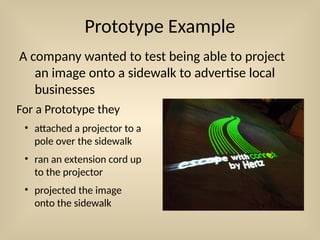
Prototype Example
A companywanted to test being able to project
an image onto a sidewalk to advertise local
businesses
For a Prototype they
• attached a projector to a
pole over the sidewalk
• ran an extension cord up
to the projector
• projected the image
onto the sidewalk
79.
Rapid Prototyping
1. DesignPrototype Evaluation
– It is an iterative process
– You will likely build more than one full scale,
working model
2. Build the Prototype
3. Determine how you will measure the results
4. Evaluate using a Function Audit
5. Evaluate for robustness
6. Consider Additional Evaluations
7. Repeat the Prototype Process
80.
Piloting
This is whenyou actually put the prototype into
use with actual users
1. Plan the Pilot
– What are the objectives?
– How will you measure the results?
– Who will be the customers?
2. Design the Pilot
3. Designate Resources
4. Run the Pilot
5. Analyze the Results
81.
Back to ProcessImprovement Tools
• Build your SIPOC Map
– Create a High-Level Map of the Process
– Identify the Outputs of the Process
– Identify the Customers of the Outputs
– Identify the Inputs Required by the Process
– Identify the Suppliers of the Inputs to the
Process
82.
Back to ProcessImprovement Tools
• Build a Process Map
• Build a Future State Value Stream Map
• Develop a Future State Process Map
• Measurement Systems Analysis
• Design of Experiments
• Conjoint Analysis
– a simplified experimental technique for
determining the best combination of attributes to
include in a product or service design
83.
Back to ProcessImprovement Tools
• Evaluate under performance or poor
performance from experiments
• Make incremental Improvements
• Develop a Control Plan
85.
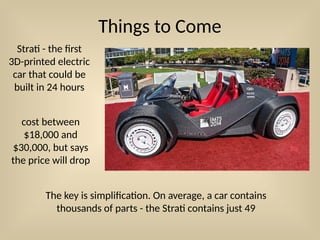
Things to Come
Strati- the first
3D-printed electric
car that could be
built in 24 hours
The key is simplification. On average, a car contains
thousands of parts - the Strati contains just 49
cost between
$18,000 and
$30,000, but says
the price will drop
86.
Artificial Intelligence
Diagnosing sepsis–
Sepsis is a complication that is treatable if caught early, but
patients can experience organ failure, or even death
Artificial Intelligence algorithms that scour data on electronic
medical records can help doctors diagnose sepsis a full 24
hours earlier, on average
Search and Rescue –
Artificial Intelligence permits computer programmers to write
basic algorithms that can examine extensive footage and
find missing people in less than 2 hours
In addition, AI algorithms can sift through social media sites,
such as Twitter, to learn about missing people and
disasters
87.
Artificial Intelligence
Cybersecurity –
Findingflaws and attacks on computer code is a manual
process, and it's typically a difficult one
During a DARPA Challenge - Artificial Intelligence entry Xandra
discovered a new attack in binary code, figured out how it
worked, reached out over a network and breached the
defenses of one of its opponents, a system named Jima.
And Jima detected that breach, offered a patch, decided to
field it and ended the breach.
The entire episode took 15 minutes. "It all happened before
any human being knew that flaw existed,"
88.
New Materials
Graphene -
Grapheneis basically a substance which is 300 times stronger
than steel and made of only a thin layer of pure carbon,
making it literally as light as a feather
Each sheet of graphene is only one atom thick, and one
square meter weighs just 0.77 milligrams.
The uses of this technology could be revolutionary: Space
exploration and the aviation industry would benefit from
the extremely light and strong material that could be used
in aircraft construction. Graphene could revolutionize
electronic devices by enabling lightweight, thin, flexible,
yet durable display screens, cellphones, and much more.
Editor's Notes
#6 Think about the ability to make crowns, implants, etc. at the dentist’s office instead of sending off for one to be made
#11 Xiaomi Redmi 2, Mi 3, and Mi 4i are as attractive and budget-friendly here as they are abroad—the most expensive, the Mi 4i, costs $219 off-contract
#12 I want you to think about this as I talk about Disruptive Innovation
#19 Body-on-frame
Advantages
Easier to design, build and modify (less of an issue now that Computer-Assisted Design (CAD) is commonplace, but still an advantage for coach-built vehicles).
Quieter, because the stresses do not pass into the body, which is isolated from the frame with rubber pads around the attachment bolts. Less significant lately, but earlier bodies would squeak and rattle, ever more as they rusted, lubricants drained, and fasteners loosened. Isolated bodies had a lesser degree of these modes of aging.
Easier to repair after accidents. This is crucial for taxicabs, because damaged bolt-on fenders can be replaced in the firm's own garage - for petty cash, with the cab returned to earning status immediately - whereas a monocoque body would require straightening by paid specialists on a machine expensive to rent - with the cab laid up for repair longer. Grand-Am allows tubular spaceframe cars to replace their monocoque counterparts, as the cars can easily be repaired with new clips.
Could allow a manufacturer to easily sub-contract portions of work, e.g. as when Austin subcontracted the aluminium body work of the Austin A40 Sports to Jensen Motors.
Generally more capable of towing and offroad
Disadvantages
Heavier than unibody - lower performance and/or higher fuel consumption.
Far less resistant to torsional flexing (flexing of the whole car in corners) - compromising handling and road grip.
No crumple zone - higher rate of death and serious injury (in some cars, but larger cars such as the Ford Crown Victoria are highly rated for safety). Some cars have adopted a "front clip" and "rear clip" format similar to what is used in NASCAR race cars where the car is split into three sections, and the clips absorb the impact, allowing the "clip" to be replaced when repairing the car.[3]
#20 A monocoque body construction is used on most cars today to reduce weight and improve structural integrity. Read on to know more
Monocoque body construction integrates the body and chassis of a vehicle together into a one piece structure. The body and drivetrain are integrated into a single unit by wielding the components together. The drivetrain and body are cast as one structure onto a frame. A monocoque body absorbs all or most of the stresses which the body is subjected to.
Before the monocoque body construction became popular body-on-frame chassis was used for vehicle construction. A separate car body was mounted to a frame that supported the drivetrain. Body-on-frame was popular even after monocoque construction came into being because it was easy and relatively inexpensive to add a different type of body to create a different car that had the same chassis and drivetrain. The body-on-frame type of automobile construction had its limitations as the cars were very heavy which meant high fuel consumption and lower performance figures. Handling and road grip were compromised as the body tended to roll a lot while cornering as it never felt one with the drivetrain. Body-on-frame construction had a higher number of accident fatalities as crumple zones could not be integrated onto the car.
Because a monocoque body construction integrates the frame of the vehicle to the drivetrain of the vehicle the car has better handling traits and lowers the kerb weight of the vehicle. A monocoque body construction improves the fuel economy of a vehicle and makes it safer for occupants in the event of a crash as crumple zones can be integrated into the body of the car. Modern monocoques are designed to distribute the load evenly over the body of the car such as the pillars of cars. High tensile steel panels are used in load bearing parts to make the structure of the car safe. The monocoque body construction technique is still under research and development for enhanced safety and better drive dynamics. Some monocoques have a bonded rear window glass which contributes to the structural integrity of the car.
#23 How are people preferring to buy books now?
Why?
#27 Target had been the company's top money maker since 1977
Would Dayton Hudson still exist without Target?
The other Dayton Hudson Stores — Dayton’s, Hudson’s, Marshall Field’s, and Mervyns. Marshall Fields was sold in 2004
#28 Eastman Kodak filed for bankruptcy in January 2012 – its fate can be traced back to one source: the former king of photography's failure to reinvent itself in the digital age.
The problem is that, during its 10-year window of opportunity, Kodak did little to prepare for the later disruption. In fact, Kodak made exactly the mistake that George Eastman, its founder, avoided twice before when faced with disruptive technologies:
when he gave up a profitable dry-plate business to move to film and
when he invested in color film even though it was demonstrably inferior to black and white film (which Kodak dominated).
It was not until a decade later, in 1991, that Kodak's first digital product for every-day use hit the market, and it was not a camera, but a Photo CD.
Kodak introduced a line of pocket-sized digital cameras in 1996 but made its biggest push into the marketplace in 2001 with the Easyshare brand. By then, the field was already crowded with products from Canon Inc and other Asian manufacturers.
Kodak said in its filing that it hoped to emerge from bankruptcy in 2013. It tried to restructure in the past by closing 13 film plants and 130 photo labs between 2004 and 2007, slashing its workforce by 50,000.
#42 By mid-September, daily revenues had fallen from $16 million per day to $2 million (excluding the 30 per cent app store fee) and daily downloads had declined from a peak of 27 million to 700,000 downloads
Pokemon Go launched with relatively little actual "game“
featured shallower gameplay than its siblings on Nintendo's gaming platforms
mechanisms for battling Pokemon were relatively simplistic, with arbitrary-seeming controls
there was no way for people to interact in real time in the game
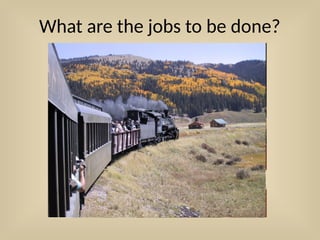
#44 Show each picture and try to understand the Job to be done