WHAT IS A WEBQUEST?
A WebQuest to guide your quest through the web.
INTRODUCTION
 In our effort to share experiences and resources
that could be used effectively in a TEALE
classroom, we chose to expose you to the inquiry-
based vehicle for learning called “WebQuest”.
 This WebQuest is simply an introduction. You
will not be given enough time to experience the
complete process, however, if you are interested
in learning more, CII does offer workshops
and 1-on-1 training for this topic.
THE TASK
 To determine whether WebQuests are a potential
solution for your teaching needs and worthy of
further exploration, you will learn about
WebQuests through participating in one.
 In the next few minutes, you will:
 Understand what is a WebQuest
 Experience how a WebQuest can work in a TEALE
environment
 Explore a few examples of WebQuests, which will
offer you ideas of how you could apply this concept to
your course of study
SO WHAT IS A WEBQUEST?
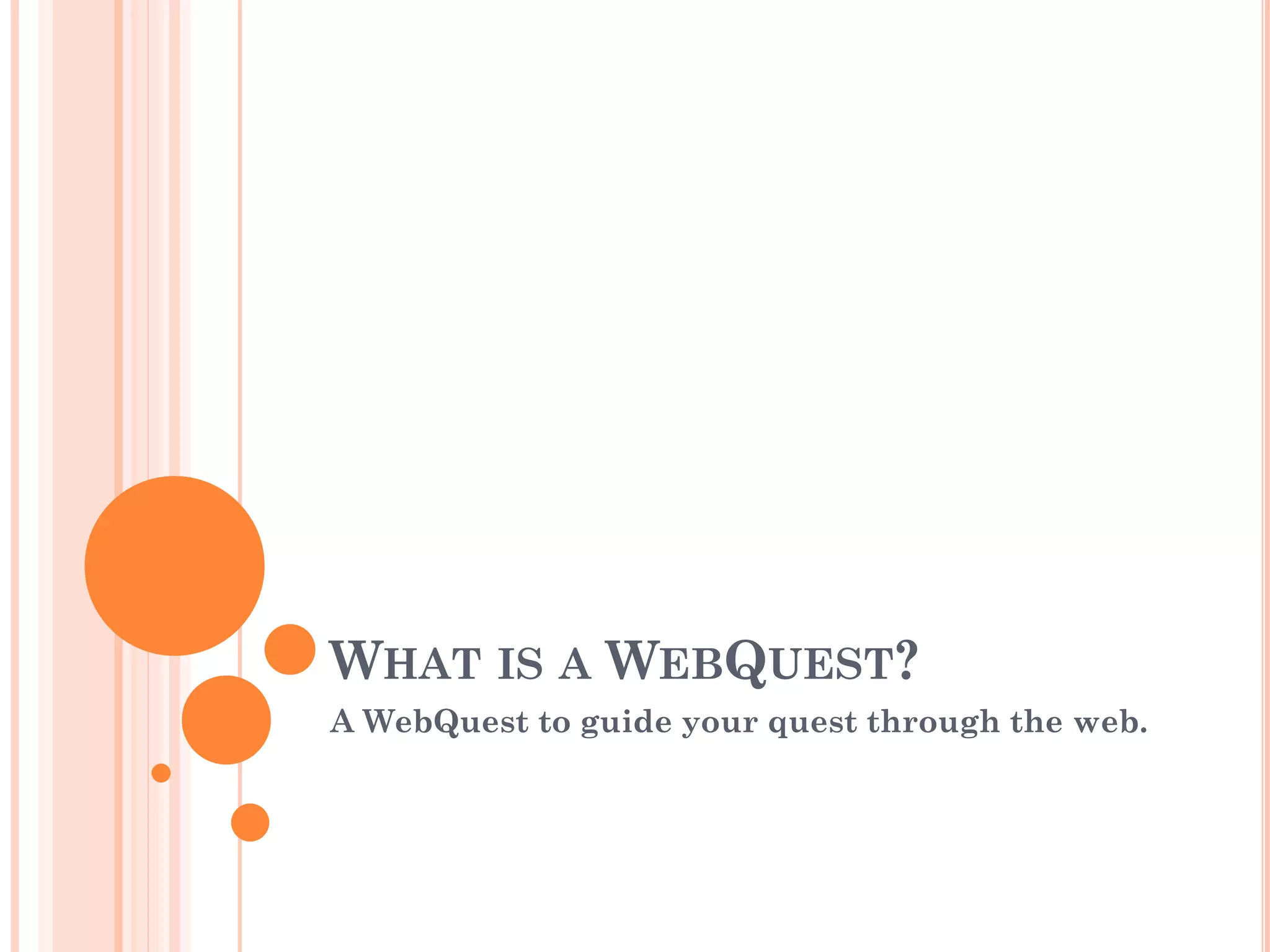
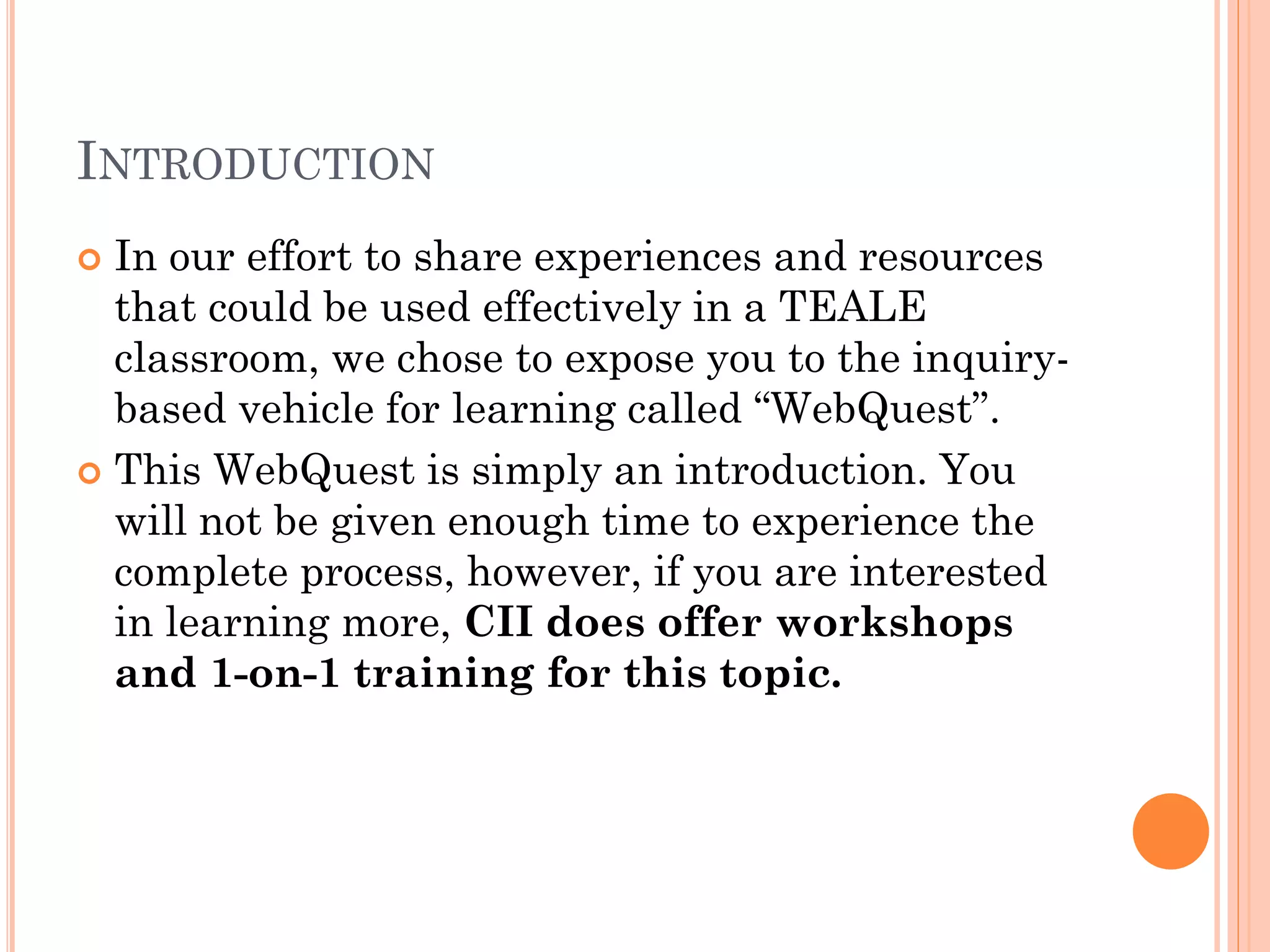
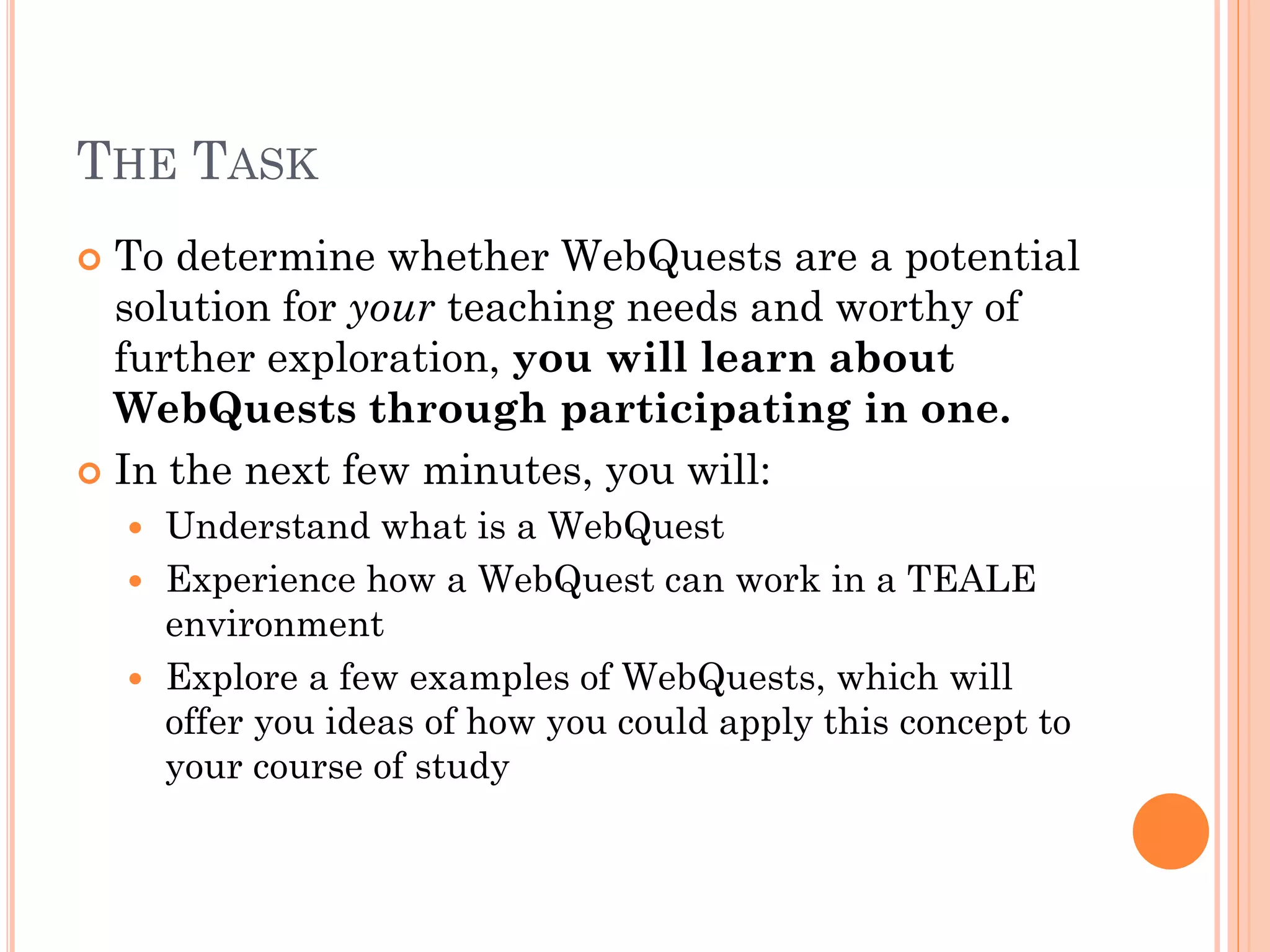
 A WebQuest is an inquiry-based, project-based
learning experience. Groups of students are given
a task to complete. Each participant has a
specific role so that everyone is responsible for
the success of the project, and no one can hide
behind the other members of their team. The
instructor provides the resources and tools
needed to complete the project effectively.
SO WHAT IS A WEBQUEST?
 Review one of the following resources to learn
more about WebQuests:
 YouTube Video: WebQuest 101 Part 1 – What is
a WebQuest? and Part 2 – How to make a
WebQuest.
 Web Research: Read Why WebQuests? and The
WebQuest Formula on the Education World
website.
THE PROCESS
 Each participant should find one WebQuest to explore on
Questgarden.com or Slideshare.net.
 For Slideshare and put the words “WebQuest” and your course of
study in the search bar to bring up relevant WebQuests. Choose one to
explore.
 Analyze the chosen WebQuest through the lens of your specific
role: Efficiency Expert (seated left of the TV), Affiliator
(farthest from TV on left), Altitudinist (right of TV right),
and Technophile (farthest on right). Roles are described in
the upcoming slides.
 Since we will be limited on time, one participant should share
his or her chosen WebQuest with the group, summarizing the
activity and sharing his or her role-specific analysis.
 The rest of the participants should then share their analyses
of the WebQuest through the lens of their specific roles.
 Together, do a complete assessment of the WebQuest and
decide on whether it is something you would recommend
adopting for a course.
YOUR ROLES: EACH PARTICIPANT SHOULD
FULFILL ONE ROLE. HAPPY QUESTING!
 The Efficiency Expert: You value time a great
deal. You believe that too much time is wasted in
today's classrooms on unfocused activity and learners
not knowing what they should be doing at a given
moment. To you, a good WebQuest is one that
delivers the most learning bang for the buck. If it's a
short, unambitious activity that teaches a small thing
well, then you like it. If it's a longterm activity, it had
better deliver a deep understanding of the topic it
covers, in your view.
 This is the participant seated to the left of the TV.
 The roles described are taken directly from a resource
developed by Bernie Dodge, the originator of the WebQuest
concept.
http://edweb.sdsu.edu/webquest/webquestwebquest-hs.html
YOUR ROLES: EACH PARTICIPANT SHOULD
FULFILL ONE ROLE. HAPPY QUESTING!
 The Affiliator: To you, the best learning activities
are those in which students learn to work together.
WebQuests that force collaboration and create a need
for discussion and consensus are the best in your
view. If a WebQuest could be done by a student
working alone, it leaves you cold.
 This is the participant seated farthest away to the left of
the TV.
 The roles described are taken directly from a resource
developed by Bernie Dodge, the originator of the WebQuest
concept.
http://edweb.sdsu.edu/webquest/webquestwebquest-hs.html
YOUR ROLES: EACH PARTICIPANT SHOULD
FULFILL ONE ROLE. HAPPY QUESTING!
 The Altitudinist: Higher level thinking is
everything to you. There's too much emphasis on
factual recall in schools today. The only justification
for bringing technology into schools is if it opens up
the possibility that students will have to analyze
information, synthesize multiple perspectives, and
take a stance on the merits of something. You also
value sites that allow for some creative expression on
the part of the learner.
 This is the participant seated to the right of the TV.
 The roles described are taken directly from a resource
developed by Bernie Dodge, the originator of the WebQuest
concept.
http://edweb.sdsu.edu/webquest/webquestwebquest-hs.html
YOUR ROLES: EACH PARTICIPANT SHOULD
FULFILL ONE ROLE. HAPPY QUESTING!
 The Technophile: You love this internet thang. To
you, the best WebQuest is one that makes the best
use of the technology of the Web. If a WebQuest has
attractive colors, animated gifs, and lots of links to
interesting sites, you love it. If it makes minimal use
of the Web, you'd rather use a worksheet.
 This is the participant seated farthest away to the right of
the TV.
 The roles described are taken directly from a resource
developed by Bernie Dodge, the originator of the WebQuest
concept.
http://edweb.sdsu.edu/webquest/webquestwebquest-hs.html

What is a web quest

  • 1.
    WHAT IS AWEBQUEST? A WebQuest to guide your quest through the web.
  • 2.
    INTRODUCTION  In oureffort to share experiences and resources that could be used effectively in a TEALE classroom, we chose to expose you to the inquiry- based vehicle for learning called “WebQuest”.  This WebQuest is simply an introduction. You will not be given enough time to experience the complete process, however, if you are interested in learning more, CII does offer workshops and 1-on-1 training for this topic.
  • 3.
    THE TASK  Todetermine whether WebQuests are a potential solution for your teaching needs and worthy of further exploration, you will learn about WebQuests through participating in one.  In the next few minutes, you will:  Understand what is a WebQuest  Experience how a WebQuest can work in a TEALE environment  Explore a few examples of WebQuests, which will offer you ideas of how you could apply this concept to your course of study
  • 4.
    SO WHAT ISA WEBQUEST?  A WebQuest is an inquiry-based, project-based learning experience. Groups of students are given a task to complete. Each participant has a specific role so that everyone is responsible for the success of the project, and no one can hide behind the other members of their team. The instructor provides the resources and tools needed to complete the project effectively.
  • 5.
    SO WHAT ISA WEBQUEST?  Review one of the following resources to learn more about WebQuests:  YouTube Video: WebQuest 101 Part 1 – What is a WebQuest? and Part 2 – How to make a WebQuest.  Web Research: Read Why WebQuests? and The WebQuest Formula on the Education World website.
  • 6.
    THE PROCESS  Eachparticipant should find one WebQuest to explore on Questgarden.com or Slideshare.net.  For Slideshare and put the words “WebQuest” and your course of study in the search bar to bring up relevant WebQuests. Choose one to explore.  Analyze the chosen WebQuest through the lens of your specific role: Efficiency Expert (seated left of the TV), Affiliator (farthest from TV on left), Altitudinist (right of TV right), and Technophile (farthest on right). Roles are described in the upcoming slides.  Since we will be limited on time, one participant should share his or her chosen WebQuest with the group, summarizing the activity and sharing his or her role-specific analysis.  The rest of the participants should then share their analyses of the WebQuest through the lens of their specific roles.  Together, do a complete assessment of the WebQuest and decide on whether it is something you would recommend adopting for a course.
  • 7.
    YOUR ROLES: EACHPARTICIPANT SHOULD FULFILL ONE ROLE. HAPPY QUESTING!  The Efficiency Expert: You value time a great deal. You believe that too much time is wasted in today's classrooms on unfocused activity and learners not knowing what they should be doing at a given moment. To you, a good WebQuest is one that delivers the most learning bang for the buck. If it's a short, unambitious activity that teaches a small thing well, then you like it. If it's a longterm activity, it had better deliver a deep understanding of the topic it covers, in your view.  This is the participant seated to the left of the TV.  The roles described are taken directly from a resource developed by Bernie Dodge, the originator of the WebQuest concept. http://edweb.sdsu.edu/webquest/webquestwebquest-hs.html
  • 8.
    YOUR ROLES: EACHPARTICIPANT SHOULD FULFILL ONE ROLE. HAPPY QUESTING!  The Affiliator: To you, the best learning activities are those in which students learn to work together. WebQuests that force collaboration and create a need for discussion and consensus are the best in your view. If a WebQuest could be done by a student working alone, it leaves you cold.  This is the participant seated farthest away to the left of the TV.  The roles described are taken directly from a resource developed by Bernie Dodge, the originator of the WebQuest concept. http://edweb.sdsu.edu/webquest/webquestwebquest-hs.html
  • 9.
    YOUR ROLES: EACHPARTICIPANT SHOULD FULFILL ONE ROLE. HAPPY QUESTING!  The Altitudinist: Higher level thinking is everything to you. There's too much emphasis on factual recall in schools today. The only justification for bringing technology into schools is if it opens up the possibility that students will have to analyze information, synthesize multiple perspectives, and take a stance on the merits of something. You also value sites that allow for some creative expression on the part of the learner.  This is the participant seated to the right of the TV.  The roles described are taken directly from a resource developed by Bernie Dodge, the originator of the WebQuest concept. http://edweb.sdsu.edu/webquest/webquestwebquest-hs.html
  • 10.
    YOUR ROLES: EACHPARTICIPANT SHOULD FULFILL ONE ROLE. HAPPY QUESTING!  The Technophile: You love this internet thang. To you, the best WebQuest is one that makes the best use of the technology of the Web. If a WebQuest has attractive colors, animated gifs, and lots of links to interesting sites, you love it. If it makes minimal use of the Web, you'd rather use a worksheet.  This is the participant seated farthest away to the right of the TV.  The roles described are taken directly from a resource developed by Bernie Dodge, the originator of the WebQuest concept. http://edweb.sdsu.edu/webquest/webquestwebquest-hs.html