Contact Information: Becky Ford Technology Training Center [email_address] What is a WebQuest?
A WebQuest is an  inquiry -oriented activity in which most or all of the information used by learners is drawn from the Web.  WebQuests are designed to use learners’ time well, to  focus  on  using   information  rather than  looking  for it, and to support learners’  thinking  at the levels of  analysis, synthesis, and evaluation .   The model was developed in the early 90’s at San Diego State University by Bernie Dodge and Tom March.
 
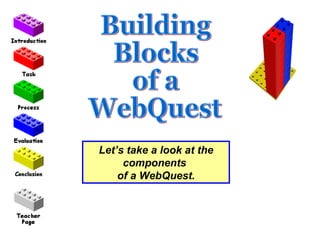
Let’s take a look at the components  of a WebQuest. Building Blocks of a WebQuest
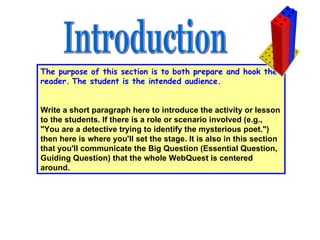
The purpose of this section is to both prepare and hook the reader.   The student is the intended audience.                                                                                                             Write a short paragraph here to introduce the activity or lesson to the students. If there is a role or scenario involved (e.g., "You are a detective trying to identify the mysterious poet.") then here is where you'll set the stage. It is also in this section that you'll communicate the Big Question (Essential Question, Guiding Question) that the whole WebQuest is centered around.  Introduction
Task The task focuses learners on what they are going to do - specifically, the culminating performance or product that drives all of the learning activities.  Describe crisply and clearly what the end result of the learners' activities will be. Don't list the steps that students will go through to get to the end point. That belongs in the Process section.   Task
Process This section outlines how the learners will accomplish the task.  Scaffolding  includes clear steps, resources, and tools for organizing information.   To accomplish the task, what steps should the learners go through?...Learners will access the on-line resources that you've identifed as they go through the Process....In the Process block, you might also provide some guidance on how to organize the information gathered.   Process
Evaluation This section describes the evaluation criteria needed to meet performance and content standards.   Describe to the learners how their performance will be evaluated. The  assessment  rubric(s )  should align with the culminating project or performance, as outlined in the task section of the WebQuest. Specify whether there will be a common grade for group work vs. individual grades. Evaluation
Conclusion The conclusion brings closure and encourages reflection.   Summarize what the learners will have accomplished or learned by completing this activity or lesson. You might also include some rhetorical questions or additional links to encourage them to extend their thinking into other content beyond this lesson.   Conclusion
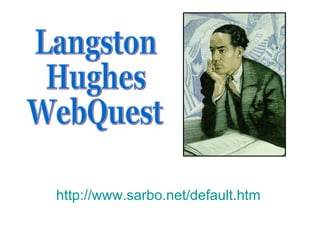
http://www.sarbo.net/default.htm   Langston  Hughes WebQuest
Continue working through the PowerPoint. Spend some time looking at the WebQuests’ Hotlist. Think about writing your own WebQuest using the   templates provided. Classroom Tip! In your classroom, work through a WebQuest as a whole class or have students work through the WebQuest as a center activity.
The Power of WebQuests According to Bernie Dodge (1997), a WebQuest is an inquiry-oriented activity in which students interact with information gleaned primarily from resources on the Internet.   http://webquest.sdsu.edu/ "The Matrix"           You are visitor #                                                        since February 28, 1998.                 This site is hosted by the  Educational Technology Department  at  San Diego State University . Updated continuously by  Bernie Dodge . Please suggest additions by writing  [email_address] Were you redirected here from a different URL? Please change all old links from edweb.sdsu.edu/webquest/blahblah to---> webquest.sdsu.edu/blahblah Information is available about our  Masters ,  Doctorate  and  Online Certificate  Programs.  
Dr. Alice Christie's Matrix of 400 WebQuests http:// www.west.asu.edu/achristie/wqmatrix.html   A Hotlist created by Midge Frazel   Understanding and Using  WebQuests The Big WebQuest Collection WebQuest  Collections High School Literature WebQuests  http://webquest.sdsu.edu/literature-wq.htm   High School WebQuests http://its.leesummit.k12.mo.us/webquests.htm   WebQuest Direct   http://www.webquestdirect.com.au/whatis_articles2.asp   The Best WebQuests http:// bestwebquests.com / Tech Teachers http:// www.techteachers.com/unittable.htm
WebQuests Third Grade through Sixth Grade   http://www.eduscapes.com/sessions/travel/36webquests.htm   Math Hotlist of WebQuests   http:// www.iwebquest.com/hotlists/mathwebquest.htm   Primary School List of WebQuests http:// www.primaryschool.com.au/webquestsresults.php   Big List of WebQuests- Unicom http://www.unicom-inc.com/education/wbqlink.cfm Yukon Department of Education http:// www.yesnet.yk.ca/staffroom/webquest.html   Models for Teachers   http://education.wichita.edu/m3/index.htm I WebQuest http:// www.iwebquest.com /
WebQuests in Our Future  (Kathy Schrock's PowerPoint Introduction)  http://www.discoveryschool.com/schrockguide/webquest/webquest.html WebQuests: A Strategy for Scaffolding Higher Level Learning   http://edweb.sdsu.edu/webquest/necc98.htm Rubric for Evaluating WebQuests  http://edweb.sdsu.edu/webquest/webquestrubric.html WebQuest Taskonomy  http:// edweb.sdsu.edu/webquest/taskonomy.html Some Thoughts About WebQuests  http://edweb.sdsu.edu/courses/edtec596/about_webquests.html New Revised WebQuest (Jim Andris)  http://www.siue.edu/~jandris/north/newquest.html
To search for a specific WebQuest use Google   www.google.com   search engine and type in exactly what you want by name:  Example: Langston Hughes Webquest   Poetry Webquests   Literature Webquests Searching  for Specific WebQuests

老庄

  • 1.
    Contact Information: BeckyFord Technology Training Center [email_address] What is a WebQuest?
  • 2.
    A WebQuest isan inquiry -oriented activity in which most or all of the information used by learners is drawn from the Web. WebQuests are designed to use learners’ time well, to focus on using information rather than looking for it, and to support learners’ thinking at the levels of analysis, synthesis, and evaluation . The model was developed in the early 90’s at San Diego State University by Bernie Dodge and Tom March.
  • 3.
  • 4.
    Let’s take alook at the components of a WebQuest. Building Blocks of a WebQuest
  • 5.
    The purpose ofthis section is to both prepare and hook the reader. The student is the intended audience.                                                                                                             Write a short paragraph here to introduce the activity or lesson to the students. If there is a role or scenario involved (e.g., "You are a detective trying to identify the mysterious poet.") then here is where you'll set the stage. It is also in this section that you'll communicate the Big Question (Essential Question, Guiding Question) that the whole WebQuest is centered around. Introduction
  • 6.
    Task The taskfocuses learners on what they are going to do - specifically, the culminating performance or product that drives all of the learning activities. Describe crisply and clearly what the end result of the learners' activities will be. Don't list the steps that students will go through to get to the end point. That belongs in the Process section. Task
  • 7.
    Process This sectionoutlines how the learners will accomplish the task. Scaffolding includes clear steps, resources, and tools for organizing information. To accomplish the task, what steps should the learners go through?...Learners will access the on-line resources that you've identifed as they go through the Process....In the Process block, you might also provide some guidance on how to organize the information gathered. Process
  • 8.
    Evaluation This sectiondescribes the evaluation criteria needed to meet performance and content standards. Describe to the learners how their performance will be evaluated. The assessment rubric(s ) should align with the culminating project or performance, as outlined in the task section of the WebQuest. Specify whether there will be a common grade for group work vs. individual grades. Evaluation
  • 9.
    Conclusion The conclusionbrings closure and encourages reflection. Summarize what the learners will have accomplished or learned by completing this activity or lesson. You might also include some rhetorical questions or additional links to encourage them to extend their thinking into other content beyond this lesson. Conclusion
  • 10.
    http://www.sarbo.net/default.htm Langston Hughes WebQuest
  • 11.
    Continue working throughthe PowerPoint. Spend some time looking at the WebQuests’ Hotlist. Think about writing your own WebQuest using the templates provided. Classroom Tip! In your classroom, work through a WebQuest as a whole class or have students work through the WebQuest as a center activity.
  • 12.
    The Power ofWebQuests According to Bernie Dodge (1997), a WebQuest is an inquiry-oriented activity in which students interact with information gleaned primarily from resources on the Internet. http://webquest.sdsu.edu/ "The Matrix" You are visitor #                                                      since February 28, 1998.           This site is hosted by the Educational Technology Department at San Diego State University . Updated continuously by Bernie Dodge . Please suggest additions by writing [email_address] Were you redirected here from a different URL? Please change all old links from edweb.sdsu.edu/webquest/blahblah to---> webquest.sdsu.edu/blahblah Information is available about our Masters , Doctorate and Online Certificate Programs.  
  • 13.
    Dr. Alice Christie'sMatrix of 400 WebQuests http:// www.west.asu.edu/achristie/wqmatrix.html A Hotlist created by Midge Frazel Understanding and Using WebQuests The Big WebQuest Collection WebQuest Collections High School Literature WebQuests http://webquest.sdsu.edu/literature-wq.htm High School WebQuests http://its.leesummit.k12.mo.us/webquests.htm WebQuest Direct   http://www.webquestdirect.com.au/whatis_articles2.asp The Best WebQuests http:// bestwebquests.com / Tech Teachers http:// www.techteachers.com/unittable.htm
  • 14.
    WebQuests Third Gradethrough Sixth Grade http://www.eduscapes.com/sessions/travel/36webquests.htm Math Hotlist of WebQuests http:// www.iwebquest.com/hotlists/mathwebquest.htm Primary School List of WebQuests http:// www.primaryschool.com.au/webquestsresults.php Big List of WebQuests- Unicom http://www.unicom-inc.com/education/wbqlink.cfm Yukon Department of Education http:// www.yesnet.yk.ca/staffroom/webquest.html Models for Teachers http://education.wichita.edu/m3/index.htm I WebQuest http:// www.iwebquest.com /
  • 15.
    WebQuests in OurFuture (Kathy Schrock's PowerPoint Introduction) http://www.discoveryschool.com/schrockguide/webquest/webquest.html WebQuests: A Strategy for Scaffolding Higher Level Learning   http://edweb.sdsu.edu/webquest/necc98.htm Rubric for Evaluating WebQuests http://edweb.sdsu.edu/webquest/webquestrubric.html WebQuest Taskonomy http:// edweb.sdsu.edu/webquest/taskonomy.html Some Thoughts About WebQuests http://edweb.sdsu.edu/courses/edtec596/about_webquests.html New Revised WebQuest (Jim Andris) http://www.siue.edu/~jandris/north/newquest.html
  • 16.
    To search fora specific WebQuest use Google www.google.com search engine and type in exactly what you want by name: Example: Langston Hughes Webquest Poetry Webquests Literature Webquests Searching for Specific WebQuests