
What is a Profit and Loss
Statement
Leigh Barker
A profit and loss statement is a financial
statement that..
A profit and loss statement is a financial statement that reports on revenue,
operating costs and expenses incurred by an entity within a nominated period
of time. It is generally prepared at regular intervals usually monthly and at
financial year end and is used for monitoring business activity and highlights
where an entity is succeeding and where it is struggling.
Profit and loss statements follow a general
format
Profit and loss statements follow a general format.They commence with
revenue that is earned during an accounting period which generally are such
items as sales or service fees.Then there are expenses incurred during that
same accounting period which generally comprise such transactions as the
cost of goods sold, rent, salaries, advertising etc.
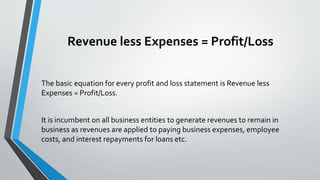
Revenue less Expenses = Profit/Loss
The basic equation for every profit and loss statement is Revenue less
Expenses = Profit/Loss.
It is incumbent on all business entities to generate revenues to remain in
business as revenues are applied to paying business expenses, employee
costs, and interest repayments for loans etc.
It is important to compare profit and loss
statements
It is important to compare profit and loss statements from different
accounting periods as the changes in revenues, operating costs and expenses
over time may be more important than the numbers themselves.
Whereas accountants use the profit and loss statement to gauge the accuracy
of financial transactions others use this information to judge an entities health
whereas the entity itself can review the statement for productive purposes.
Leigh Barker Accountant
Please note: Prepared by Leigh Barker Accountant at MWC Group,Tangible
Assets, Portfolio Finance, Gordon andWest Pennant Hills. Note that all
content of this blog is general in nature and anyone intending to apply the
information to practical circumstances should seek professional advice to
independently verify their interpretation and the information’s applicability to
their particular circumstance.

What is a Profit and Loss Statement

  • 1.
    What is aProfit and Loss Statement Leigh Barker
  • 2.
    A profit andloss statement is a financial statement that.. A profit and loss statement is a financial statement that reports on revenue, operating costs and expenses incurred by an entity within a nominated period of time. It is generally prepared at regular intervals usually monthly and at financial year end and is used for monitoring business activity and highlights where an entity is succeeding and where it is struggling.
  • 3.
    Profit and lossstatements follow a general format Profit and loss statements follow a general format.They commence with revenue that is earned during an accounting period which generally are such items as sales or service fees.Then there are expenses incurred during that same accounting period which generally comprise such transactions as the cost of goods sold, rent, salaries, advertising etc.
  • 4.
    Revenue less Expenses= Profit/Loss The basic equation for every profit and loss statement is Revenue less Expenses = Profit/Loss. It is incumbent on all business entities to generate revenues to remain in business as revenues are applied to paying business expenses, employee costs, and interest repayments for loans etc.
  • 5.
    It is importantto compare profit and loss statements It is important to compare profit and loss statements from different accounting periods as the changes in revenues, operating costs and expenses over time may be more important than the numbers themselves. Whereas accountants use the profit and loss statement to gauge the accuracy of financial transactions others use this information to judge an entities health whereas the entity itself can review the statement for productive purposes.
  • 6.
    Leigh Barker Accountant Pleasenote: Prepared by Leigh Barker Accountant at MWC Group,Tangible Assets, Portfolio Finance, Gordon andWest Pennant Hills. Note that all content of this blog is general in nature and anyone intending to apply the information to practical circumstances should seek professional advice to independently verify their interpretation and the information’s applicability to their particular circumstance.