ua l
                   n n rt
                  A po
                   Re


Accounting Cycle Review


                             1
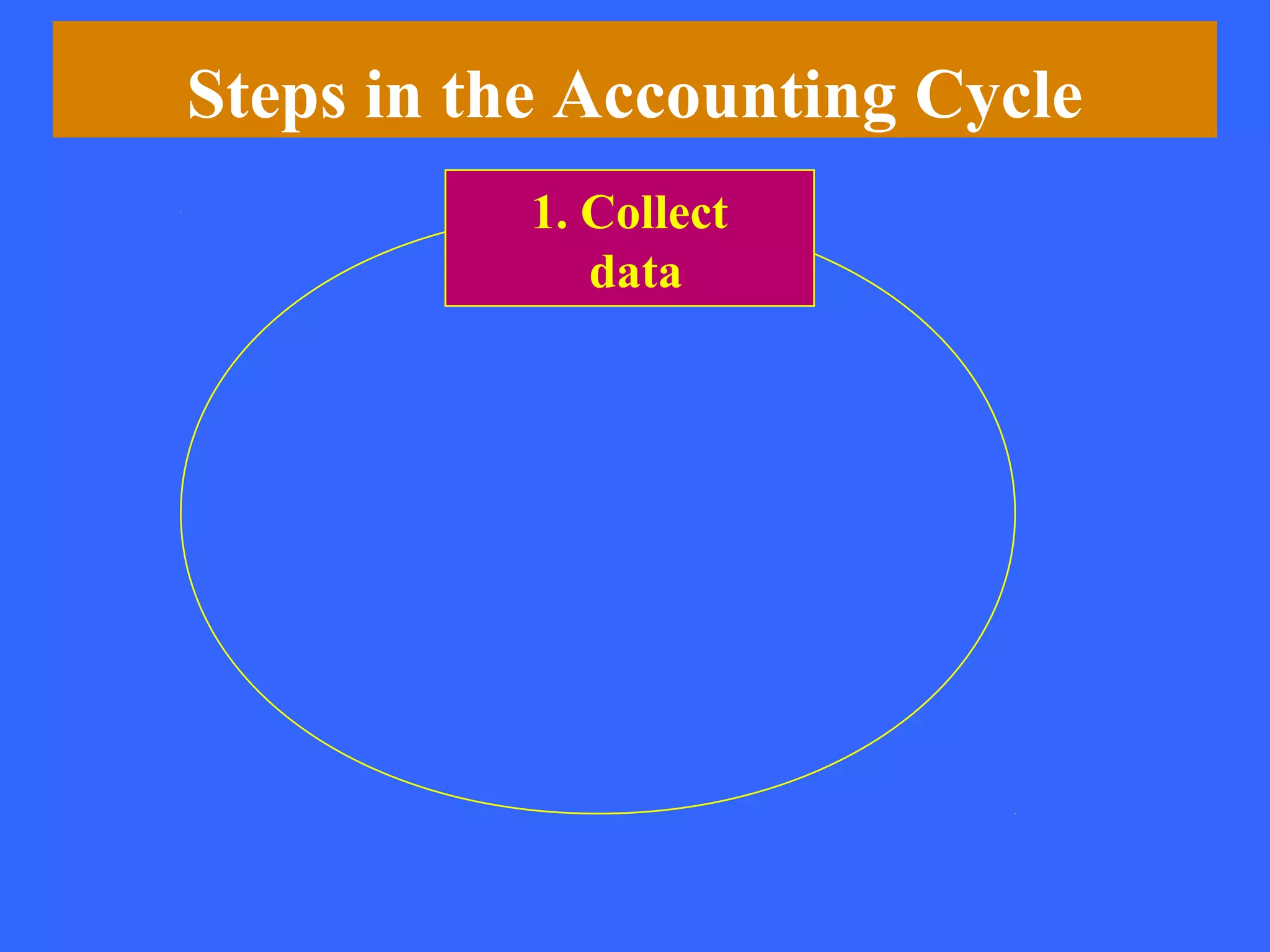
Steps in the Accounting Cycle
           1. Collect
              data
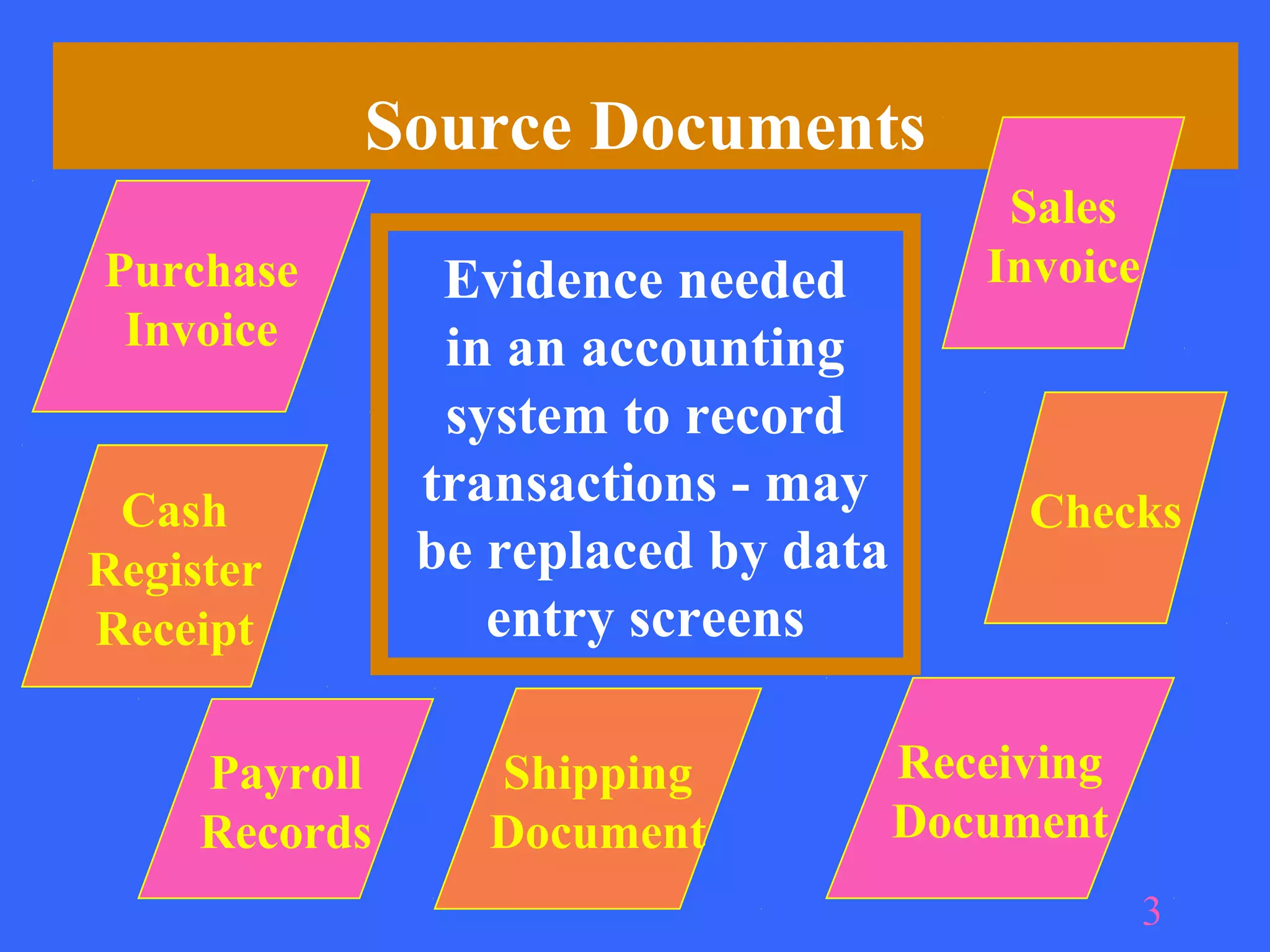
Source Documents
                                         Sales
Purchase        Evidence needed         Invoice
 Invoice        in an accounting
                system to record
 Cash
               transactions - may         Checks
Register       be replaced by data
Receipt           entry screens

     Payroll     Shipping            Receiving
     Records     Document            Document
                                                  3
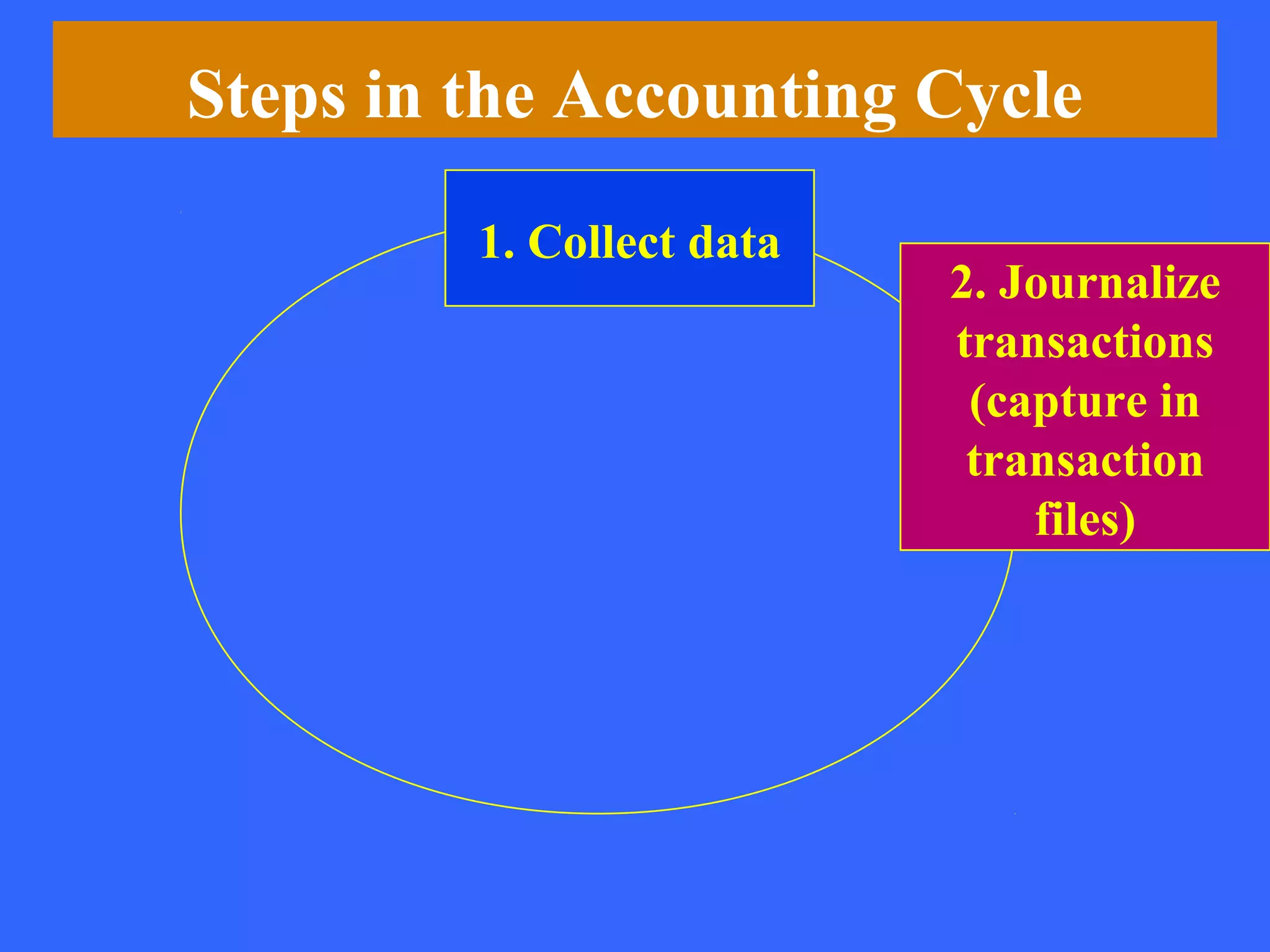
Steps in the Accounting Cycle
         1. Collect data
                           2. Journalize
                           transactions
                            (capture in
                            transaction
                               files)
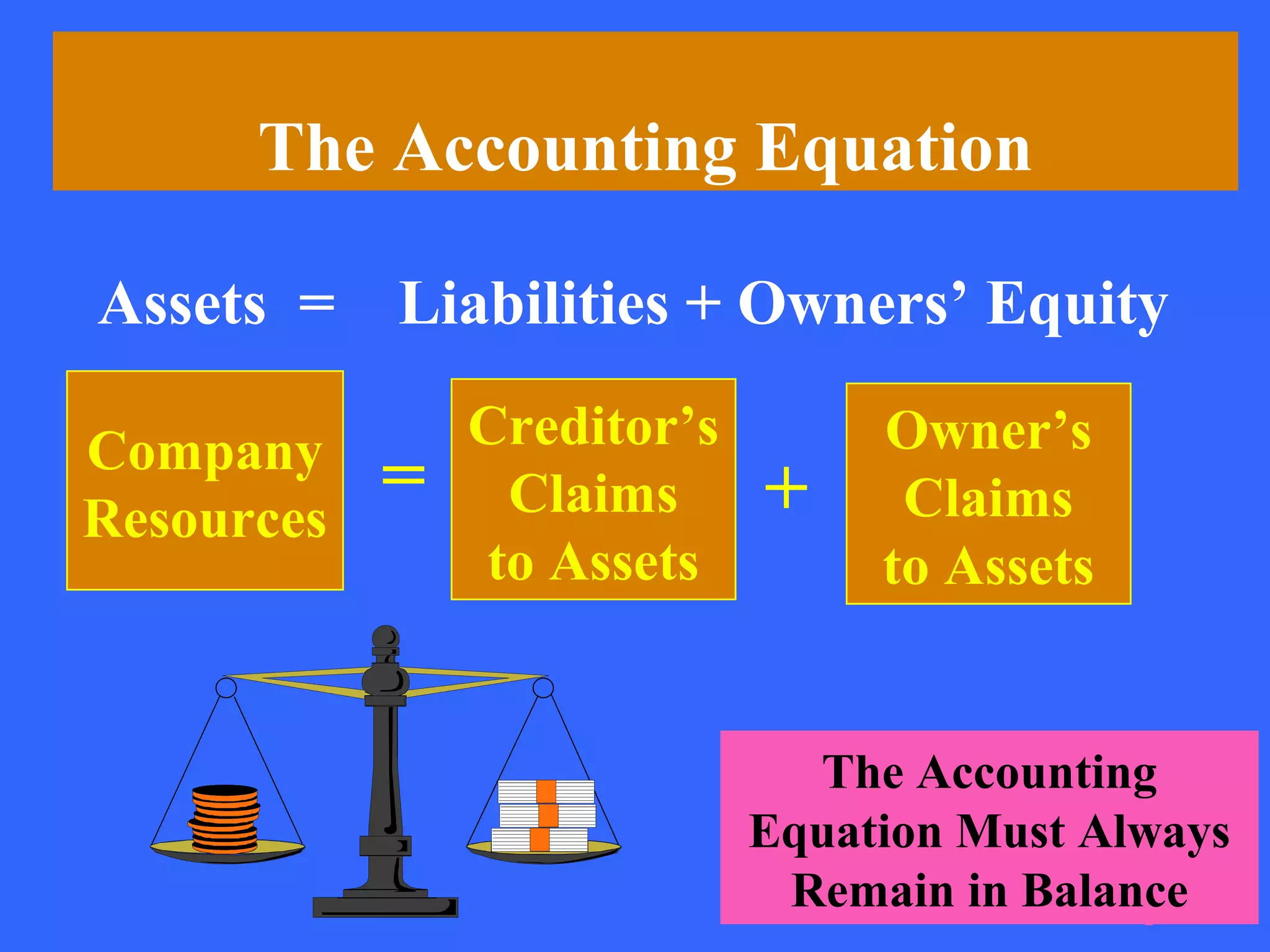
The Accounting Equation

Assets =    Liabilities + Owners’ Equity

Company         Creditor’s        Owner’s
Resources
            =    Claims      +     Claims
                to Assets         to Assets


                               The Accounting
                             Equation Must Always
                              Remain in Balance
                                             5
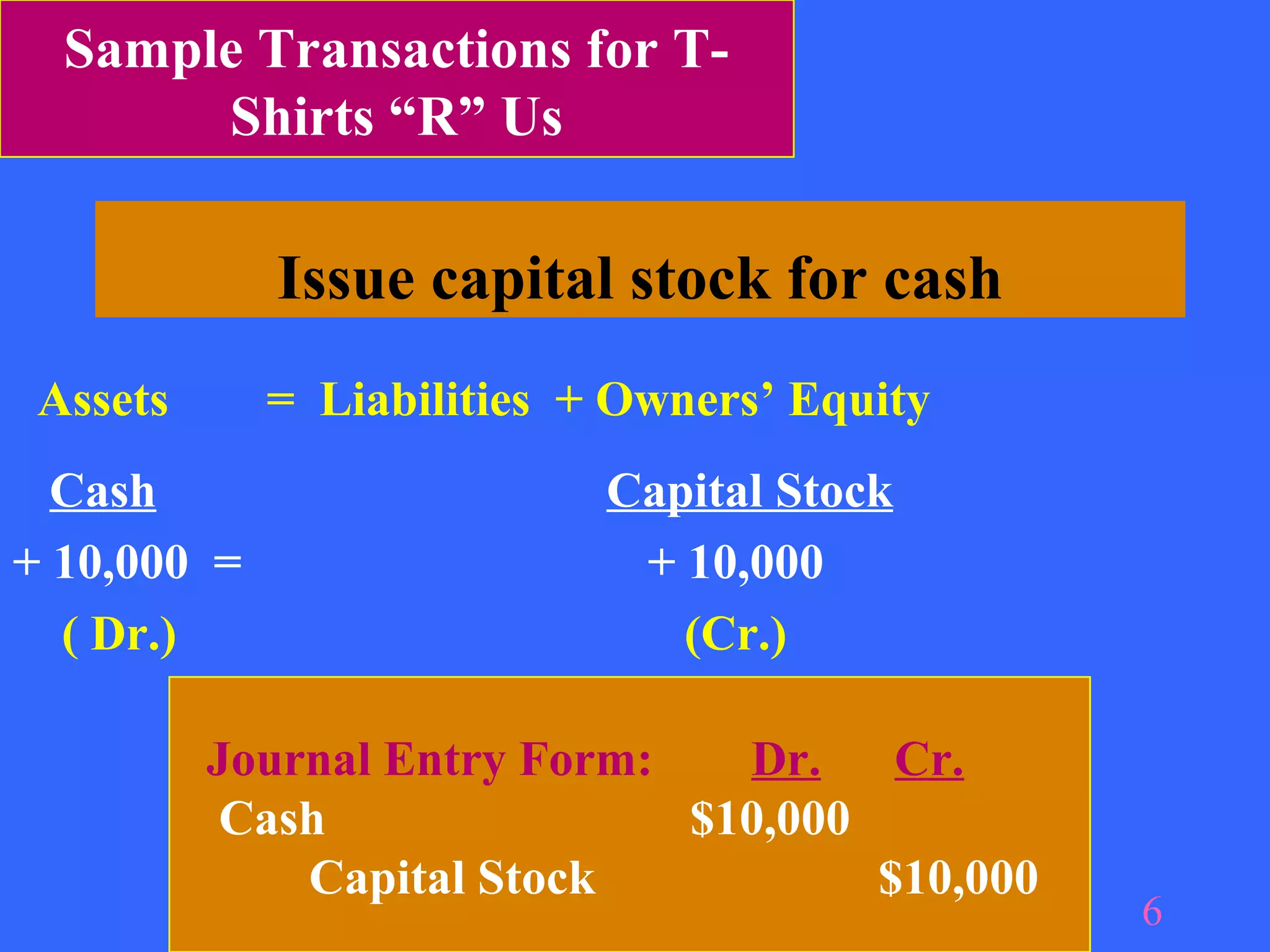
Sample Transactions for T-
       Shirts “R” Us

             Issue capital stock for cash
 Assets      = Liabilities + Owners’ Equity
  Cash                      Capital Stock
+ 10,000 =                   + 10,000
  ( Dr.)                       (Cr.)

          Journal Entry Form:   Dr. Cr.
           Cash               $10,000
              Capital Stock           $10,000
                                                6
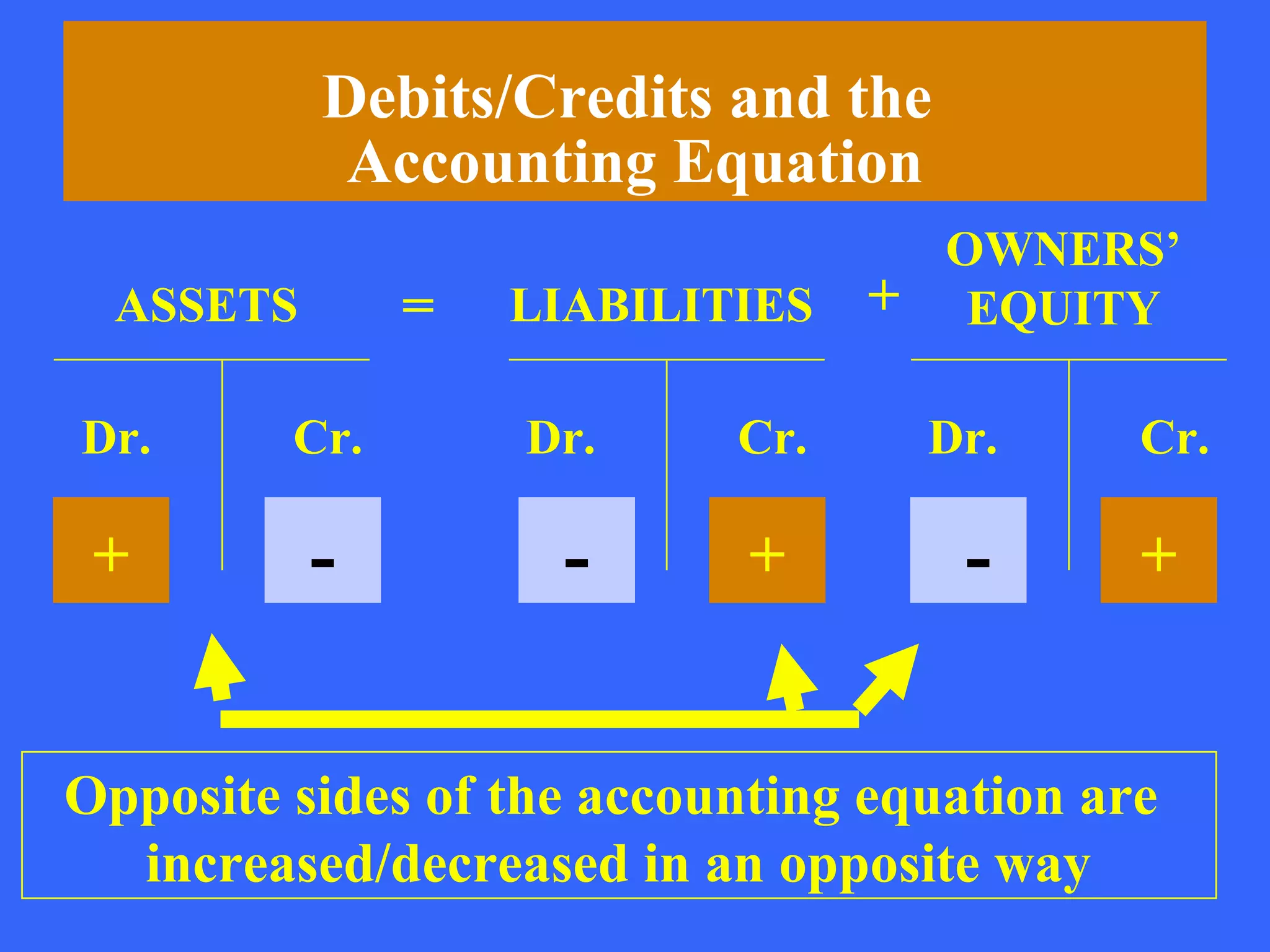
Debits/Credits and the
            Accounting Equation
                                   OWNERS’
  ASSETS       =   LIABILITIES   + EQUITY

Dr.      Cr.       Dr.     Cr.     Dr.      Cr.

 +         -        -       +        -      +


Opposite sides of the accounting equation are
  increased/decreased in an opposite way
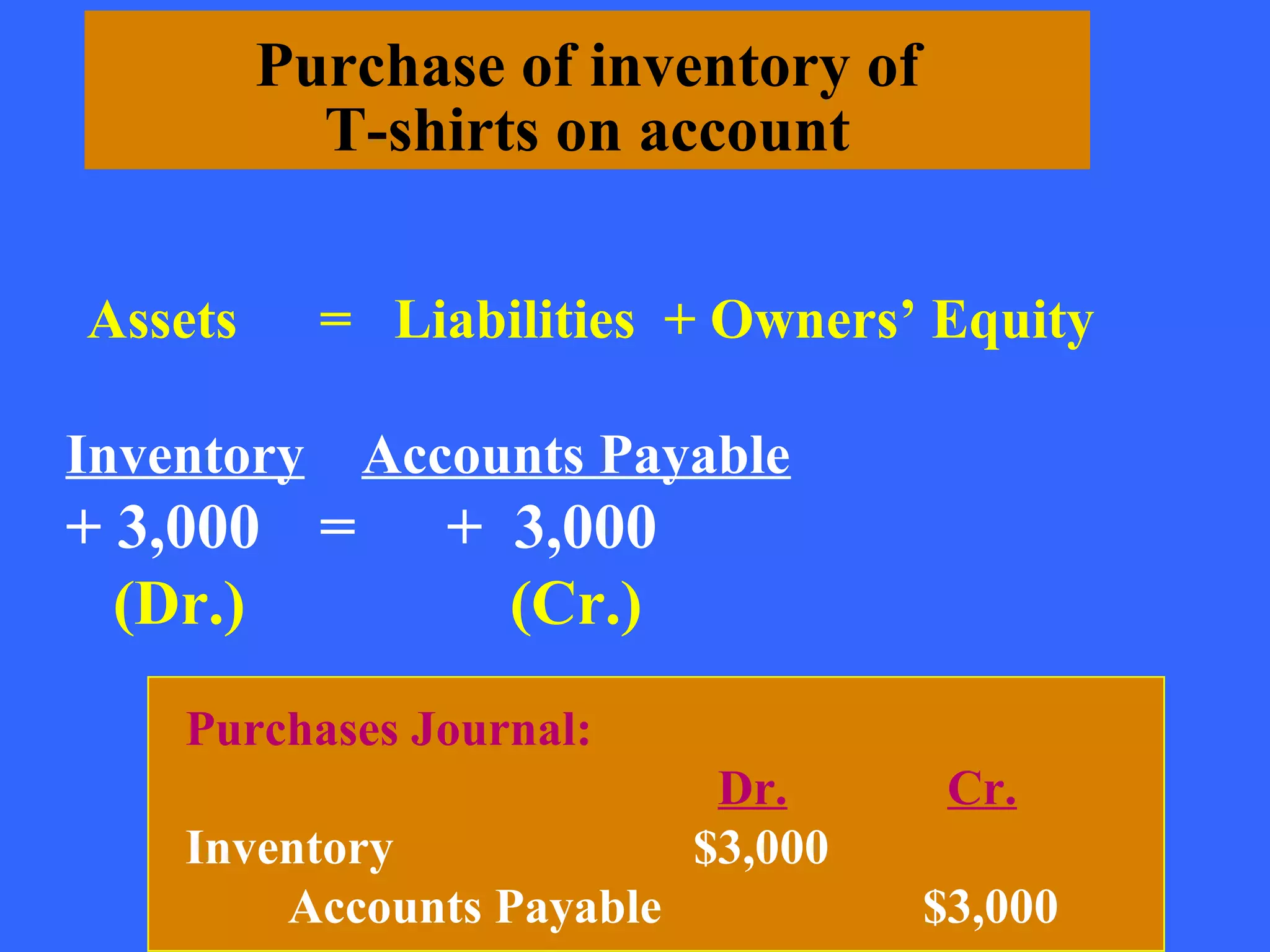
Purchase of inventory of
           T-shirts on account

Assets      = Liabilities + Owners’ Equity

Inventory    Accounts Payable
+ 3,000 =       + 3,000
  (Dr.)           (Cr.)
    Purchases Journal:
                            Dr.      Cr.
    Inventory              $3,000
        Accounts Payable            $3,000   8
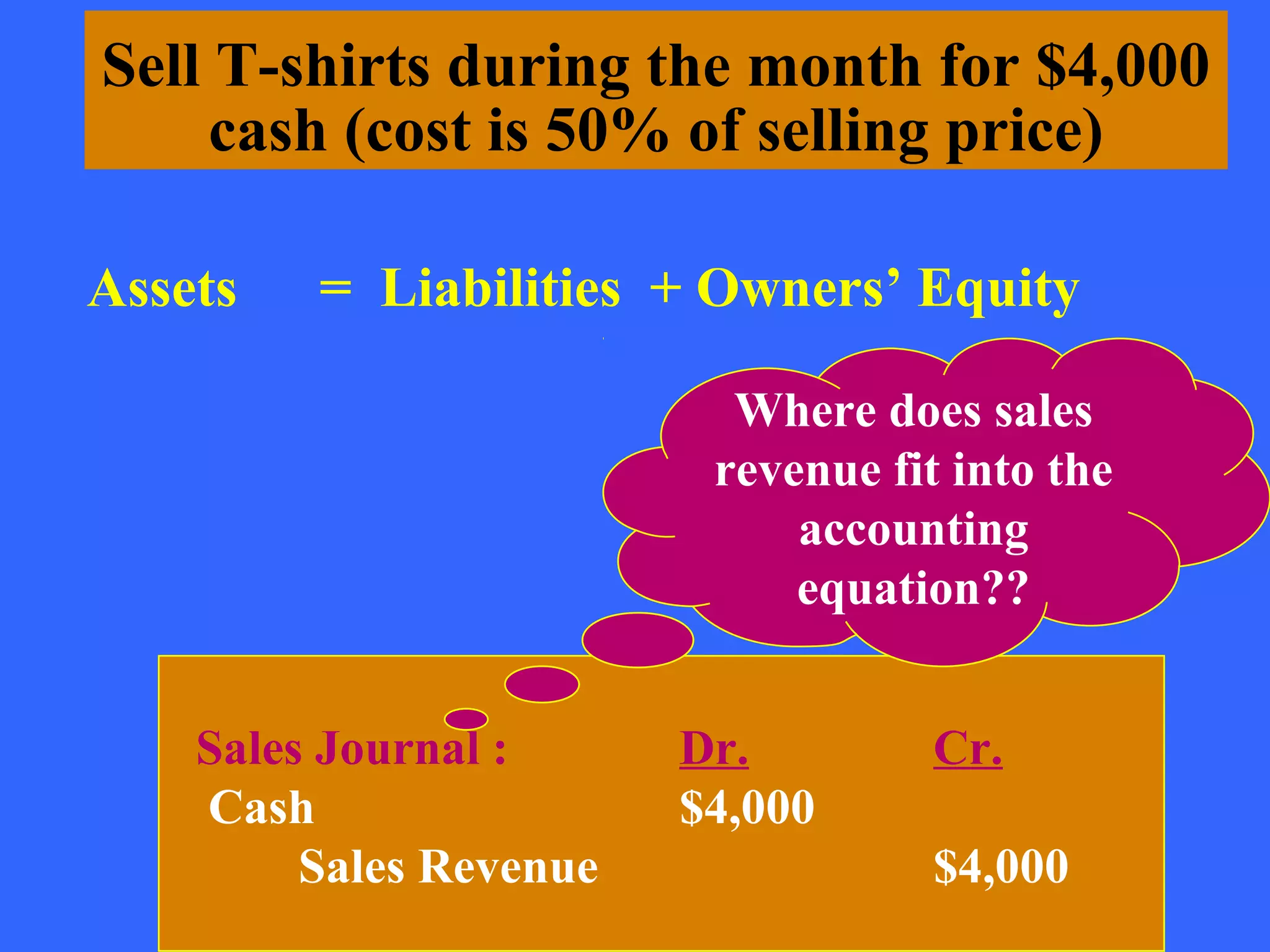
Sell T-shirts during the month for $4,000
     cash (cost is 50% of selling price)

Assets   = Liabilities + Owners’ Equity

                           Where does sales
                          revenue fit into the
                              accounting
                              equation??


    Sales Journal :      Dr.        Cr.
    Cash                 $4,000
         Sales Revenue              $4,000
                                                 9
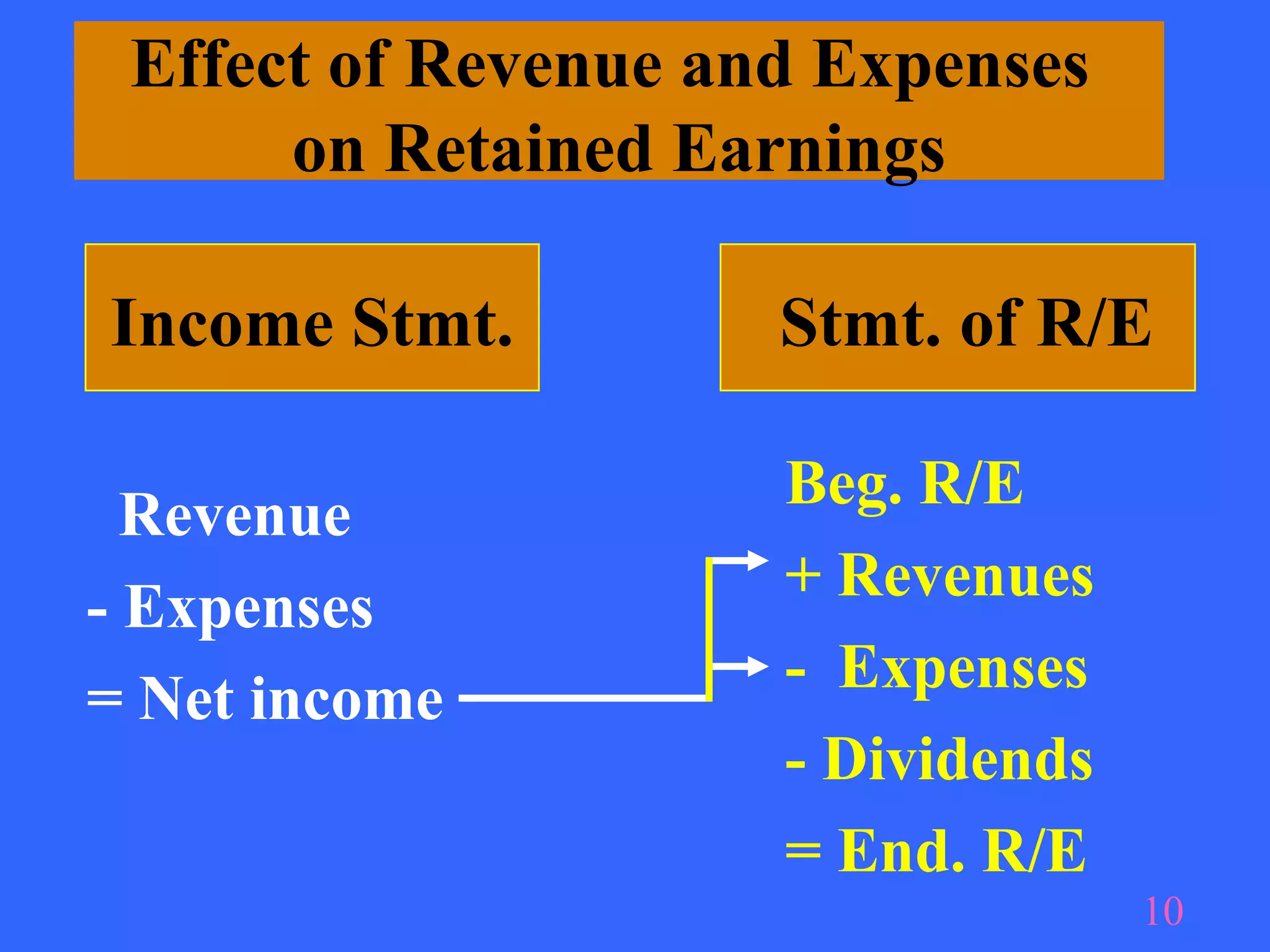
Effect of Revenue and Expenses
      on Retained Earnings

Income Stmt.         Stmt. of R/E

                     Beg. R/E
  Revenue
                     + Revenues
- Expenses
                     - Expenses
= Net income
                     - Dividends
                     = End. R/E
                                   10
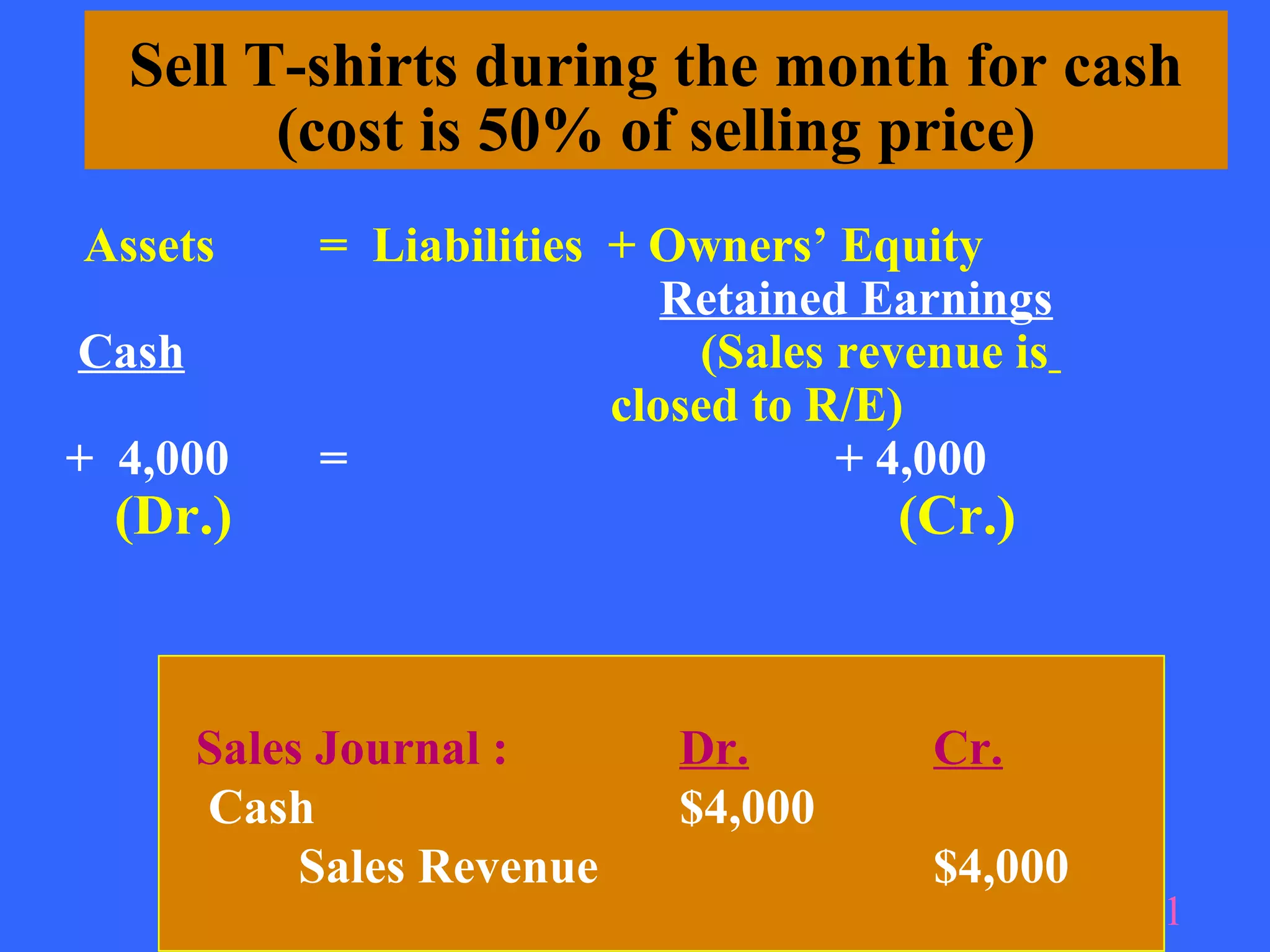
Sell T-shirts during the month for cash
        (cost is 50% of selling price)
Assets      = Liabilities + Owners’ Equity
                             Retained Earnings
Cash                          (Sales revenue is
                          closed to R/E)
+ 4,000     =                        + 4,000
  (Dr.)                                (Cr.)


       Sales Journal :       Dr.         Cr.
       Cash                  $4,000
            Sales Revenue                $4,000
                                                  11
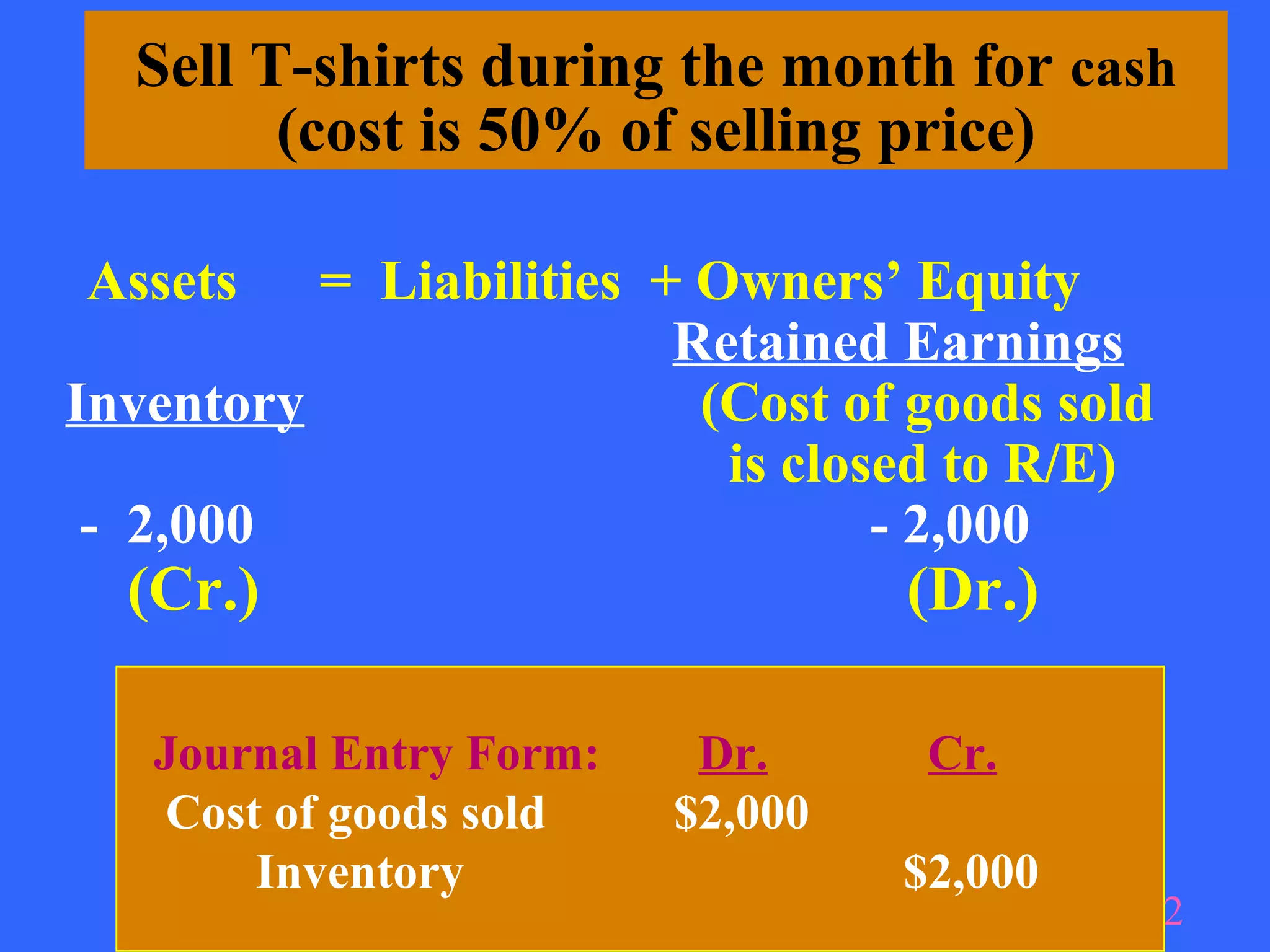
Sell T-shirts during the month for cash
        (cost is 50% of selling price)

Assets    = Liabilities + Owners’ Equity
                         Retained Earnings
Inventory                 (Cost of goods sold
                           is closed to R/E)
 - 2,000                          - 2,000
  (Cr.)                           (Dr.)

   Journal Entry Form:    Dr.      Cr.
   Cost of goods sold    $2,000
       Inventory                  $2,000
                                            12
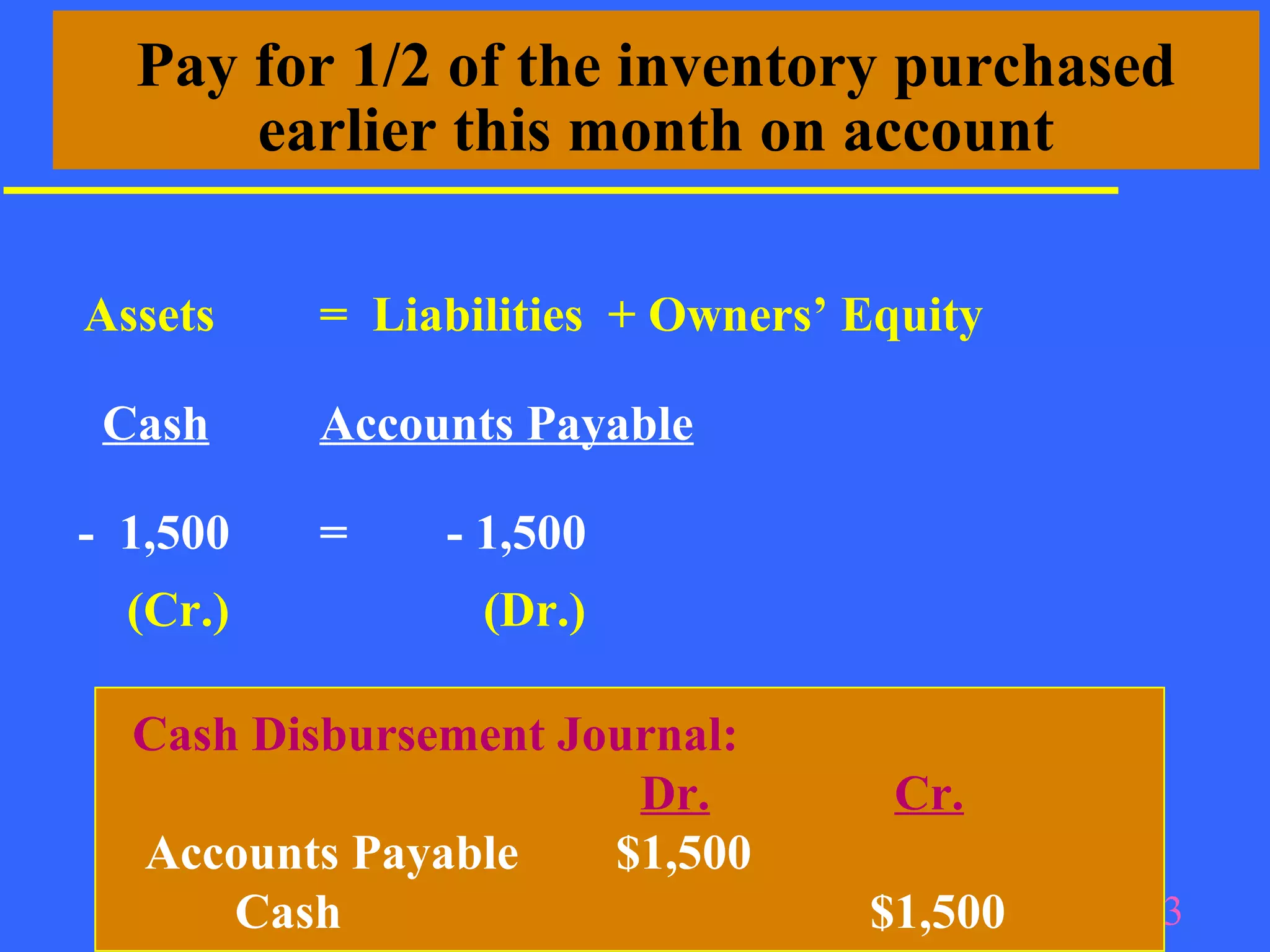
Pay for 1/2 of the inventory purchased
      earlier this month on account

Assets    = Liabilities + Owners’ Equity

 Cash     Accounts Payable

- 1,500   =    - 1,500
  (Cr.)          (Dr.)

  Cash Disbursement Journal:
                       Dr.         Cr.
  Accounts Payable    $1,500
      Cash                        $1,500   13
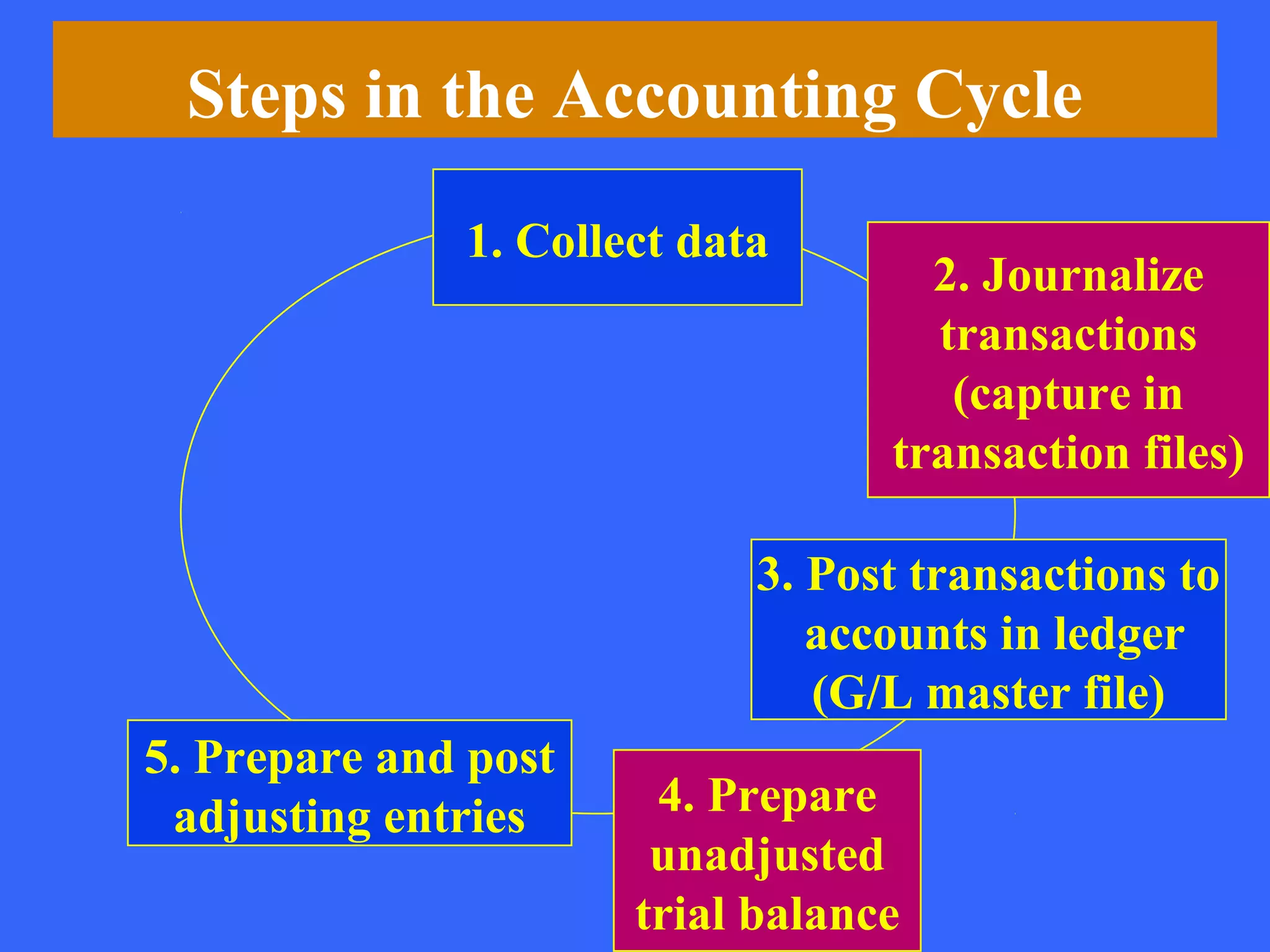
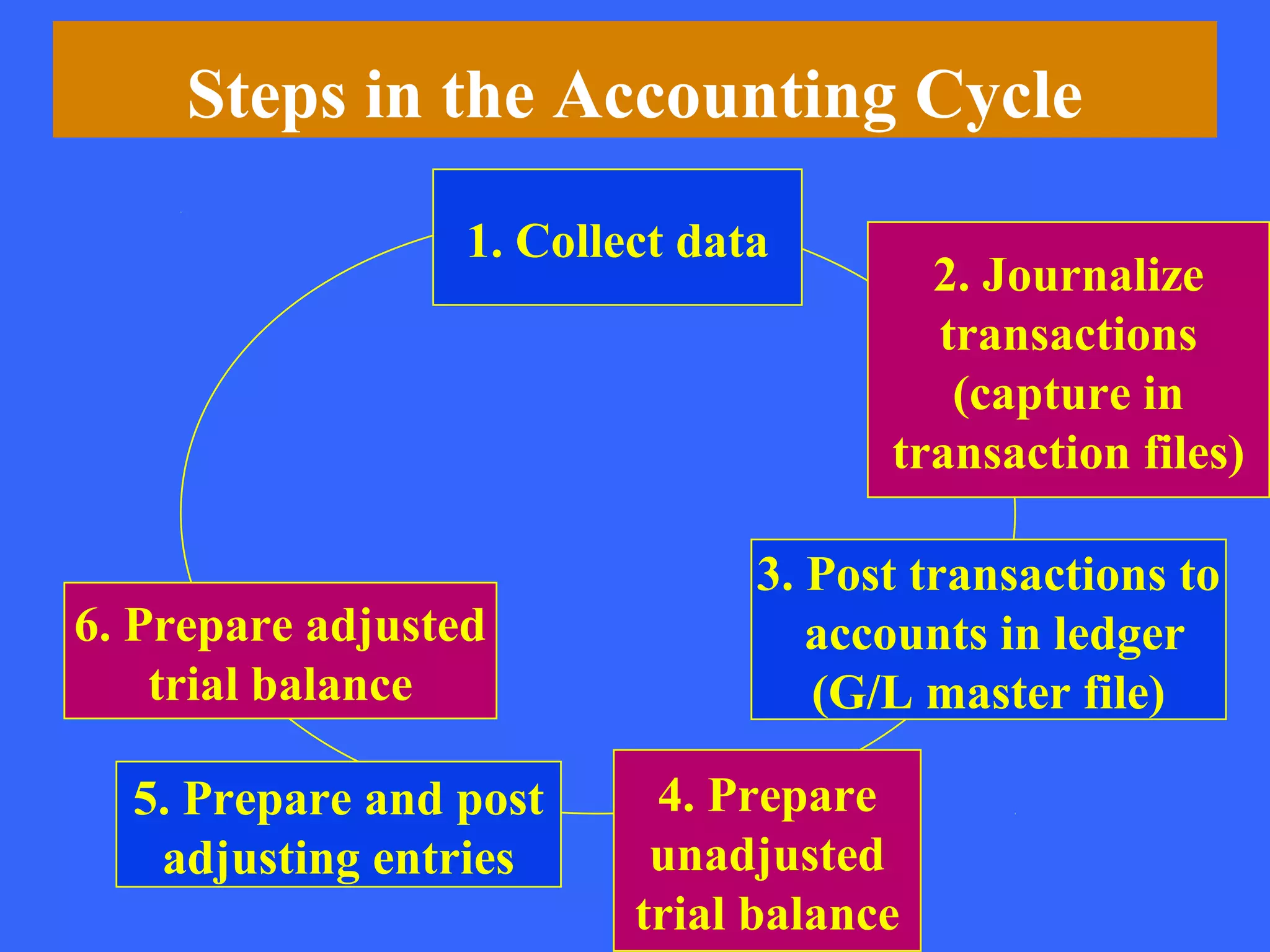
Steps in the Accounting Cycle
         1. Collect data
                              2. Journalize
                              transactions
                               (capture in
                            transaction files)

                       3. Post transactions to
                          accounts in ledger
                          (G/L master file)
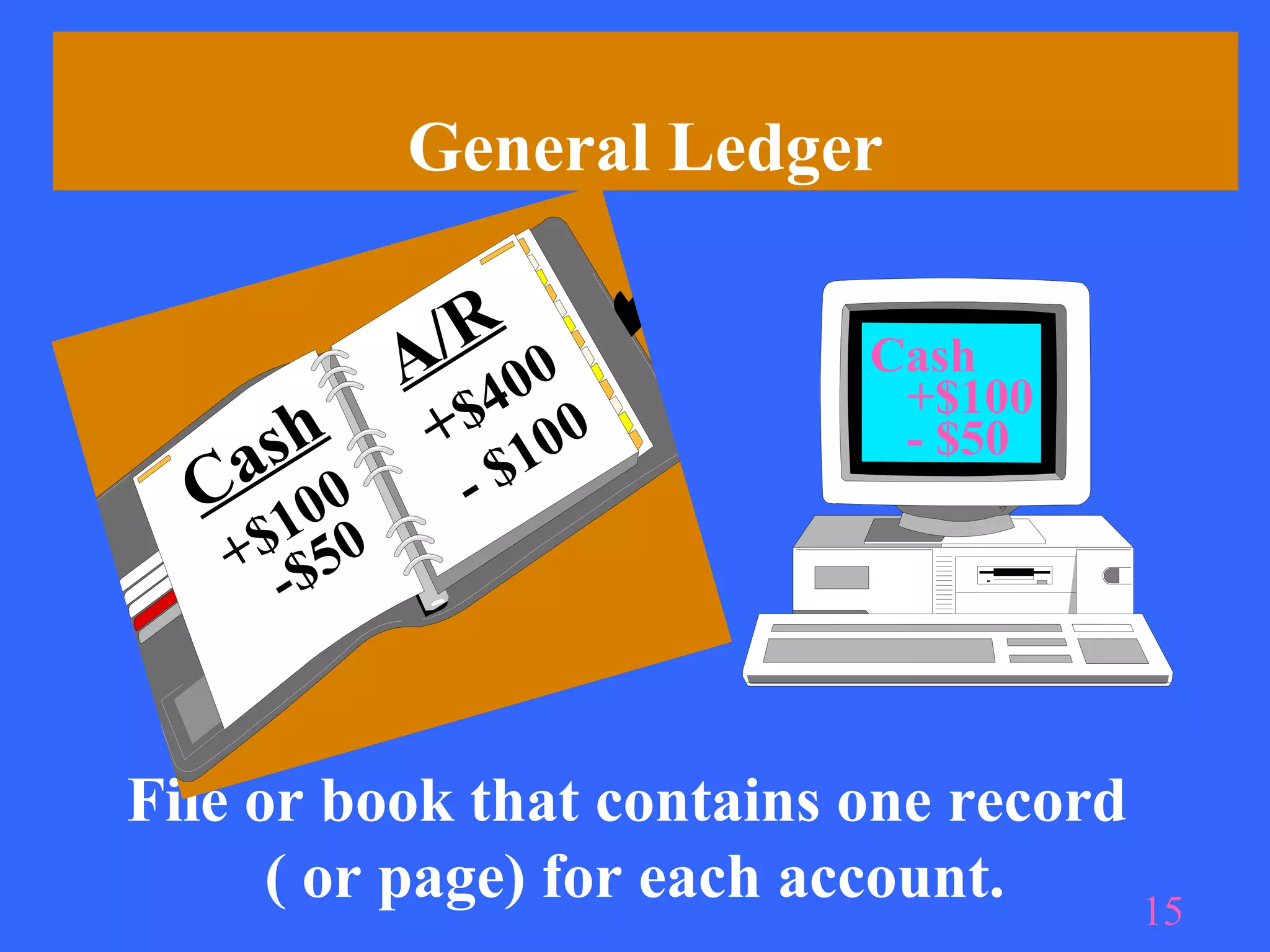
General Ledger

              /R 0
             A 40           Cash
                             +$100
    sh        +$ 10 0        - $50
   a 0
  C 10         -$
    +$ $50
      -


File or book that contains one record
      ( or page) for each account.    15
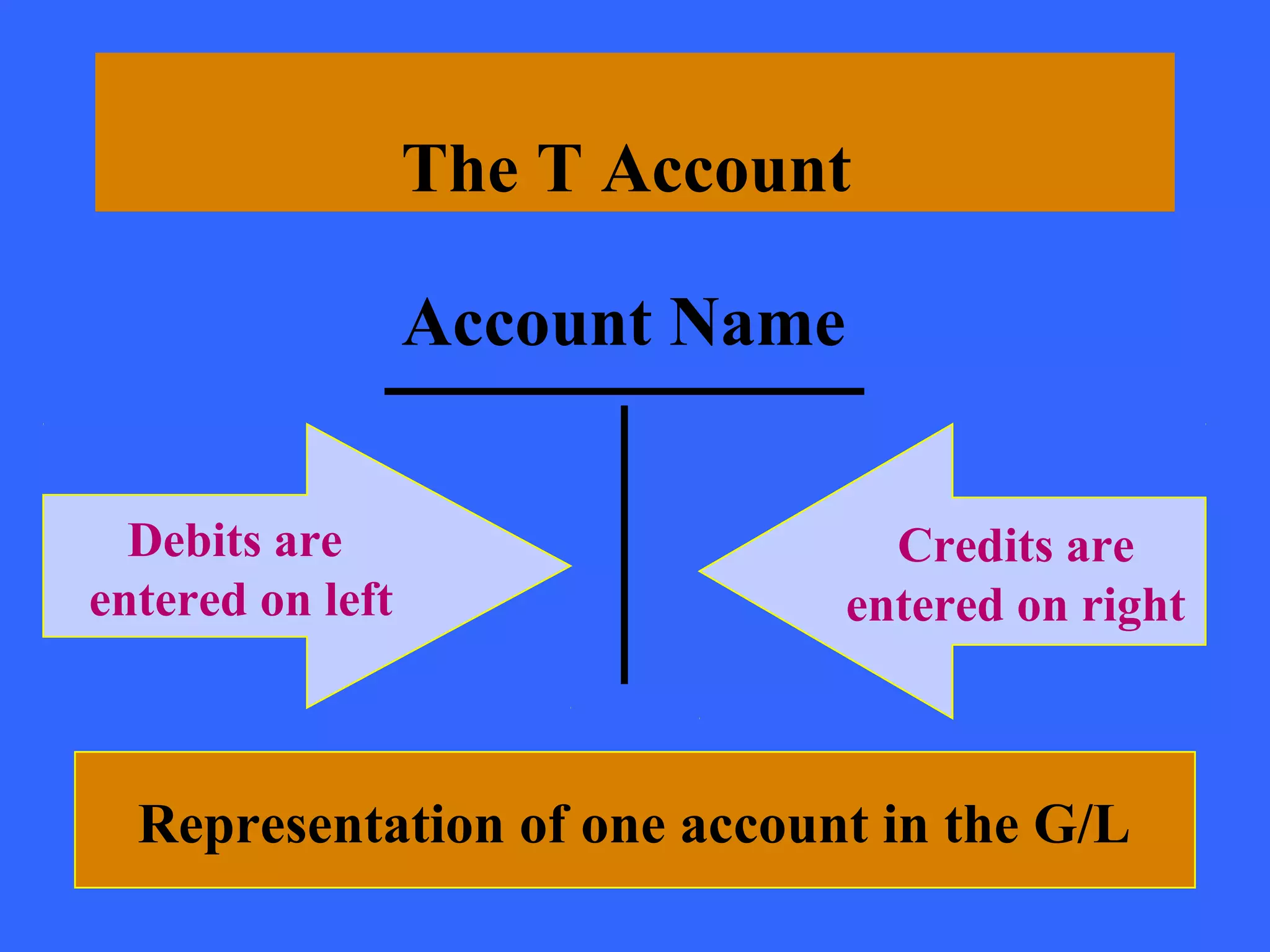
The T Account

                  Account Name

  Debits are                       Credits are
entered on left                  entered on right


  Representation of one account in the G/L
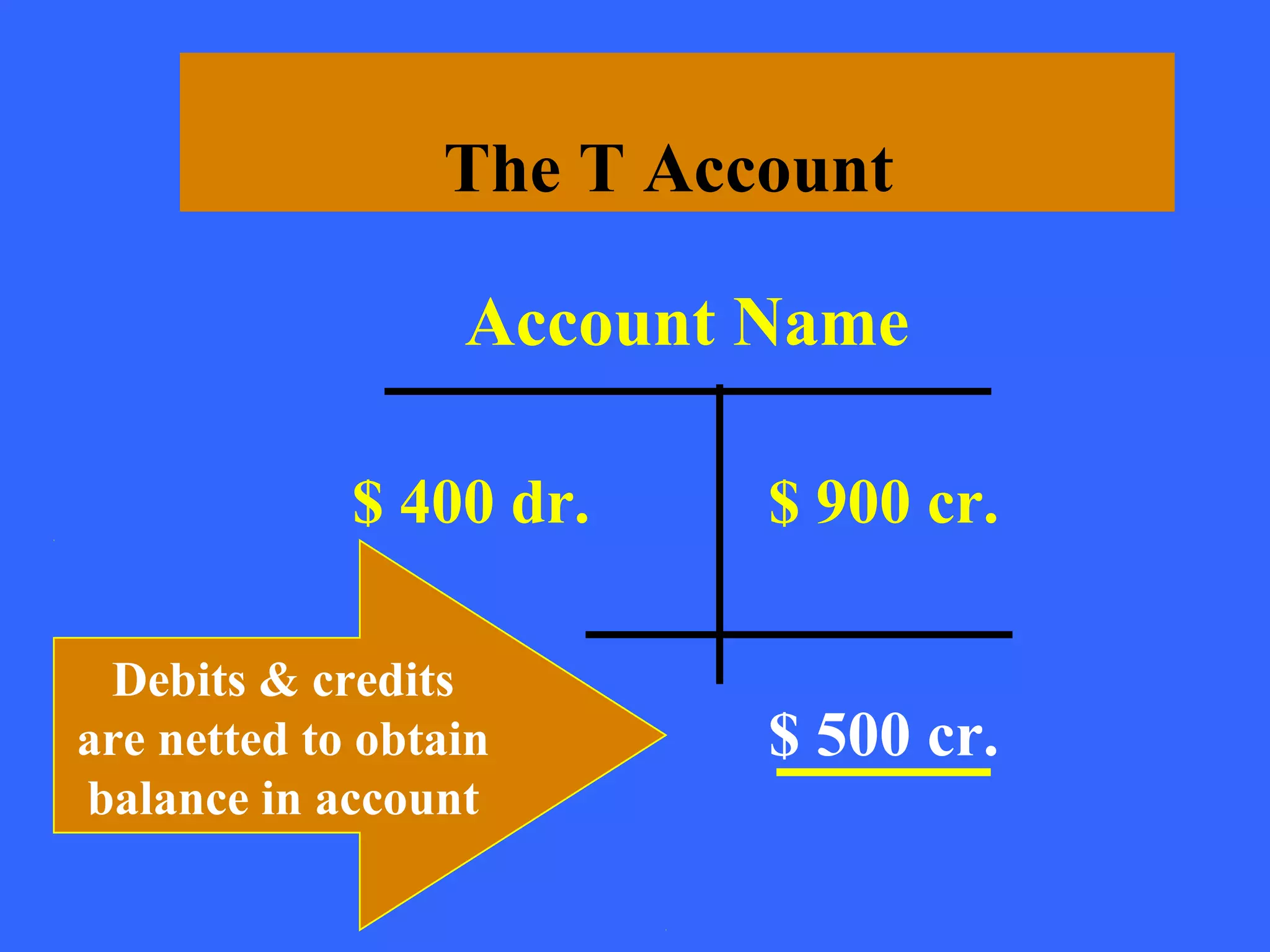
The T Account

                  Account Name

             $ 400 dr.    $ 900 cr.

 Debits & credits
are netted to obtain      $ 500 cr.
balance in account
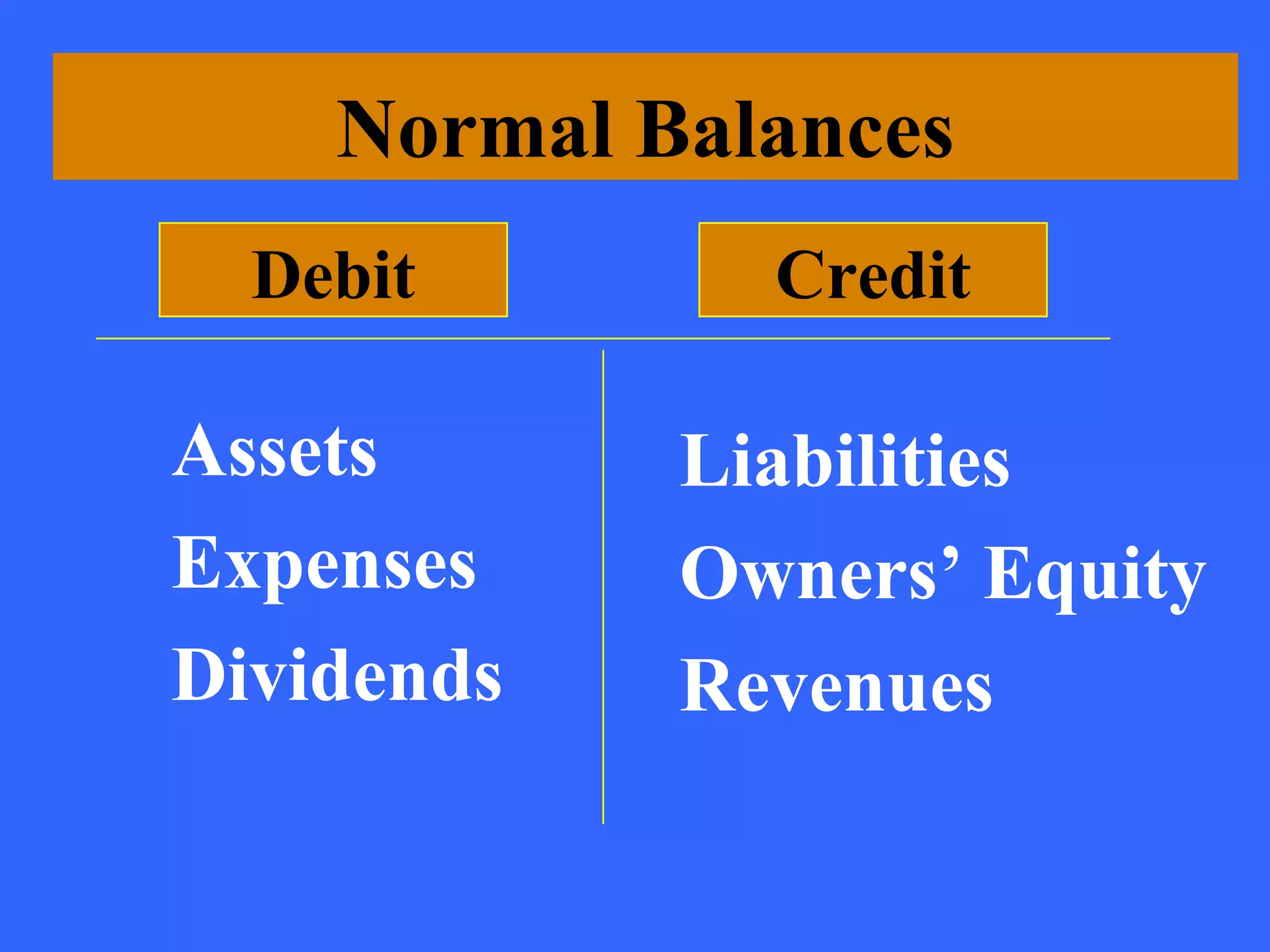
Normal Balances
  Debit       Credit

Assets      Liabilities
Expenses    Owners’ Equity
Dividends   Revenues
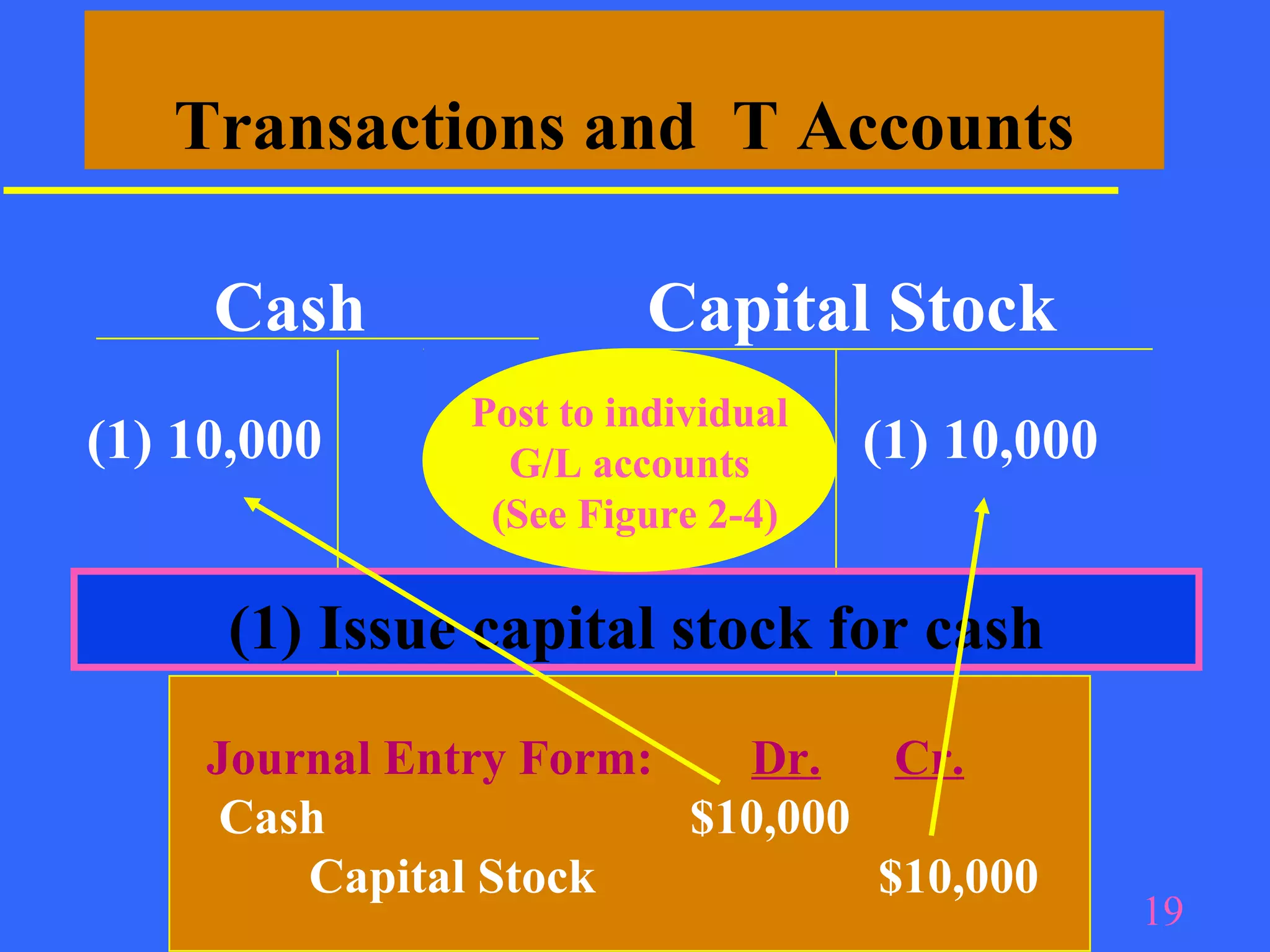
Transactions and T Accounts

     Cash                Capital Stock
                Post to individual
(1) 10,000        G/L accounts       (1) 10,000
                 (See Figure 2-4)

      (1) Issue capital stock for cash
     Journal Entry Form:   Dr. Cr.
      Cash               $10,000
         Capital Stock           $10,000
                                                  19
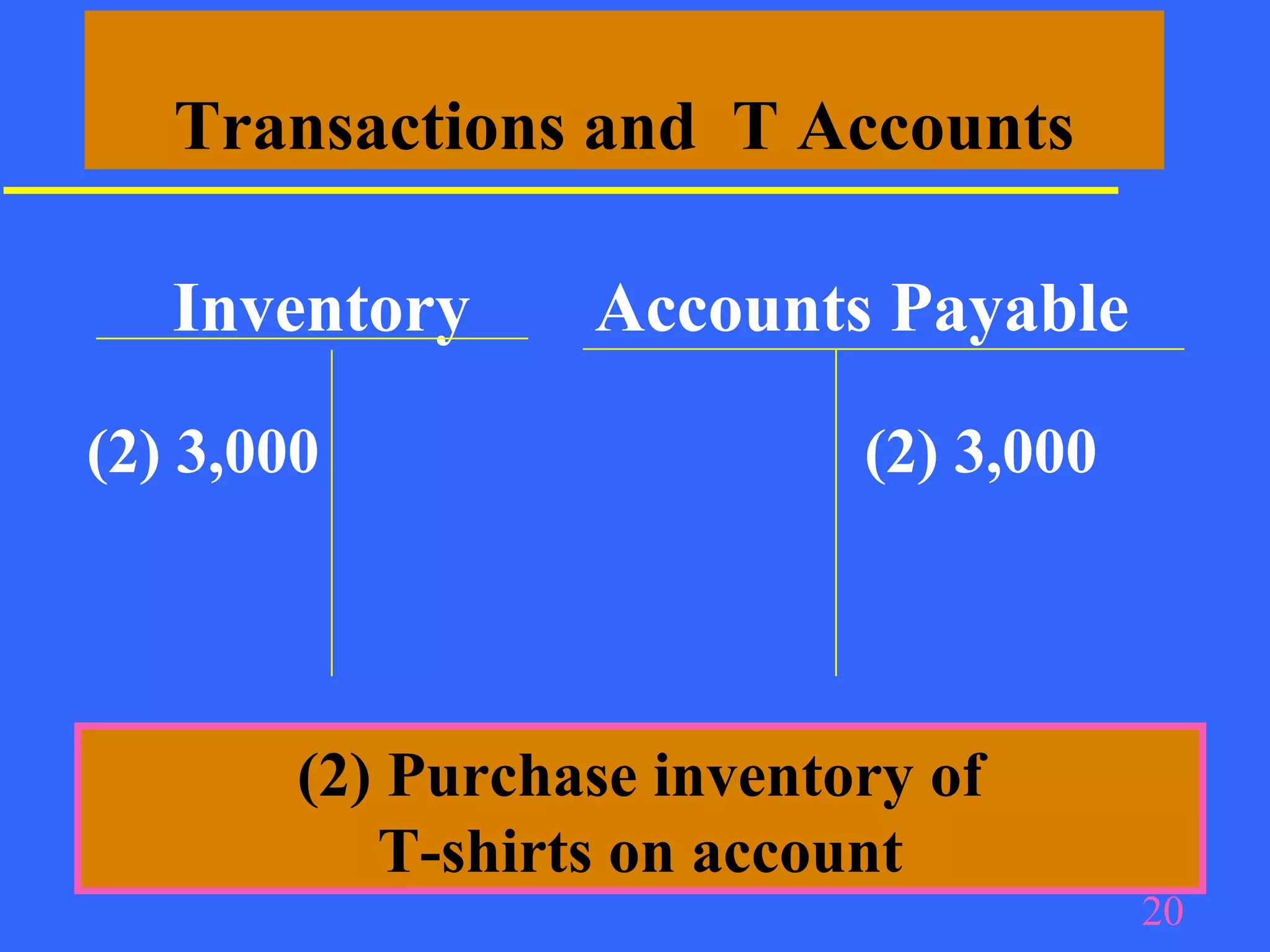
Transactions and T Accounts

   Inventory      Accounts Payable

(2) 3,000                   (2) 3,000


        (2) Purchase inventory of
           T-shirts on account
                                        20
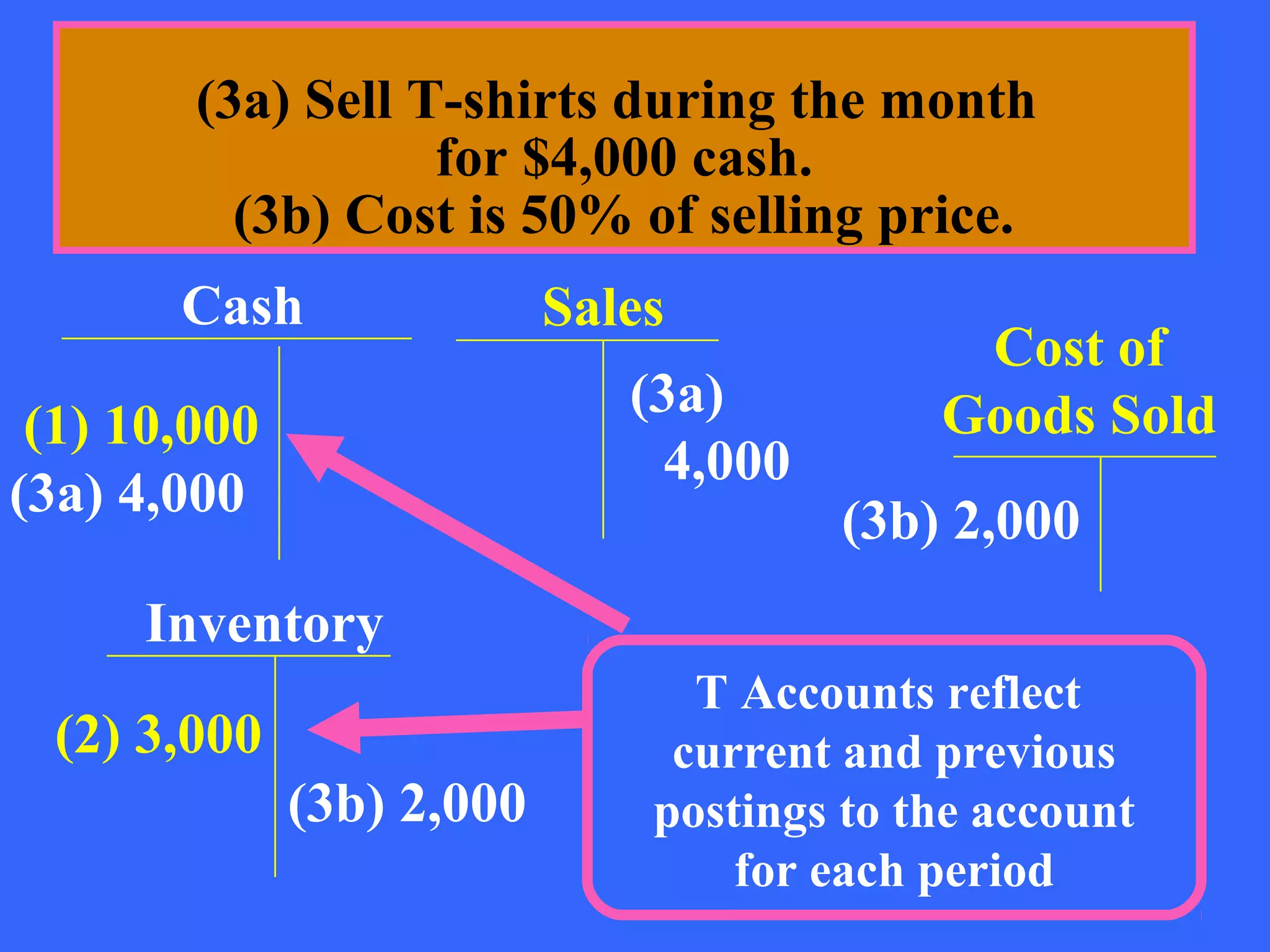
(3a) Sell T-shirts during the month
                   for $4,000 cash.
          (3b) Cost is 50% of selling price.
       Cash                Sales
                                             Cost of
                              (3a)          Goods Sold
 (1) 10,000
                                4,000
(3a) 4,000                              (3b) 2,000
     Inventory
                                 T Accounts reflect
  (2) 3,000                     current and previous
              (3b) 2,000       postings to the account
                                   for each period
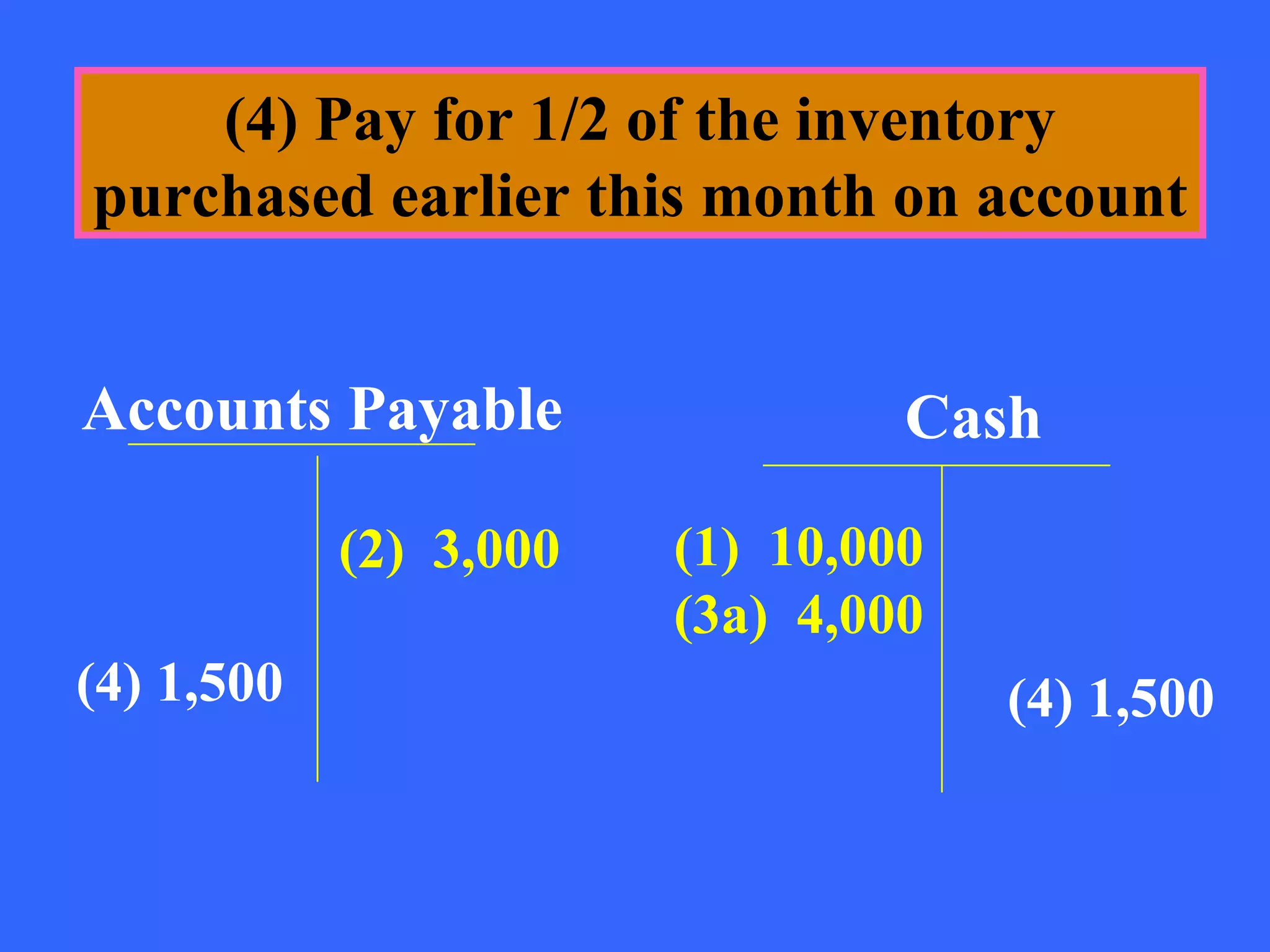
(4) Pay for 1/2 of the inventory
purchased earlier this month on account


Accounts Payable                 Cash

            (2) 3,000   (1) 10,000
                        (3a) 4,000
(4) 1,500                            (4) 1,500
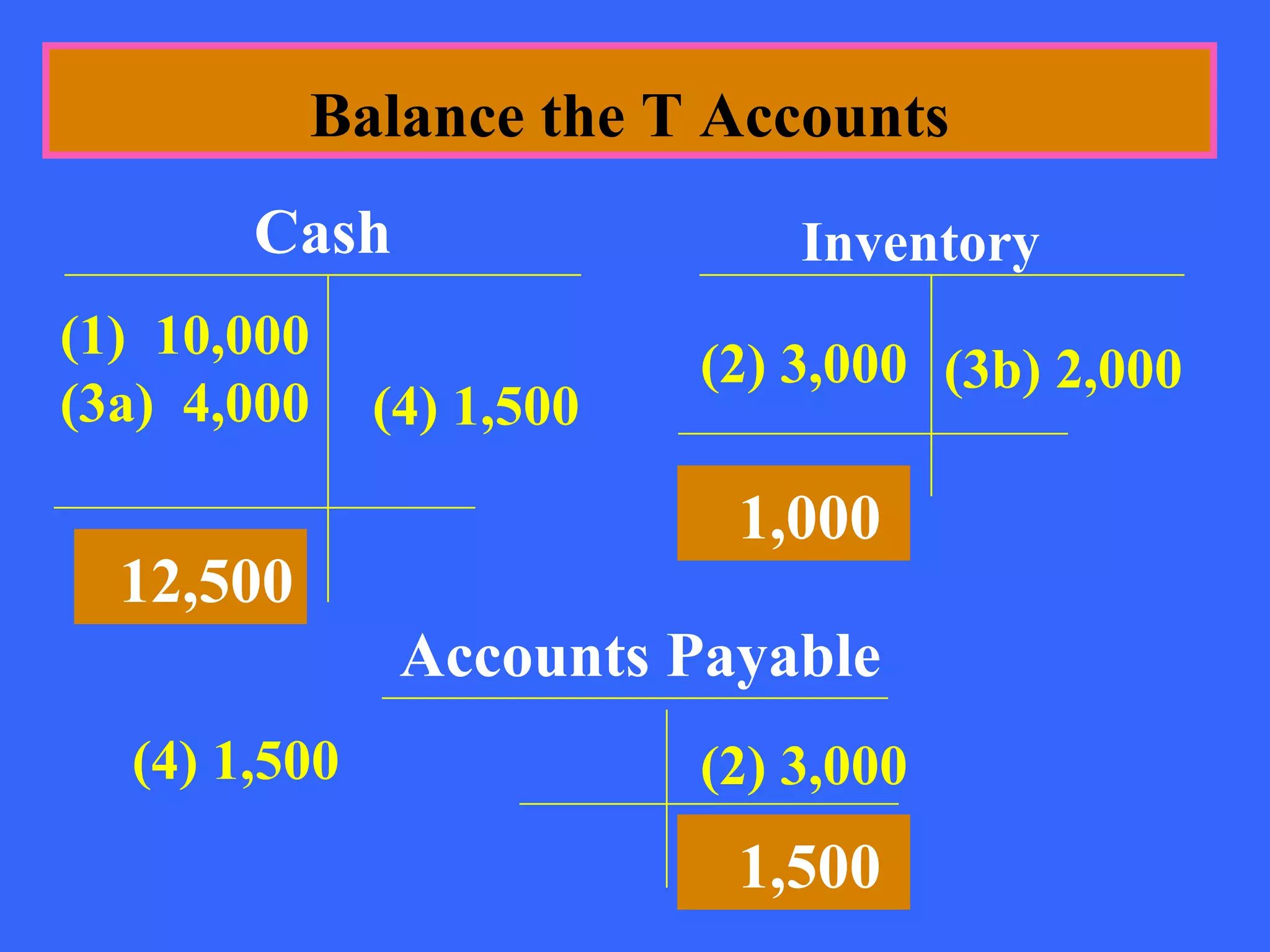
Balance the T Accounts
       Cash                   Inventory
(1) 10,000
                          (2) 3,000 (3b) 2,000
(3a) 4,000    (4) 1,500

                           1,000
  12,500
               Accounts Payable
  (4) 1,500               (2) 3,000
                           1,500
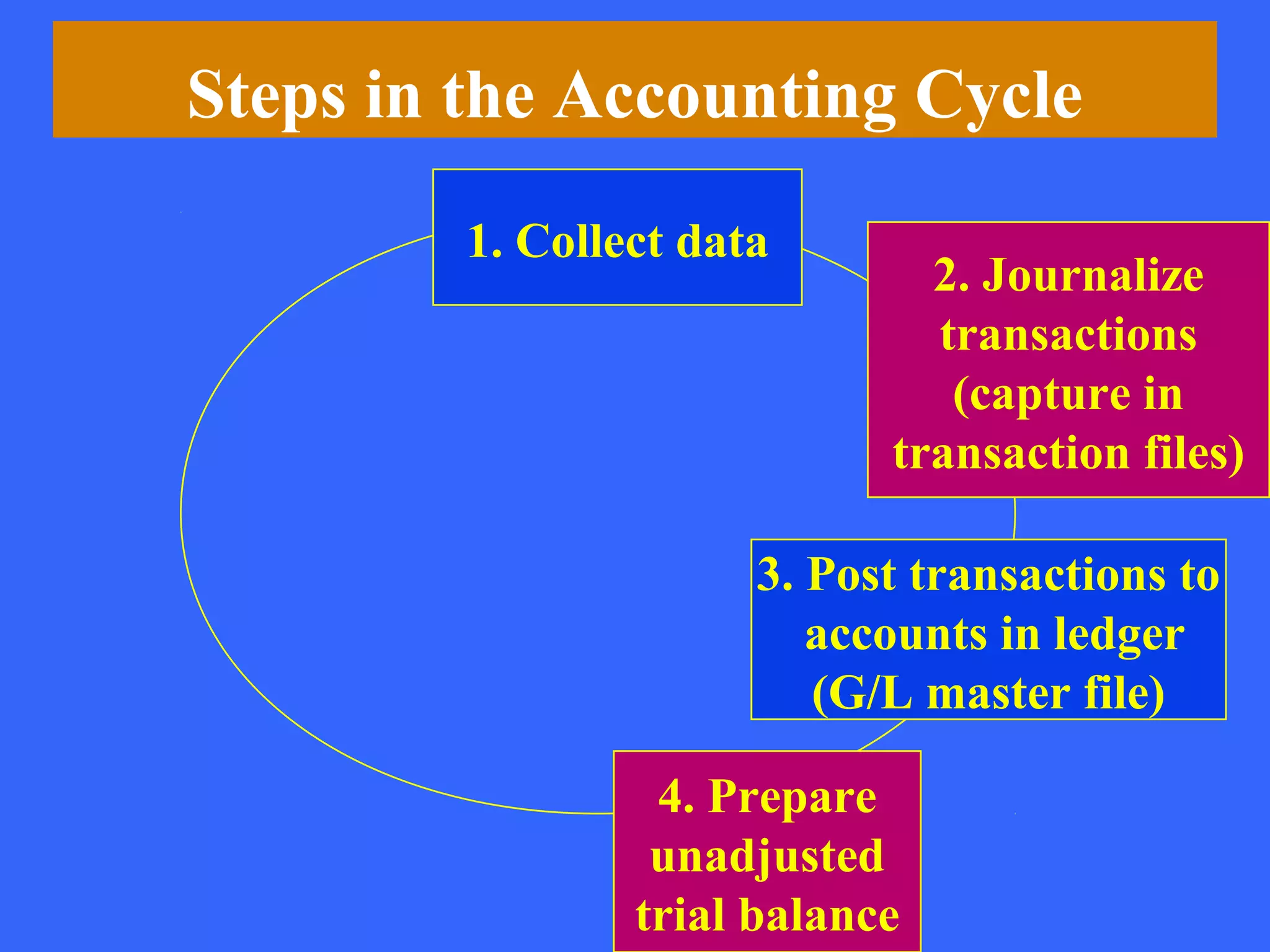
Steps in the Accounting Cycle
         1. Collect data
                               2. Journalize
                               transactions
                                (capture in
                             transaction files)

                       3. Post transactions to
                          accounts in ledger
                          (G/L master file)

                  4. Prepare
                  unadjusted
                 trial balance
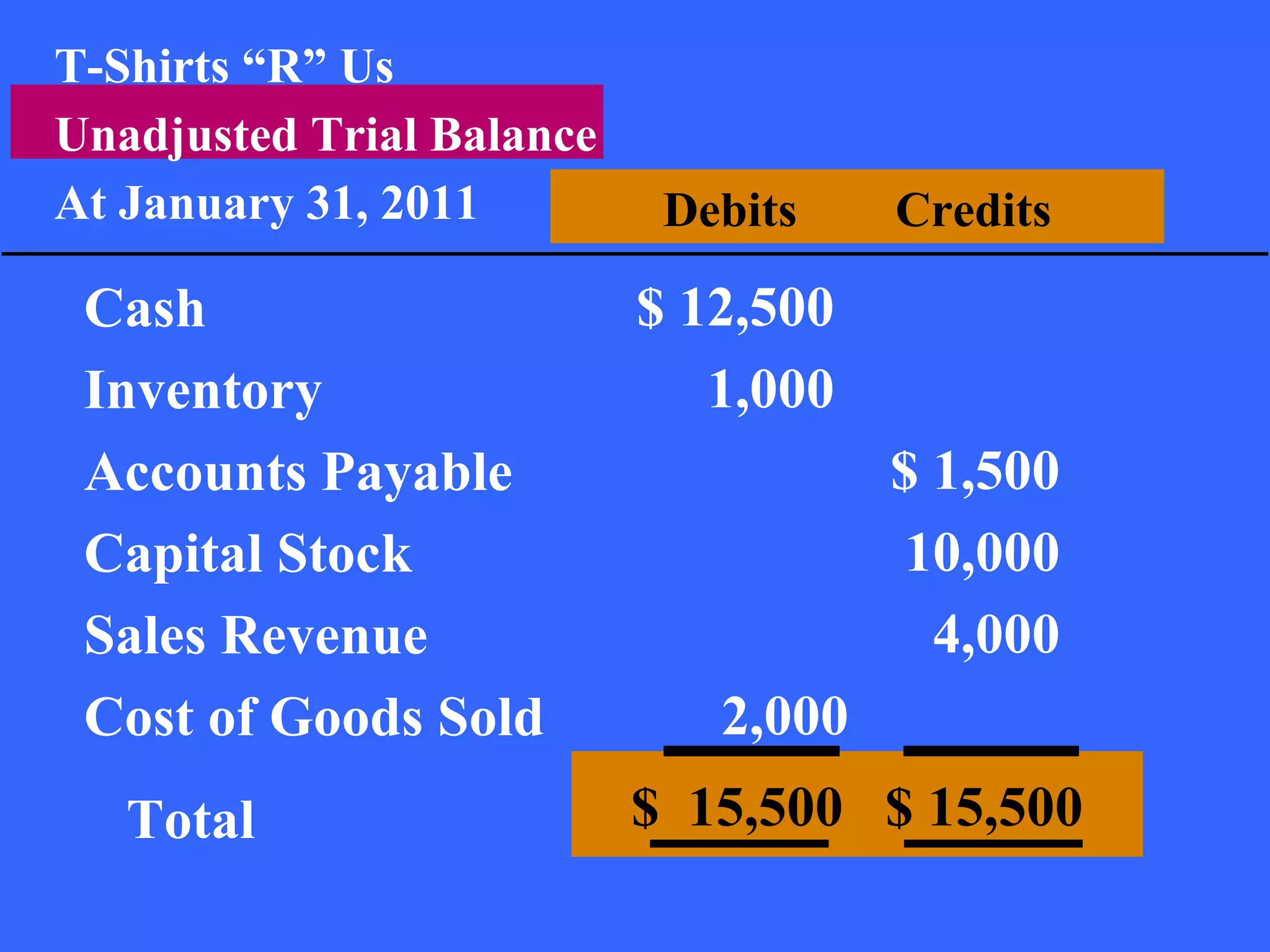
T-Shirts “R” Us
Unadjusted Trial Balance
At January 31, 2011         Debits    Credits

 Cash                      $ 12,500
 Inventory                    1,000
 Accounts Payable                     $ 1,500
 Capital Stock                         10,000
 Sales Revenue                          4,000
 Cost of Goods Sold           2,000
   Total                   $ 15,500 $ 15,500
Steps in the Accounting Cycle
              1. Collect data
                                    2. Journalize
                                    transactions
                                     (capture in
                                  transaction files)

                            3. Post transactions to
                               accounts in ledger
                               (G/L master file)
5. Prepare and post
 adjusting entries     4. Prepare
                       unadjusted
                      trial balance
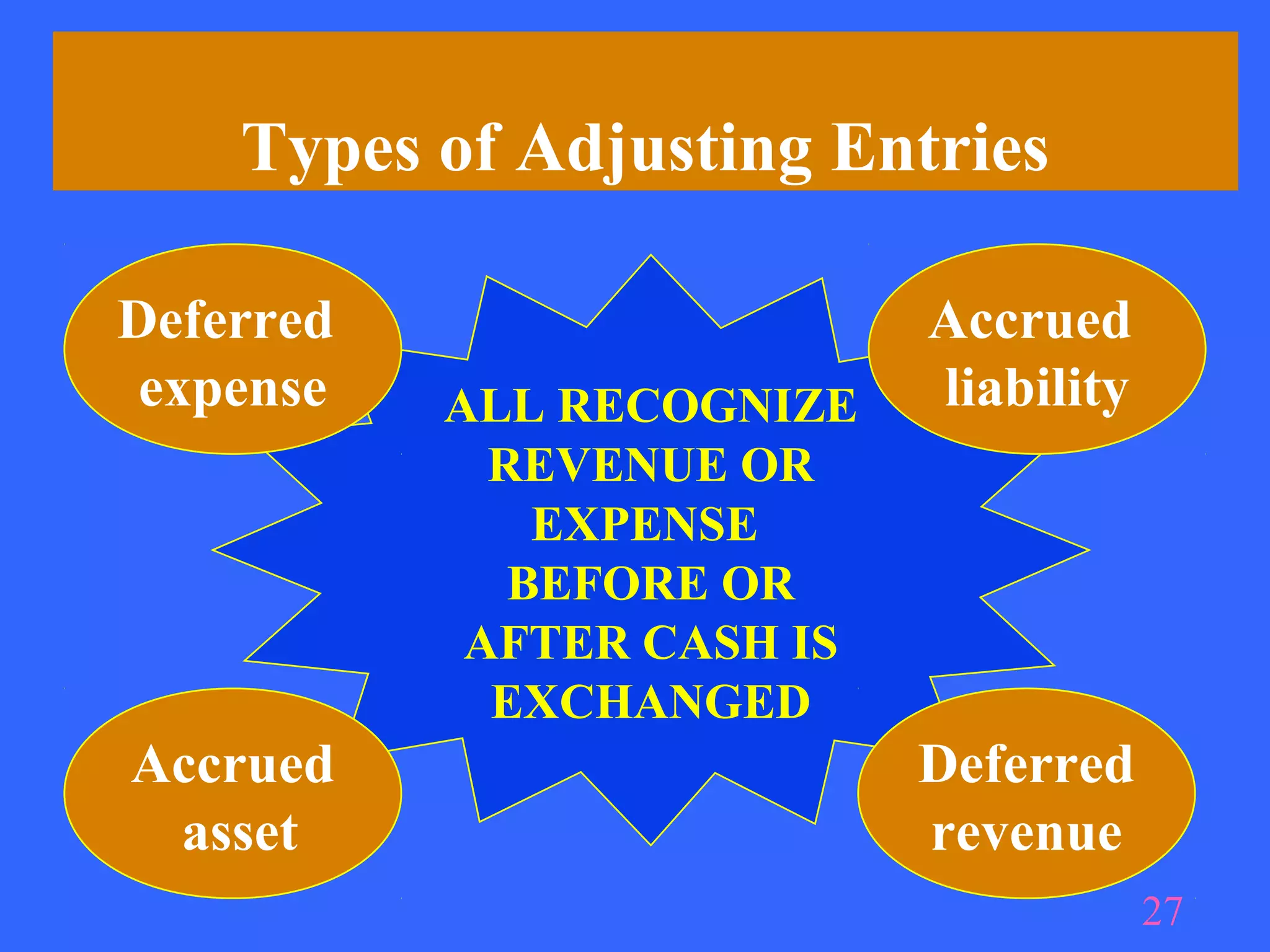
Types of Adjusting Entries

Deferred                    Accrued
 expense   ALL RECOGNIZE    liability
             REVENUE OR
               EXPENSE
              BEFORE OR
            AFTER CASH IS
             EXCHANGED
Accrued                     Deferred
 asset                      revenue
                                        27
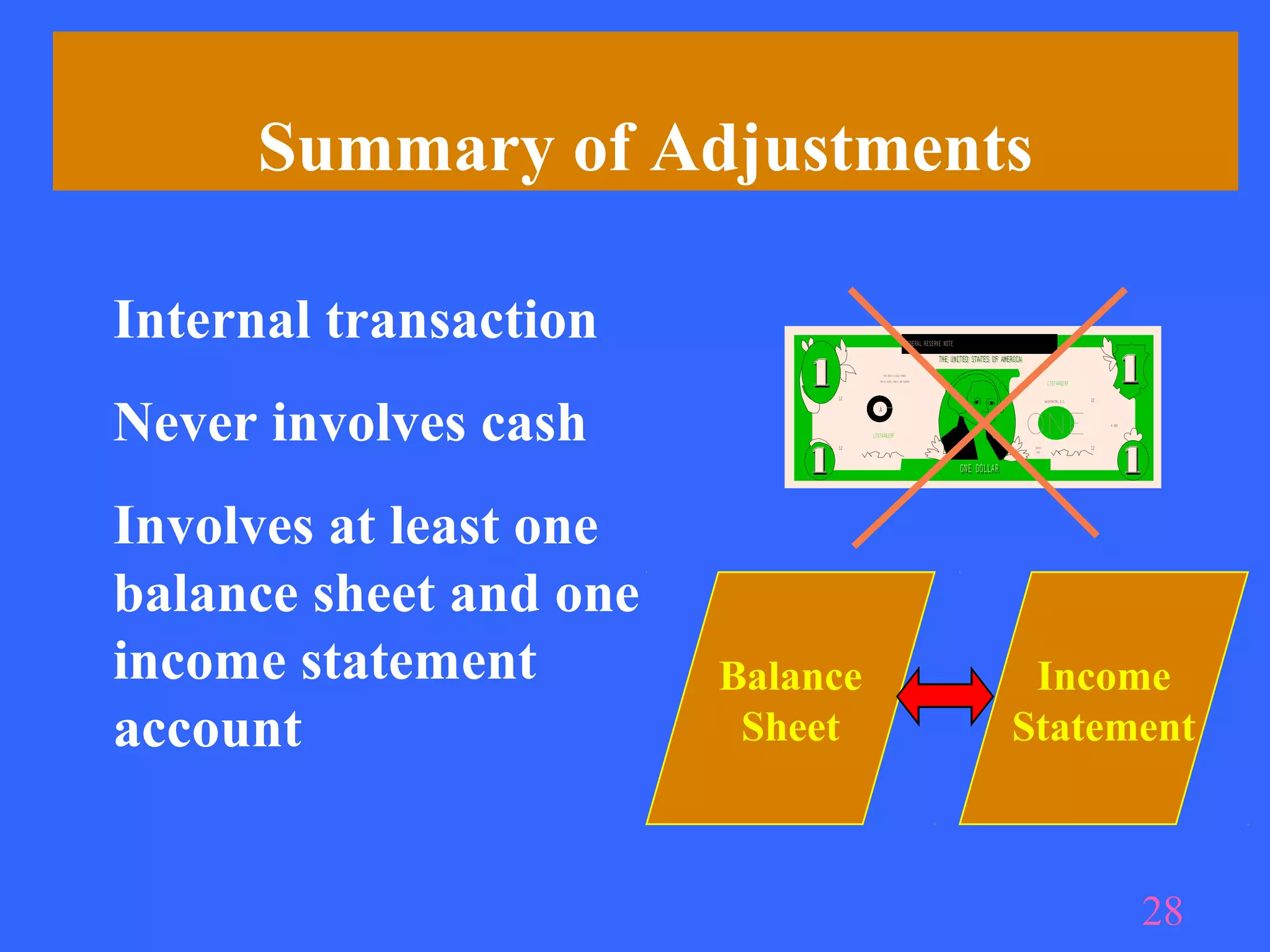
Summary of Adjustments

Internal transaction                                            FEDERAL RESERVE NOTE

                                                                             THE UNITED STATES OF AMERICA
                                                                              THE UNITED STATES OF AMERICA
                                         THIS NOTE IS LEGAL TENDER


                                                                                                                       L70744629F
                                     FOR ALL DEBTS, PUBLIC AND PRIVATE


Never involves cash
                             12                                                                                       WASHINGTON, D.C.   12

                                     A

                                                                                                                                              H 293

                                  L70744629F

                             12                                                                              SERIES                      12
                                                                                                              1985


                                                                                       ONE DOLLAR
                                                                                       ONE DOLLAR


Involves at least one
balance sheet and one
income statement        Balance                                                                        Income
account                  Sheet                                                                        Statement


                                                                                                                                                      28
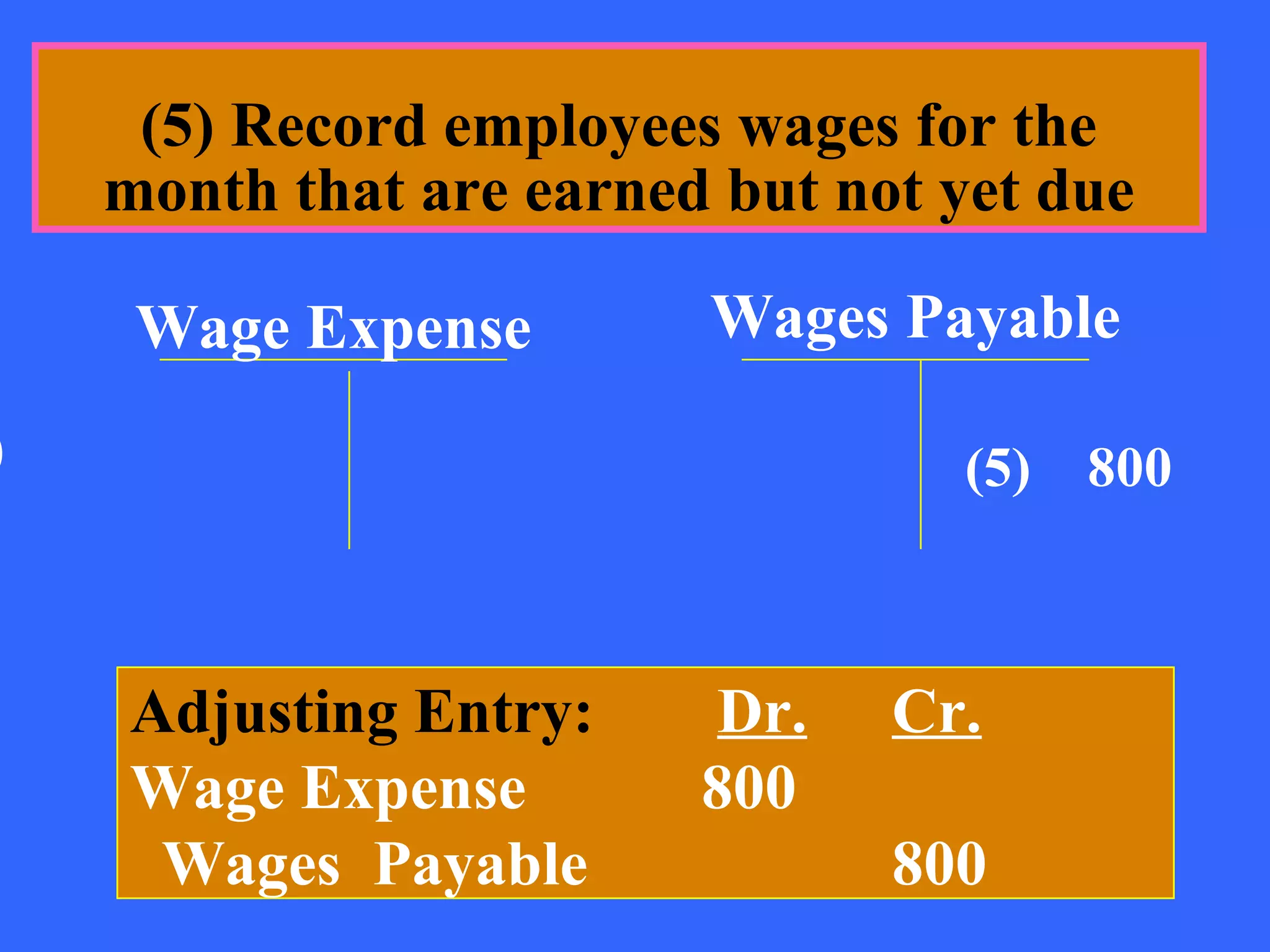
(5) Record employees wages for the
    month that are earned but not yet due

     Wage Expense        Wages Payable

0                                 (5)   800


    Adjusting Entry:      Dr.   Cr.
    Wage Expense         800
     Wages Payable              800
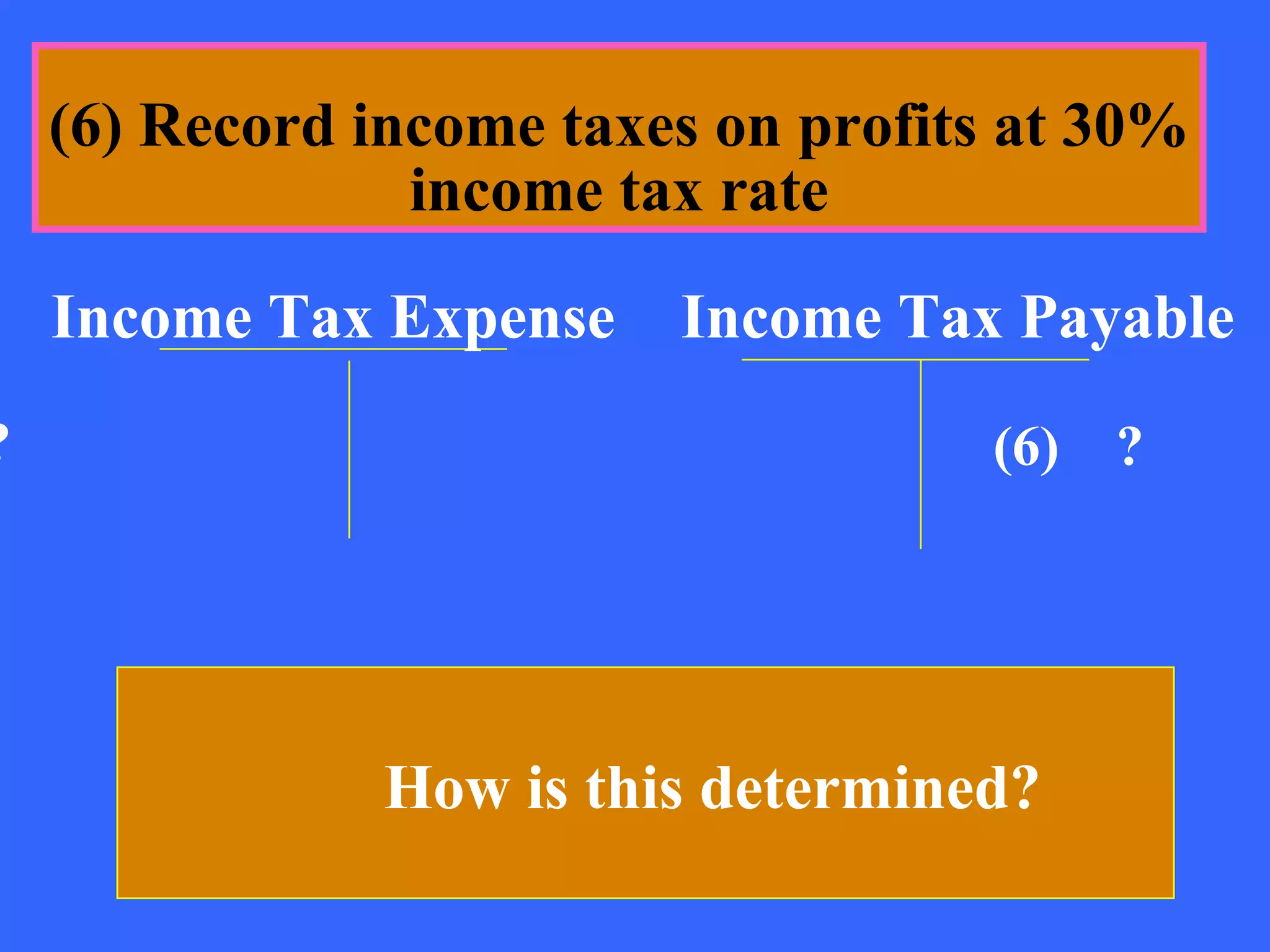
(6) Record income taxes on profits at 30%
                 income tax rate

    Income Tax Expense    Income Tax Payable
?                                    (6)   ?


                How is this determined?
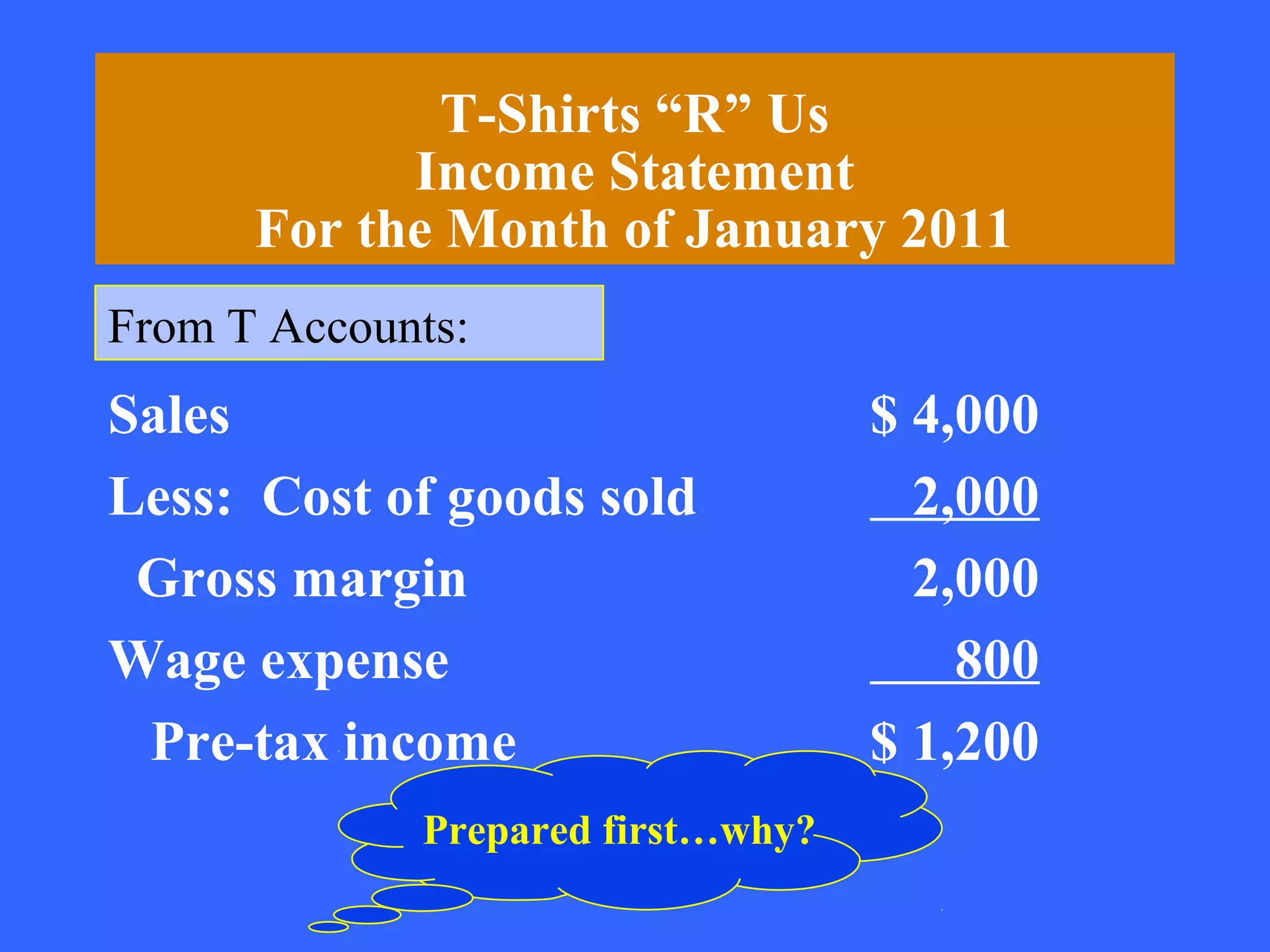
T-Shirts “R” Us
            Income Statement
      For the Month of January 2011
From T Accounts:
Sales                              $ 4,000
Less: Cost of goods sold             2,000
 Gross margin                        2,000
Wage expense                           800
 Pre-tax income                    $ 1,200
             Prepared first…why?
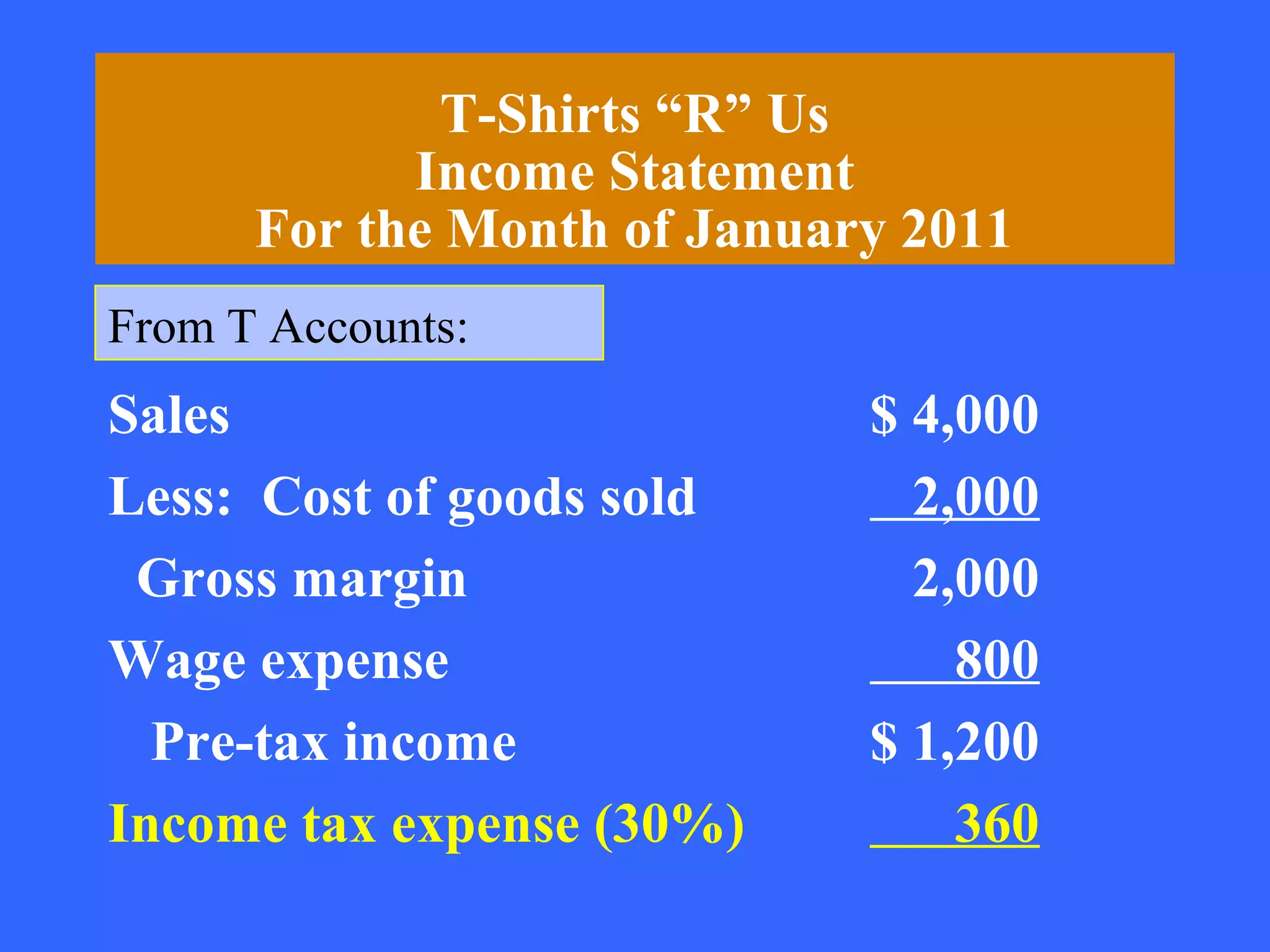
T-Shirts “R” Us
            Income Statement
      For the Month of January 2011
From T Accounts:
Sales                        $ 4,000
Less: Cost of goods sold       2,000
 Gross margin                  2,000
Wage expense                     800
  Pre-tax income             $ 1,200
Income tax expense (30%)         360
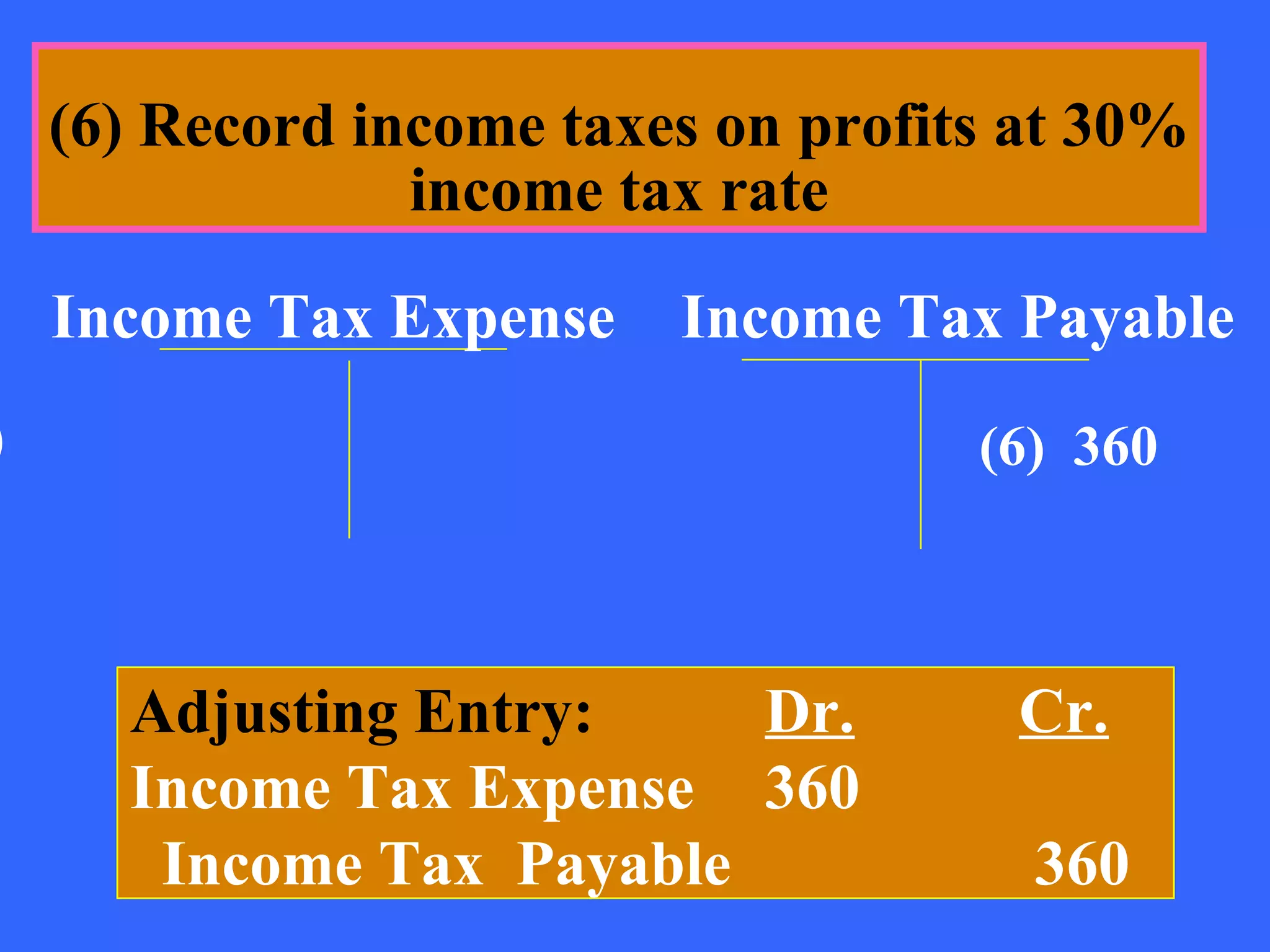
(6) Record income taxes on profits at 30%
                 income tax rate

    Income Tax Expense    Income Tax Payable
0                                    (6) 360


      Adjusting Entry:    Dr.         Cr.
      Income Tax Expense 360
       Income Tax Payable              360
Steps in the Accounting Cycle
                  1. Collect data
                                        2. Journalize
                                        transactions
                                         (capture in
                                      transaction files)

                                3. Post transactions to
6. Prepare adjusted                accounts in ledger
    trial balance                  (G/L master file)

  5. Prepare and post      4. Prepare
   adjusting entries       unadjusted
                          trial balance
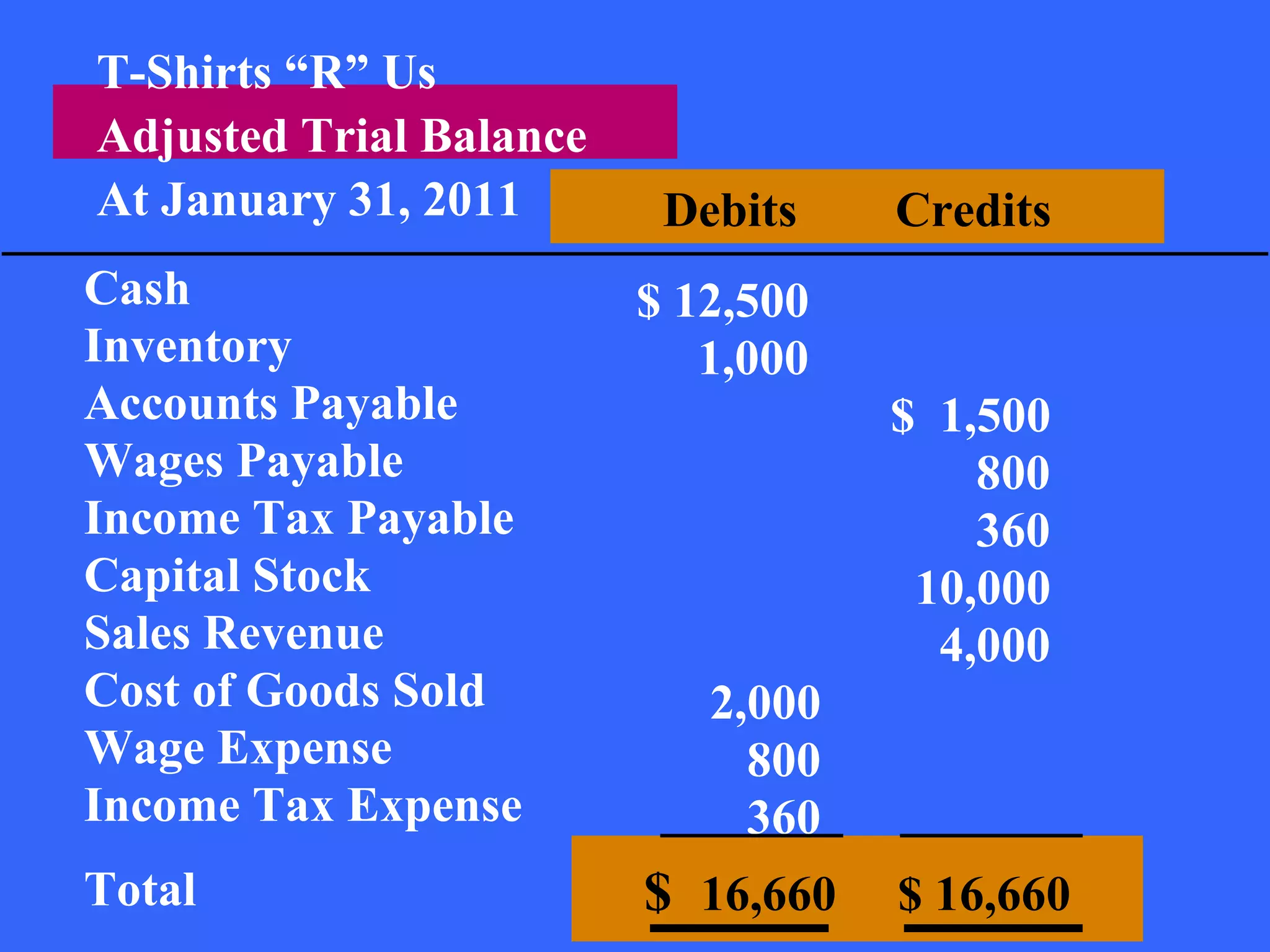
T-Shirts “R” Us
Adjusted Trial Balance
At January 31, 2011       Debits    Credits
Cash                     $ 12,500
Inventory                   1,000
Accounts Payable                    $ 1,500
Wages Payable                           800
Income Tax Payable                      360
Capital Stock                        10,000
Sales Revenue                         4,000
Cost of Goods Sold          2,000
Wage Expense                  800
Income Tax Expense            360
Total                    $ 16,660   $ 16,660
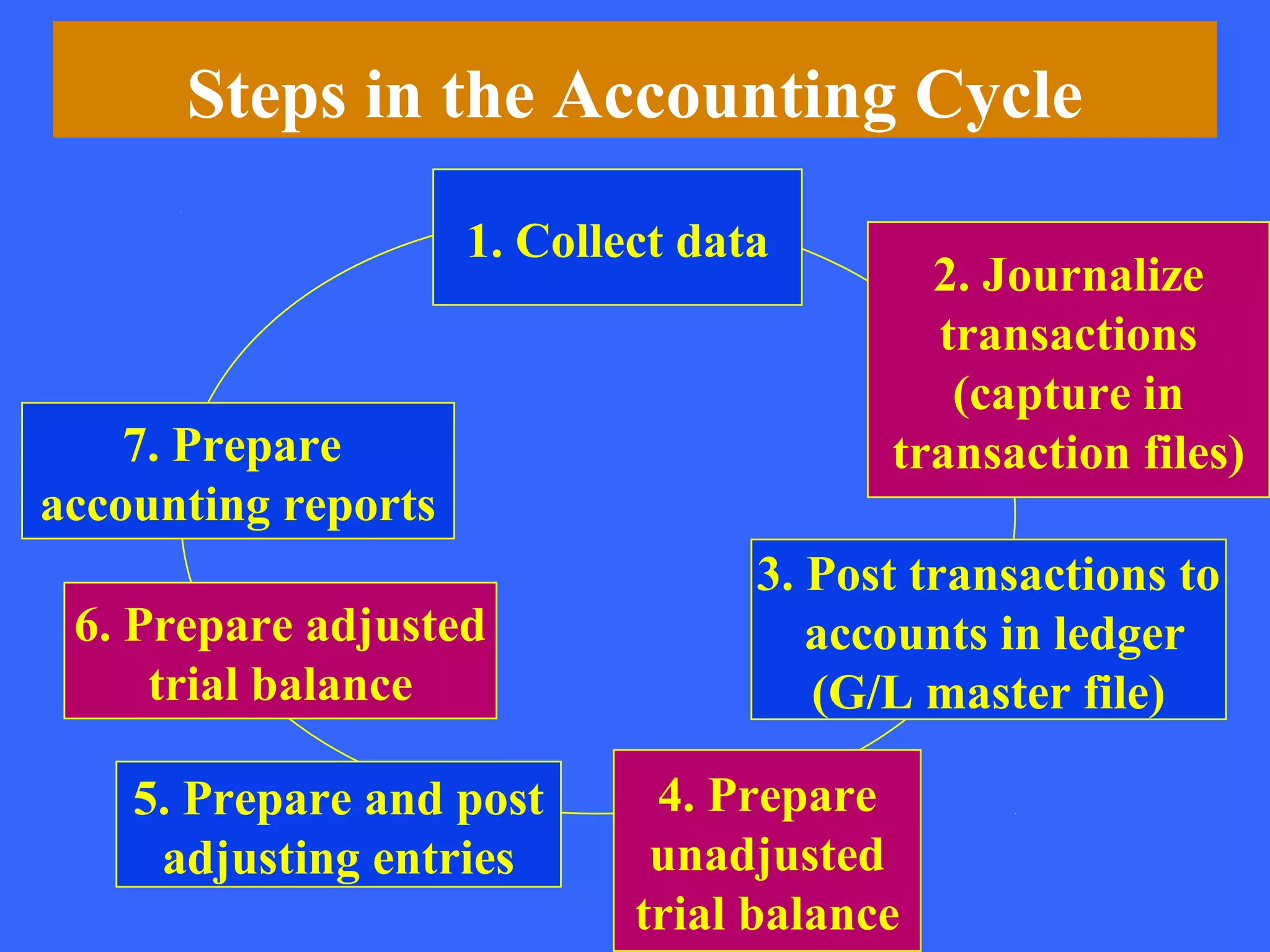
Steps in the Accounting Cycle
                     1. Collect data
                                           2. Journalize
                                           transactions
                                            (capture in
    7. Prepare                           transaction files)
accounting reports
                                   3. Post transactions to
 6. Prepare adjusted                  accounts in ledger
     trial balance                    (G/L master file)

    5. Prepare and post       4. Prepare
     adjusting entries        unadjusted
                             trial balance
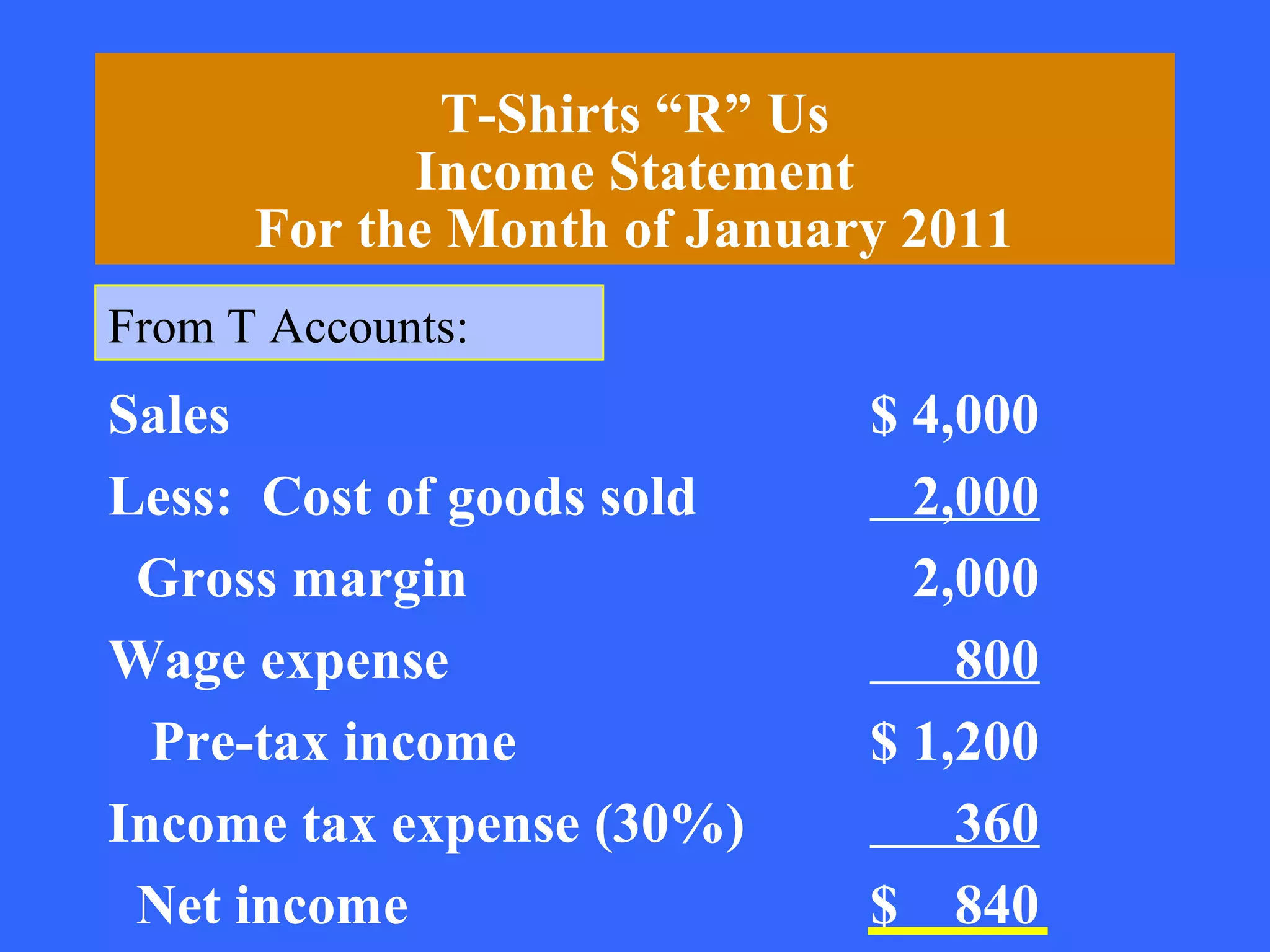
T-Shirts “R” Us
            Income Statement
      For the Month of January 2011
From T Accounts:
Sales                        $ 4,000
Less: Cost of goods sold       2,000
 Gross margin                  2,000
Wage expense                     800
  Pre-tax income             $ 1,200
Income tax expense (30%)         360
 Net income                  $ 840
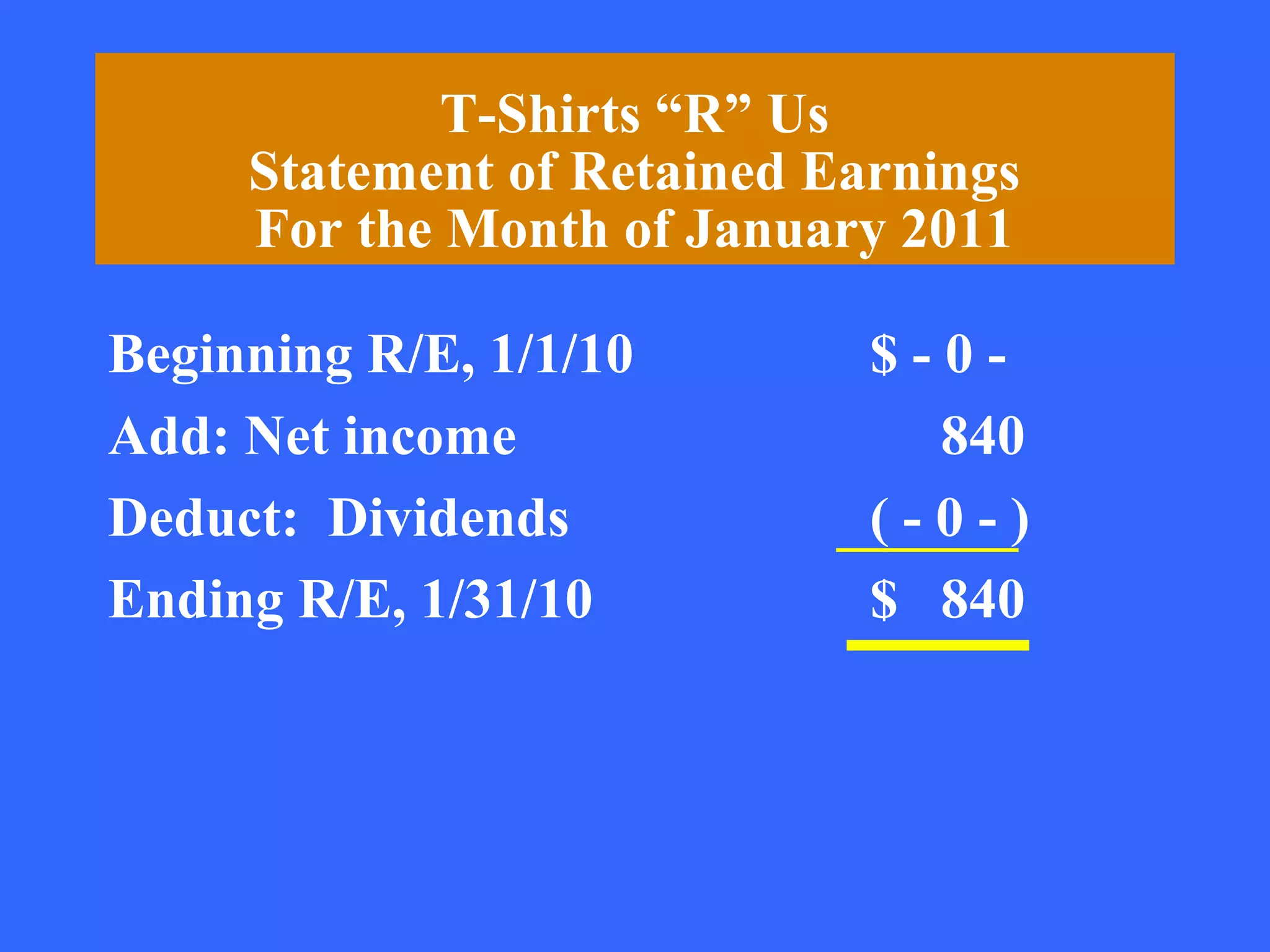
T-Shirts “R” Us
     Statement of Retained Earnings
     For the Month of January 2011

Beginning R/E, 1/1/10        $-0-
Add: Net income                840
Deduct: Dividends            (-0-)
Ending R/E, 1/31/10          $ 840
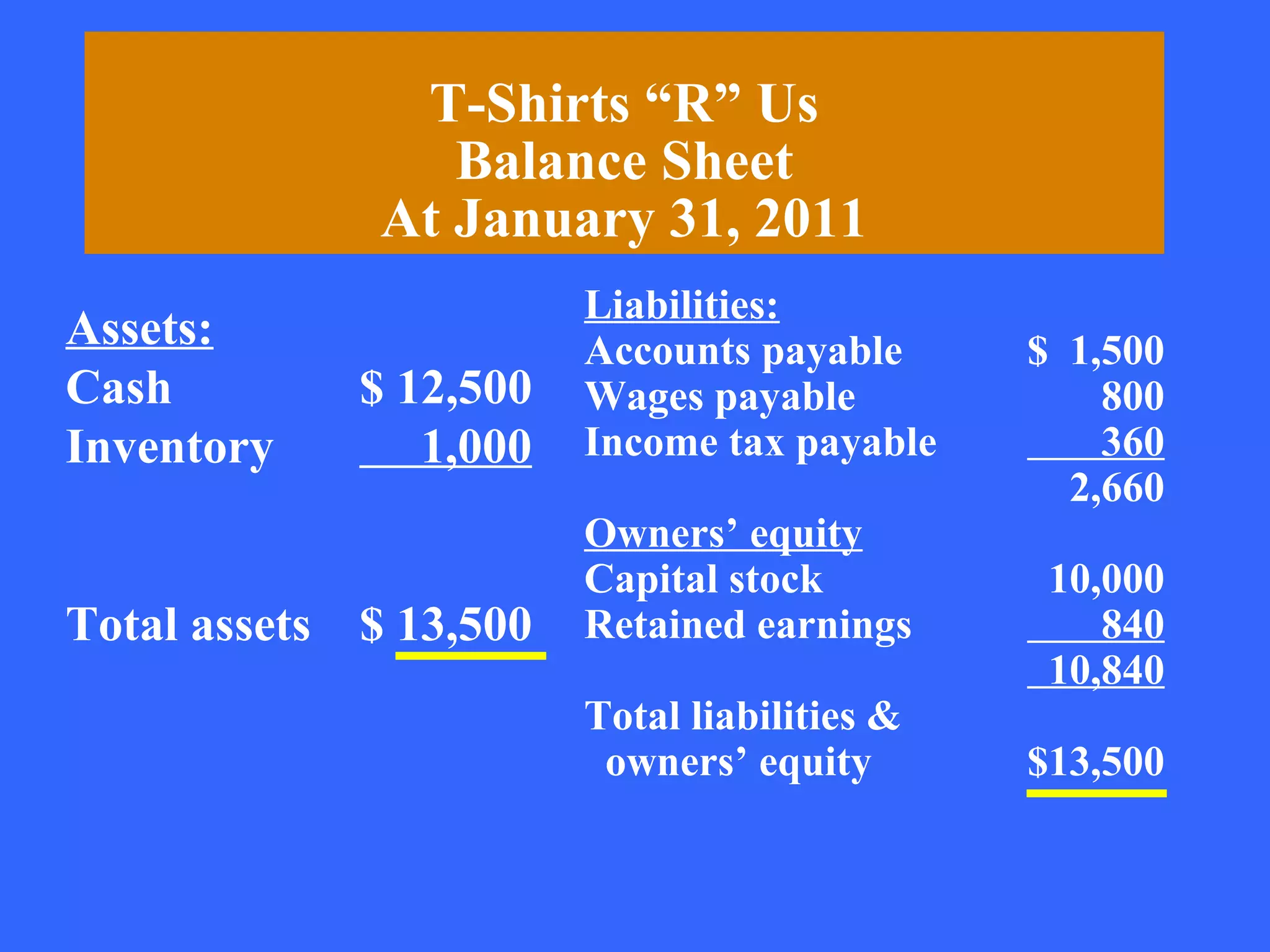
T-Shirts “R” Us
                 Balance Sheet
              At January 31, 2011
                        Liabilities:
Assets:                 Accounts payable      $ 1,500
Cash         $ 12,500   Wages payable             800
Inventory       1,000   Income tax payable        360
                                                2,660
                        Owners’ equity
                        Capital stock          10,000
Total assets $ 13,500   Retained earnings         840
                                               10,840
                        Total liabilities &
                         owners’ equity       $13,500
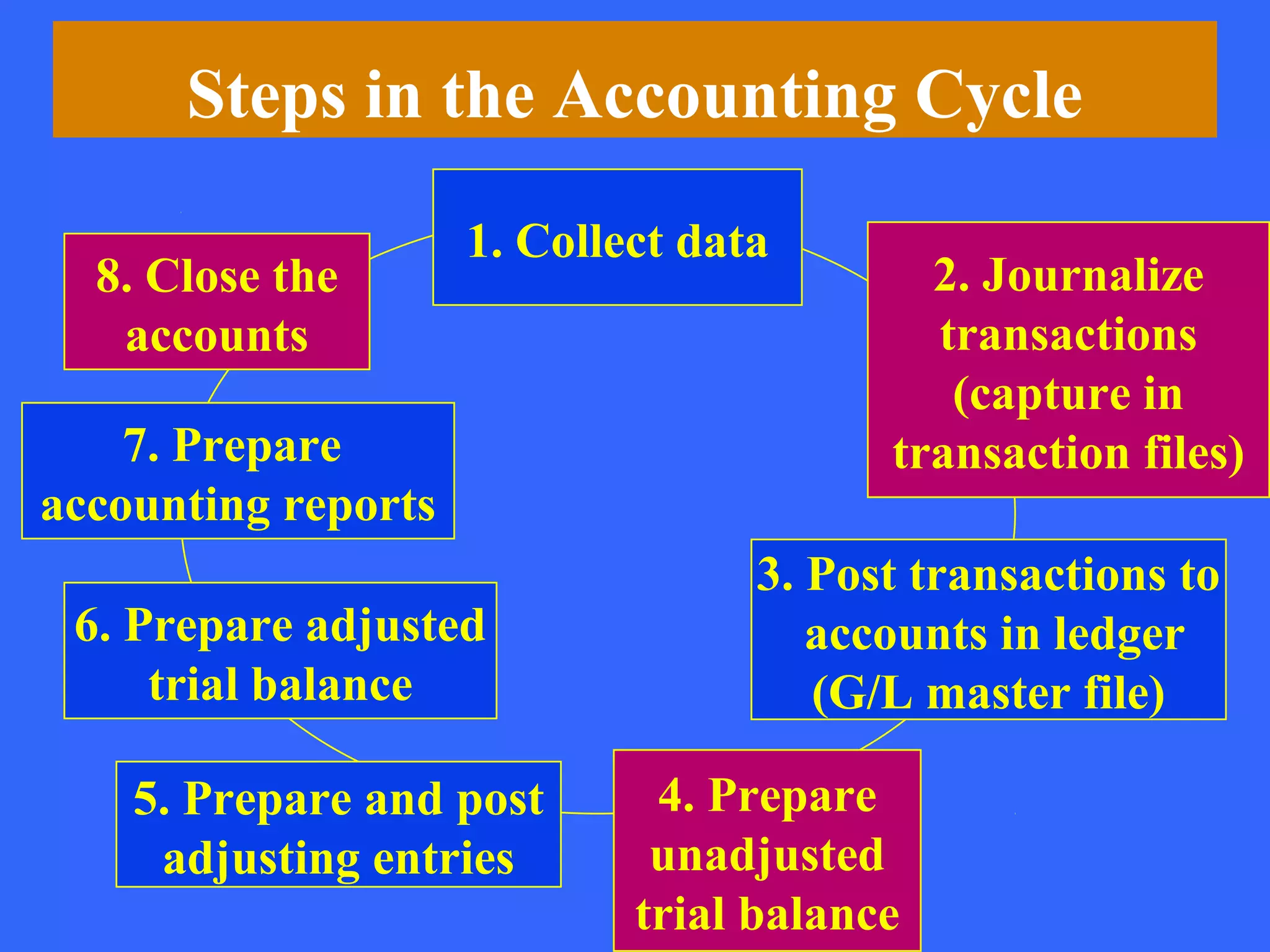
Steps in the Accounting Cycle
                     1. Collect data
  8. Close the                             2. Journalize
   accounts                                transactions
                                            (capture in
    7. Prepare                           transaction files)
accounting reports
                                   3. Post transactions to
 6. Prepare adjusted                  accounts in ledger
     trial balance                    (G/L master file)

    5. Prepare and post       4. Prepare
     adjusting entries        unadjusted
                             trial balance
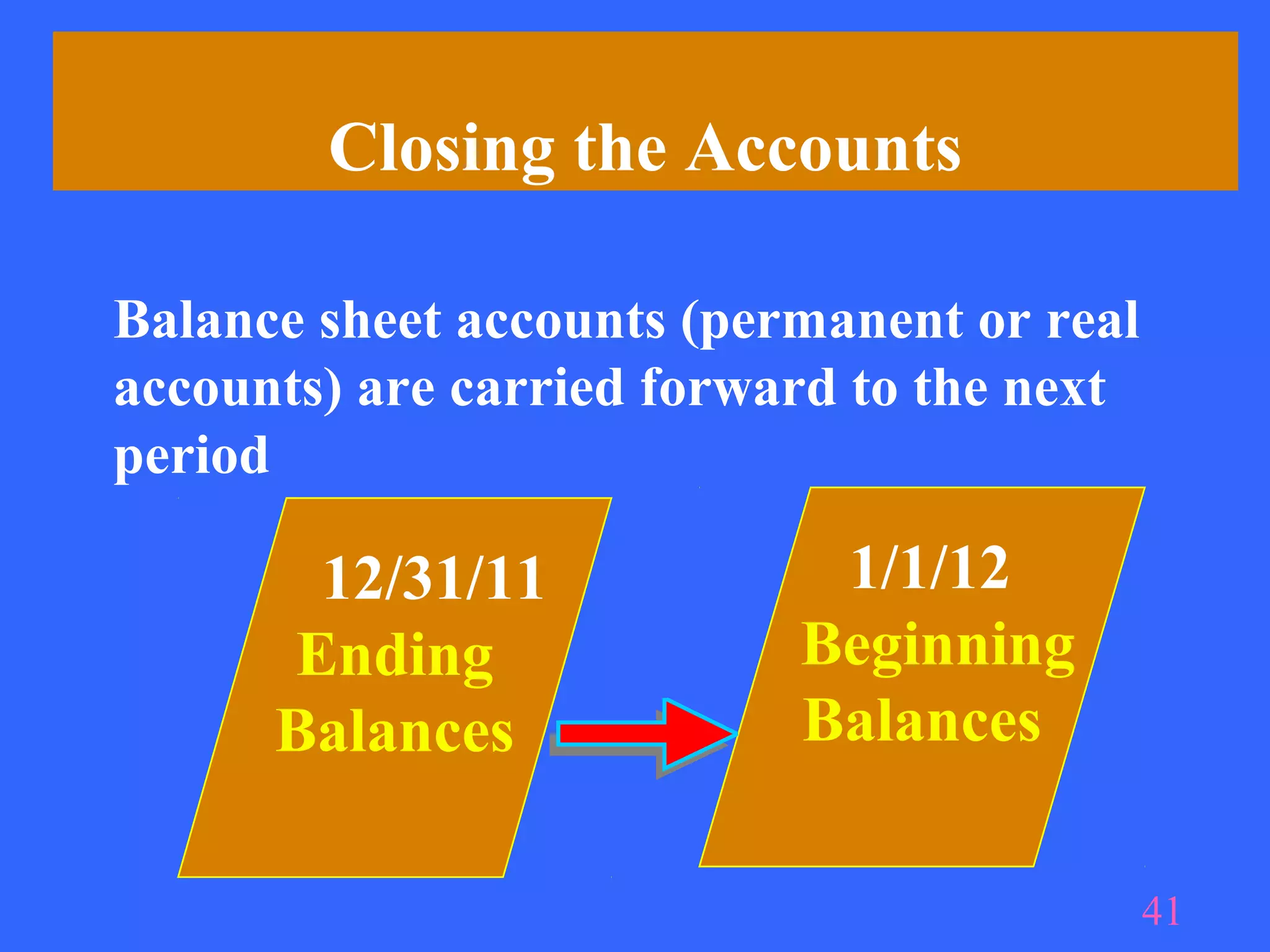
Closing the Accounts

Balance sheet accounts (permanent or real
accounts) are carried forward to the next
period

        12/31/11            1/1/12
       Ending              Beginning
      Balances             Balances

                                            41
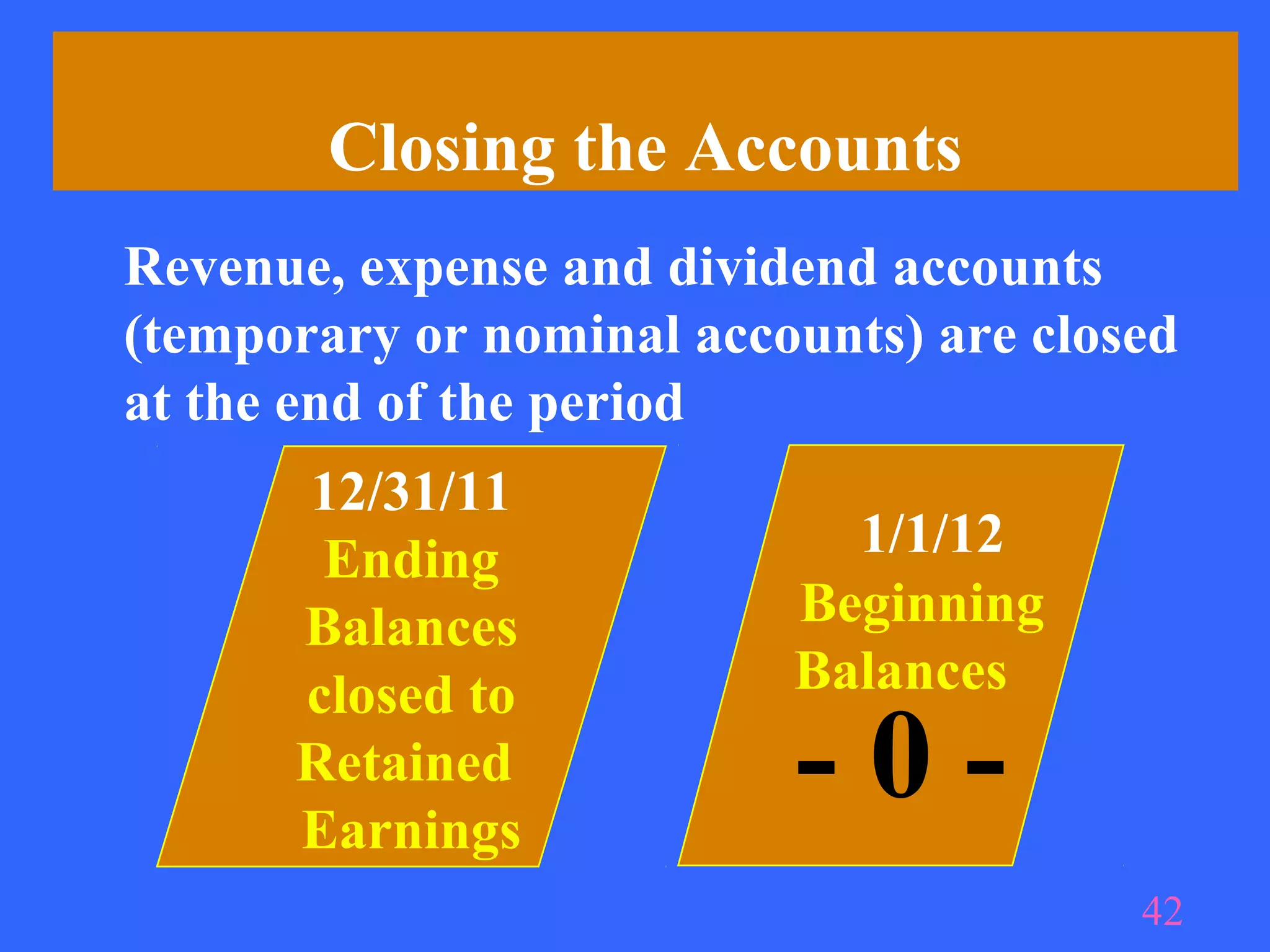
Closing the Accounts
Revenue, expense and dividend accounts
(temporary or nominal accounts) are closed
at the end of the period
      12/31/11
       Ending               1/1/12
      Balances            Beginning
      closed to           Balances
      Retained
      Earnings
                          -0-
                                        42
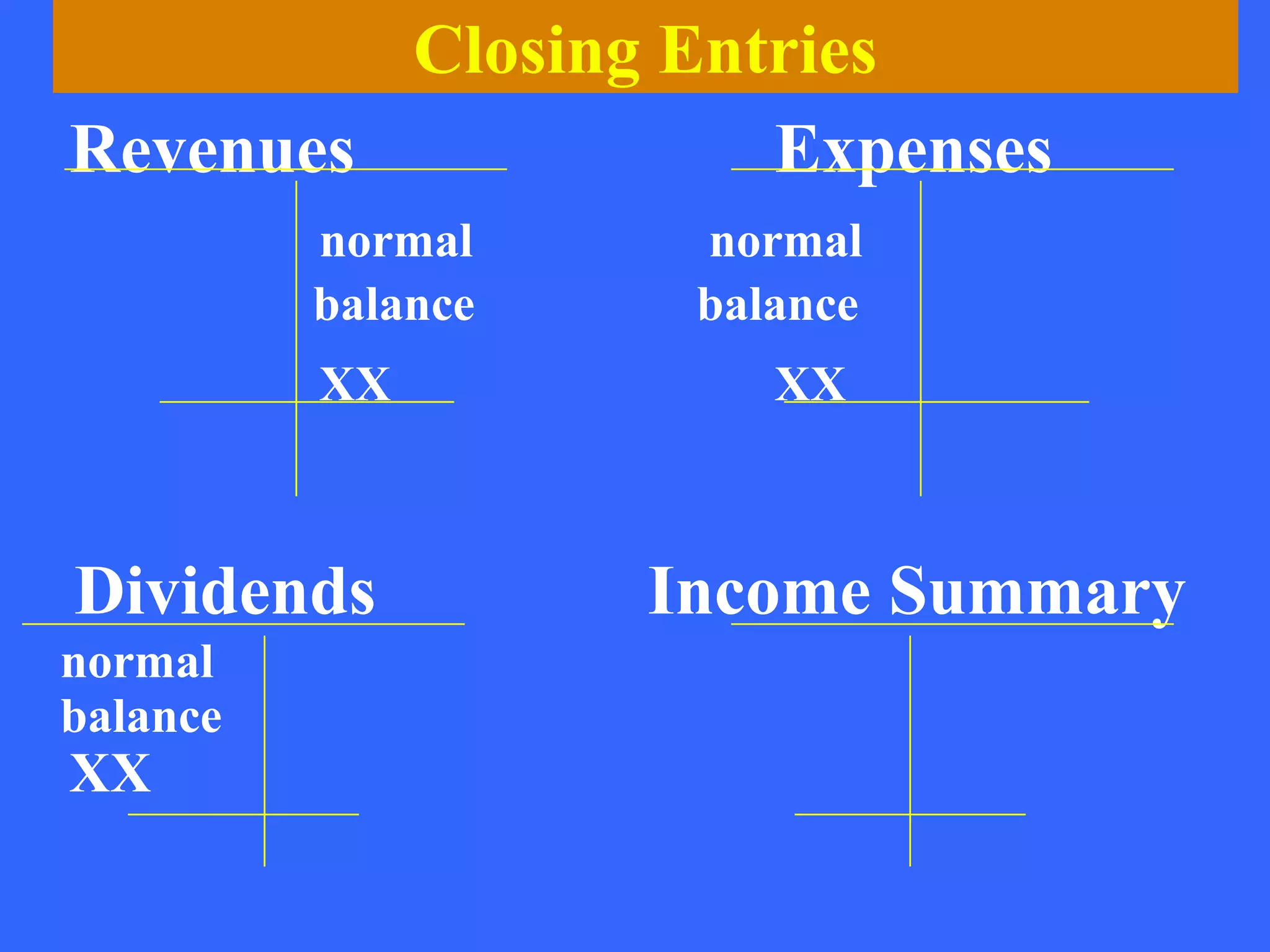
Closing Entries
 Revenues            Expenses
close to    normal        normal     close to
income sum. balance       balance    income sum.
  XX         XX              XX          XX

          -0-              -0-
  Dividends             Income Summary
 normal    close to   from expense   from revenue
 balance    R/E        closings        closings
 XX         XX          XX               XX
  -0-                                balance closed
                                       to R/E
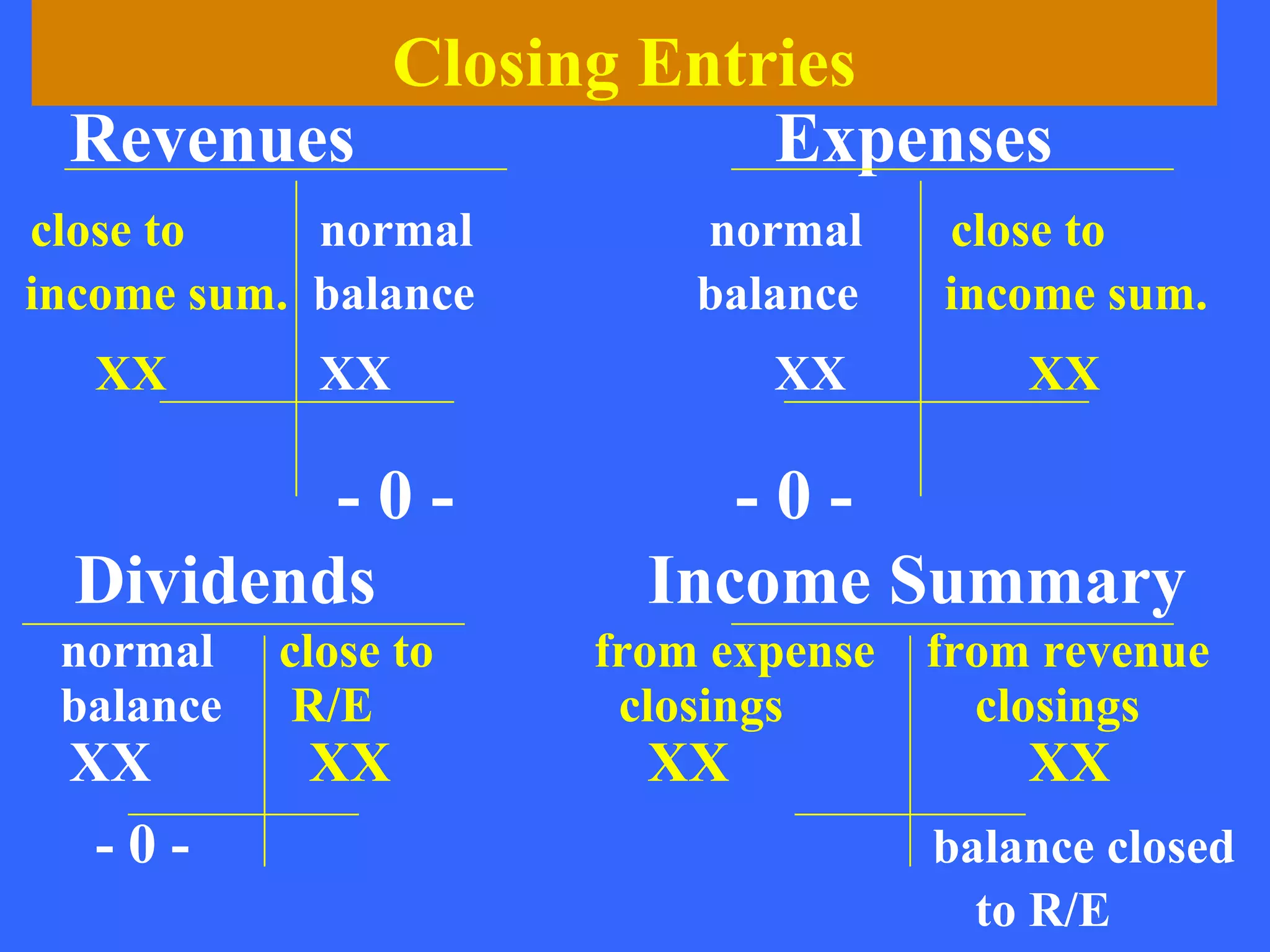
Closing Entries
 Revenues             Expenses
close to    normal        normal     close to
income sum. balance       balance    income sum.
  XX         XX              XX          XX

          -0-              -0-
  Dividends             Income Summary
 normal    close to   from expense   from revenue
 balance    R/E        closings        closings
 XX         XX          XX               XX
  -0-                                balance closed
                                       to R/E

Accounting cycle review

  • 1.
    ua l n n rt A po Re Accounting Cycle Review 1
  • 2.
    Steps in theAccounting Cycle 1. Collect data
  • 3.
    Source Documents Sales Purchase Evidence needed Invoice Invoice in an accounting system to record Cash transactions - may Checks Register be replaced by data Receipt entry screens Payroll Shipping Receiving Records Document Document 3
  • 4.
    Steps in theAccounting Cycle 1. Collect data 2. Journalize transactions (capture in transaction files)
  • 5.
    The Accounting Equation Assets= Liabilities + Owners’ Equity Company Creditor’s Owner’s Resources = Claims + Claims to Assets to Assets The Accounting Equation Must Always Remain in Balance 5
  • 6.
    Sample Transactions forT- Shirts “R” Us Issue capital stock for cash Assets = Liabilities + Owners’ Equity Cash Capital Stock + 10,000 = + 10,000 ( Dr.) (Cr.) Journal Entry Form: Dr. Cr. Cash $10,000 Capital Stock $10,000 6
  • 7.
    Debits/Credits and the Accounting Equation OWNERS’ ASSETS = LIABILITIES + EQUITY Dr. Cr. Dr. Cr. Dr. Cr. + - - + - + Opposite sides of the accounting equation are increased/decreased in an opposite way
  • 8.
    Purchase of inventoryof T-shirts on account Assets = Liabilities + Owners’ Equity Inventory Accounts Payable + 3,000 = + 3,000 (Dr.) (Cr.) Purchases Journal: Dr. Cr. Inventory $3,000 Accounts Payable $3,000 8
  • 9.
    Sell T-shirts duringthe month for $4,000 cash (cost is 50% of selling price) Assets = Liabilities + Owners’ Equity Where does sales revenue fit into the accounting equation?? Sales Journal : Dr. Cr. Cash $4,000 Sales Revenue $4,000 9
  • 10.
    Effect of Revenueand Expenses on Retained Earnings Income Stmt. Stmt. of R/E Beg. R/E Revenue + Revenues - Expenses - Expenses = Net income - Dividends = End. R/E 10
  • 11.
    Sell T-shirts duringthe month for cash (cost is 50% of selling price) Assets = Liabilities + Owners’ Equity Retained Earnings Cash (Sales revenue is closed to R/E) + 4,000 = + 4,000 (Dr.) (Cr.) Sales Journal : Dr. Cr. Cash $4,000 Sales Revenue $4,000 11
  • 12.
    Sell T-shirts duringthe month for cash (cost is 50% of selling price) Assets = Liabilities + Owners’ Equity Retained Earnings Inventory (Cost of goods sold is closed to R/E) - 2,000 - 2,000 (Cr.) (Dr.) Journal Entry Form: Dr. Cr. Cost of goods sold $2,000 Inventory $2,000 12
  • 13.
    Pay for 1/2of the inventory purchased earlier this month on account Assets = Liabilities + Owners’ Equity Cash Accounts Payable - 1,500 = - 1,500 (Cr.) (Dr.) Cash Disbursement Journal: Dr. Cr. Accounts Payable $1,500 Cash $1,500 13
  • 14.
    Steps in theAccounting Cycle 1. Collect data 2. Journalize transactions (capture in transaction files) 3. Post transactions to accounts in ledger (G/L master file)
  • 15.
    General Ledger /R 0 A 40 Cash +$100 sh +$ 10 0 - $50 a 0 C 10 -$ +$ $50 - File or book that contains one record ( or page) for each account. 15
  • 16.
    The T Account Account Name Debits are Credits are entered on left entered on right Representation of one account in the G/L
  • 17.
    The T Account Account Name $ 400 dr. $ 900 cr. Debits & credits are netted to obtain $ 500 cr. balance in account
  • 18.
    Normal Balances Debit Credit Assets Liabilities Expenses Owners’ Equity Dividends Revenues
  • 19.
    Transactions and TAccounts Cash Capital Stock Post to individual (1) 10,000 G/L accounts (1) 10,000 (See Figure 2-4) (1) Issue capital stock for cash Journal Entry Form: Dr. Cr. Cash $10,000 Capital Stock $10,000 19
  • 20.
    Transactions and TAccounts Inventory Accounts Payable (2) 3,000 (2) 3,000 (2) Purchase inventory of T-shirts on account 20
  • 21.
    (3a) Sell T-shirtsduring the month for $4,000 cash. (3b) Cost is 50% of selling price. Cash Sales Cost of (3a) Goods Sold (1) 10,000 4,000 (3a) 4,000 (3b) 2,000 Inventory T Accounts reflect (2) 3,000 current and previous (3b) 2,000 postings to the account for each period
  • 22.
    (4) Pay for1/2 of the inventory purchased earlier this month on account Accounts Payable Cash (2) 3,000 (1) 10,000 (3a) 4,000 (4) 1,500 (4) 1,500
  • 23.
    Balance the TAccounts Cash Inventory (1) 10,000 (2) 3,000 (3b) 2,000 (3a) 4,000 (4) 1,500 1,000 12,500 Accounts Payable (4) 1,500 (2) 3,000 1,500
  • 24.
    Steps in theAccounting Cycle 1. Collect data 2. Journalize transactions (capture in transaction files) 3. Post transactions to accounts in ledger (G/L master file) 4. Prepare unadjusted trial balance
  • 25.
    T-Shirts “R” Us UnadjustedTrial Balance At January 31, 2011 Debits Credits Cash $ 12,500 Inventory 1,000 Accounts Payable $ 1,500 Capital Stock 10,000 Sales Revenue 4,000 Cost of Goods Sold 2,000 Total $ 15,500 $ 15,500
  • 26.
    Steps in theAccounting Cycle 1. Collect data 2. Journalize transactions (capture in transaction files) 3. Post transactions to accounts in ledger (G/L master file) 5. Prepare and post adjusting entries 4. Prepare unadjusted trial balance
  • 27.
    Types of AdjustingEntries Deferred Accrued expense ALL RECOGNIZE liability REVENUE OR EXPENSE BEFORE OR AFTER CASH IS EXCHANGED Accrued Deferred asset revenue 27
  • 28.
    Summary of Adjustments Internaltransaction FEDERAL RESERVE NOTE THE UNITED STATES OF AMERICA THE UNITED STATES OF AMERICA THIS NOTE IS LEGAL TENDER L70744629F FOR ALL DEBTS, PUBLIC AND PRIVATE Never involves cash 12 WASHINGTON, D.C. 12 A H 293 L70744629F 12 SERIES 12 1985 ONE DOLLAR ONE DOLLAR Involves at least one balance sheet and one income statement Balance Income account Sheet Statement 28
  • 29.
    (5) Record employeeswages for the month that are earned but not yet due Wage Expense Wages Payable 0 (5) 800 Adjusting Entry: Dr. Cr. Wage Expense 800 Wages Payable 800
  • 30.
    (6) Record incometaxes on profits at 30% income tax rate Income Tax Expense Income Tax Payable ? (6) ? How is this determined?
  • 31.
    T-Shirts “R” Us Income Statement For the Month of January 2011 From T Accounts: Sales $ 4,000 Less: Cost of goods sold 2,000 Gross margin 2,000 Wage expense 800 Pre-tax income $ 1,200 Prepared first…why?
  • 32.
    T-Shirts “R” Us Income Statement For the Month of January 2011 From T Accounts: Sales $ 4,000 Less: Cost of goods sold 2,000 Gross margin 2,000 Wage expense 800 Pre-tax income $ 1,200 Income tax expense (30%) 360
  • 33.
    (6) Record incometaxes on profits at 30% income tax rate Income Tax Expense Income Tax Payable 0 (6) 360 Adjusting Entry: Dr. Cr. Income Tax Expense 360 Income Tax Payable 360
  • 34.
    Steps in theAccounting Cycle 1. Collect data 2. Journalize transactions (capture in transaction files) 3. Post transactions to 6. Prepare adjusted accounts in ledger trial balance (G/L master file) 5. Prepare and post 4. Prepare adjusting entries unadjusted trial balance
  • 35.
    T-Shirts “R” Us AdjustedTrial Balance At January 31, 2011 Debits Credits Cash $ 12,500 Inventory 1,000 Accounts Payable $ 1,500 Wages Payable 800 Income Tax Payable 360 Capital Stock 10,000 Sales Revenue 4,000 Cost of Goods Sold 2,000 Wage Expense 800 Income Tax Expense 360 Total $ 16,660 $ 16,660
  • 36.
    Steps in theAccounting Cycle 1. Collect data 2. Journalize transactions (capture in 7. Prepare transaction files) accounting reports 3. Post transactions to 6. Prepare adjusted accounts in ledger trial balance (G/L master file) 5. Prepare and post 4. Prepare adjusting entries unadjusted trial balance
  • 37.
    T-Shirts “R” Us Income Statement For the Month of January 2011 From T Accounts: Sales $ 4,000 Less: Cost of goods sold 2,000 Gross margin 2,000 Wage expense 800 Pre-tax income $ 1,200 Income tax expense (30%) 360 Net income $ 840
  • 38.
    T-Shirts “R” Us Statement of Retained Earnings For the Month of January 2011 Beginning R/E, 1/1/10 $-0- Add: Net income 840 Deduct: Dividends (-0-) Ending R/E, 1/31/10 $ 840
  • 39.
    T-Shirts “R” Us Balance Sheet At January 31, 2011 Liabilities: Assets: Accounts payable $ 1,500 Cash $ 12,500 Wages payable 800 Inventory 1,000 Income tax payable 360 2,660 Owners’ equity Capital stock 10,000 Total assets $ 13,500 Retained earnings 840 10,840 Total liabilities & owners’ equity $13,500
  • 40.
    Steps in theAccounting Cycle 1. Collect data 8. Close the 2. Journalize accounts transactions (capture in 7. Prepare transaction files) accounting reports 3. Post transactions to 6. Prepare adjusted accounts in ledger trial balance (G/L master file) 5. Prepare and post 4. Prepare adjusting entries unadjusted trial balance
  • 41.
    Closing the Accounts Balancesheet accounts (permanent or real accounts) are carried forward to the next period 12/31/11 1/1/12 Ending Beginning Balances Balances 41
  • 42.
    Closing the Accounts Revenue,expense and dividend accounts (temporary or nominal accounts) are closed at the end of the period 12/31/11 Ending 1/1/12 Balances Beginning closed to Balances Retained Earnings -0- 42
  • 43.
    Closing Entries Revenues Expenses close to normal normal close to income sum. balance balance income sum. XX XX XX XX -0- -0- Dividends Income Summary normal close to from expense from revenue balance R/E closings closings XX XX XX XX -0- balance closed to R/E
  • 44.
    Closing Entries Revenues Expenses close to normal normal close to income sum. balance balance income sum. XX XX XX XX -0- -0- Dividends Income Summary normal close to from expense from revenue balance R/E closings closings XX XX XX XX -0- balance closed to R/E

Editor's Notes